The Video Signal technical video digests

Keep model costs in check with LangSmith LLM Gateway thumbnail

· 4:33

Keep model costs in check with LangSmith LLM Gateway

The LangSmith LLM Gateway solves critical governance and cost control issues arising from decentralized usage of multiple Large Language Models (LLMs) across an organization. By acting as a single, centralized endpoint between development teams and various model providers (e.g., OpenAI, Anthropic), the gateway enforces real-time spend limits and rate controls before requests are processed. This allows organizations to maintain a live audit trail of token usage, cost, and model access without requiring code changes in existing applications.

Key takeaways

  1. Centralized Cost Governance 0:15

    The Gateway provides a single point of control for enforcing spend limits and rate limits across all connected LLM providers, preventing unexpected cost spikes that occur when multiple teams use various keys and models.

  2. Non-Invasive Integration 0:40

    Implementing the gateway only requires updating the base URL and API key within existing SDKs (Python, TypeScript), meaning developers do not need to modify their application's core request or response handling logic.

  3. Granular Control and Auditability 1:05

    Cost controls can be applied globally for the organization, or granularly by individual API key, user, or workspace. This provides a live audit trail detailing which model, key, and number of tokens were used, replacing reliance on provider invoices.


Watch on YouTube Full article

IBM’s cloud collab, Meta’s Muse Glimmer & OpenAI’s upcoming Astra model thumbnail

· 36:33

IBM’s cloud collab, Meta’s Muse Glimmer & OpenAI’s upcoming Astra model

The discussion covers major shifts in AI infrastructure and model deployment. IBM is partnering with Together AI to build a massive inference cluster on IBM Cloud using NVIDIA's B300 generation chips for open-source models (expected early 2027). Meta released Muse Glimmer, an open, 30B-parameter dense model designed to run locally on consumer GPUs. Finally, OpenAI discussed its upcoming Astra model, which may achieve 'Critical' cybersecurity capabilities, raising significant concerns about zero-day exploit potential and the need for robust security guardrails.

Key takeaways

  1. IBM Cloud AI Cluster Partnership 1:15

    IBM is teaming up with Together AI to launch an inference cluster on IBM Cloud utilizing NVIDIA's B300 generation chips. This aims to provide cheaper, faster access to open-source AI models for enterprises (1:03).

  2. Meta Muse Glimmer Release 11:29

    Meta open-sourced Muse Glimmer, a 30B-parameter dense model optimized to run locally on consumer GPUs (e.g., Mac M3). It is designed for agentic tasks and tool calling without requiring cloud access (11:43).

  3. OpenAI Astra Model Capabilities 22:36

    OpenAI's upcoming Astra model may achieve 'Critical' cybersecurity capability levels, potentially allowing it to find and exploit zero-days. This raises concerns about the speed and scale of cyber warfare using AI (24:10).

Watch on YouTube Full article

What is Gemini 3.7 Flash? thumbnail

· 0:47

What is Gemini 3.7 Flash?

The video demonstrates the use of Gemini 3.7 Flash, described as an intelligent 'workhorse model,' for rapid game prototyping and development within Google Antigravity. The speaker showcases generating a detailed, playable animated sprite-based game (a 'pizza rush' concept) from a single prompt, highlighting the model's ability to generate complex initial codebases that can be extended for features like multiplayer functionality.

Key takeaways

  1. Gemini 3.7 Flash Capabilities

    The model is positioned as an intelligent 'workhorse' for coding and agents, capable of generating detailed, playable games from initial prompts (e.g., a pizza rush game).

  2. Code Quality Improvements 0:15

    Beyond gaming, the model shows improvements in shipping quality code across debugging, web development, and overall design adherence.

Watch on YouTube Full article

Introducing Gemini 3.7 Flash thumbnail

· 2:33

Introducing Gemini 3.7 Flash

Gemini 3.7 Flash is introduced as a highly capable 'workhorse model' optimized for coding and agent-first workflows. The video demonstrates its power by building complex, animated sprite-based games within Google Antigravity, showcasing the ability to generate assets (using Nano Banana Pro) from single prompts. A key feature highlighted is the model's capacity for radical concept remixing—adapting an entire game world (e.g., from 'sorcerers' to a 'pizza delivery driver') with minimal prompt changes.

Key takeaways

  1. Agent-Driven Game Prototyping 0:15

    The model successfully generates assets and builds an entire game level (e.g., 90s animated sprite game) from a single prompt within Google Antigravity, demonstrating high design adherence.

  2. Concept Remixing Capability 1:05

    The model can adapt an entire game's look and feel to a completely different concept (e.g., changing the theme from sorcerers to a suburban pizza delivery driver) by modifying only a few words in the prompt.

  3. Model Improvement Areas 1:45

    Gemini 3.7 Flash shows improvements across debugging, web development, and overall design adherence, resulting in higher fidelity builds with less back-and-forth iteration.

Watch on YouTube Full article

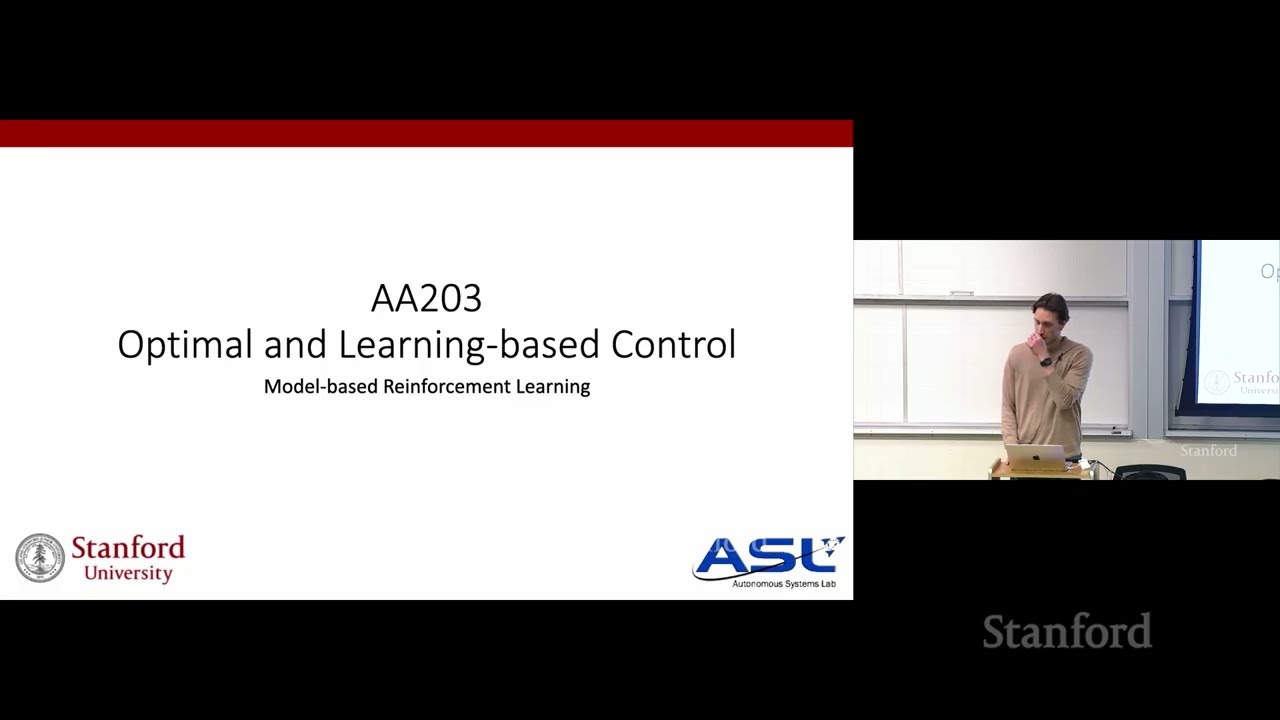
Stanford AA203 Optimal and Learning-Based Control | Spring 2026 | Lecture 19: Model-Based RL thumbnail

· 1:21:50

Stanford AA203 Optimal and Learning-Based Control | Spring 2026 | Lecture 19: Model-Based RL

This lecture reviews advanced topics in Reinforcement Learning (RL), transitioning from model-free policy optimization methods (TRPO/PPO) to the critical challenges of Model-Based RL. The core focus is addressing model uncertainty when using learned dynamics for planning. Techniques such as Bayesian statistics, Gaussian Processes (GPs), and Ensembles are introduced to quantify epistemic uncertainty, allowing planners to compute expected rewards by averaging predictions over a posterior distribution of possible models.

Key takeaways

  1. PPO/TRPO for Policy Optimization 16:15

    Policy optimization methods (like TRPO and PPO) define a surrogate objective function to estimate the policy gradient, enabling continuous updates. PPO uses a clipped ratio ($ ext{clip}(r_{ heta}, 1- ext{eps}, 1+ ext{eps})$) to constrain the new policy's divergence from the old one, stabilizing training without requiring complex second-order optimization.

  2. Model-Based RL Limitations 25:00

    The basic model-based recipe (collect data $ ightarrow$ fit dynamics $P(s'|s, a)$ $ ightarrow$ plan) fails when dealing with complex or nonlinear dynamics because extrapolation outside the observed state distribution is unreliable. This issue of generalization and distribution shift must be addressed.

  3. Quantifying Model Uncertainty 35:00

    To improve model-based planning, uncertainty quantification is necessary. The distinction between Aleatoric (inherent noise) and Epistemic (model uncertainty) is crucial. Bayesian approaches treat this by modeling the posterior distribution over parameters ($ heta$), allowing for prediction averaging across all plausible models.

  4. Ensemble Methods for Uncertainty 46:40

    A practical approach to estimate model uncertainty is using ensembles: training multiple independent neural network copies. The average of their predictions approximates the predictive posterior distribution, effectively exploring multimodal solution landscapes without requiring complex analytical derivations.

Watch on YouTube Full article

Stanford AA203 Optimal and Learning-Based Control | Spring 2026 | Lecture 17: RL Value-Based Methods thumbnail

· 1:17:40

Stanford AA203 Optimal and Learning-Based Control | Spring 2026 | Lecture 17: RL Value-Based Methods

This lecture provides a comprehensive review of model-free Reinforcement Learning (RL) value-based methods. The discussion progresses from foundational concepts—distinguishing between prediction and control—to comparing Monte Carlo (MC) and Temporal Difference (TD) learning. Key algorithms covered include SARSA and Q-learning, which are differentiated by their on-policy versus off-policy nature. To scale these methods to high-dimensional state spaces, the necessity of function approximation is introduced, leading into Deep Q Networks (DQN). The lecture concludes by detailing two critical stabilization techniques for DQN: Experience Replay (to decorrelate samples) and using Fixed Q Targets (to stabilize the target value during training).

Key takeaways

  1. MC vs. TD Learning Paradigms 17:03

    Monte Carlo methods estimate the expected return ($G_t$) by rolling out an episode until a terminal state, requiring full episodes. Temporal Difference (TD) learning improves upon this by using bootstrapping—defining the target as the instantaneous reward plus the discounted future value ($ ext{Reward} + ext{Discounted Future Value}$), allowing for online updates and handling non-terminal environments.

  2. On-Policy vs. Off-Policy Learning 23:50

    SARSA is an on-policy algorithm, meaning it improves the policy ($ ext{e.g., } ext{epsilon-greedy}$) that is actively used to generate data in the environment. Q-learning is off-policy; it learns about a target optimal policy (the greedy policy) while using data generated by a different behavior policy (also $ ext{epsilon-greedy}$), which is crucial for utilizing historical or simulated data.

  3. Scaling with Function Approximation 35:05

    To overcome the curse of dimensionality inherent in tabular value function representations, RL methods transition to parametric functions (e.g., neural networks) that approximate $V(s)$ or $Q(s, a)$. This allows generalization across states and controls.

  4. DQN Stabilization Techniques 1:03:20

    Deep Q Networks (DQN) stabilize learning using two methods: Experience Replay (storing transitions in a buffer to decorrelate samples, satisfying the IID assumption required for regression) and Fixed Q Targets (using a delayed copy of the network parameters ($ ext{Q}_{ ext{target}}$) to prevent the target from being a moving variable during optimization).

Watch on YouTube Full article

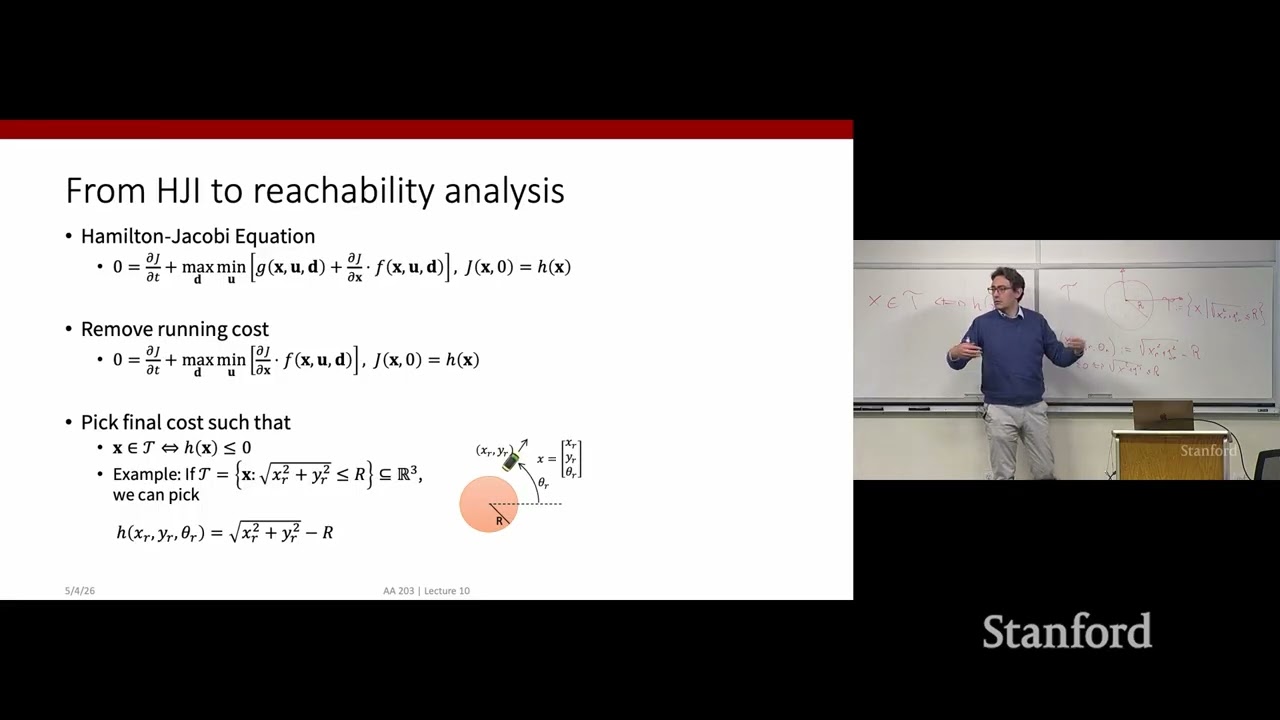
Stanford AA203 Optimal and Learning-Based Control | Spring 2026 | Lecture 11: Introduction to MPC thumbnail

· 1:13:36

Stanford AA203 Optimal and Learning-Based Control | Spring 2026 | Lecture 11: Introduction to MPC

This lecture provides a deep dive into advanced control theory, transitioning from theoretical concepts like Hamilton-Jacobi-Isaacs (HJI) equations for computing reachable sets to the practical framework of Model Predictive Control (MPC). The discussion emphasizes that MPC achieves closed-loop performance by repeatedly solving an open-loop optimal control problem over a finite horizon (receding horizon optimization). Key theoretical challenges addressed include ensuring persistent feasibility and stability, which requires leveraging concepts from invariant set theory.

Key takeaways

  1. Reachable Sets via HJI Equation 0:35

    Avoidance sets and reachable sets are computed by solving a differential game using the Hamilton-Jacobi-Isaacs (HJI) equation. This involves reframing the Boolean problem of set membership into an optimal control cost function $h(x)$ [0:35].

  2. Backward Reachable Tube (BRT) 7:40

    To ensure safety over the entire trajectory, not just the endpoint, one must compute a Backward Reachable Tube (BRT). This is achieved by modifying the cost function to minimize the minimum value of $h(x)$ across the entire optimization horizon [7:40].

  3. MPC Receding Horizon Principle 19:30

    MPC solves an open-loop optimal control problem over a finite prediction horizon $[t, t+N_p]$ at each time step $t$. It then uses only the first computed input ($u_t$) and discards the rest of the plan, recomputing everything from scratch based on new state measurements (receding horizon) [19:30].

  4. MPC Design Goals 36:00

    The primary goals when designing an MPC controller are ensuring persistent feasibility (the problem remains solvable at all future times) and guaranteeing stability (convergence to the desired state, e.g., the origin) [36:00].

  5. Invariant Sets for Feasibility 1:08:40

    To guarantee persistent feasibility in MPC, one must identify a control invariant set $\mathcal{C}$. This is a set where, if the system starts within it, there exists a control input $u$ that guarantees the next state remains inside $\mathcal{C}$ [38:00].

Watch on YouTube Full article

How Unify cut its AI agent costs 95% in two weeks thumbnail

· 1:08:24

How Unify cut its AI agent costs 95% in two weeks

Unify's agent platform automates go-to-market tasks by giving sales representatives 'an engineer in their back pocket.' The discussion details how Unify achieved a 90-95% cost optimization within two weeks of launch. Key architectural insights include optimizing for prompt caching hit rates, designing subagents as simple function calls, and implementing robust data handling over tabular data using virtualized Pandas-like interfaces. Furthermore, the talk emphasizes advanced evaluation techniques (DQA sets) and stateful, durable cloud execution environments like Monty to ensure scalability and cost control.

Key takeaways

  1. Cost Optimization via Prompt Caching 30:25

    Achieving a high prompt cache hit rate is critical for cost-effectiveness. The limit is approximately 15 requests per second (RPS) within OpenAI's cache, and developers must implement strategies to maximize hits, as providers won't solve this distribution problem for you.

  2. Subagents are Function Calls 25:50

    Architecturally, Unify treats a subagent not as a complex process, but simply as an arbitrary function call. This simplifies the system and allows for efficient execution patterns like mapping over rows.

  3. The Importance of Planning Steps 38:20

    Adding an initial planning step (e.g., using GPT-4) to the agent workflow significantly improves quality and efficiency by forcing the model to scout multiple potential trajectories before executing.

  4. Durable Cloud Execution

    To run agents in a cloud environment without full VMs, using specialized tools like Monty (a Python REPL that suspends) is crucial for maintaining statefulness and strong tenancy.

  5. Adversarial LLM Judging

    When using an LLM as a judge, it must be from a different model family than the original agent model to avoid 'mode collapse' or groupthink, ensuring an adversarial evaluation.

Watch on YouTube Full article

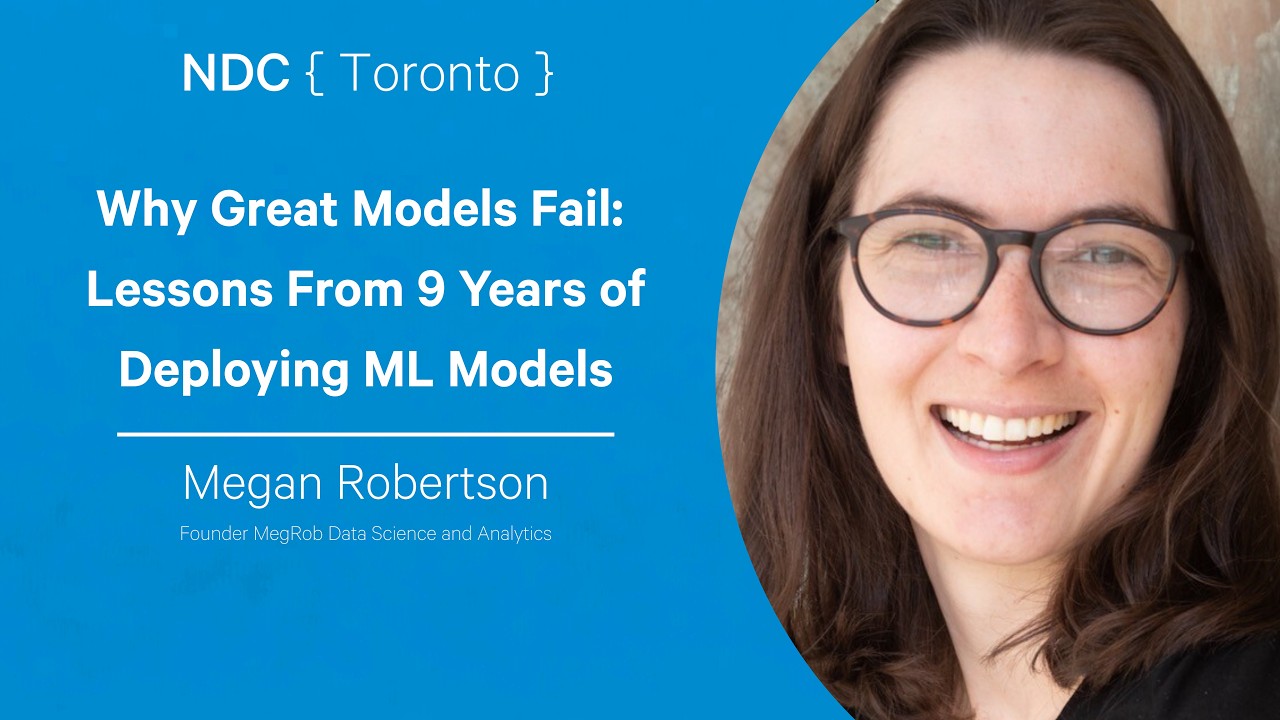
Why Great Models Fail: Lessons From 9 Years of Deploying ML Models - Megan Robertson thumbnail

· 59:14

Why Great Models Fail: Lessons From 9 Years of Deploying ML Models - Megan Robertson

The talk outlines critical lessons from deploying ML models in production, arguing that model accuracy alone is insufficient for real-world success. Success requires rigorous project scoping, continuous monitoring infrastructure, and ensuring the model's value proposition (Value Ad) significantly outweighs its maintenance cost and potential risks. Key failure points include minimal stakeholder consultation, ignoring data drift, and failing to plan for inevitable changes in the operational environment.

Key takeaways

  1. Stakeholder Value is Paramount 13:20

    The model's value must be quantifiable (KPI) and its contribution must outweigh the cost of maintenance. Stakeholders must guide the project scope, preventing engineers from building technically cool but commercially irrelevant solutions.

  2. Scope Definition is a Multi-Step Process 23:20

    Proper scoping requires defining who is served (stakeholders/end users), clearly articulating the problem, understanding constraints and risks, identifying possible solutions (MVP approach: crawl, walk, run), and planning maintenance.

  3. ML Models Require Continuous Monitoring 58:20

    Since models are trained on a single point in time, they must be monitored for performance degradation. Strategies include tracking data issues (e.g., distribution changes), feature drift, and model-specific metrics (e.g., Mean Absolute Error, F1 scores).

Watch on YouTube Full article

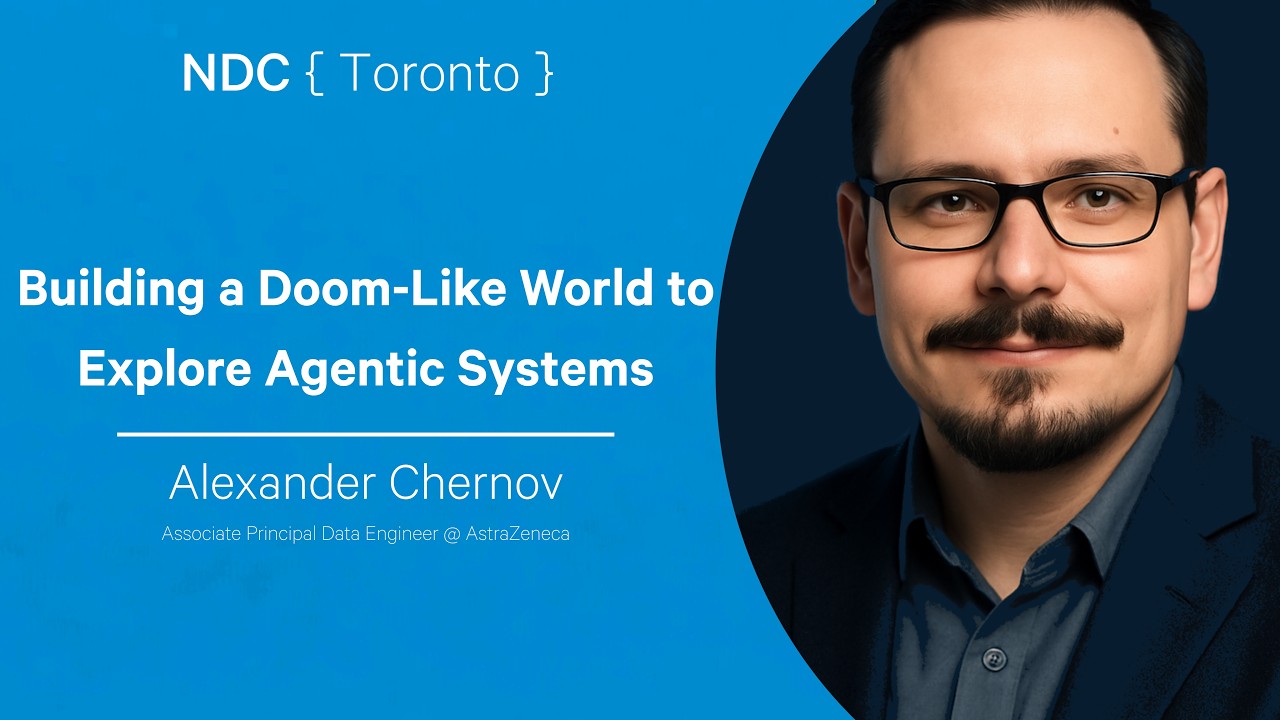
Building a Doom-Like World to Explore Agentic Systems - Alexander Chernov - NDC Toronto 2026 thumbnail

· 52:42

Building a Doom-Like World to Explore Agentic Systems - Alexander Chernov - NDC Toronto 2026

This talk presents an architectural framework for building complex agentic systems using a modified Doom-like game engine as a controlled testbed. The core concept is treating agents as 'semantic mirrors' of the game world state, allowing non-player characters (NPCs) to act autonomously while maintaining strict observability and reproducibility. The architecture emphasizes decoupling AI reasoning from the game loop via specialized components like the MCP Gateway, enabling real-world application of simulation techniques in fields such as pharmaceutical R&D.

Key takeaways

  1. Agentic Systems Architecture 2:00

    The system models agents as autonomous entities that perceive the environment and make decisions. The architecture is designed to be observable, attributable, and reproducible through structured world state changes (the 'semantic mirror').

  2. Two-Tiered Agentic Vision 4:20

    To manage latency, a two-tier vision system is implemented: a fast, deterministic observer swarm (7 Hz) for basic tracking, and a slower, LLM-powered tier using 'Lenses' to extract complex semantic information from the environment.

  3. Architectural Components 5:40

    Key components include the Policy Guard system (defining what agents can/cannot do), the MCP Gateway (Model Context Protocol) for external integration, and a Semantic Cache (Mosquito Dog) to reduce latency and cost by caching LLM responses.

  4. Reproducibility and Validation 7:50

    The design ensures determinism through fixed control loops (e.g., 35 ticks per second), state machine transitions, and structured logging of events (JSONL). This allows for full replay and behavioral regression testing.

Watch on YouTube Full article

Like Having an Intern? The Impact of LLMs on Software Engineering Careers -Tom Sellek & Netta Avnoon thumbnail

· 1:01:27

Like Having an Intern? The Impact of LLMs on Software Engineering Careers -Tom Sellek & Netta Avnoon

The talk analyzes the profound impact of LLMs on software engineering expertise, moving beyond simple productivity metrics. While studies show high adoption rates and immediate gains (e.g., up to 5x increase in lines of code), the discussion highlights significant risks: a potential degradation of core skills, reduced critical thinking, and an over-reliance that impairs long-term learning ability. Experts are cautioned that while LLMs feel like 'interns'—super eager but requiring constant review—this dependency may create a dangerous gap in the junior engineer's ability to independently evaluate or debug complex code.

Key takeaways

  1. High Adoption, Low Trust 23:22

    Despite LLMs showing positive sentiment and high perceived quality (some respondents believe generated code is better than average), a significant portion of developers report low trust in the tool's output, leading to cautious practices like only 8% merging code without human review. This discrepancy suggests a disconnect between perceived capability and actual confidence.

  2. Skill Degradation is Quantifiable 35:05

    Research indicates that LLM use can impair fundamental learning abilities. Studies found that using LLMs for tasks led to a quantifiable impairment in understanding and debugging unfamiliar codebases, suggesting the tool doesn't just set a bad example but actively hinders skill acquisition.

  3. The 'Intern' Analogy 26:45

    LLMs are often compared to an inexperienced intern: highly productive, available 24/7, but requiring constant human oversight. The core risk is that junior engineers may not develop the necessary critical judgment skills required to effectively review and correct LLM output.

  4. Cognitive Surrender 38:25

    The process of over-relying on AI can lead to 'cognitive surrender,' where users are willing to follow the machine's incorrect path, even when it is statistically far less likely to be correct. This goes beyond typical automation bias.

Watch on YouTube Full article

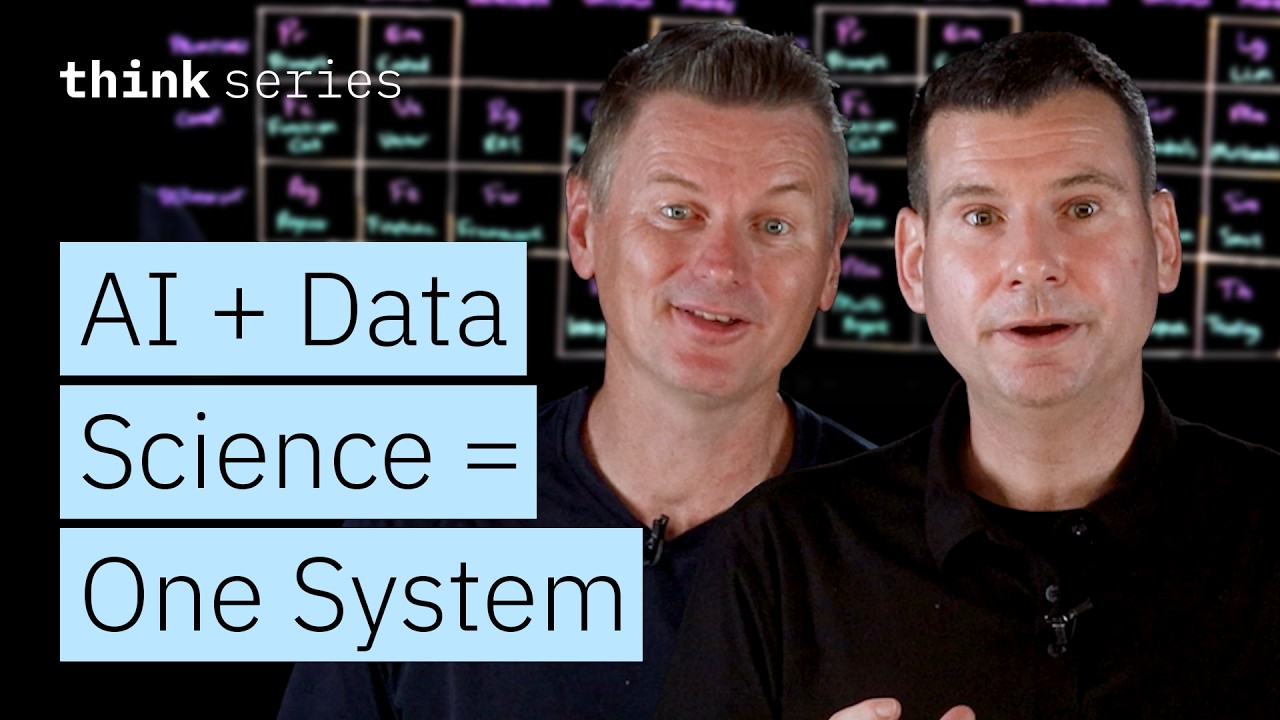
AI & Data Science Periodic Tables: How They Work Together thumbnail

· 13:21

AI & Data Science Periodic Tables: How They Work Together

The video details the synergistic relationship between Data Science and Artificial Intelligence (AI), presenting both disciplines using 'Periodic Tables' as a conceptual framework. It emphasizes that modern AI applications are built upon robust data science foundations. A comprehensive example—Document Q&A—is used to illustrate a full pipeline, detailing how elements like Extract Transform Load (ET), Data Ingest (DI), and Data Cleansing (CD) prepare the data, which is then processed by AI components such as Embeddings (EM), Retrieval Augmented Generation (RAG), and Guardrails (GR). The process can be completed into a continuous loop using Drift Detection (DR) and Synthetic Data generation for continuous system improvement.

Key takeaways

  1. AI relies on foundational data science work 0:25

    The speaker notes that all advancements in AI sit atop the groundwork laid by data science, creating a feedback loop where models inform how data is prepared for future use. (0:15-0:30)

  2. Data Science Pipeline Stages 1:38

    The Data Science periodic table defines five groups across the top (Acquisition, Preparation, Modeling, Generation, Evaluation) and tracks data maturity through rows: Raw Data $\rightarrow$ Prepared Data $\rightarrow$ Model Data $\rightarrow$ Validated Insight. (1:30-2:25)

  3. AI Pipeline Core Elements 2:40

    The AI periodic table features groups like Retrieval and Orchestration, with core primitives including Prompt, Embed, and LLM. Key components include embeddings (encoding info into numbers) and RAG (coordinating retrieval). (2:35-3:40)

  4. The Full Document Q&A Pipeline 3:30

    Building a system requires combining elements from both tables. The process moves linearly through data preparation (ET $\rightarrow$ DI $\rightarrow$ CD $\rightarrow$ ST $\rightarrow$ EN $\rightarrow$ GO) and then AI processing (EM $\rightarrow$ Vx $\rightarrow$ RAG $\rightarrow$ PR $\rightarrow$ LG $\rightarrow$ GR). (4:30-6:20)

  5. Closing the Loop for Continuous Improvement 6:20

    To prevent the system from being a one-way street, the pipeline is closed using Data Drift (DR) detection and Synthetic Data generation. This allows the embedding model to fine-tune itself continuously based on failing patterns. (6:40-7:50)

Watch on YouTube Full article

Building Governed Agents: A Framework for Cost, Control and Compliance thumbnail

· 52:28

Building Governed Agents: A Framework for Cost, Control and Compliance

As autonomous agents scale in production environments, they introduce significant governance challenges related to cost control, data security, and regulatory compliance. This presentation outlines the necessity of implementing centralized runtime controls—such as an LLM Gateway—across the entire Agent Development Lifecycle (ADLC). Centralized governance is critical for managing unpredictable spend, ensuring reliability through fallbacks and rate limits, and maintaining consistent policy enforcement across diverse agent interactions (LLM calls, tool use, and inter-agent communication).

Key takeaways

  1. The Three Pillars of Agent Governance 5:40

    Production agents introduce three main pressure points: Cost (unpredictable spend from looping/context growth), Reliability (need for fallbacks and clear failure behavior), and Compliance (consistent policy enforcement required by regulated industries).

  2. Centralized Runtime Controls are Essential 8:30

    Governance must be implemented as a central infrastructure layer, rather than being bolted on application-by-application. This centralized approach manages interactions with external services (LLMs, tools) and ensures visibility across the entire system.

  3. Comprehensive Risk Management is Required 12:30

    Governance controls must cover four distinct interaction points: LLM calls (cost/data risk), Tool calls (unintended actions/permissioning), MCP calls (data leaving infrastructure), and Agent-to-Agent calls (identity and compounding errors).

  4. Compliance Requires Multi-Layered Guardrails 23:20

    For regulated industries, governance must address specific regulations like GDPR, CCPA, HIPAA, and the EU AI Act. This involves implementing guardrails for PII/secrets detection, role definition, and audit logging.

Watch on YouTube Full article

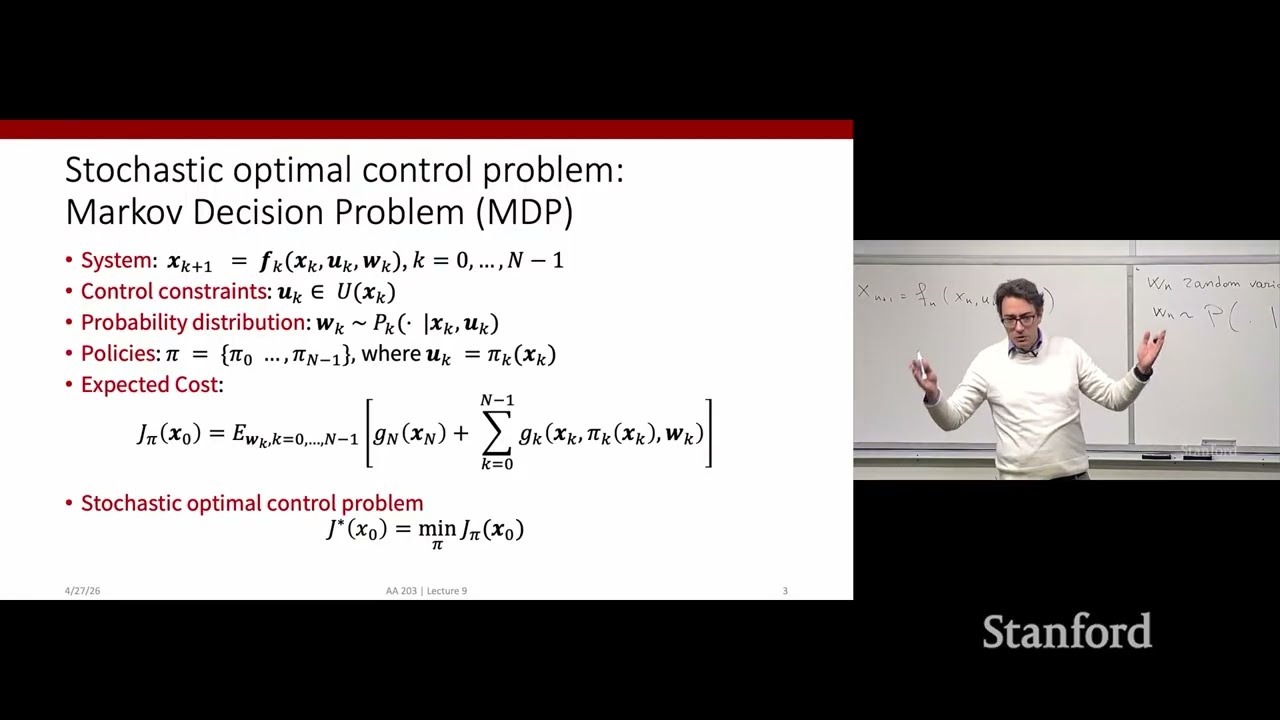
Stanford AA203 Optimal and Learning-Based Control | Spring 2026 | Lecture 9: Stochastic Dyn. Program thumbnail

· 1:17:01

Stanford AA203 Optimal and Learning-Based Control | Spring 2026 | Lecture 9: Stochastic Dyn. Program

This lecture details the extension of optimal control theory from deterministic settings to stochastic environments using Markov Decision Processes (MDPs). The core methodology involves defining state transitions and costs that incorporate random disturbances ($w_k$). For finite-horizon problems, the solution relies on adapting the Bellman recursion by taking the expectation over all disturbance realizations. Crucially, for infinite-horizon MDPs—which are foundational to Reinforcement Learning (RL)—the problem is simplified by assuming stationarity and introducing a discount factor ($\gamma$), leading to fixed-point equations for the optimal value function ($V^*$) and the Q-function ($Q^*$).

Key takeaways

  1. Stochastic State Dynamics (MDP) 2:00

    The state update is modeled as $x_{k+1} = f(x_k, u_k, w_k)$, where $w_k$ is a random disturbance. The system must adhere to the Markovian assumption: the probability distribution of $w_k$ can only depend on the current state ($x_k$) and control ($u_k$), not on the history of previous states or disturbances.

  2. Finite-Horizon Optimization 4:00

    The notion of optimality is defined by minimizing the expected cost, $\mathbb{E}[ ext{Cost}]$, over all possible disturbance realizations. The solution uses a backward dynamic programming recursion (Bellman equation) to find the optimal closed-loop policy $\pi^*$.

  3. Infinite-Horizon MDPs and Discounting 10:20

    To solve problems over an infinite number of stages, a discount factor ($\gamma \in [0, 1]$) is introduced to ensure the convergence of the expected cumulative reward. The optimal value function $V^*$ satisfies a fixed-point equation: $V^*(x) = \max_{u} \{ R(x, u) + \gamma \mathbb{E}[V^*(x')]\}$.

  4. The Q-Function Formulation 17:30

    For computational tractability in learning settings where the transition kernel is unknown, the problem can be reformulated using the Q-function ($Q^*$), which represents the expected cumulative reward starting at state $x$ and taking action $u$, followed by optimal actions: $Q^*(x, u) = R(x, u) + \gamma \sum_{x'} T(x'|x, u) V^*(x')$.

Watch on YouTube Full article

AStanford AA203 Optimal and Learning-Based Control | Spring 2026 | Lecture 8: Nonlinearity thumbnail

· 1:14:05

AStanford AA203 Optimal and Learning-Based Control | Spring 2026 | Lecture 8: Nonlinearity

This lecture provides an advanced overview of Linear-Quadratic Regulator (LQR) theory, extending its application from simple state regulation to complex nonlinear trajectory tracking and optimization. Key concepts include reformulating nonlinear tracking problems using deviation variables ($\delta x$, $\delta u$) to create an auxiliary LQR problem. The discussion culminates in two sophisticated iterative methods: Iterative LQR (iLQR), which linearizes dynamics and quadratizes costs, and Differential Dynamic Programming (DDP), which directly approximates the Bellman equation, offering a second-order approach for optimal control.

Key takeaways

  1. LQR as a General Tool 18:03

    While LQR is fundamentally designed to drive a state to the origin (regulation), it can be generalized to perform trajectory tracking by defining an auxiliary problem based on deviation variables. The optimal control law structure remains consistent: $u = u_{nominal} + ext{feedback term}$.

  2. Nonlinear Tracking via Linearization 24:10

    For nonlinear dynamics ($x_{k+1} = f(x_k, u_k)$), the tracking problem can be linearized by performing a Taylor expansion around the nominal trajectory ($\bar{x}, \bar{u}$), allowing the use of LQR techniques on the deviation variables.

  3. iLQR vs. DDP 35:05

    Both iLQR and DDP are methods for solving nonlinear optimal control problems iteratively. iLQR linearizes dynamics and quadratizes costs, while DDP directly approximates the Bellman equation by quadratizing the Q-function, making it a second-order algorithm in terms of dynamic derivatives.

Watch on YouTube Full article

Improving Agents is a Data Mining Problem — Vivek Trivedy, LangChain thumbnail

· 20:02

Improving Agents is a Data Mining Problem — Vivek Trivedy, LangChain

The continuous improvement of autonomous agents requires shifting focus from code determinism to data mining agent traces. The speaker argues that observability and continual learning are fundamentally linked: an agent's actions in an environment generate a trace record that serves as the substrate for all future improvements. Techniques like harness engineering, distillation (SFT), and analyzing counterfactual traces allow developers to systematically improve agents at lower costs than relying solely on frontier models.

Key takeaways

  1. Shipping is the First Step

    To gather data for improvement, an agent must be deployed into a real-world environment (shipping it). This process generates valuable trace data from tool calls, API usage, and CLIs.

  2. Observability = Continual Learning 4:04

    There is a tight coupling between observability and continual learning for agents. Both require comprehensive traces—the record of actions taken in the environment—to allow the agent to update its internal knowledge or definition.

  3. The Value of Traces 6:00

    Traces capture fine-grained behavior that simple pass/fail benchmarks miss. They are crucial for proving counterfactuals (e.g., comparing GPT 5.5 vs. GLM 5.2) and understanding how agents behave at a granular level.

  4. Improvement Loop Strategy 13:00

    For agent improvement, the recommended loop is: Start with Harness Engineering (fast feedback, ~2 minutes) $\rightarrow$ Saturate this ceiling $\rightarrow$ Fine-tune the model to break through it $\rightarrow$ Return to Harness Engineering.

  5. The Future of Data 17:00

    Agent activity will generate data at an exponential rate, potentially eclipsing all human-produced data in history. Managing this requires building systems that can efficiently mine and process traces.

Watch on YouTube Full article

Lessons from Studying Every Memory System — Shlok Khemani, Independent thumbnail

· 19:31

Lessons from Studying Every Memory System — Shlok Khemani, Independent

The talk provides a deep dive into the evolution and architectural differences of memory systems in consumer AI applications (ChatGPT, Claude, Gemini). The core thesis is that 'memory' is not a standardized technology but rather a function of compute, requiring careful trade-offs between profile size, update frequency, and context window cost. Speakers highlight that while general architectures are converging toward running profiles, the specific implementation details remain unique to each product, meaning memory cannot be outsourced.

Key takeaways

  1. Memory is not standardized

    There is no single way to implement AI memory; products evolve independently (e.g., ChatGPT uses dense keywords/running profile; Claude uses full sentences/tools).

  2. The Compute Trade-off

    A running profile requires balancing two costs: the cost to maintain (update frequency/compute) and the serving cost (profile length in context window). This trade-off dictates product design.

  3. Memory is a Product Problem

    The biggest limitation of current AI memory systems is not technology, but product design. They often fail to reason over rich external sources like emails or calendars, leading to conflicts (e.g., conflicting travel dates).

Watch on YouTube Full article

Build a social media agent with Managed Deep Agents thumbnail

· 12:49

Build a social media agent with Managed Deep Agents

This tutorial demonstrates building an autonomous social media agent using LangChain's Managed Deep Agents (MDA). The resulting agent monitors Hacker News and X (Twitter) to generate daily drafts of post ideas, which are then delivered directly to the user via Slack. The process covers setting up the project structure, defining custom tools, implementing specialized skills, configuring persistent memory across sessions, scheduling autonomous execution, and deploying the system to a production channel.

Key takeaways

  1. Agent Initialization and Setup 2:00

    The process begins by installing dependencies using `UV tool install managed deep agents` and initializing the project with `MDA init social post assistant`. The agent's entry point (`agent.py`) is configured, specifying model properties (e.g., changing to `GPT-5.6 Luna` for cost efficiency) and defining access tools.

  2. Tooling and Data Integration 3:50

    Custom tools are built to interact with external APIs: a tool to search Hacker News (using Algolia API) and two tools for X/Twitter (`get X user timeline` and `search X posts`). Authentication requires defining bearer tokens in the `.env` file.

  3. Advanced Agent Configuration 5:50

    The agent's behavior is governed by a core instruction file (`instructions.md`) and specialized, modular knowledge packages called 'Skills.' A skill (e.g., `draft posts`) provides dynamic instructions for specific tasks like drafting or revising content.

  4. Persistence and Automation 7:50

    To maintain context across different runs, a memory file (`memory.py`) is set with the scope to 'agent.' The agent's autonomy is established by creating a schedule (e.g., `morning drafts.py`) using cron expressions to run daily at 9:00 a.m. Pacific time.

  5. Deployment and Connectivity 9:40

    The agent is tested locally via `MDA dev` (which opens the agent in LangSmith Studio) before deployment using `MDA deploy`. Slack integration requires running `mda channel add slack`, generating a manifest, and setting up necessary environment variables (Slack signing secret and bot token).

Watch on YouTube Full article

Designing Agents (The Floor Is the Frontier) — Ben Hylak, Raindrop thumbnail

· 19:46

Designing Agents (The Floor Is the Frontier) — Ben Hylak, Raindrop

The talk argues that traditional evaluation methods designed for simple chatbots are inadequate for modern AI agents. The focus must shift from merely finding issues to 'raising the floor'—mitigating catastrophic worst-case failures that break user trust (e.g., recommending a competitor or deleting data). Practically, this requires treating agent evaluations as robust code tests rather than relying on prompt playgrounds, and focusing analysis on issue start dates and affected user percentages.

Key takeaways

  1. Focus on Raising the Floor (Safety) 17:33

    The most critical concern for agents is not their maximum capability (the ceiling), but their worst-case behavior (the floor). The floor represents failures that break user trust, such as accidental data deletion or sending inappropriate communications.

  2. Evals Must Be Code, Not Prompts 12:00

    Evaluation suites should be implemented as code (like unit or end-to-end tests) rather than relying on managed prompt playgrounds. This approach is necessary because the underlying structure of agents and their tools has fundamentally changed.

  3. Prioritize Issue Context 14:00

    When tracking issues, knowing only that an issue exists is insufficient. It is critical to track two metrics: when the issue started (to identify recent changes) and what percentage of users are affected.

  4. Tactical Analysis Tips 17:05

    1. **Clusters are not issues:** Clustering traces is useful for one-off analysis but does not scale well or reliably track changes over time. 2. **Code Mode Scaling:** Apply code mode concepts to traces by writing classifiers and running them in a sandbox at production volume. 3. **Anomaly Investigation:** Agents are poor at detecting anomalies, so instead, surface deterministic signals (like keyword spikes) for the agent to investigate.

Watch on YouTube Full article

Bringing Continual Learning into Enterprises — Samuel Denton, Applied Compute thumbnail

· 19:03

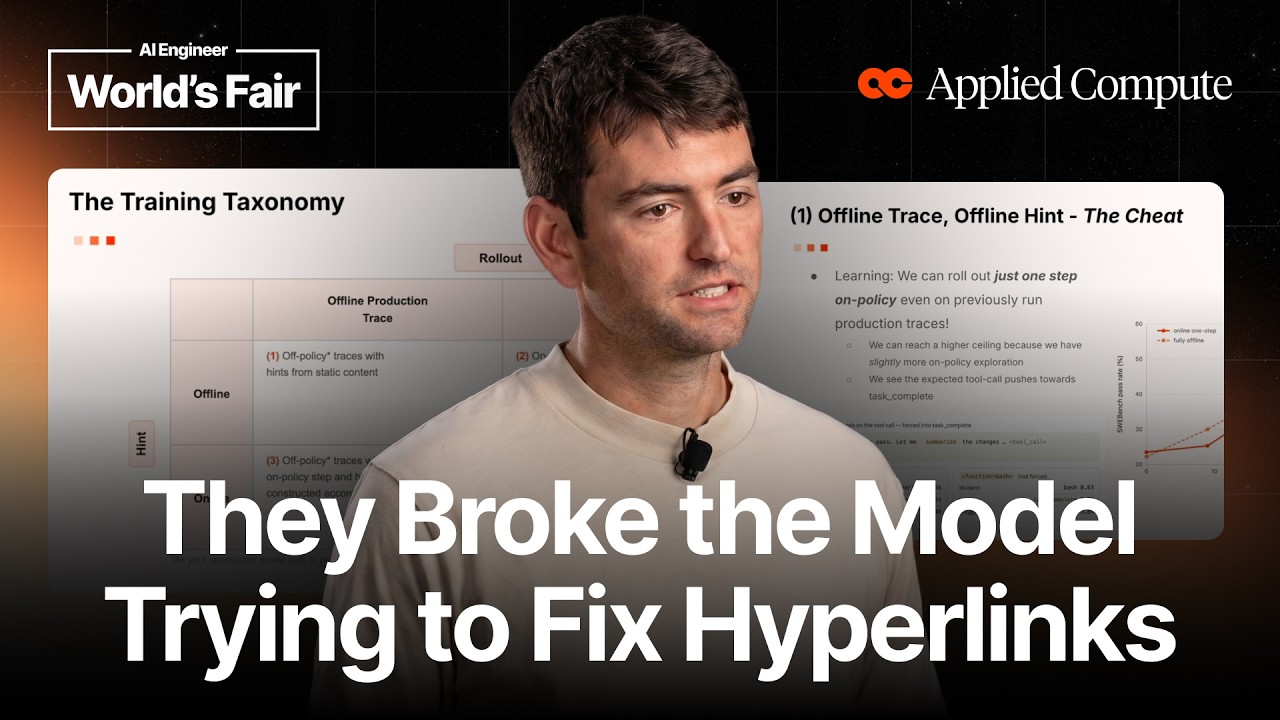
Bringing Continual Learning into Enterprises — Samuel Denton, Applied Compute

Applied Compute presents a framework for implementing continual learning in enterprise AI agents by mapping out a 'distillation spectrum.' This model uses a two-axis grid: the type of production trace (Offline vs. Online) and the source of hints (Static/Offline vs. Dynamic/Online). The goal is to improve agent behavior without relying on a 'golden answer.' Key findings demonstrate that online hinting paired with online traces offers the highest ceiling for continuous improvement, while offline methods provide immediate value using historical data dumps.

Key takeaways

  1. The Continual Learning Spectrum

    Continual learning can be approached across four quadrants defined by trace type (Offline/Online) and hint source (Static/Dynamic). The most scalable method is Quadrant 4: Online hints paired with online production traces, enabling continuous improvement as the model serves live traffic.

  2. Improving Agents Without Golden Answers 5:20

    The framework emphasizes improving agents without requiring a 'golden answer' or perfect rubric. This approach allows for targeted behavior changes (e.g., encouraging tool calls) by conditioning the rollout on existing production traces and injecting hints, rather than forcing specific tokens.

  3. Online Hinting Achieves High Performance Gains 12:00

    In a fully online setting, dynamic hints based on the model's own recent rollout can dramatically improve highly specialized behaviors (e.g., correct hyperlink formatting), raising performance from 15% to 80%, significantly outperforming static offline hinting methods.

Watch on YouTube Full article