Channel

Hugging Face

Digests from Hugging Face

· 25:04

Tau Crash Course: The Python Port of Pi

Tau is a Python-based coding agent harness designed as an architectural port of Pi, aimed at standardizing and enhancing reliable AI workflow development. It features a Textual TUI for interaction and maintains core functionality like session management, tool calling (read, write, edit, bash), and skill invocation. Key technical aspects include the ability to store sessions in a JSONL format for easy analysis and integration into larger build pipelines.

Key takeaways

  1. Architectural Porting

    Tau is a coding harness developed entirely in Python and functions as an architectural port of Pi, ensuring core functionality remains consistent while updating the user interface.

  2. TUI Framework

    The Terminal User Interface (TUI) for Tau is built using Textual, which results in some differences from Pi's native TUI but maintains similar command structures.

  3. Session Management and Tree Structure 13:39

    Sessions are stored as a tree structure, where every message points to its parent ID. This allows users to fork conversations or navigate history using the `/tree` command.

  4. Data Export for Analysis

    Sessions can be exported into a JSONL format (JSON Lines), making them easily parsable for external analysis, skill testing, and integration with other agents.

Watch on YouTube Full article

· 41:28

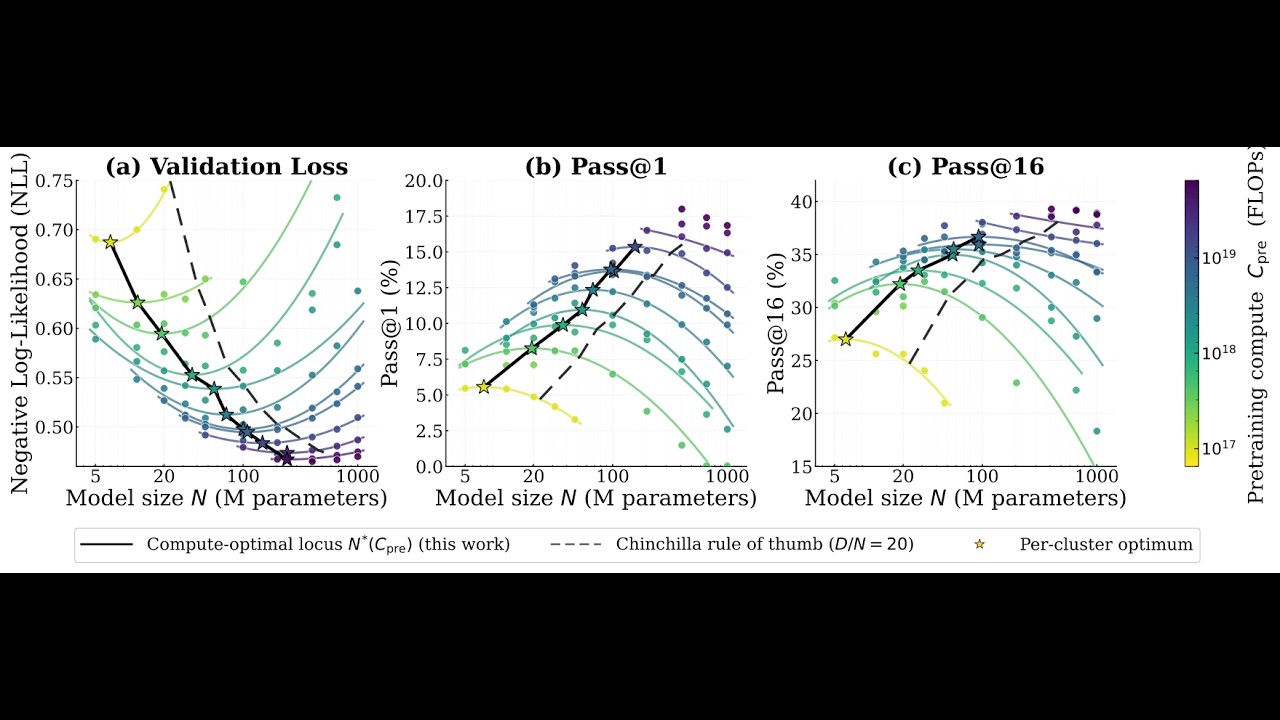
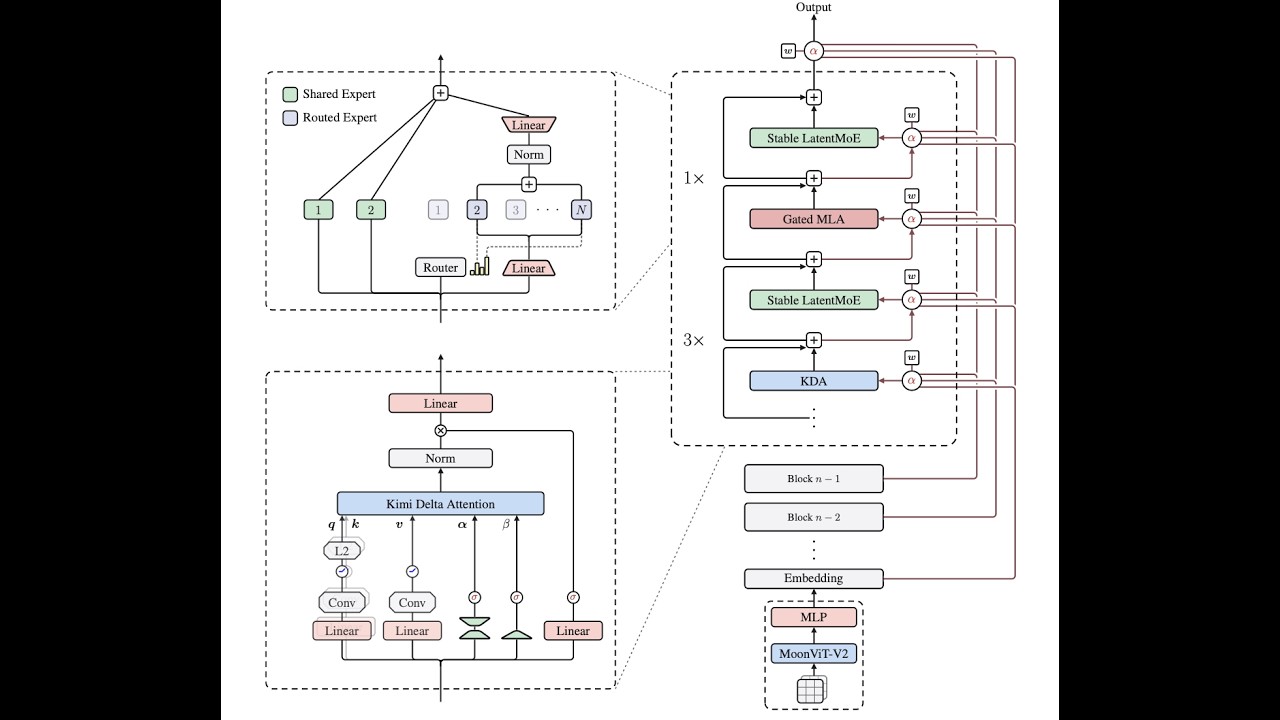
Hugging Face Journal Club: Kimi K3

The discussion summarizes the Kimi K3 tech report, detailing a highly complex and scaled training pipeline for large language models. Key innovations include specialized agentic structures (general, deep research, coding), multi-tier on-policy distillation across nine domain experts, and advanced infrastructure techniques like partial rollout schemes and dynamic resource scheduling. The talk emphasizes that the model's performance is achieved through sophisticated engineering efforts rather than a single breakthrough concept.

Key takeaways

  1. Multi-Tier Expert Specialization 2:00

    The training pipeline involves generating nine specialized domain experts (3 reasoning levels: low, high, max) for three general domains (general tasks, deep research, coding). These are combined using multi-tier on-policy distillation into a single student model.

  2. Partial Rollout Scheme 4:08

    A novel RL technique where the system samples $k$ rollouts from $n$ prompts. It uses an additional parameter $\lambda$ to measure completed rollouts within a budget, updating weights on that subset and pushing incomplete rollouts into subsequent iterations.

  3. Extensible Chat Template 6:42

    The Kimi K3 model utilizes an 'extensible token markup language' for its chat template. This design aims to be easy to learn during SFT while remaining flexible enough to accommodate future modalities without re-engineering the core template.

  4. Advanced Infrastructure Scaling 30:35

    The system employs sophisticated resource management, including a dynamic rollout auto throttling scheduler based on KV cache pressure and a method for collocating RL training and inference by automatically balancing GPU resources between the two tasks.

Watch on YouTube Full article

· 1:17:20

Training Agents 3: Reinforcement Learning

This session introduces Group Relative Policy Optimization (GRPO), a reinforcement learning (RL) method that advances agent training beyond mere imitation (SFT/Distillation). GRPO trains models by sampling multiple completions per prompt and using the group's relative scores—calculated via a reward function—as the primary training signal. This approach is highly effective for complex tasks, allowing agents to learn from their own varied trajectories in an iterative loop.

Key takeaways

  1. GRPO Mechanics 20:30

    GRPO calculates advantages relative to the group average (Reward - Group Average / Group Standard Deviation). This method eliminates the need for a separate value model, reward model, or critic, simplifying the RL loop. The process involves generating multiple rollouts, scoring them with a verifiable Python function (the reward function), and updating the policy based on these relative advantages.

  2. Training Pipeline Progression 5:05

    The training pipeline typically progresses from Supervised Fine-Tuning (SFT) for dense, off-policy signals, to Distillation for richer online rollouts, and finally to RL/GRPO for sparse, on-policy learning. SFT is often used first to bootstrap the model's understanding of the task structure.

  3. Reward Function Design 26:40

    Defining a verifiable reward function is critical; it acts as a 'contract' defining success. Rewards can be composed of multiple components, such as a format check (e.g., ensuring JSON structure) and an accuracy check (e.g., passing unit tests). For agentic tasks, using test suites or compiling code provides robust signals.

  4. Interpreting Training Curves 35:00

    Monitoring training curves via tools like Track.io is essential for debugging. Key metrics include the reward (should rise), entropy (should remain stable/flat, not dive or spike), and completion length. Failure modes—such as 'reward hacking' (high reward but low test accuracy) or 'collapse' (low entropy)—require deep data inspection.

Watch on YouTube Full article

· 6:44

The Hugging Face Hub for Enterprise & Academia

The paid organizational plan for the Hugging Face Hub provides advanced features critical for enterprise and academic use cases, focusing on enhanced collaboration, robust security, and strict governance. Key upgrades include private workspaces with built-in versioning and lineage tracking, centralized identity management via SSO (SAML/OIDC), IP allowlisting, audit logs, and streamlined billing through prepaid credits that separate storage costs from compute usage.

Key takeaways

  1. Private Collaboration Workspace 0:25

    Organizations gain a single shared namespace for models, datasets, and Spaces, featuring built-in versioning and lineage tracking. Resource Groups allow granular access control to repositories (0:25).

  2. Advanced Data Interaction 0:41

    The Dataset Viewer allows users to query private data using an agent interface (e.g., SQL console), enabling natural language queries against datasets (0:41).

  3. Enterprise Security & Compliance 2:10

    Security features include Single Sign-On (SSO) via SAML/OIDC, centralized token management, IP allowlisting for corporate network restriction, and the option to choose data storage regions (e.g., within the EU). The infrastructure is SOC 2 Type II certified (1:30).

  4. Governance and Automation 2:32

    Features like audit logs, service accounts for CI/CD workflows, SCIM provisioning for user lifecycle syncing, and gated access flows ensure controlled adoption of open-weight models at scale (1:52).

Watch on YouTube Full article

· 53:22

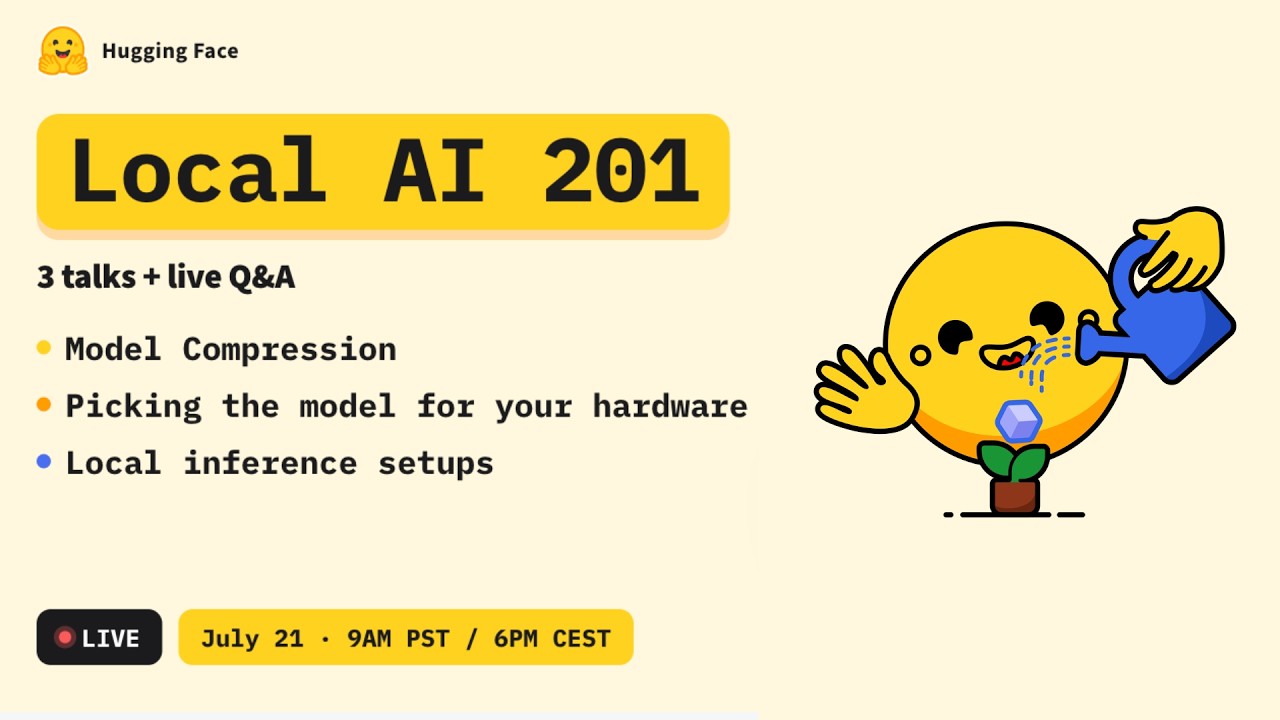
Local AI 201

The session provides an advanced deep dive into local AI deployment, emphasizing that successful LLM inference is not determined by hardware capacity alone. Instead, it requires selecting a balanced stack comprising the right model, quantization level, and specialized inference engine (e.g., VLLM, llama.cpp) for the specific use case—whether single-user chat or high-concurrency agentic workflows. Key performance metrics like memory bandwidth are shown to be more critical than raw memory capacity when scaling up requests.

Key takeaways

  1. Start with the Use Case, Not the Hardware 2:09

    When designing a local AI solution, always begin by defining the required use case (e.g., single-user chatbot vs. 50-person agentic workflow). The hardware, model, and engine stack must then be selected to support that specific requirement.

  2. Memory Bandwidth is Critical for Throughput 4:08

    For serving multiple requests (high throughput), memory bandwidth is often a more critical bottleneck than total memory capacity. For example, the RTX 5090 was shown to achieve significantly higher performance due to its high bandwidth compared to other devices.

  3. Engine Selection Dictates Performance Under Load 5:41

    The choice of inference engine (e.g., VLLM vs. llama.cpp) and kernel optimization is paramount. Improperly selecting an engine can severely limit performance, causing a high-bandwidth device to perform worse than a lower-bandwidth machine under load.

  4. Local AI Offers Superior Privacy and Control 7:30

    Running LLMs locally provides massive advantages in security, privacy, and control compared to relying on third-party cloud APIs. This allows users to fully tune the stack for long-term stability.

Watch on YouTube Full article

· 30:27

Hugging Face Journal Club: AsyncOPD and How Stale Can On-Policy Distillation Be?

The discussion details Asynchronous On-Policy Distillation (AsyncOPD), a method designed to significantly boost training throughput by making the distillation process fully asynchronous. While conventional methods are synchronous and suffer from GPU blocking during backpropagation, AsyncOPD continuously generates rollouts from policies while simultaneously scoring them with a teacher model. This approach achieves substantial speedups (1.5x to 2.7x) compared to synchronous methods, though it introduces complexity related to maintaining stability when student rollouts become significantly off-policy.

Key takeaways

  1. AsyncOPD for Throughput Gains 23:23

    By decoupling the generator (student policy), scorer (teacher model), and backpropagator, AsyncOPD eliminates GPU blocking inherent in synchronous distillation. This allows continuous operation, leading to throughput improvements of 1.5x to 2.7x on various math benchmarks.

  2. Addressing Cache Misses via Monte Carlo Sampling 30:07

    When calculating Reverse KL divergence using Top-K logits, cache misses can occur because the required log probabilities for the loss calculation may not have been stored during the initial sampling phase. MC sampling is proposed as a solution to estimate the loss accurately by storing and correcting estimates using important sampling.

  3. Trade-offs in Off-Policy Distillation 20:50

    While fully asynchronous methods offer high throughput, they require careful handling of off-policy rollouts. The stability and accuracy are dependent on the degree of staleness allowed (the difference between the current policy and the teacher's distribution).

Watch on YouTube Full article

· 36:00

New Model: Inkling by Thinking Machine on Hugging Face

Thinking Machines announced Inkling, a massive open model with nearly one trillion parameters. It is designed as a natively multimodal architecture, accepting image, text, and audio inputs simultaneously. Key technical features include a Mixture-of-Experts (MoE) structure (975B total / 41B active params), a 1M token context window, and advanced deployment support across multiple frameworks like `transformers`, SGLang, vLLM, and `llama.cpp`. The model is available in BF16 and NVFP4 formats, facilitating high-performance inference on various hardware setups.

Key takeaways

  1. Multimodal Capability & Scale 3:50

    Inkling is a true multimodal model that natively processes image, text, and audio inputs using a single architecture. It boasts an immense 1M token context window and was trained on 45T tokens.

  2. Architectural Innovations 5:10

    The model utilizes relative attention (replacing RoPE) and a specialized SConv layer to efficiently aggregate hidden states, making it highly efficient for multimodal tasks compared to previous models.

  3. Deployment Flexibility 7:10

    Inkling supports multiple deployment paths: BF16 (requiring ~2TB VRAM) and NVFP4 (600GB VRAM). It provides day-zero support for `transformers`, SGLang, vLLM, and `llama.cpp` (including GGUF quants via Unsloth), enabling diverse inference environments.

Watch on YouTube Full article

· 53:45

Build Small Winners Reveal

The Build Small Hackathon winners reveal celebrated projects that emphasize building highly functional applications using small, efficient models and local/on-device processing. The community demonstrated a strong focus on 'local first' AI solutions, achieving impressive metrics like 64% of apps running fully offline. Winning projects showcased practical utility—such as scam defense (Jawbreaker) or specialized coaching (Posify)—proving that powerful, real-world impact can be achieved with tiny model footprints.

Key takeaways

  1. Focus on Local and Small Models 18:05

    The hackathon emphasized building small apps using sub-32 billion parameter models. Key metrics showed that 64% of submissions ran fully offline, highlighting the viability of 'local first' AI architectures.

  2. High Utility in Niche Applications 27:20

    Winning projects demonstrated significant real-world utility. Examples include Jawbreaker (a private scam defense tool for suspicious text/emails) and Agenda Parser (breaking down dense local government agendas), proving the value of small, focused solutions.

  3. Advanced Technical Implementation 30:30

    Winners utilized advanced techniques like WebGPU for browser-based real-time games (Parry) and quantization methods (GGUF) to drastically reduce cold boot times, demonstrating high technical polish.

  4. Open Source Model Ecosystem 22:20

    The most popular model family used was Qwen (288 spaces), followed by MiniCPM OpenBMB and Nematron, confirming the community's reliance on diverse open-source models.

Watch on YouTube Full article