Hugging Face Journal Club: Scaling Laws for Pre-training & RL
Summary
The discussion analyzes a paper proposing a joint scaling law for pre-training and Reinforcement Learning (RL), which models how compute allocation across these stages impacts downstream task performance. Key findings suggest that increasing compute allocated to pre-training significantly boosts the model's ability on specific tasks (Pass 1) but has diminishing returns on generalized capability (Pass K). The analysis highlights the importance of optimizing the trade-off between SFT and RL compute budgets.
Key takeaways
-
Pre-training vs. RL Compute Allocation
15:20
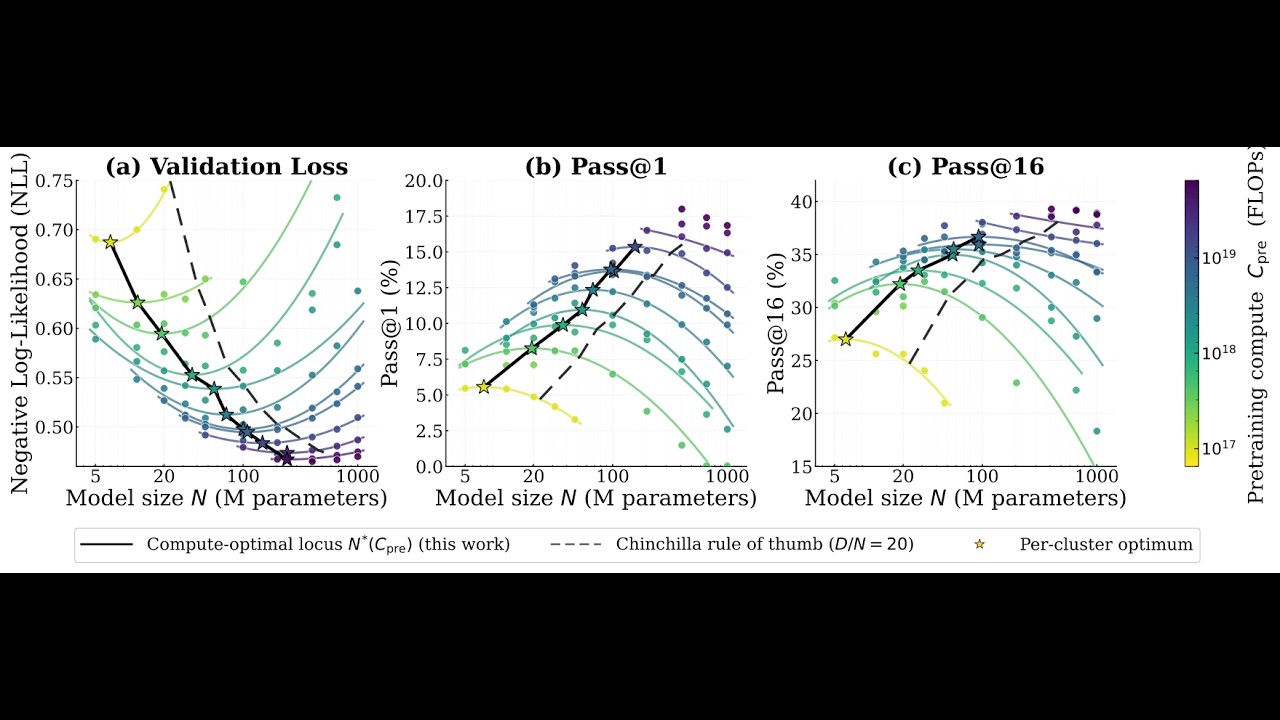
The primary takeaway is that increasing compute allocated to pre-training leads to higher performance on downstream tasks (Pass 1). Conversely, while RL improves Pass 1, the model's generalized capability (Pass K) remains relatively stable regardless of the pre-training scale.
-
Scaling Laws and Model Size
24:45
When fixing the total compute budget, training smaller models for longer is generally more effective than attempting to train larger models, contradicting simple Chinchilla scaling assumptions in certain contexts.
Technical details
-
Joint Scaling Law (Pre-training & RL)
120s
The paper proposes a joint scaling law governing the relationship between pre-training compute and subsequent RL performance. This moves beyond traditional single-stage scaling laws like Chinchilla's.
-
Training Pipeline Stages
75s
The standard pipeline involves three stages: Pre-training $\rightarrow$ Supervised Fine-Guning (SFT) $\rightarrow$ Reinforcement Learning (RL). The compute allocation across these stages is critical for performance.
-
Process-Level Supervision in RL
260s
The RL setup used chess as a benchmark, providing step-by-step rewards for every action taken. This contrasts with conventional RL that often only scores on the final trajectory, offering 'process level supervision.'
Mentioned resources
Channel & topics
Watch on YouTube · Back to latest
This independent, AI-assisted summary is provided for commentary and informational purposes. It may contain errors or omit important context. Please watch the original video for the creator's complete presentation. Video, thumbnail, and related copyrights belong to their respective owners.