Topic

Model Optimization

All digests tagged Model Optimization

Local Models: Trust, Control, Optimization — Carter Abdallah, NVIDIA thumbnail

· 43:21

Local Models: Trust, Control, Optimization — Carter Abdallah, NVIDIA

The panel emphasized that for AI systems to achieve true sovereignty and trust, the ecosystem must be open—encompassing not just models but the entire training stack. Open weights allow users to own their data traces and customize models (e.g., Neotron, Trinity) via post-training environments, enabling specialized performance far exceeding generalized frontier closed APIs. The future points toward local/on-device compute becoming viable for most daily tasks, shifting AI development from relying solely on massive cloud endpoints.

Key takeaways

  1. Open Models Ensure Trust and Sovereignty 17:32

    Trust in open models is derived from verifiability: users can inspect the files, matrices, and running code (e.g., implementations from Prime Intellect, VLM, SGLang) rather than relying on unverifiable closed APIs. The ability to run a model locally ensures predictable output regardless of geopolitical or corporate access changes.

  2. Specialization Outperforms Generalization 22:00

    Open models allow for deep customization and post-training on specific use cases (e.g., finance automation). This specialization can yield better performance than generalized frontier models while being significantly cheaper to operate, enabling a data flywheel by allowing users to own their output traces.

  3. Local Compute is the Next Inflection Point 40:01

    The industry is moving toward local AI capability. The panel predicts that within the next year, open models will achieve capabilities comparable to frontier closed models (e.g., better than Fable), making it possible for most daily tasks to run on personal devices.

Watch on YouTube Full article

Hugging Face Journal Club: Scaling Laws for Pre-training & RL thumbnail

· 30:57

Hugging Face Journal Club: Scaling Laws for Pre-training & RL

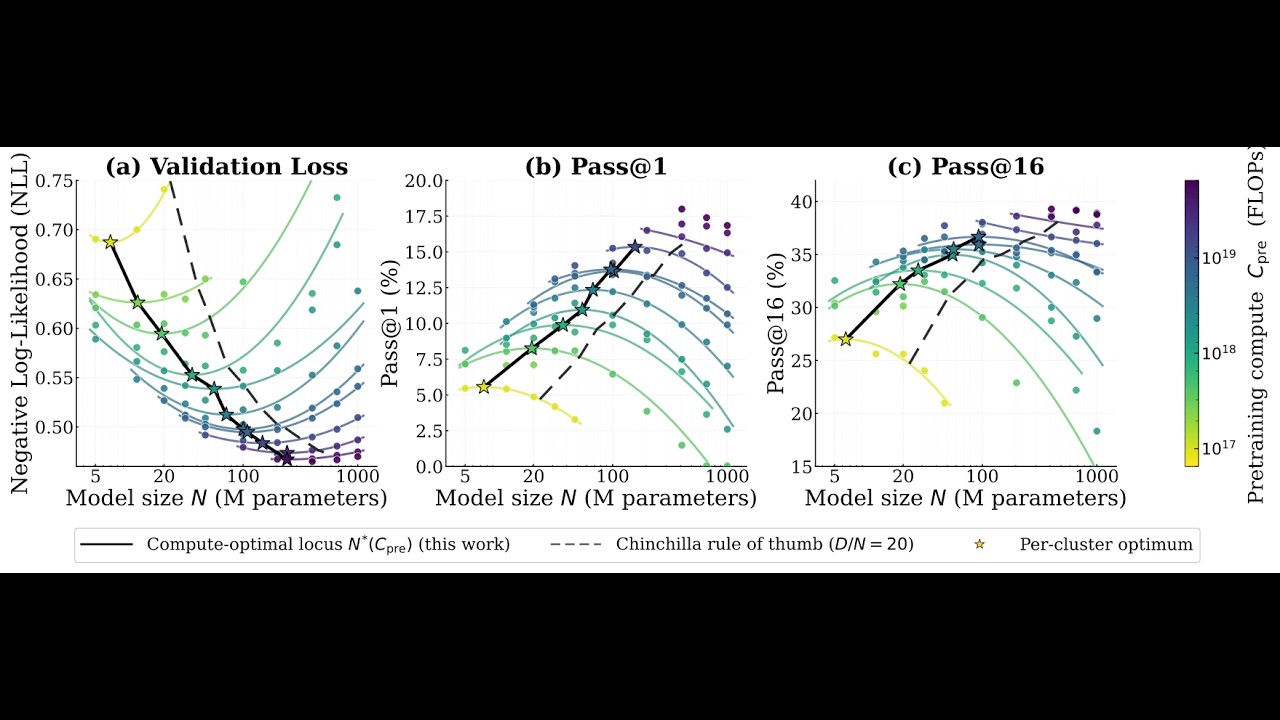
The discussion analyzes a paper proposing a joint scaling law for pre-training and Reinforcement Learning (RL), which models how compute allocation across these stages impacts downstream task performance. Key findings suggest that increasing compute allocated to pre-training significantly boosts the model's ability on specific tasks (Pass 1) but has diminishing returns on generalized capability (Pass K). The analysis highlights the importance of optimizing the trade-off between SFT and RL compute budgets.

Key takeaways

  1. Pre-training vs. RL Compute Allocation 15:20

    The primary takeaway is that increasing compute allocated to pre-training leads to higher performance on downstream tasks (Pass 1). Conversely, while RL improves Pass 1, the model's generalized capability (Pass K) remains relatively stable regardless of the pre-training scale.

  2. Scaling Laws and Model Size 24:45

    When fixing the total compute budget, training smaller models for longer is generally more effective than attempting to train larger models, contradicting simple Chinchilla scaling assumptions in certain contexts.

Watch on YouTube Full article

Stanford CS329A Self-Improving AI Agents | Part 6 | Train Time Scaling/Scaling RL thumbnail

· 1:12:39

Stanford CS329A Self-Improving AI Agents | Part 6 | Train Time Scaling/Scaling RL

This lecture explores advanced techniques for scaling Large Language Model (LLM) reasoning capabilities through 'train-time scaling' and Reinforcement Learning (RL). The discussion covers three key papers: STaR (Self-Taught Reasoner), DeepSeekMath, and DAPO. Key findings demonstrate that smaller models can achieve high accuracy on complex benchmarks like AIME by leveraging structured training data generation (STaR) or advanced RL algorithms (DAPO/GRPO). The core insight is that closing the feedback loop—using model outputs to improve the model itself—is crucial for boosting reasoning, especially in domains with verifiability.

Key takeaways

  1. Train-Time Scaling vs. Test-Time Scaling 2:00

    While test-time scaling (inference-based techniques like majority voting) improves accuracy by sampling outputs, train-time scaling uses the model's own filtered outputs to fine-tune and improve the model weights directly, creating a powerful closed feedback loop.

  2. STaR Boosts Reasoning via Rationalization 6:30

    The STaR method bootstraps reasoning by generating solutions on a small set of examples. It filters for correct answers and then generates rationales (hints) for incorrect attempts, allowing the model to learn from failed paths iteratively.

  3. GRPO Addresses RL Memory Constraints 10:05

    DeepSeekMath introduced Group Relative Policy Optimization (GRPO), an efficient alternative to PPO that reduces memory overhead by using a group baseline instead of maintaining multiple policy copies, enabling scaling RL to larger models.

  4. DAPO Stabilizes Complex Reasoning 17:30

    DAPO addresses training instability in long chain-of-thought reasoning by implementing asymmetric clipping (allowing bigger increases) and dynamic sampling (filtering out zero or one reward groups to maintain a useful gradient signal).

Watch on YouTube Full article