Topic

Data Sovereignty

All digests tagged Data Sovereignty

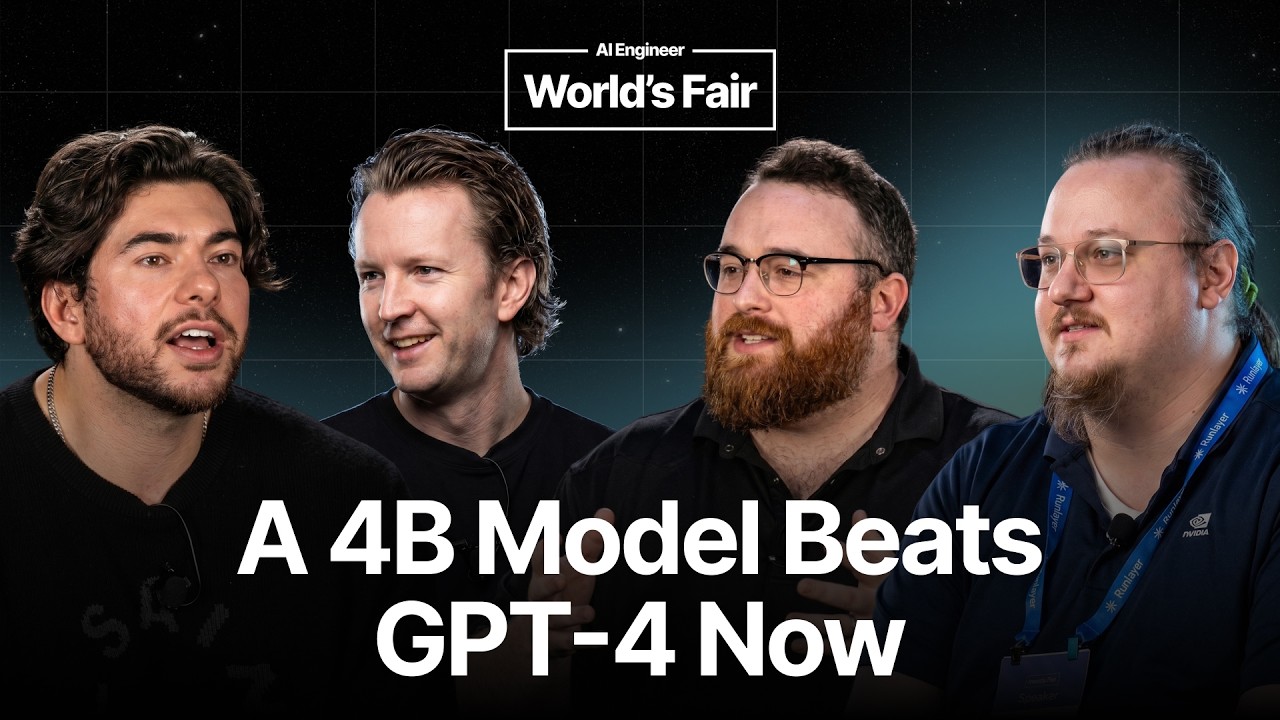
Local Models: Trust, Control, Optimization — Carter Abdallah, NVIDIA thumbnail

· 43:21

Local Models: Trust, Control, Optimization — Carter Abdallah, NVIDIA

The panel emphasized that for AI systems to achieve true sovereignty and trust, the ecosystem must be open—encompassing not just models but the entire training stack. Open weights allow users to own their data traces and customize models (e.g., Neotron, Trinity) via post-training environments, enabling specialized performance far exceeding generalized frontier closed APIs. The future points toward local/on-device compute becoming viable for most daily tasks, shifting AI development from relying solely on massive cloud endpoints.

Key takeaways

  1. Open Models Ensure Trust and Sovereignty 17:32

    Trust in open models is derived from verifiability: users can inspect the files, matrices, and running code (e.g., implementations from Prime Intellect, VLM, SGLang) rather than relying on unverifiable closed APIs. The ability to run a model locally ensures predictable output regardless of geopolitical or corporate access changes.

  2. Specialization Outperforms Generalization 22:00

    Open models allow for deep customization and post-training on specific use cases (e.g., finance automation). This specialization can yield better performance than generalized frontier models while being significantly cheaper to operate, enabling a data flywheel by allowing users to own their output traces.

  3. Local Compute is the Next Inflection Point 40:01

    The industry is moving toward local AI capability. The panel predicts that within the next year, open models will achieve capabilities comparable to frontier closed models (e.g., better than Fable), making it possible for most daily tasks to run on personal devices.

Watch on YouTube Full article

US AI Dominance Is Over: Here's Why thumbnail

· 24:01

US AI Dominance Is Over: Here's Why

The use of Chinese AI models should be selective and requires rigorous due diligence, as 'Chinese model' is not a monolithic category. While these models offer significant economic advantages for high-volume, bounded tasks (e.g., DeepSeek V4 Pro at $0.87/M tokens vs Kimi K3 at $15/M tokens), their suitability depends entirely on the specific task, required capability, and deployment path. Engineers must prioritize measuring 'cost per accepted result' over simple token price to accurately assess total cost of ownership (TCO).

Key takeaways

  1. Economic Value vs. Capability Gap

    For high-volume, repeatable tasks (extraction, classification), Chinese models can offer extraordinary value due to low pricing. However, for ambiguous or high-stakes judgment calls, the strongest American frontier systems may still be necessary as a baseline.

  2. Cost Metric is Key 17:09

    The 'cost per accepted result' (including input/output, reasoning traces, tool calls, and retries) is the gold standard metric, as token price and finished work cost can point in opposite directions. A cheap model can become expensive if it requires long reasoning traces.

  3. Deployment Strategy Matters 23:50

    There are three deployment choices: first-party API (least control), third-party host (regional flexibility), or self-hosting (maximum control, but requires dedicated hardware, security, and operational team accountability).

Watch on YouTube Full article

📅 ThursdAI - LIVE from AI Engineer Worlds Fair - OpenAI, DeepMind, EXO, Sakana & more friends thumbnail

· 2:53:57

📅 ThursdAI - LIVE from AI Engineer Worlds Fair - OpenAI, DeepMind, EXO, Sakana & more friends

This live panel discussion from the AI Engineer World's Fair focuses on the critical shift toward local and open-source AI models. Speakers debated the current state of frontier models (like OpenAI's GPT-5.6) versus decentralized, sovereign AI solutions running on consumer hardware. Key technical topics included model routing (Fugu), agentic workflows using tools like Weights & Biases' Coreweave Ara, and the necessity of local inference to ensure data sovereignty and prevent vendor lock-in.

Key takeaways

  1. The resurgence of Fable 22:40

    Fable is back, marking a significant moment for open models. The discussion highlighted that this trend emphasizes the need for decentralized AI solutions over reliance on single cloud providers.

  2. Local AI and Sovereignty 35:50

    Running large language models (LLMs) locally is presented as crucial for guaranteeing data sovereignty, preventing vendor lock-in, and ensuring continuous operation regardless of cloud provider restrictions.

  3. Model Routing and Orchestration 45:00

    The concept of model routers (like Fugu) was presented as a superior method for achieving high performance, allowing users to dynamically select the best model for specific tasks rather than relying on a single monolithic LLM.

  4. The Agentic Era and Tooling 1:03:20

    Tools like Weights & Biases' Coreweave Ara are emerging to automate the entire AI research loop (auto-research), moving beyond simple chatbots into full agentic co-pilots for ML engineers.

Watch on YouTube Full article