Topic

Local AI

All digests tagged Local AI

Seattle Spark Hack Winners Livestream Spotlight: LiveKit & Memo thumbnail

· 42:28

Seattle Spark Hack Winners Livestream Spotlight: LiveKit & Memo

This summary covers the NVIDIA DGX Spark Hack winners spotlight, featuring two local AI applications: LifeKit, an offline survival companion, and Memo, a local-first wearable assistant. Both projects demonstrate the capability of running complex, multi-modal AI workflows—including vision, speech, and retrieval—on edge devices like the Acer Veriton GN100. The core technical focus is on achieving reliable, low-latency AI functionality without constant internet connectivity, utilizing advanced NVIDIA models like Neotron and Cosmos.

Key takeaways

  1. Offline AI Capability (LifeKit) 20:00

    LifeKit addresses the critical need for stable information access when internet connectivity fails. It uses local AI and Retrieval Augmented Generation (RAG) against extensive, downloadable knowledge bases (e.g., Wikipedia) to provide guidance on survival topics (first aid, navigation) without relying on external servers.

  2. Selective Memory and Privacy (Memo) 27:30

    Memo is a wearable assistant designed for elderly care, focusing on privacy by only tracking objects explicitly chosen by the user (e.g., keys, wallet). It uses visual evidence and confirmation to save location data, ensuring that the system does not record or store general video feeds.

  3. Concurrent Model Orchestration 22:30

    Both projects rely on running multiple NVIDIA models concurrently (e.g., Neotron, Cosmos, Parakeet, VSSs, NIM, VLM) on the GN100. The primary architectural challenge is orchestrating these disparate tools—from speech transcription to reasoning—into a single, reliable, and deterministic application.
Watch on YouTube Full article

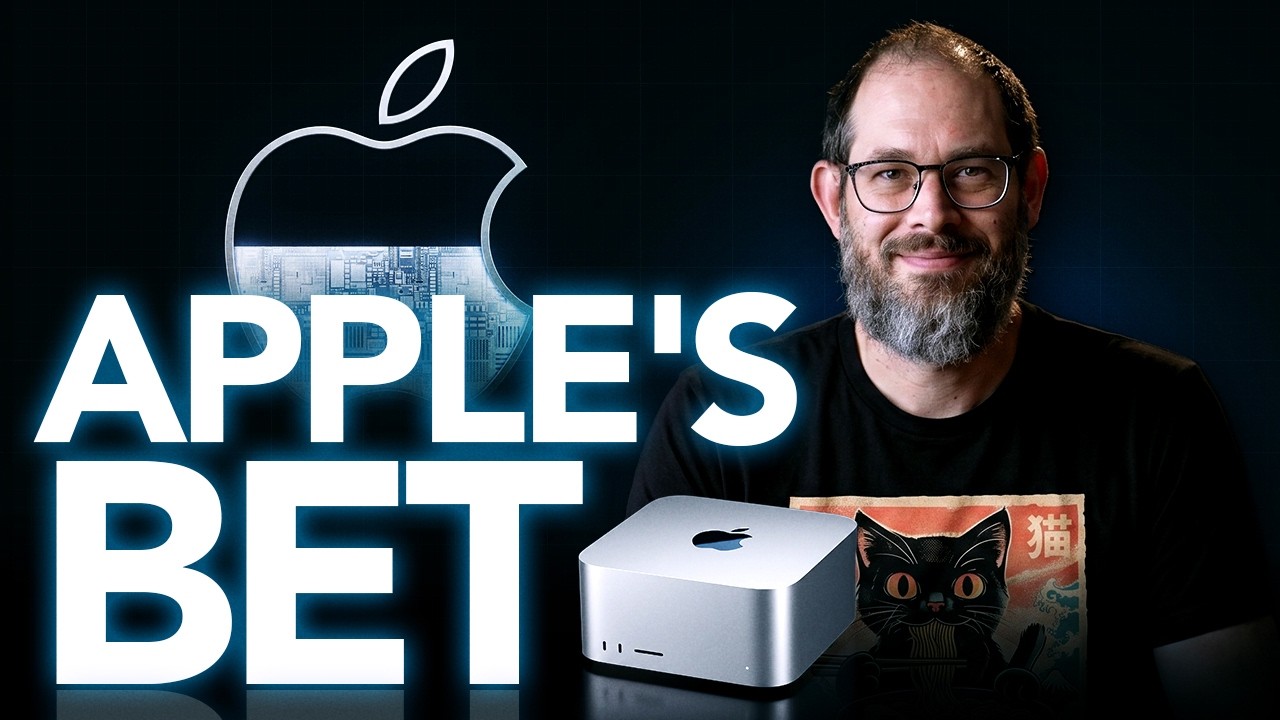
Apple's New Mac Line is Built Around Local AI. The Bet Is You'd Rather Own Than Rent. thumbnail

· 22:33

Apple's New Mac Line is Built Around Local AI. The Bet Is You'd Rather Own Than Rent.

Apple has rebuilt its entire desktop Mac line around local AI capabilities, positioning the hardware as a platform for running agents and large language models (LLMs) on-device. While the launch appears to challenge NVIDIA's dominance in AI compute, the speaker argues that the core decision facing serious AI workers is whether they should 'own' their intelligence via local compute or 'rent' it through persistent cloud services. The hardware provides a memory ladder from Mac Mini (M6/M5 Pro) up to Mac Studio (M5 Ultra, 512 GB), enabling multiple agents and large models locally, but the technical setup for seamless model routing remains an open challenge.

Key takeaways

  1. Local AI Compute vs. Cloud Computing

    The central debate is whether users should invest in local hardware (owning compute) or rely on persistent cloud services (renting intelligence). The speaker notes that while Apple provides powerful local options, frontier agents are rapidly moving to the cloud for superior context and constant updates.

  2. Apple's Hardware Strategy 5:04

    The Mac line offers a memory ladder: M6/M5 Pro (Mac Mini) for basic agents, M5 Max (Mac Studio) for larger models, and M5 Ultra up to 512 GB of unified memory. This allows users to run multiple local agents simultaneously.

  3. The 'Missing Middle' Bet 20:00

    The market is poised for a 'bothand' scenario: investing in local compute (Macs) while also utilizing cloud services when necessary. The challenge lies in creating seamless routing between these two environments.

Watch on YouTube Full article

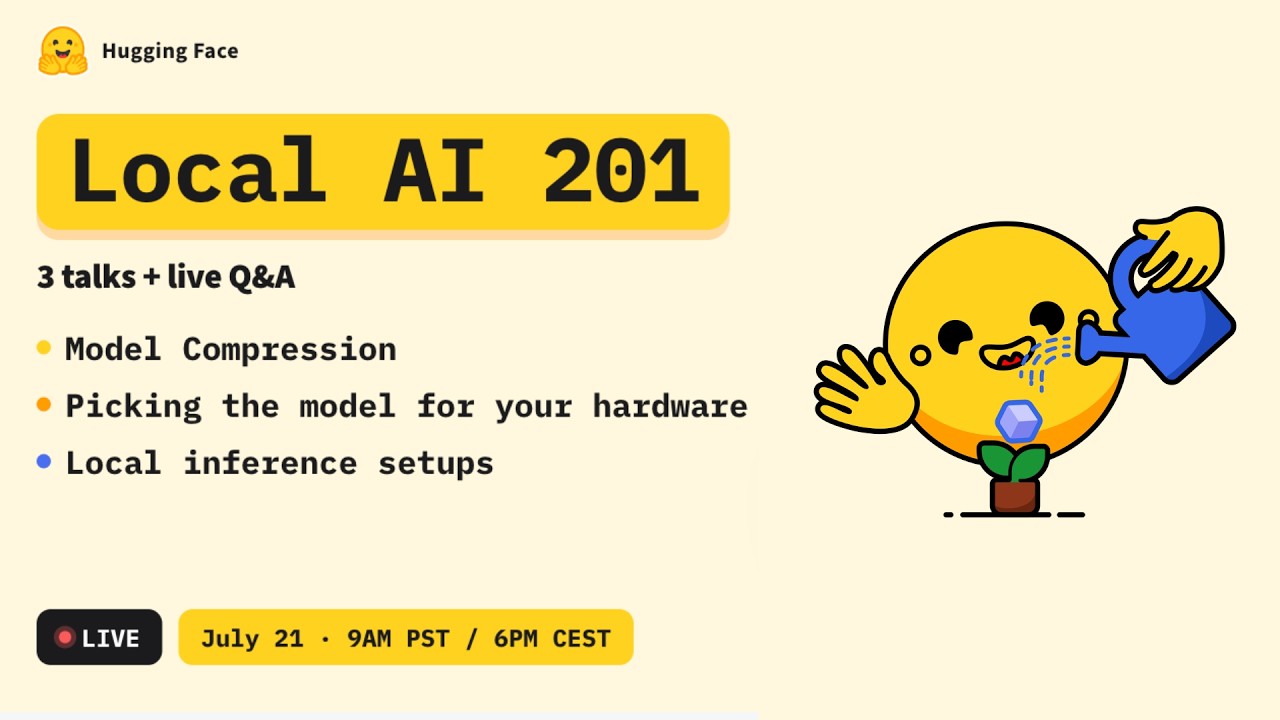
Local AI 201 thumbnail

· 53:22

Local AI 201

The session provides an advanced deep dive into local AI deployment, emphasizing that successful LLM inference is not determined by hardware capacity alone. Instead, it requires selecting a balanced stack comprising the right model, quantization level, and specialized inference engine (e.g., VLLM, llama.cpp) for the specific use case—whether single-user chat or high-concurrency agentic workflows. Key performance metrics like memory bandwidth are shown to be more critical than raw memory capacity when scaling up requests.

Key takeaways

  1. Start with the Use Case, Not the Hardware 2:09

    When designing a local AI solution, always begin by defining the required use case (e.g., single-user chatbot vs. 50-person agentic workflow). The hardware, model, and engine stack must then be selected to support that specific requirement.

  2. Memory Bandwidth is Critical for Throughput 4:08

    For serving multiple requests (high throughput), memory bandwidth is often a more critical bottleneck than total memory capacity. For example, the RTX 5090 was shown to achieve significantly higher performance due to its high bandwidth compared to other devices.

  3. Engine Selection Dictates Performance Under Load 5:41

    The choice of inference engine (e.g., VLLM vs. llama.cpp) and kernel optimization is paramount. Improperly selecting an engine can severely limit performance, causing a high-bandwidth device to perform worse than a lower-bandwidth machine under load.

  4. Local AI Offers Superior Privacy and Control 7:30

    Running LLMs locally provides massive advantages in security, privacy, and control compared to relying on third-party cloud APIs. This allows users to fully tune the stack for long-term stability.

Watch on YouTube Full article

📅 ThursdAI - LIVE from AI Engineer Worlds Fair - OpenAI, DeepMind, EXO, Sakana & more friends thumbnail

· 2:53:57

📅 ThursdAI - LIVE from AI Engineer Worlds Fair - OpenAI, DeepMind, EXO, Sakana & more friends

This live panel discussion from the AI Engineer World's Fair focuses on the critical shift toward local and open-source AI models. Speakers debated the current state of frontier models (like OpenAI's GPT-5.6) versus decentralized, sovereign AI solutions running on consumer hardware. Key technical topics included model routing (Fugu), agentic workflows using tools like Weights & Biases' Coreweave Ara, and the necessity of local inference to ensure data sovereignty and prevent vendor lock-in.

Key takeaways

  1. The resurgence of Fable 22:40

    Fable is back, marking a significant moment for open models. The discussion highlighted that this trend emphasizes the need for decentralized AI solutions over reliance on single cloud providers.

  2. Local AI and Sovereignty 35:50

    Running large language models (LLMs) locally is presented as crucial for guaranteeing data sovereignty, preventing vendor lock-in, and ensuring continuous operation regardless of cloud provider restrictions.

  3. Model Routing and Orchestration 45:00

    The concept of model routers (like Fugu) was presented as a superior method for achieving high performance, allowing users to dynamically select the best model for specific tasks rather than relying on a single monolithic LLM.

  4. The Agentic Era and Tooling 1:03:20

    Tools like Weights & Biases' Coreweave Ara are emerging to automate the entire AI research loop (auto-research), moving beyond simple chatbots into full agentic co-pilots for ML engineers.

Watch on YouTube Full article