AI News & Strategy Daily | Nate B Jones
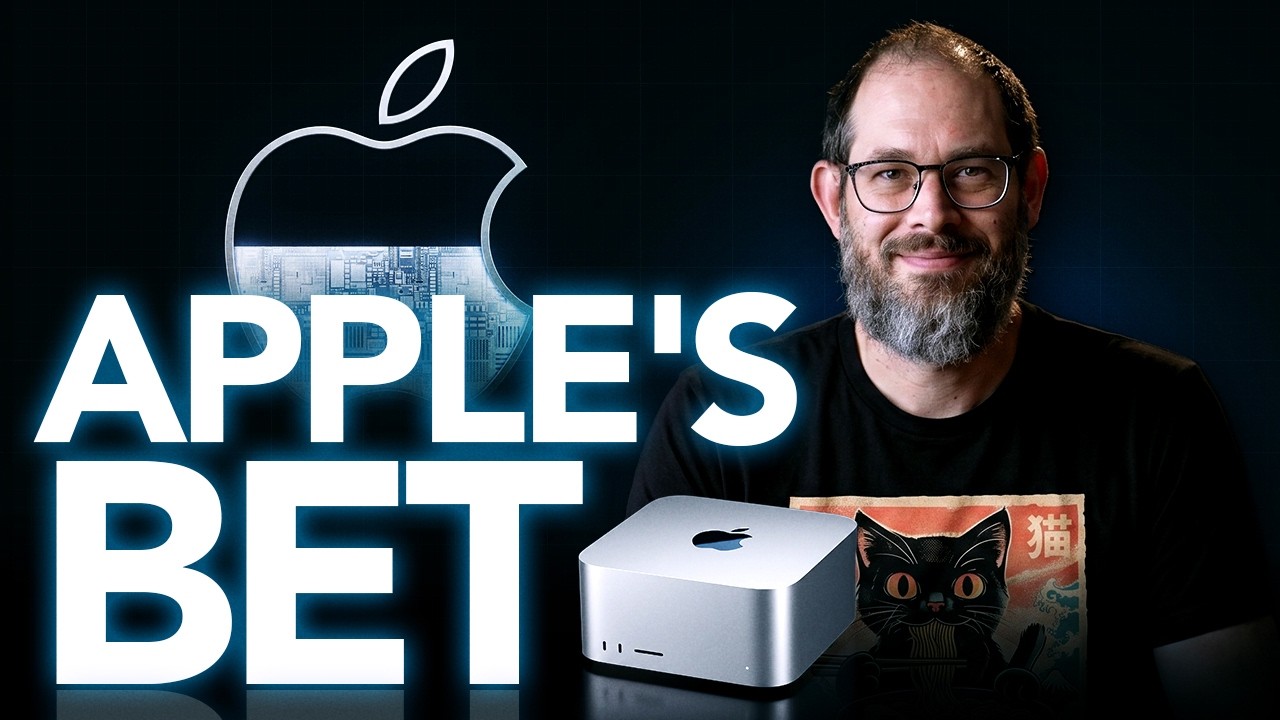
Apple's New Mac Line is Built Around Local AI. The Bet Is You'd Rather Own Than Rent.
Summary
Apple has rebuilt its entire desktop Mac line around local AI capabilities, positioning the hardware as a platform for running agents and large language models (LLMs) on-device. While the launch appears to challenge NVIDIA's dominance in AI compute, the speaker argues that the core decision facing serious AI workers is whether they should 'own' their intelligence via local compute or 'rent' it through persistent cloud services. The hardware provides a memory ladder from Mac Mini (M6/M5 Pro) up to Mac Studio (M5 Ultra, 512 GB), enabling multiple agents and large models locally, but the technical setup for seamless model routing remains an open challenge.
Key takeaways
-
Local AI Compute vs. Cloud Computing
The central debate is whether users should invest in local hardware (owning compute) or rely on persistent cloud services (renting intelligence). The speaker notes that while Apple provides powerful local options, frontier agents are rapidly moving to the cloud for superior context and constant updates.
-
Apple's Hardware Strategy
5:04
The Mac line offers a memory ladder: M6/M5 Pro (Mac Mini) for basic agents, M5 Max (Mac Studio) for larger models, and M5 Ultra up to 512 GB of unified memory. This allows users to run multiple local agents simultaneously.
-
The 'Missing Middle' Bet
20:00
The market is poised for a 'bothand' scenario: investing in local compute (Macs) while also utilizing cloud services when necessary. The challenge lies in creating seamless routing between these two environments.
Technical details
-
Apple Mac Line Specifications
280s
The new line includes M6/M5 Pro (Mac Mini) and M5 Max/Ultra (Mac Studio). Key specs include: M6 version memory range of 16 to 32 GB; M5 Pro reaching 64 GB; M5 Ultra offering up to 512 GB with 1.2 TB/s bandwidth. Apple claims this is sufficient for running large language models entirely on device.
-
Chipset Deployment Anomaly
140s
A 'strange wrinkle' noted by the speaker is that Apple placed the new M6 generation at the bottom of the desktop line, while the more powerful Mini and Studio models still utilize the M5 chipsets (M5 Pro, M5 Max, M5 Ultra).
-
Local Compute Economics
560s
The value proposition is paying a high upfront cost for hardware and electricity, rather than incurring unknown monthly costs per token from cloud services.
Mentioned resources
- HuggingFace
- NVIDIA DGX Spark
Channel & topics
Watch on YouTube · Back to latest
This independent, AI-assisted summary is provided for commentary and informational purposes. It may contain errors or omit important context. Please watch the original video for the creator's complete presentation. Video, thumbnail, and related copyrights belong to their respective owners.