Topic

NVIDIA DGX Spark

All digests tagged NVIDIA DGX Spark

DGX Spark Live: Perplexity Portable Computer Goes Local thumbnail

· 26:37

DGX Spark Live: Perplexity Portable Computer Goes Local

Perplexity introduced Portable Computer, an agent platform designed to run fully on-device using NVIDIA DGX Spark. This system brings complex, multi-step AI workflows—including inference and agent harnessing—to a simple local interface, prioritizing data privacy by keeping sensitive processing offline. While defaulting to local models (like Qwen 27B), the architecture supports controlled escalation to frontier cloud models only when necessary or permitted.

Key takeaways

  1. Local-First AI Architecture 3:42

    Portable Computer runs the entire stack—including agent harness and inference—locally on DGX Spark, eliminating token caps and metered compute for local tasks. This ensures sensitive data (e.g., tax documents) remains fully private [0:03:42].

  2. Simplified Agent Experience 1:58

    The platform abstracts away the underlying complexity of agent harnesses and inference, providing users with a simple interface to execute sophisticated AI tasks without needing deep knowledge of the stack [0:01:58].

  3. Hybrid Scalability 2:36

    While designed for local operation, Portable Computer is 'local first' but can escalate to use frontier cloud models (e.g., Anthropic, OpenAI) and connect via a robust connector ecosystem when required [0:02:37].
Watch on YouTube Full article

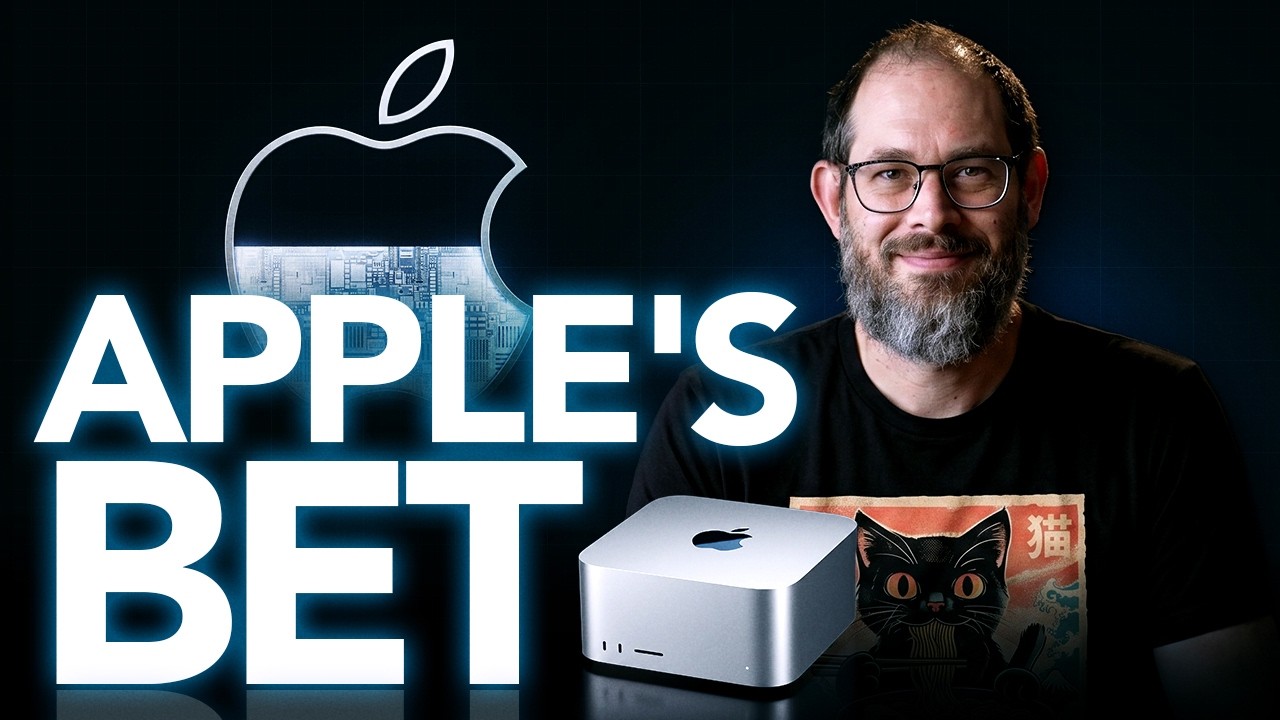
Apple's New Mac Line is Built Around Local AI. The Bet Is You'd Rather Own Than Rent. thumbnail

· 22:33

Apple's New Mac Line is Built Around Local AI. The Bet Is You'd Rather Own Than Rent.

Apple has rebuilt its entire desktop Mac line around local AI capabilities, positioning the hardware as a platform for running agents and large language models (LLMs) on-device. While the launch appears to challenge NVIDIA's dominance in AI compute, the speaker argues that the core decision facing serious AI workers is whether they should 'own' their intelligence via local compute or 'rent' it through persistent cloud services. The hardware provides a memory ladder from Mac Mini (M6/M5 Pro) up to Mac Studio (M5 Ultra, 512 GB), enabling multiple agents and large models locally, but the technical setup for seamless model routing remains an open challenge.

Key takeaways

  1. Local AI Compute vs. Cloud Computing

    The central debate is whether users should invest in local hardware (owning compute) or rely on persistent cloud services (renting intelligence). The speaker notes that while Apple provides powerful local options, frontier agents are rapidly moving to the cloud for superior context and constant updates.

  2. Apple's Hardware Strategy 5:04

    The Mac line offers a memory ladder: M6/M5 Pro (Mac Mini) for basic agents, M5 Max (Mac Studio) for larger models, and M5 Ultra up to 512 GB of unified memory. This allows users to run multiple local agents simultaneously.

  3. The 'Missing Middle' Bet 20:00

    The market is poised for a 'bothand' scenario: investing in local compute (Macs) while also utilizing cloud services when necessary. The challenge lies in creating seamless routing between these two environments.

Watch on YouTube Full article