Topic

AI Infrastructure

All digests tagged AI Infrastructure

Why We Made Jev — Diogo Almeida, TypeSafe Co-founder & CEO thumbnail

· 2:22:22

Why We Made Jev — Diogo Almeida, TypeSafe Co-founder & CEO

The video introduces Jev, a new class of AI model termed 'System One Models,' designed not for chat or general text completion, but for deep integration into software infrastructure. The core thesis is that AI's next wave of value lies in being a machine-native component optimized for 'intelligence per dollar.' The discussion emphasizes moving away from traditional methods like RLHF and public benchmarks, advocating instead for focusing on reliability, structured state, and decomposing complex tasks into small, measurable, and verifiable decisions.

Key takeaways

  1. System One Models (Jev) 18:40

    Jev is designed to be a large programmable model optimized for intelligence per dollar, intended for code consumption rather than text reply. This represents a shift from pre-trained LLMs (autocomplete) or RHF models (chatbot instruction following).

  2. Critique of Current AI Alignment Methods 26:40

    The speaker critiques RLHF (Reinforcement Learning from Human Feedback) and mode collapse, arguing that these methods are often misaligned with the needs of software engineering. He posits that reliability and robustness are more critical than simple determinism.

  3. The Importance of Decomposition 35:00

    To maximize reliability and power, developers should decompose AI workflows into many small, measurable decisions rather than relying on large, single system messages. This approach allows for programmatic verification and bug fixing.

  4. Anti-Benchmarking Stance 40:00

    The speaker argues that public benchmarks are 'extremely gameable' and antithetical to true intelligence. He stresses that long-term value must be measured by how the model performs within a specific, real-world workflow.
Watch on YouTube Full article

Operating Distributed Inference Systems at Scale — Nishant Gupta & Naman Ahuja, Meta thumbnail

· 19:51

Operating Distributed Inference Systems at Scale — Nishant Gupta & Naman Ahuja, Meta

Inference workloads are rapidly becoming foundational, hyperscale infrastructure, outpacing even major microservices. The complexity has shifted from optimizing models or kernels to mastering the orchestration layer—the 'control plane.' This requires treating a request as a distributed transaction, necessitating sophisticated scheduling and reliability mechanisms that account for seven axes (e.g., GPU generation, KV cache state, tenant priority). The core optimization metric must shift from 'cost per token' to 'cost per successful task.'

Key takeaways

  1. Inference as a Distributed Transaction 11:45

    Unlike traditional RPC calls, inference involves multiple network hops (gateway, router, scheduler, runtime) where any step can retry, time out, or fail. Reliability must therefore be managed by the control plane, which sees the entire workflow, especially when partial failures occur (e.g., after streaming 200 tokens).

  2. The Shift to Orchestration 3:50

    The value has moved from simple models to the orchestration layer. The system must manage complex interactions, such as a routing decision changing the cache hit rate, which subsequently affects batch composition and GPU utilization. This coupling is the new complexity.

  3. Optimization Metric: Cost per Successful Task 14:05

    The goal of optimization is not merely minimizing cost per token or per request. The critical metric is 'cost per successful task,' as this reflects the actual value delivered to the user and accounts for retries, failures, and operational overhead.

  4. The Need for a Dedicated Control Plane 17:00

    As inference scales, it requires its own dedicated control plane, analogous to how Kubernetes managed VMs. This plane must manage resources beyond CPU/Memory, including GPU, KV cache, and token limits, to make optimal scheduling and routing decisions.

Watch on YouTube Full article

DGX Spark Live: Perplexity Portable Computer Goes Local thumbnail

· 26:37

DGX Spark Live: Perplexity Portable Computer Goes Local

Perplexity introduced Portable Computer, an agent platform designed to run fully on-device using NVIDIA DGX Spark. This system brings complex, multi-step AI workflows—including inference and agent harnessing—to a simple local interface, prioritizing data privacy by keeping sensitive processing offline. While defaulting to local models (like Qwen 27B), the architecture supports controlled escalation to frontier cloud models only when necessary or permitted.

Key takeaways

  1. Local-First AI Architecture 3:42

    Portable Computer runs the entire stack—including agent harness and inference—locally on DGX Spark, eliminating token caps and metered compute for local tasks. This ensures sensitive data (e.g., tax documents) remains fully private [0:03:42].

  2. Simplified Agent Experience 1:58

    The platform abstracts away the underlying complexity of agent harnesses and inference, providing users with a simple interface to execute sophisticated AI tasks without needing deep knowledge of the stack [0:01:58].

  3. Hybrid Scalability 2:36

    While designed for local operation, Portable Computer is 'local first' but can escalate to use frontier cloud models (e.g., Anthropic, OpenAI) and connect via a robust connector ecosystem when required [0:02:37].

Watch on YouTube Full article

IBM’s mainframe chip collab, NVIDIA’s Poolside deal & Ox Alpha’s reveal thumbnail

· 30:59

IBM’s mainframe chip collab, NVIDIA’s Poolside deal & Ox Alpha’s reveal

The discussion covered major developments in AI infrastructure, focusing on IBM's new dual-architecture mainframe processor combining z/OS and Arm. This aims to bring modern AI workloads closer to mission-critical data residing on mainframes. Furthermore, NVIDIA's strategy was analyzed through its $6 billion deal with Poolside and the acquisition of Hugging Face, positioning NVIDIA as a central player in the open-source AI ecosystem by controlling key software standards. Finally, the reveal of Z.ai’s GLM-5.3-Flash model highlighted the trend toward stealth model releases.

Key takeaways

  1. IBM's Dual-Architecture Mainframe Processor 21:50

    IBM unveiled a new dual processor architecture at Hot Chips that combines IBM Z (mainframe workload) with Arm. This allows systems to run Arm-native Linux workloads alongside z/OS, addressing the challenge of integrating modern AI software into mission-critical mainframe environments.

  2. NVIDIA's Open Ecosystem Strategy 2:00

    NVIDIA is making a strategic play to be the center of open-source AI by acquiring Hugging Face (the cornerstone of open AI software) and securing a $6 billion license deal with Poolside. This solidifies their position in hardware while maintaining an open model ecosystem.

  3. LLM Model Release Tactics 24:30

    The anonymous 'Ox Alpha' model was revealed to be Z.ai’s GLM-5.3-Flash, an open-source LLM built with sparse and linear attention techniques. The discussion noted that stealth launches are a highly effective marketing strategy for generating hype and speculation.

Watch on YouTube Full article

Stripe Paid $7.5 Billion For OpenRouter. You Are Living In The Age Of Startups. thumbnail

· 25:19

Stripe Paid $7.5 Billion For OpenRouter. You Are Living In The Age Of Startups.

Stripe's reported $7.5 billion acquisition of OpenRouter (a company valued at $1.3 billion in May) signals a fundamental shift toward the 'intelligence age.' The speaker argues that this massive investment reflects Stripe's belief that intelligence consumption is becoming a core economic flow, necessitating new infrastructure for agent-to-agent commerce. Key technical shifts include the rapid growth of token volume (doubling every 11 weeks), the rise of agents using APIs and command lines directly, and the need for protocols to manage payments, fraud, and routing across hundreds of AI models.

Key takeaways

  1. Stripe's Strategic Bet on Intelligence

    Stripe paid a reported $7.5 billion for OpenRouter, which provides developers one route to over 400 AI models from 80+ providers. This premium suggests Stripe views intelligence consumption as a critical economic flow requiring ownership of the underlying infrastructure.

  2. The New Moore's Law 6:15

    Token volume is cited as the new metric, with OpenRouter's weekly token volume having grown roughly 24,000x since August 2023 and doubling every 11 weeks. This rapid growth indicates that demand for AI services is outpacing traditional organizational absorption.

  3. The Agent-to-Agent Economy 18:05

    The shift involves agents becoming workers, buyers, and suppliers within a company. Stripe's infrastructure (e.g., Stripe Projects) supports this by handling payments, fraud, and billing for machine interactions, moving beyond the traditional human customer journey.

  4. Singularity as an Economic Event 7:45

    Stripe has set January 1, 2026, as the singularity date. This timing is linked to observed parabolic rises in new firm creation and the explosion of command-line usage by coding agents, suggesting a confluence of business formation and non-human actors entering the system.

Watch on YouTube Full article

Preferences Over Benchmarks: Model Routing — Archana Kamath & Tyler Gillam, DigitalOcean thumbnail

· 15:54

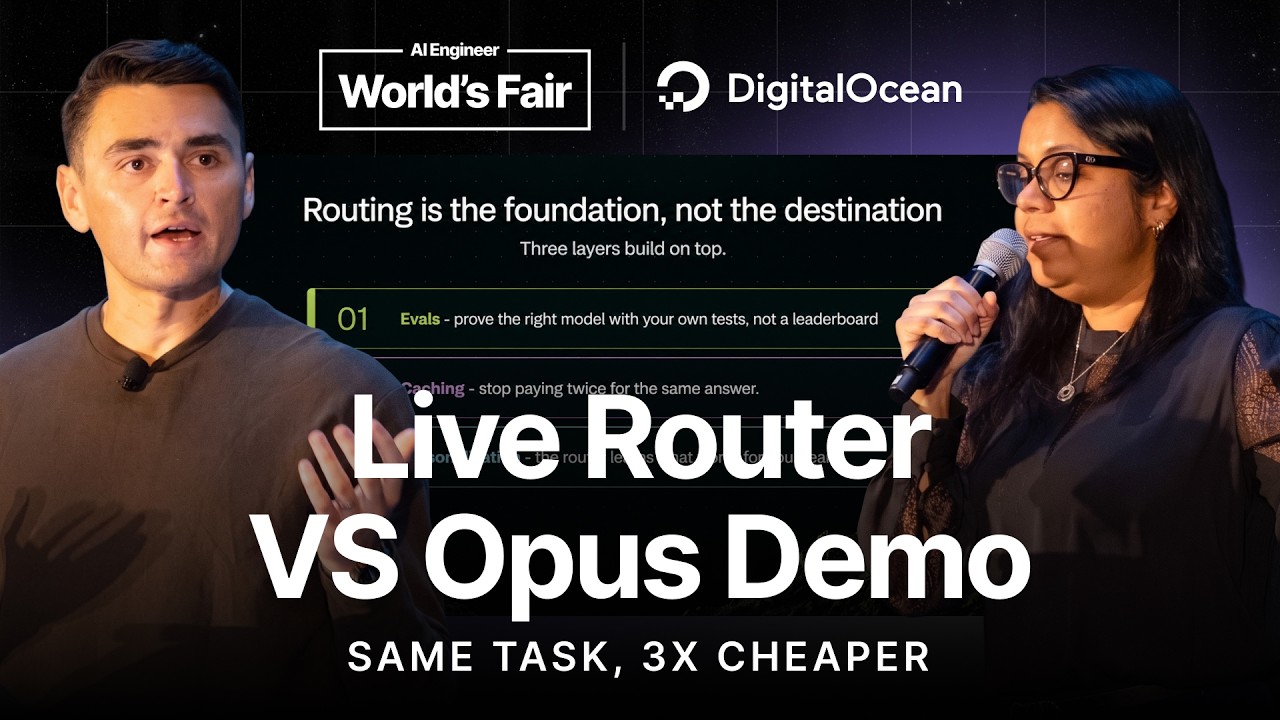
Preferences Over Benchmarks: Model Routing — Archana Kamath & Tyler Gillam, DigitalOcean

The talk argues that relying on public benchmarks to select a single best LLM is flawed; model selection must be based on specific operational preferences. The solution presented is an Inference Router—a purpose-built Mixture of Experts (MoE) model that dynamically selects the optimal LLM for each request based on declared constraints, including task type, cost tolerance, required latency, and system prompts. This approach significantly reduces inference costs and improves performance stability compared to using a single premium model across all tasks.

Key takeaways

  1. Model selection must be preference-driven, not benchmark-driven 4:02

    The 'right' model depends on the specific request context (task, cost, latency) and cannot be determined by a single public leaderboard. For instance, classification may use a small open model for cost efficiency, while code review requires a frontier model for accuracy.

  2. Model orchestration is the new phase of cloud optimization

    Due to exploding inference costs and single-model risk, advanced model orchestration (like routing) is becoming a critical discipline for production applications.

  3. The router optimizes cost and speed per task

    In live demos, the router successfully matched tasks (e.g., code generation, test writing) to specialized models (e.g., GLM 5.2, Claude 3 Sonnet), resulting in significantly lower total session costs (e.g., 8 cents vs. 25 cents) while maintaining comparable quality.

  4. The router is customizable and open-source 5:20

    The solution runs on an open proxy plan and a purpose-built routing model (both open source), allowing users to define custom decision tree rules, set failover policies, and evaluate performance using internal metrics rather than external leaderboards.

Watch on YouTube Full article

Agentic SDLC at Uber — Uday Kiran Medisetty & Adam Huda, Uber thumbnail

· 18:26

Agentic SDLC at Uber — Uday Kiran Medisetty & Adam Huda, Uber

Uber has implemented a comprehensive 'Software Factory' powered by agentic AI to revolutionize its SDLC. Key infrastructure investments include a centralized Model Gateway for security and latency control, an MCP Gateway for token optimization, and a Context Graph that unifies knowledge across disparate systems. These building blocks enable autonomous agents (like Minion) to accelerate development from idea generation (via Cortana) through drafting PRs, validating changes in inner loops (e.g., comparing simulator screenshots against Figma specs), and managing maintenance tasks.

Key takeaways

  1. Agentic Adoption Metrics

    Over the last year, agentic AI led to more than 70% of Uber's Pull Requests (PRs) originating from local or cloud agents, resulting in double the lines of code per engineer year-over-year.

  2. Model Gateway Performance 2:06

    The Model Gateway handles all internal model calls through a single endpoint, ensuring PII redaction for over 20 types and running five specialized safety models under a strict 100 millisecond guardrail budget. It processes over 100 million requests daily across 800+ projects.

  3. Token Optimization 5:51

    The MCP Gateway, combined with projecting MCPS into CLI patterns and using Omni MCP, cut fleetwide token usage by more than 40%.

Watch on YouTube Full article

Infra behind Krea 2: How to train and serve at scale — Gabriel Jorge Menezes, Krea.ai thumbnail

· 16:55

Infra behind Krea 2: How to train and serve at scale — Gabriel Jorge Menezes, Krea.ai

Gabriel Jorge Menezes details the complex infrastructure required to train and serve Krea 2, a diffusion transformer model trained from scratch on thousands of GPUs. The system addresses challenges like silent failures at scale, GPU thermal throttling, and cross-node communication issues by implementing advanced monitoring (tensor core utilization, InfiniBand metrics). For serving, they built a robust architecture using Gang scheduling and Kubernetes features (virtual kubelet, taints/tolerations) to ensure training workloads can utilize the entire cluster while maintaining production uptime through seamless traffic flipping.

Key takeaways

  1. Metrics are essential for large-scale pre-training 9:50

    Do not rely on GPU utilization (which is 'a lie'). Instead, monitor tensor core utilization and collect custom metrics like InfiniBand/NVLink errors, as most failures relate to cross-node communication. [5:58], [6:48]

  2. Embrace failure for stability 4:18

    When scaling training runs, instead of debugging every crash, it is often more efficient to 'let it crash.' The system should be designed to recover and run successfully on the same nodes over extended periods. [4:18]

  3. Checkpointing must be extremely fast 8:29

    To make long training runs survivable, checkpoint aggressively against a high-speed filesystem capable of writing terabytes quickly (e.g., achieving >1 TB/30 seconds). [8:29]

  4. Decouple training and production workloads 11:01

    Use a system that allows high-priority training jobs to utilize the entire cluster while seamlessly migrating inference traffic (production) to external providers or other clusters, ensuring zero downtime. [11:01]

Watch on YouTube Full article

Building an Agentic Video Editor for Mass Consumer — Ekaterina Deyneka, Reelful thumbnail

· 12:45

Building an Agentic Video Editor for Mass Consumer — Ekaterina Deyneka, Reelful

Reelful addresses the complexity of video editing by implementing an agentic workflow that automates content creation from raw footage. The system accepts user media and directional prompts, utilizing a multi-stage pipeline—including Media Understanding, Creative Planning, and execution within a sandboxed environment—to generate polished videos. Architecturally, the process is compared to agentic app building, but with the added complexity of judging optimal cuts and structure from messy, real-world footage.

Key takeaways

  1. Agentic Video Editing Definition 2:09

    The user provides raw media and context/directions (e.g., 'add captions,' 'add music'). The agent then autonomously finds usable moments, assembles the clip, and generates supplementary assets like captions, music, voiceovers, and B-roll.

  2. Architectural Parallelism 5:33

    From an infrastructure standpoint, agentic video editing is structurally similar to agentic app building. Both require a prompt/input (media + prompt for video) and execute within a remote 'sandbox' environment by an agent equipped with tools and skills.

  3. The Challenge of Editing vs. Generating 6:50

    Editing real footage is significantly more complex than generating content from scratch, as the agent must actively judge which moments to keep or omit and organize messy, incomplete material into a polished result.

  4. The Full Agentic Pipeline 8:50

    The process involves: (1) Media Understanding/Transcription $ ightarrow$ (2) Creative Plan generation (for user approval) $ ightarrow$ (3) Sandbox execution by the agent (using skills like cut rules, font pairings, B-roll generation) $ ightarrow$ (4) Remotion composition $ ightarrow$ (5) Verification Layer (to ensure renderability).

Watch on YouTube Full article

How To Turn Evals Into A Better Model thumbnail

· 35:46

How To Turn Evals Into A Better Model

This session details advanced strategies for improving Large Language Model (LLM) performance, arguing that optimizing the evaluation environment (Evals) is often more impactful than immediate fine-tuning. The core components of an eval are the Task Set, the Harness, and the Scoring Function. Furthermore, it provides a deep dive into Reinforcement Learning (RL), outlining its architecture—including inference engines (VLM, SGLang), orchestrators, and trainers—and warning about common pitfalls like reward hacking.

Key takeaways

  1. Prioritize Eval Improvement Over Fine-Tuning 9:39

    Before fine-tuning a model, thoroughly audit the evaluation setup. Improvements can often be found by adjusting sampling parameters (e.g., using temperature > 0), swapping harnesses (like Pi for open-source control), or increasing resource allocation/timeouts. [0:08:19]

  2. Understand the Three Parts of an Eval 5:15

    Every evaluation consists of three parts: the Task Set (data, prompts, tools); the Harness (the program loop driving LLM interaction with an environment); and the Scoring Function/Reward Function (which can be deterministic or use a judge LLM). [0:00:55]

  3. Reinforcement Learning (RL) is for System Improvement 13:24

    RL is a powerful, advanced training algorithm used to improve model capabilities on specific tasks by learning from trial and error. It should be considered the last step after optimizing the eval environment. [0:13:24]

  4. Beware of Reward Hacking 22:24

    RL is highly sensitive to weak or poorly designed evals. Models may learn to optimize for a proxy metric (reward hacking) rather than solving the true underlying task, necessitating careful evaluation design and red teaming. [0:22:24]

Watch on YouTube Full article

NVIDIA Went To Wall Street For $500 Billion. Your Retirement Is In The Deal. thumbnail

· 16:14

NVIDIA Went To Wall Street For $500 Billion. Your Retirement Is In The Deal.

The video analyzes Nvidia's effort to mobilize over $500 billion in third-party capital for global AI infrastructure buildout. While six major financial institutions (Apollo, BlackRock, Blackstone, Brookfield, Goldman Sachs, and KKR) have signed Memoranda of Understanding (MoUs), the speaker clarifies that this does not represent guaranteed funds. The core argument is that financing national-scale AI requires sophisticated financial engineering—similar to historical railroad development—to turn future end-customer demand into immediate capital for physical assets like power, cooling, and racks of accelerators. Key risks include asset concentration, fee incentives, and the uncertain collateral value of GPUs.

Key takeaways

  1. Nvidia's $500B figure is not raised capital

    The announced agreements with Apollo, BlackRock, Blackstone, Brookfield, Goldman Sachs, and KKR are Memoranda of Understanding (MoUs) that remain subject to final execution and investor commitment. The financing mechanism relies on mobilizing third-party capital for AI infrastructure buildout over time.

  2. AI demand is measured by end-customer revenue 5:55

    To accurately gauge market size, one must count the outside customer dollar only once. Exponential View estimates $110 billion in generative AI revenue over the trailing 12 months, with an annualized pace above $175 billion.

  3. GPU-backed debt is entering institutional finance

    The market for financing compute capacity is maturing: CoreWeave recently closed an $8.5 billion loan facility rated A3 by Moody's and A- low by DBRS, marking the first investment-grade financing secured by high-performance computing infrastructure.

  4. Financing requires specialized risk division

    A typical AI data center deal structure involves an equity investor taking the first loss, a lender supplying debt (using equipment as collateral), and potentially limited credit support from the chip provider (e.g., Nvidia providing up to 25% of an opportunity).

Watch on YouTube Full article

Bringing agents onto the world wide web — Paul Klein IV, Browserbase thumbnail

· 18:26

Bringing agents onto the world wide web — Paul Klein IV, Browserbase

The talk argues that the current bottleneck for building reliable web agents is not model capability (AI), but rather the missing engineering infrastructure—the 'harness' and scalable systems. Reliable browser agents must be multimodal, harness-engineered with memory/skills, and operate on consistent, robust infrastructure. The speaker emphasizes that solving this overhang is an engineering problem that companies can tackle today, accelerating AI diffusion into real-world enterprise use cases (e.g., logistics, banking).

Key takeaways

  1. The bottleneck is the harness, not the model. 7:12

    Model capabilities have advanced significantly; therefore, agents struggle due to missing scaffolding and systems around the LLM (the 'harness'). Building a custom harness optimized for a domain can improve results beyond baseline models. (4:32)

  2. Reliable browser agents require three components. 11:45

    They must be multimodal, harness-engineered (using skills and memory), and run on reliable infrastructure that guarantees consistent page rendering across all runs. (7:05)

  3. The web needs to adapt for agents. 17:04

    Key improvements required from the web include better accessibility trees, adoption of Chrome's Web MCP, solving agent login/authentication securely, and establishing a trust framework (a 'Verisign moment') for agents. (10:24)

  4. Infrastructure must be scalable and consistent. 15:09

    Production environments require infrastructure that can handle thousands of agents, maintain consistency (e.g., preventing mobile/desktop layout shifts), and ideally achieve SOC 2 compliance at scale. (9:09)

Watch on YouTube Full article

Keep model costs in check with LangSmith LLM Gateway thumbnail

· 4:33

Keep model costs in check with LangSmith LLM Gateway

The LangSmith LLM Gateway solves critical governance and cost control issues arising from decentralized usage of multiple Large Language Models (LLMs) across an organization. By acting as a single, centralized endpoint between development teams and various model providers (e.g., OpenAI, Anthropic), the gateway enforces real-time spend limits and rate controls before requests are processed. This allows organizations to maintain a live audit trail of token usage, cost, and model access without requiring code changes in existing applications.

Key takeaways

  1. Centralized Cost Governance 0:15

    The Gateway provides a single point of control for enforcing spend limits and rate limits across all connected LLM providers, preventing unexpected cost spikes that occur when multiple teams use various keys and models.

  2. Non-Invasive Integration 0:40

    Implementing the gateway only requires updating the base URL and API key within existing SDKs (Python, TypeScript), meaning developers do not need to modify their application's core request or response handling logic.

  3. Granular Control and Auditability 1:05

    Cost controls can be applied globally for the organization, or granularly by individual API key, user, or workspace. This provides a live audit trail detailing which model, key, and number of tokens were used, replacing reliance on provider invoices.

Watch on YouTube Full article

IBM’s cloud collab, Meta’s Muse Glimmer & OpenAI’s upcoming Astra model thumbnail

· 36:33

IBM’s cloud collab, Meta’s Muse Glimmer & OpenAI’s upcoming Astra model

The discussion covers major shifts in AI infrastructure and model deployment. IBM is partnering with Together AI to build a massive inference cluster on IBM Cloud using NVIDIA's B300 generation chips for open-source models (expected early 2027). Meta released Muse Glimmer, an open, 30B-parameter dense model designed to run locally on consumer GPUs. Finally, OpenAI discussed its upcoming Astra model, which may achieve 'Critical' cybersecurity capabilities, raising significant concerns about zero-day exploit potential and the need for robust security guardrails.

Key takeaways

  1. IBM Cloud AI Cluster Partnership 1:15

    IBM is teaming up with Together AI to launch an inference cluster on IBM Cloud utilizing NVIDIA's B300 generation chips. This aims to provide cheaper, faster access to open-source AI models for enterprises (1:03).

  2. Meta Muse Glimmer Release 11:29

    Meta open-sourced Muse Glimmer, a 30B-parameter dense model optimized to run locally on consumer GPUs (e.g., Mac M3). It is designed for agentic tasks and tool calling without requiring cloud access (11:43).

  3. OpenAI Astra Model Capabilities 22:36

    OpenAI's upcoming Astra model may achieve 'Critical' cybersecurity capability levels, potentially allowing it to find and exploit zero-days. This raises concerns about the speed and scale of cyber warfare using AI (24:10).

Watch on YouTube Full article

40 Trillion Tokens a Day (Yes, More Than OpenAI) | Lin Qiao, CEO of Fireworks thumbnail

· 1:19:05

40 Trillion Tokens a Day (Yes, More Than OpenAI) | Lin Qiao, CEO of Fireworks

The discussion centers on the industry shift from general-purpose AI models (like those from OpenAI/Anthropic) toward specialized intelligence. Lin Qiao of Fireworks argues that true innovation lies in leveraging proprietary, locked-in enterprise data—the 'alpha'—to build customized models. She asserts that this specialization is necessary because generalized models cannot capture a company's unique knowledge or judgment. Technically, the conversation details advanced training methods (SFT, DPO, KTO, RL) and emphasizes platform control, noting that Fireworks achieves bitwise equivalence between training and inference results to ensure maximum quality while optimizing for cost and speed.

Key takeaways

  1. The Rise of Specialized Intelligence 1:08:55

    Lin Qiao argues that the future belongs to specialized intelligence—customized models built on private company data—rather than general-purpose AGI. She believes every company is unique, making it difficult for a single general model to capture proprietary knowledge (41:35).

  2. Fireworks' Scale and Focus 22:16

    Fireworks claims to process over 40 trillion tokens daily, stating that 95% of this traffic comes from customized model inference deployment, not off-the-shelf APIs. This volume surpasses both OpenAI API and Gemini API usage (13:36).

  3. Open vs. Closed Models for Security 1:18:20

    Lin Qiao suggests that open models are better suited to strike a balance in the security debate, encouraging broader community participation to increase defensive complexity against potential cyber threats (47:00).

Watch on YouTube Full article

State of Data — Sean Cai, Independent / State of Data thumbnail

· 18:22

State of Data — Sean Cai, Independent / State of Data

The data market is undergoing a structural shift from relying on sheer quantity of annotated images (the 'least interesting part') to capturing high-quality, process-based expertise. Data's value lies in the trajectory and reasoning trace—not just the final output. The speaker argues that while model improvement requires balancing compute, data, and talent, data remains the most underfunded leg. Successful companies must pivot from being mere 'data businesses' to becoming infrastructure providers (neo-labs) that build robust pipelines into real-world work.

Key takeaways

  1. Data Shift: From State to Process 2:08

    The most valuable data is process-based data—the reasoning trace or sequence of decisions, rather than state-based data (e.g., rows in an ERP). Type one data (pure capture of real workflows like GitHub commits) offers superior realism compared to type two data (contrived examples manufactured by experts).

  2. The Importance of Verifiability 5:50

    A task's ease of training is proportional to its verifiability, which depends on three axes: asymmetry of verification (decomposability into checkable steps), veracity of verification (consensus on what 'correct' means), and proliferation of verification (availability of fresh examples). Coding scored highly because it solved all three.

  3. The Builder's Moat is the Pipeline 13:10

    For data companies, the durable value accrues to the services and application layer of actual work. The true moat for builders is not the raw data itself, but the pipeline into real-world work and the infrastructure required to keep retraining as models improve.

Watch on YouTube Full article

The AI Memory Problem: Why Long Context Isn’t Enough — Dan Biderman, Engram Co-founder & CEO thumbnail

· 49:44

The AI Memory Problem: Why Long Context Isn’t Enough — Dan Biderman, Engram Co-founder & CEO

The talk addresses the limitations of current AI architectures—specifically that simply increasing context window size or relying solely on Retrieval-Augmented Generation (RAG) is insufficient for building truly intelligent, long-horizon agents. Dan Biderman introduces a paradigm shift focusing on 'continual learning' and knowledge compression. Key solutions include using specialized knowledge representations called 'cartridges,' implementing 'test-time training' (or test-time compute), and achieving high token efficiency to enable models to handle the anticipated petabytes of proprietary enterprise data.

Key takeaways

  1. Beyond RAG: The Need for Internalized Knowledge 15:14

    Current methods like RAG are limited because they only provide external, textual context. True intelligence requires embedding knowledge into the model's parameters (weights) to achieve 'intuition,' allowing the model to generalize and extrapolate beyond explicit notes or recipes.

  2. The Problem of Scale: Context Rot and Token Limits 23:30

    As companies accumulate trillions of tokens of proprietary data, simple context management fails due to 'context rot' (the model becoming less accurate the more context it reads) and extreme token consumption. This necessitates methods that are both highly efficient and scalable.

  3. The Solution Stack: Cartridges, Training, and Memory 30:05

    Engram proposes a multi-faceted approach combining knowledge compression via 'cartridges' (compact capsules of knowledge), gradient-based updates during inference ('test-time training'), and advanced memory layers to achieve superior token efficiency and model accuracy.

  4. The Future: Autonomous, Personalized AI

    The ultimate goal is a system where the model autonomously determines what knowledge should be internalized (in weights) versus what should remain external (in text/RAG), creating personalized models that improve continuously with user interaction, similar to nurturing a Tamagotchi.

Watch on YouTube Full article

The Future of AI Infra: from Kubernetes to Agent Sandboxes — Akshat Bubna, Modal CTO thumbnail

· 59:10

The Future of AI Infra: from Kubernetes to Agent Sandboxes — Akshat Bubna, Modal CTO

Modal CTO Akshat Bubna discusses how modern AI workloads—especially those involving agents and elastic inference—exceed the design capabilities of traditional cloud infrastructure like Kubernetes. Modal addresses this by providing a specialized, highly elastic platform built on primitives such as serverless functions, GPU snapshotting, private IPv6 networking, and RDMA support. The discussion highlights a critical shift from optimizing for Developer Experience (DX) to enabling Agent Experience (AX), where the infrastructure must support complex, bursty compute patterns like those found in RL rollouts or custom model deployment across multiple cloud providers.

Key takeaways

  1. Shift from DX to AX 17:33

    Modal is shifting its focus from Developer Experience (DX) to Agent Experience (AX). This shift acknowledges that agents will increasingly operate on infrastructure, making the ability for an agent to self-provision and modify resources via decorators more valuable than manually writing complex YAML files in Kubernetes.

  2. K8s Limitations for AI 4:19

    Traditional orchestration tools like Kubernetes were not designed for highly bursty, compute-heavy workloads common in AI. They struggle with the rapid scaling and specialized resource needs (like accelerators) required by modern models.

  3. Elastic Inference & Autoscaling 21:00

    The platform excels at elastic inference for custom models (e.g., audio, video, robotics). The core challenge is managing unpredictable traffic patterns and scaling rapidly across different regions, a problem Modal addresses through its autoscaling primitives.

  4. Advanced Performance Primitives 27:30

    To achieve frontier-level inference performance, Modal utilizes techniques like speculative decoding (using a smaller 'draft model' to predict tokens ahead of the main model) and DeFlash (a block-based speculator), achieving significant speedups without quality loss.

Watch on YouTube Full article