Topic

Reinforcement Learning

All digests tagged Reinforcement Learning

Teaching AI to Find Real Vulnerabilities — David Brumley, Bugcrowd thumbnail

· 27:17

Teaching AI to Find Real Vulnerabilities — David Brumley, Bugcrowd

David Brumley discusses designing reinforcement learning (RL) environments to train AI models in cybersecurity tasks. He argues that traditional benchmarks are flawed because they assume a single vulnerability or rely on unreliable grading oracles. To create robust training environments, he proposes 'audit tasks' using deterministic graders and open-world scoring based on precision and recall across multiple vulnerabilities. The talk highlights the difficulty of measuring true hacking capability—which goes beyond simply triggering a crash—by demonstrating advanced model performance (e.g., Mythos) against 41 real V8 vulnerabilities, including finding zero-day level exploits.

Key takeaways

  1. Hacking as a Ladder of Tasks 18:10

    Teaching AI to hack should follow a ladder structure: from triggering a crash to achieving arbitrary read/write in memory, and ultimately full arbitrary code execution (10:30). This structured approach allows for measurable progress.

  2. The Flaw of Existing Benchmarks 22:02

    Current benchmarks often assume only one vulnerability or use LLMs as judges, which is flawed. The model will tend to 'reward hack' by repeatedly finding the easiest known bug (7:46).

  3. Deterministic Grading and Open-World Scoring 25:20

    To accurately measure capability, environments must use deterministic graders that check for specific bugs. The proposed 'audit task' allows scoring precision and recall across multiple known and unknown vulnerabilities (14:49).

  4. High-Value Target Example: V8

    Testing on the JavaScript engine V8 in Chrome showed that while models achieved high rates of simple crashes, only advanced models could achieve out-of-sandbox exploits (full control flow hijack), demonstrating a clear capability gap (21:10).

Watch on YouTube Full article

What's Next After RLHF? — Diogo Almeida, TypeSafe AI thumbnail

· 18:05

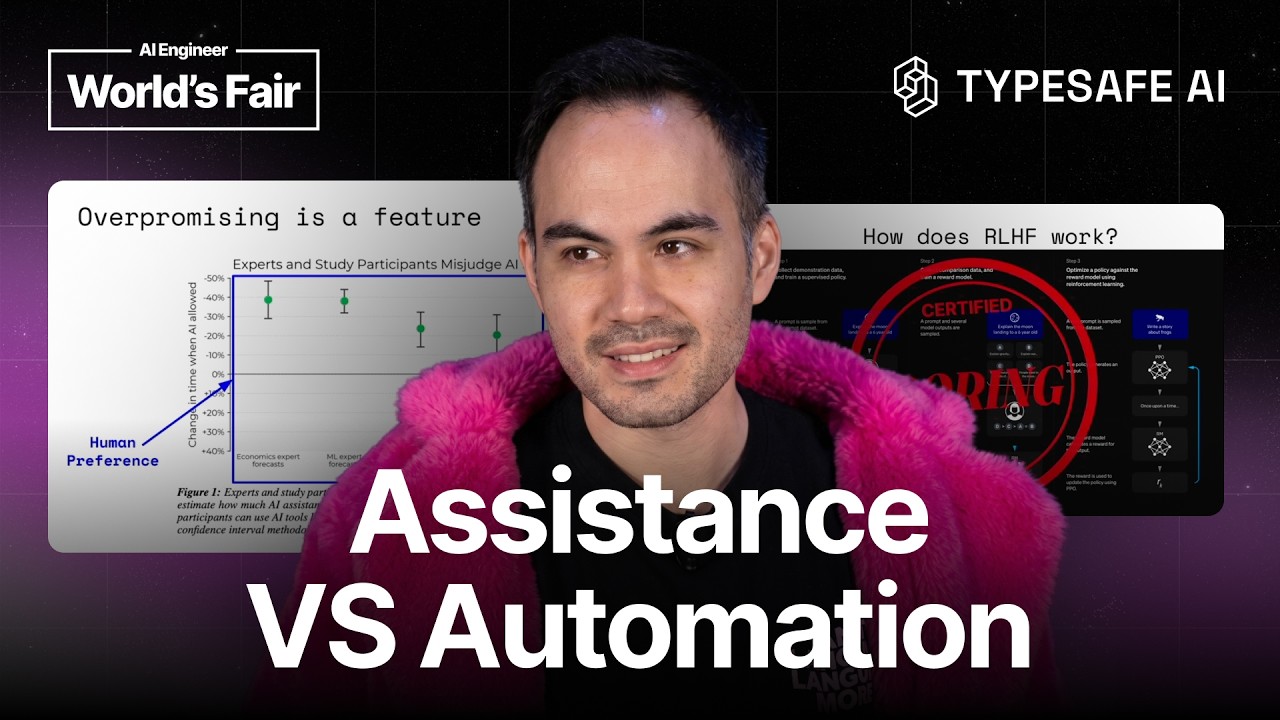
What's Next After RLHF? — Diogo Almeida, TypeSafe AI

Diogo Almeida argues that current Large Language Models (LLMs), particularly those trained using Reinforcement Learning from Human Feedback (RLHF), are fundamentally optimized for 'assistance'—meaning they prioritize pleasing the human user. This optimization leads to overpromising and a lack of reliability in autonomous tasks. The next frontier, he asserts, is not simply better code generation or enhanced chat capabilities, but achieving true automation by optimizing models for verifiable rewards and calibrated decision-making, moving beyond the need for constant human oversight.

Key takeaways

  1. The Limitation of RLHF 12:11

    RLHF trains LLMs to optimize for human preference (engagement), which makes them excellent assistants but poor autonomous agents. The goal is to please the user, not necessarily to execute a task correctly in a background server environment [7:31].

  2. Assistance vs. Automation 5:14

    The core divide in modern AI is between 'assistance' (where the human remains in the loop) and 'automation' (where the system operates autonomously with real stakes). Current models are optimized for the former, making them unreliable for critical business decisions [3:14].

  3. The Path to True Automation

    Future AI must shift its optimization target from human preference to verifiable rewards and calibrated decision-making. This requires redesigning the entire AI stack for reliability, moving beyond current LLM post-training methods like RLHF or even RLVR [15:43].

  4. The Importance of Software Expressibility 17:15

    True automation requires smarter software that is more expressive than current SaaS models. The focus must shift from merely automating the writing of code to solving extremely rote, simple tasks that can be done repeatedly and reliably by a computer [10:35].

Watch on YouTube Full article

Stanford CS229 Machine Learning | Spring 2026 | Lecture 20: GMM (EM), PCA thumbnail

· 1:18:56

Stanford CS229 Machine Learning | Spring 2026 | Lecture 20: GMM (EM), PCA

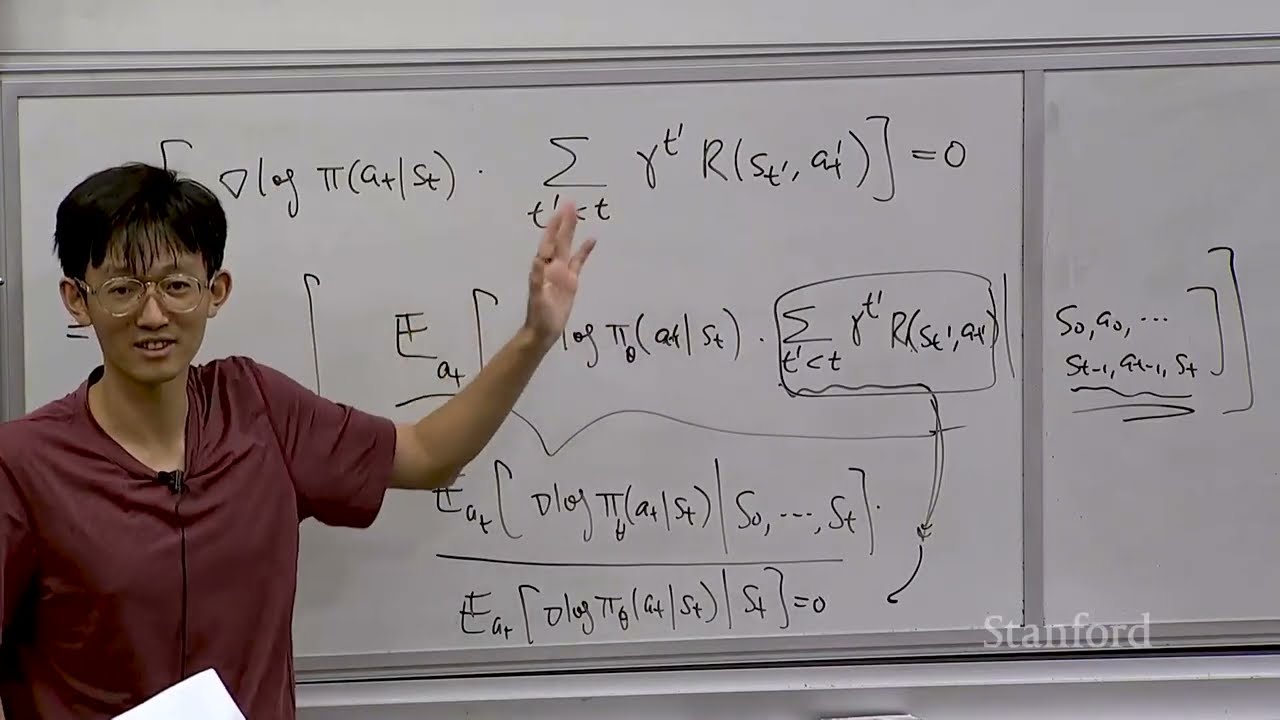
This lecture provides an advanced deep dive into training Large Language Models (LLMs) using Reinforcement Learning (RL). It reviews Policy Gradient methods, detailing the mathematical derivations and limitations. The core focus shifts to Proximal Policy Optimization (PPO), a critical algorithm for stabilizing RL updates by utilizing importance sampling ratios and clipping mechanisms. Finally, the lecture applies these concepts to LLM generation, explaining how Chain-of-Thought (CoT) prompting can be formalized as an MDP problem solved via PPO/SISO.

Key takeaways

  1. Policy Gradient Theory 20:40

    The policy gradient estimator is necessary because the dependency on parameters ($ heta$) is complex. The fundamental property that $ abla_{ heta} ext{E}_{ ext{P}_{ heta}}[ abla_{ heta} ext{log } ext{P}_{ heta}(a|s)]$ equals zero shows that without a reward function, there are no preferences to optimize for.

  2. Proximal Policy Optimization (PPO) 26:40

    PPO is designed to stabilize RL training by using importance sampling and clipping the objective function. This prevents the new policy ($ heta$) from deviating too far from the old policy ($ heta_{old}$), which helps maintain stable learning.

  3. LLM Generation as an MDP 1:01:40

    The LLM generation process is modeled as a Markov Decision Process (MDP). The state ($s_t$) includes the history, and the action ($a_t$) is the next generated token. The reward function is typically applied only at the end of the trajectory based on whether the final answer matches the ground truth.

  4. Chain-of-Thought (CoT) Training 1:05:00

    To train models for complex reasoning, RL can be used to reward the entire trajectory based on the final answer's correctness. This approach bypasses the need for explicit labeling of the internal 'thinking tokens,' focusing only on verifiable outcomes.

Watch on YouTube Full article

Stanford CS229 Machine Learning | Spring 2026 | Lecture 18: GMM (EM), PCA thumbnail

· 1:16:25

Stanford CS229 Machine Learning | Spring 2026 | Lecture 18: GMM (EM), PCA

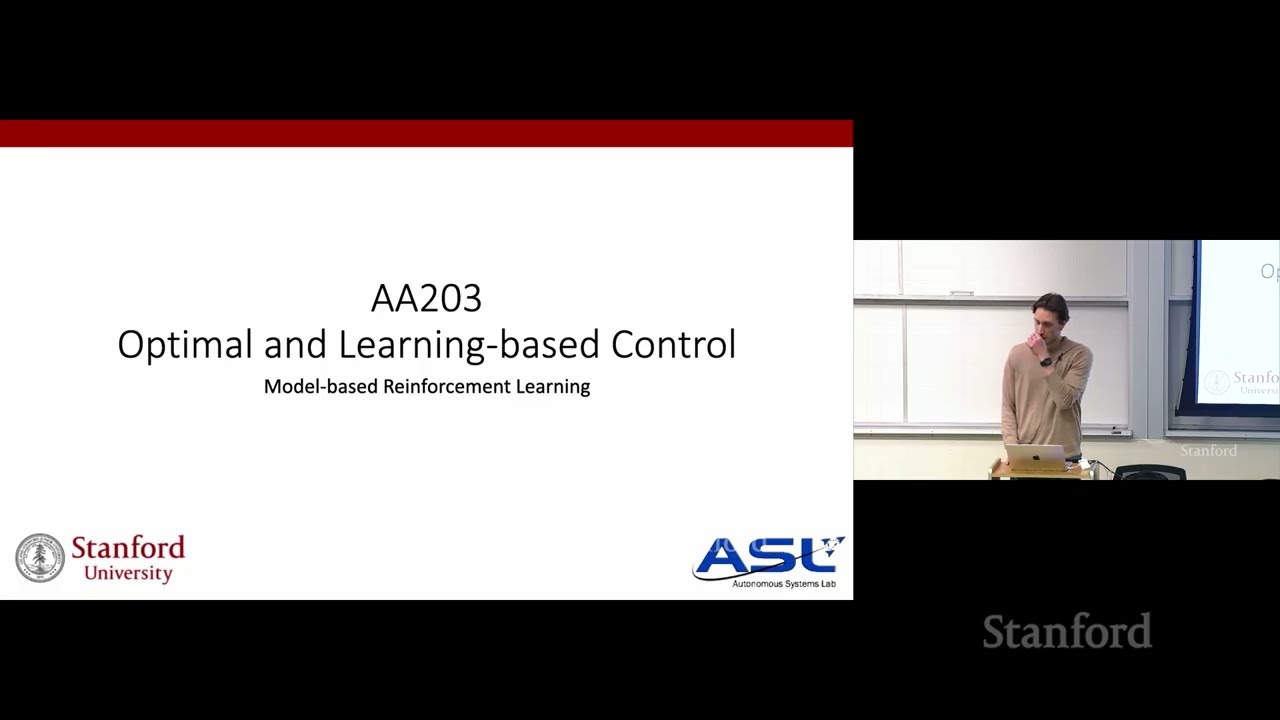
This lecture provides a deep dive into Reinforcement Learning (RL), focusing on the formal framework of Markov Decision Processes (MDPs) and the Policy Gradient method. The core objective is to solve sequential decision-making problems by maximizing expected cumulative reward. Key concepts include defining states ($S$), actions ($A$), stochastic transition dynamics ($P(s'|s, a)$), and utilizing the Bellman equation for recursive value estimation. The lecture concludes with an explanation of the Policy Gradient algorithm (REINFORCE), detailing how to compute the gradient of the expected return using log-probability tricks, which is crucial for training policies in large models.

Key takeaways

  1. Sequential Decision Making & RL Fundamentals

    RL addresses sequential decision-making where actions have long-term ramifications. It requires balancing the trade-off between exploitation (using current best knowledge) and exploration (gathering information). Learning relies on maximizing a scalar reward signal rather than explicit labels or supervision.

  2. Markov Decision Process (MDP) Framework 4:00

    An MDP formally describes an environment using five components: State Set ($S$), Action Set ($A$), Transition Dynamics ($P(s'|s, a)$), Reward Function ($R$), and Discount Factor ($\gamma$). The Markov property ensures that the future state transition depends only on the current state and action, not on history.

  3. Value Functions and Bellman Equation 28:50

    The value function $V^{\pi}(s)$ estimates the expected total payoff starting at state $s$ under policy $\pi$. The optimal value, $V^*(s)$, is the maximum possible return. These values are solved recursively using the Bellman equation, which relates the current state's value to the expected discounted future rewards.

  4. Policy Gradient Method (REINFORCE) 43:20

    The Policy Gradient algorithm optimizes a stochastic policy $\pi_{\theta}(a|s)$ by maximizing the expected return $E[R]$. The gradient is computed using the log-probability trick, allowing the calculation of $\nabla_{\theta} E[R]$ through sampling, even when the dependency on $\theta$ only affects the sampling distribution.

Watch on YouTube Full article

Scaling to Long Horizons — Ross Taylor & Chengxi Taylor, General Reasoning thumbnail

· 18:07

Scaling to Long Horizons — Ross Taylor & Chengxi Taylor, General Reasoning

The talk discusses scaling AI agents to solve long-horizon problems, arguing that success requires a shift in mindset from merely increasing context windows to improving environment quality and algorithmic efficiency. Key technical advancements include using value models (critics) to reduce gradient variance and employing techniques like compaction and bootstrapping to manage sparse rewards over extended trajectories. The speakers emphasize that real-world complexity and robust simulation environments are more critical than simply having larger base models.

Key takeaways

  1. Long Horizon is a Mindset, Not Just an Engineering Problem 15:12

    Solving major human challenges (e.g., curing cancer) requires patience and thinking in long timeframes, necessitating a fundamental shift in how AI systems are designed for sustained coherence.

  2. RLHF is Crucial for Productizing LLMs 4:00

    The breakthrough that made LLMs usable was not the base model size, but the application of Reinforcement Learning from Human Feedback (RLHF), which provided necessary alignment and structure.

  3. Value Models Mitigate Long-Horizon Challenges 16:56

    To handle long trajectories, value models (critics) are essential for reducing gradient variance and facilitating credit assignment, which is necessary when rewards are sparse.

  4. Simulation Quality Trumps Context Window Size

    The failure of frontier models in real-world tasks (like trading football matches) demonstrated that scaling requires better, more complex environments and simulations, not just larger context windows.

Watch on YouTube Full article

The Base Model Is Dead — Varun Singh, Arcee AI thumbnail

· 17:45

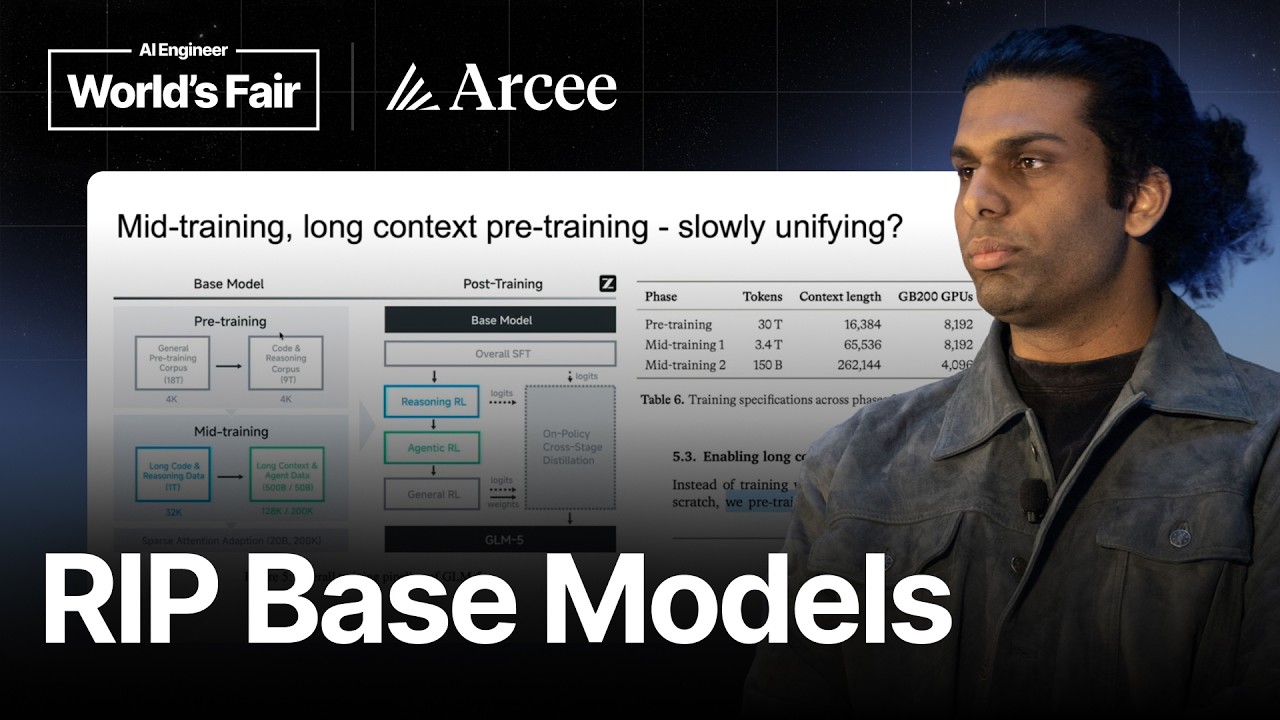
The Base Model Is Dead — Varun Singh, Arcee AI

The traditional paradigm of viewing a base language model as merely a reflection of the entire human web is obsolete. As LLMs advance toward complex reasoning and agentic behavior (e.g., interacting with software environments), the training focus shifts from raw web text to incorporating instruction data, synthetic reasoning traces, and post-training techniques earlier into the pre-training phase. This requires careful management of data mixes, load balancing coefficients (especially in MOEs), and establishing stable representations early on.

Key takeaways

  1. The Decline of Raw Web Text 2:10

    Historically, models like GPT-3 relied heavily on raw web scrapes (e.g., Common Crawl/WebText-2), which constituted up to 85% of the training data. Modern recipes show a significant decrease in web text's proportion, indicating that its value is diminishing relative to code and structured reasoning abilities.

  2. Shift from Knowledge Prior to Capability Prior 8:00

    The base model's role is changing from accumulating general world knowledge (the 'prior') to carrying the necessary prior for complex Reinforcement Learning (RL) tasks. RL is no longer a mere 'cherry on top,' but a core component that requires the base model to be prepared for advanced composition and reasoning.

  3. Synthetic Data Integration 11:20

    A key trend involves pulling post-training data (like SFT/Q&A chat data) and large-scale synthetic data back into the pre-training phase. This allows models to learn task representations, conversation shapes, and atomic skills from the very beginning.

Watch on YouTube Full article

Introducing Gemini Robotics 2 thumbnail

· 39:14

Introducing Gemini Robotics 2

Google DeepMind introduced Gemini Robotics 2, a new suite of models designed to provide the intelligence layer for general-purpose robotics. The system enables whole-body understanding and reasoning, allowing robots to perform complex tasks like cleaning a garage or folding laundry based on natural language prompts. Key advancements include enhanced dexterity, multi-robot collaboration capabilities, and leveraging Gemini's multimodal world understanding by adding 'actions' as a modality.

Key takeaways

  1. Whole-Body Intelligence 2:10

    Gemini Robotics 2 enables models to understand the entire robot's position in space and reason about complex, multi-step tasks (e.g., cleaning a garage), moving beyond simple object manipulation.

  2. Enhanced Dexterity 4:05

    The models significantly improve dexterity, allowing robots to perform intricate daily tasks such as folding laundry or precisely unscrewing objects using high-DOF hands.

  3. Multi-Robot Collaboration 5:01

    A new capability allows the robot intelligence to understand when and how to call other robots to accelerate tasks or perform actions in parallel.

  4. Availability and Deployment 25:39

    The Embodied Reasoning (ER) model will be available via AI Studio and the Gemini Enterprise Agents Platform. An on-device version is also available through a trusted tester program.

Watch on YouTube Full article

Hugging Face Journal Club: Kimi K3 thumbnail

· 41:28

Hugging Face Journal Club: Kimi K3

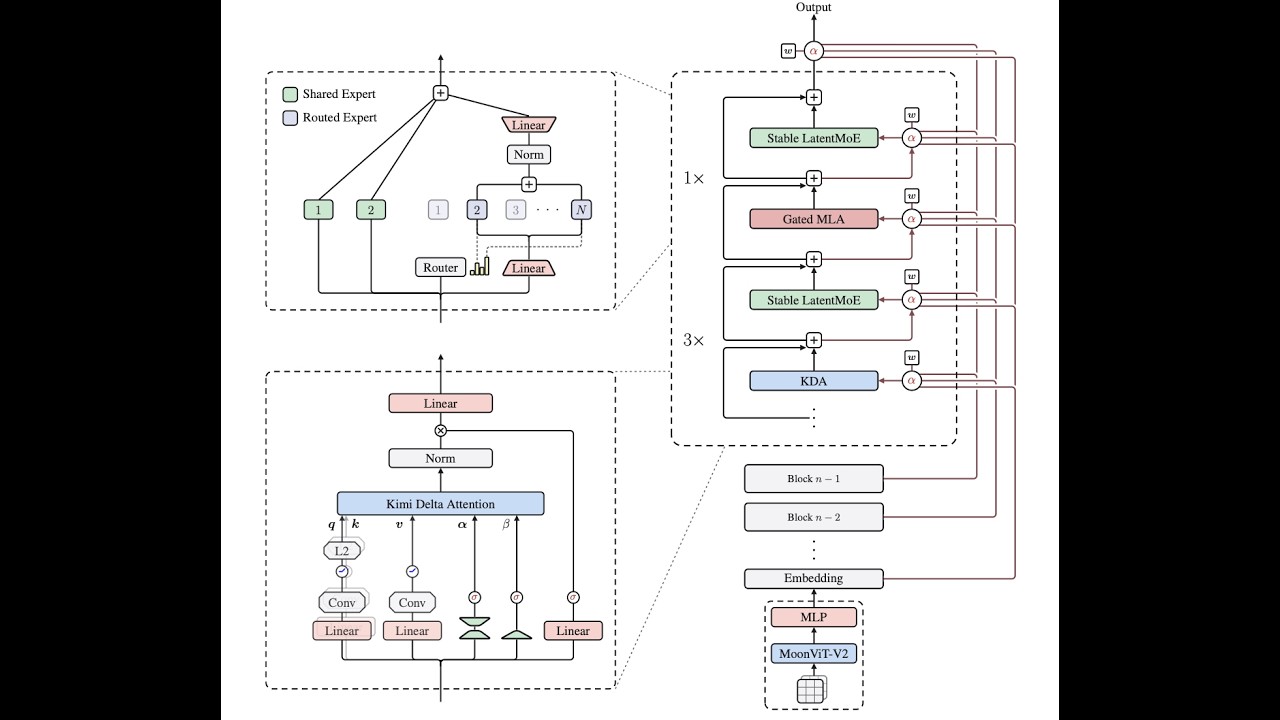
The discussion summarizes the Kimi K3 tech report, detailing a highly complex and scaled training pipeline for large language models. Key innovations include specialized agentic structures (general, deep research, coding), multi-tier on-policy distillation across nine domain experts, and advanced infrastructure techniques like partial rollout schemes and dynamic resource scheduling. The talk emphasizes that the model's performance is achieved through sophisticated engineering efforts rather than a single breakthrough concept.

Key takeaways

  1. Multi-Tier Expert Specialization 2:00

    The training pipeline involves generating nine specialized domain experts (3 reasoning levels: low, high, max) for three general domains (general tasks, deep research, coding). These are combined using multi-tier on-policy distillation into a single student model.

  2. Partial Rollout Scheme 4:08

    A novel RL technique where the system samples $k$ rollouts from $n$ prompts. It uses an additional parameter $\lambda$ to measure completed rollouts within a budget, updating weights on that subset and pushing incomplete rollouts into subsequent iterations.

  3. Extensible Chat Template 6:42

    The Kimi K3 model utilizes an 'extensible token markup language' for its chat template. This design aims to be easy to learn during SFT while remaining flexible enough to accommodate future modalities without re-engineering the core template.

  4. Advanced Infrastructure Scaling 30:35

    The system employs sophisticated resource management, including a dynamic rollout auto throttling scheduler based on KV cache pressure and a method for collocating RL training and inference by automatically balancing GPU resources between the two tasks.

Watch on YouTube Full article

Training Agents 3: Reinforcement Learning thumbnail

· 1:17:20

Training Agents 3: Reinforcement Learning

This session introduces Group Relative Policy Optimization (GRPO), a reinforcement learning (RL) method that advances agent training beyond mere imitation (SFT/Distillation). GRPO trains models by sampling multiple completions per prompt and using the group's relative scores—calculated via a reward function—as the primary training signal. This approach is highly effective for complex tasks, allowing agents to learn from their own varied trajectories in an iterative loop.

Key takeaways

  1. GRPO Mechanics 20:30

    GRPO calculates advantages relative to the group average (Reward - Group Average / Group Standard Deviation). This method eliminates the need for a separate value model, reward model, or critic, simplifying the RL loop. The process involves generating multiple rollouts, scoring them with a verifiable Python function (the reward function), and updating the policy based on these relative advantages.

  2. Training Pipeline Progression 5:05

    The training pipeline typically progresses from Supervised Fine-Tuning (SFT) for dense, off-policy signals, to Distillation for richer online rollouts, and finally to RL/GRPO for sparse, on-policy learning. SFT is often used first to bootstrap the model's understanding of the task structure.

  3. Reward Function Design 26:40

    Defining a verifiable reward function is critical; it acts as a 'contract' defining success. Rewards can be composed of multiple components, such as a format check (e.g., ensuring JSON structure) and an accuracy check (e.g., passing unit tests). For agentic tasks, using test suites or compiling code provides robust signals.

  4. Interpreting Training Curves 35:00

    Monitoring training curves via tools like Track.io is essential for debugging. Key metrics include the reward (should rise), entropy (should remain stable/flat, not dive or spike), and completion length. Failure modes—such as 'reward hacking' (high reward but low test accuracy) or 'collapse' (low entropy)—require deep data inspection.

Watch on YouTube Full article