Topic

Policy Optimization

All digests tagged Policy Optimization

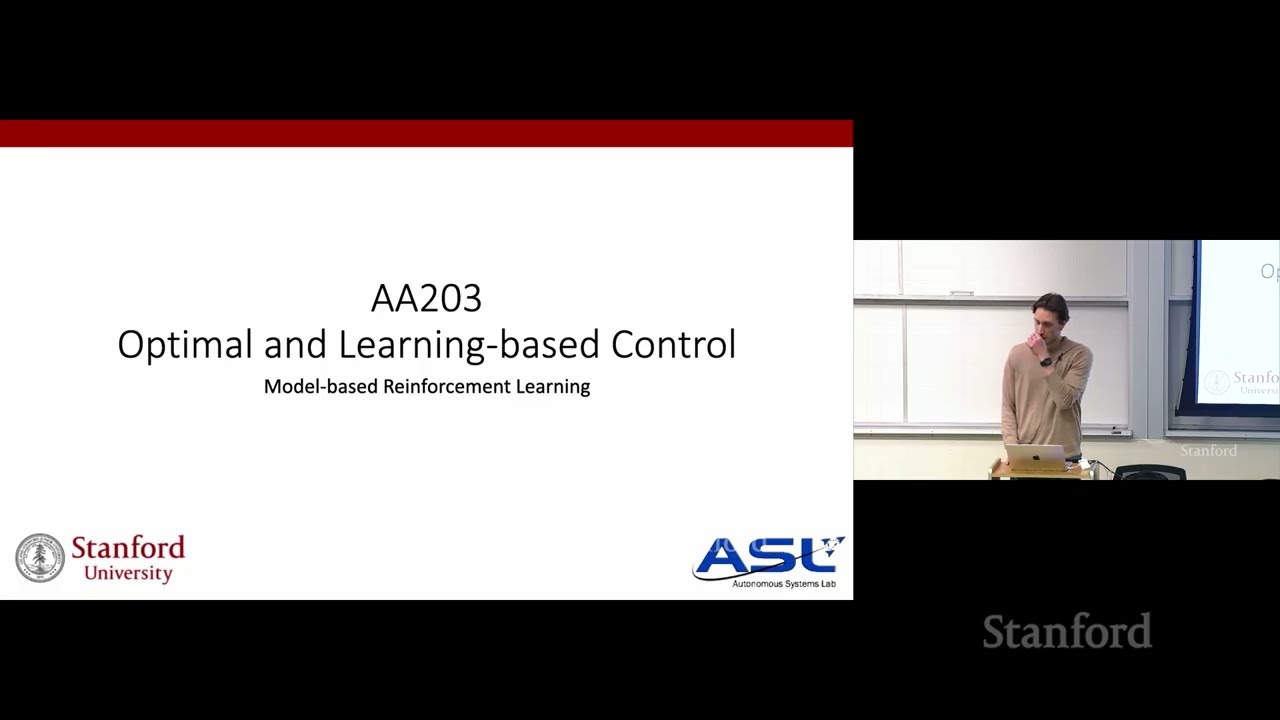
Stanford AA203 Optimal and Learning-Based Control | Spring 2026 | Lecture 19: Model-Based RL thumbnail

· 1:21:50

Stanford AA203 Optimal and Learning-Based Control | Spring 2026 | Lecture 19: Model-Based RL

This lecture reviews advanced topics in Reinforcement Learning (RL), transitioning from model-free policy optimization methods (TRPO/PPO) to the critical challenges of Model-Based RL. The core focus is addressing model uncertainty when using learned dynamics for planning. Techniques such as Bayesian statistics, Gaussian Processes (GPs), and Ensembles are introduced to quantify epistemic uncertainty, allowing planners to compute expected rewards by averaging predictions over a posterior distribution of possible models.

Key takeaways

  1. PPO/TRPO for Policy Optimization 16:15

    Policy optimization methods (like TRPO and PPO) define a surrogate objective function to estimate the policy gradient, enabling continuous updates. PPO uses a clipped ratio ($ ext{clip}(r_{ heta}, 1- ext{eps}, 1+ ext{eps})$) to constrain the new policy's divergence from the old one, stabilizing training without requiring complex second-order optimization.

  2. Model-Based RL Limitations 25:00

    The basic model-based recipe (collect data $ ightarrow$ fit dynamics $P(s'|s, a)$ $ ightarrow$ plan) fails when dealing with complex or nonlinear dynamics because extrapolation outside the observed state distribution is unreliable. This issue of generalization and distribution shift must be addressed.

  3. Quantifying Model Uncertainty 35:00

    To improve model-based planning, uncertainty quantification is necessary. The distinction between Aleatoric (inherent noise) and Epistemic (model uncertainty) is crucial. Bayesian approaches treat this by modeling the posterior distribution over parameters ($ heta$), allowing for prediction averaging across all plausible models.

  4. Ensemble Methods for Uncertainty 46:40

    A practical approach to estimate model uncertainty is using ensembles: training multiple independent neural network copies. The average of their predictions approximates the predictive posterior distribution, effectively exploring multimodal solution landscapes without requiring complex analytical derivations.

Watch on YouTube Full article

Training Agents 3: Reinforcement Learning thumbnail

· 1:17:20

Training Agents 3: Reinforcement Learning

This session introduces Group Relative Policy Optimization (GRPO), a reinforcement learning (RL) method that advances agent training beyond mere imitation (SFT/Distillation). GRPO trains models by sampling multiple completions per prompt and using the group's relative scores—calculated via a reward function—as the primary training signal. This approach is highly effective for complex tasks, allowing agents to learn from their own varied trajectories in an iterative loop.

Key takeaways

  1. GRPO Mechanics 20:30

    GRPO calculates advantages relative to the group average (Reward - Group Average / Group Standard Deviation). This method eliminates the need for a separate value model, reward model, or critic, simplifying the RL loop. The process involves generating multiple rollouts, scoring them with a verifiable Python function (the reward function), and updating the policy based on these relative advantages.

  2. Training Pipeline Progression 5:05

    The training pipeline typically progresses from Supervised Fine-Tuning (SFT) for dense, off-policy signals, to Distillation for richer online rollouts, and finally to RL/GRPO for sparse, on-policy learning. SFT is often used first to bootstrap the model's understanding of the task structure.

  3. Reward Function Design 26:40

    Defining a verifiable reward function is critical; it acts as a 'contract' defining success. Rewards can be composed of multiple components, such as a format check (e.g., ensuring JSON structure) and an accuracy check (e.g., passing unit tests). For agentic tasks, using test suites or compiling code provides robust signals.

  4. Interpreting Training Curves 35:00

    Monitoring training curves via tools like Track.io is essential for debugging. Key metrics include the reward (should rise), entropy (should remain stable/flat, not dive or spike), and completion length. Failure modes—such as 'reward hacking' (high reward but low test accuracy) or 'collapse' (low entropy)—require deep data inspection.

Watch on YouTube Full article