Topic

Bayesian Inference

All digests tagged Bayesian Inference

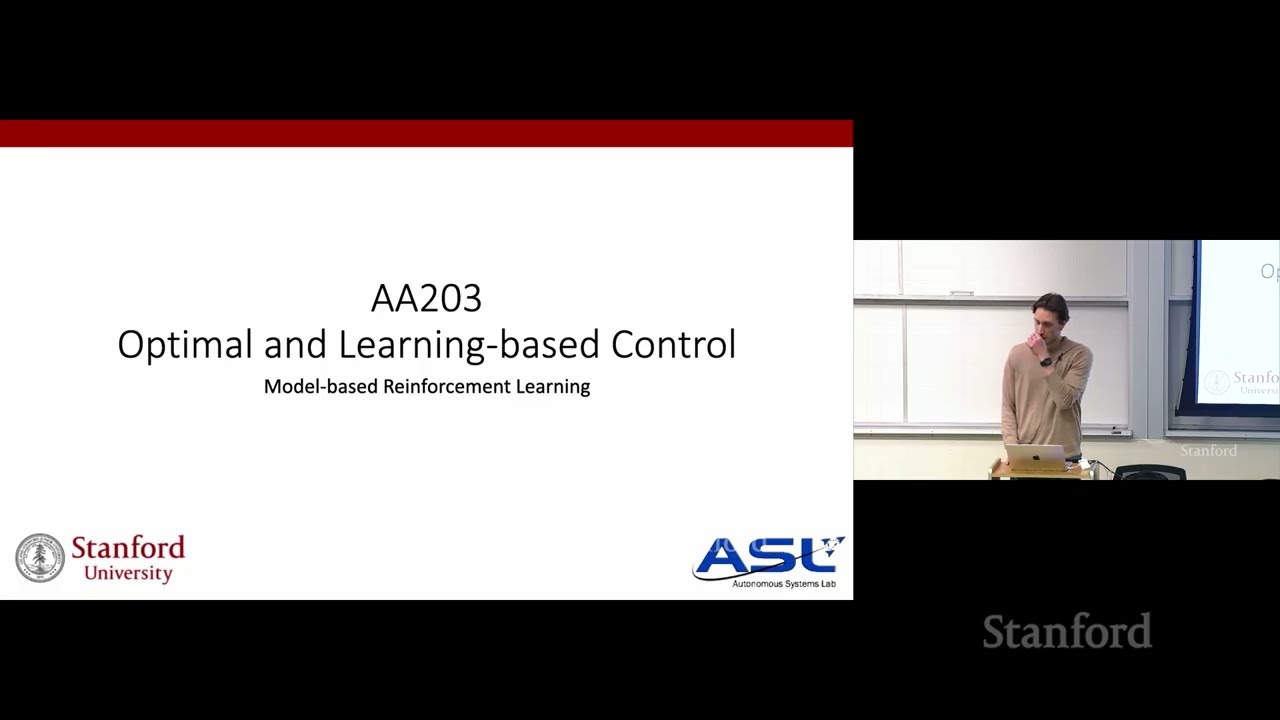
Stanford AA203 Optimal and Learning-Based Control | Spring 2026 | Lecture 19: Model-Based RL thumbnail

· 1:21:50

Stanford AA203 Optimal and Learning-Based Control | Spring 2026 | Lecture 19: Model-Based RL

This lecture reviews advanced topics in Reinforcement Learning (RL), transitioning from model-free policy optimization methods (TRPO/PPO) to the critical challenges of Model-Based RL. The core focus is addressing model uncertainty when using learned dynamics for planning. Techniques such as Bayesian statistics, Gaussian Processes (GPs), and Ensembles are introduced to quantify epistemic uncertainty, allowing planners to compute expected rewards by averaging predictions over a posterior distribution of possible models.

Key takeaways

  1. PPO/TRPO for Policy Optimization 16:15

    Policy optimization methods (like TRPO and PPO) define a surrogate objective function to estimate the policy gradient, enabling continuous updates. PPO uses a clipped ratio ($ ext{clip}(r_{ heta}, 1- ext{eps}, 1+ ext{eps})$) to constrain the new policy's divergence from the old one, stabilizing training without requiring complex second-order optimization.

  2. Model-Based RL Limitations 25:00

    The basic model-based recipe (collect data $ ightarrow$ fit dynamics $P(s'|s, a)$ $ ightarrow$ plan) fails when dealing with complex or nonlinear dynamics because extrapolation outside the observed state distribution is unreliable. This issue of generalization and distribution shift must be addressed.

  3. Quantifying Model Uncertainty 35:00

    To improve model-based planning, uncertainty quantification is necessary. The distinction between Aleatoric (inherent noise) and Epistemic (model uncertainty) is crucial. Bayesian approaches treat this by modeling the posterior distribution over parameters ($ heta$), allowing for prediction averaging across all plausible models.

  4. Ensemble Methods for Uncertainty 46:40

    A practical approach to estimate model uncertainty is using ensembles: training multiple independent neural network copies. The average of their predictions approximates the predictive posterior distribution, effectively exploring multimodal solution landscapes without requiring complex analytical derivations.

Watch on YouTube Full article

Stanford CS547 HCI Seminar | Spring 2026 | Promoting Agency in Human-AI Interaction thumbnail

· 44:21

Stanford CS547 HCI Seminar | Spring 2026 | Promoting Agency in Human-AI Interaction

This seminar explores designing AI systems that promote user agency when LLMs are used as personal advisers (coaches/counselors), rather than mere assistants. The core thesis is that successful health behavior change requires systems to elicit qualitative context and navigate uncertainty to provide non-prescriptive support. Practical implementations, such as the GPT coach chatbot and the Bloom iOS application, demonstrate how integrating motivational interviewing strategies with wearable data can improve user mindset and sense of control. Algorithmically, the work proposes 'zero-shot Bayesian Adaptive Planning' using LLMs to strategically balance asking informative questions versus acting on known information by modeling latent uncertainty over the user's state.

Key takeaways

  1. Shift from Assistant to Adviser 2:00

    LLM usage is shifting toward deeply personal advice (e.g., health, relationships), requiring a design paradigm that augments the user rather than automating tasks. This necessitates non-prescriptive support.

  2. The Role of Qualitative Context 4:00

    Effective coaching relies on eliciting qualitative context (goals, values, motivations) over quantitative data (step count, heart rate). This aligns with principles from Motivational Interviewing.

  3. GPT coach Implementation 8:10

    The GPT coach chatbot uses three prompt chains—Dialogue State Chain, Motivational Interviewing Chain, and Tool Use Chain—to integrate qualitative coaching strategies with quantitative data from the Apple Health Kit API.

  4. Algorithmic Solution: Bayesian Adaptive Planning 17:55

    To improve strategic decision-making, the proposed algorithm uses Reinforcement Learning (RL) theory to model latent uncertainty ($ heta$) over the user's state. The agent must learn to strategically trade off asking informative questions against acting on current knowledge.

Watch on YouTube Full article