Topic

Evaluation Design

All digests tagged Evaluation Design

How To Turn Evals Into A Better Model thumbnail

· 35:46

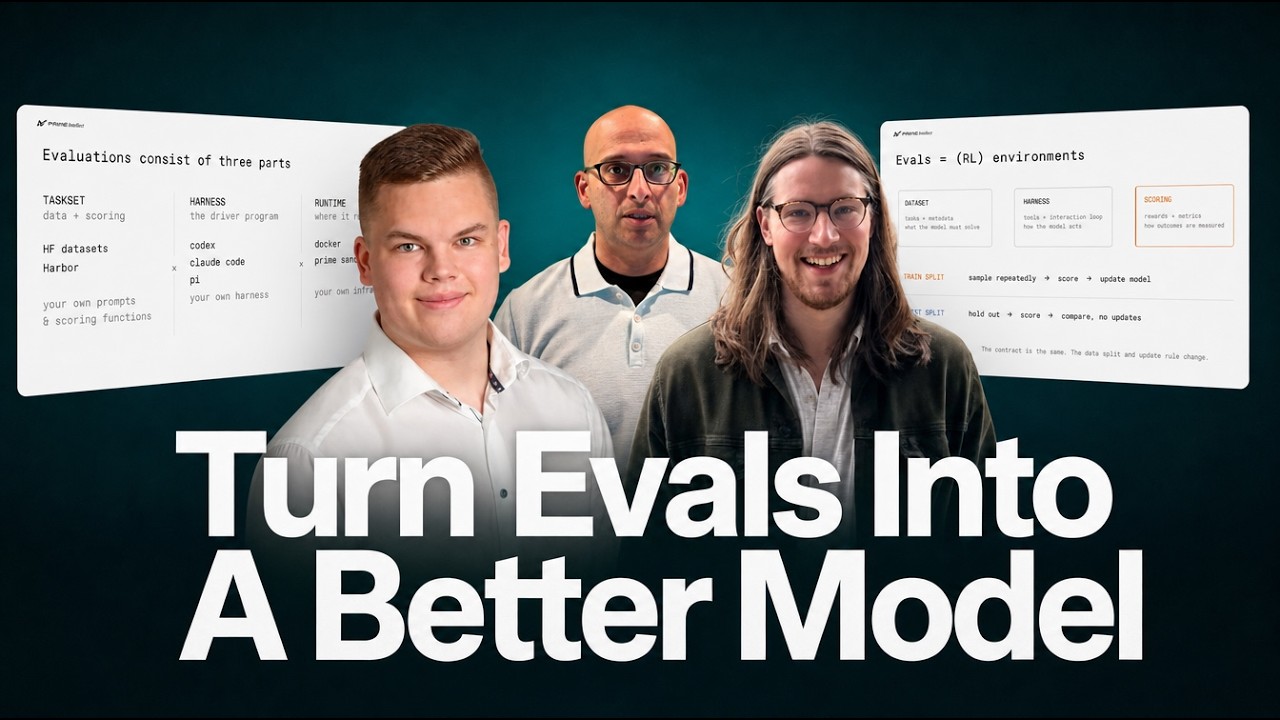
How To Turn Evals Into A Better Model

This session details advanced strategies for improving Large Language Model (LLM) performance, arguing that optimizing the evaluation environment (Evals) is often more impactful than immediate fine-tuning. The core components of an eval are the Task Set, the Harness, and the Scoring Function. Furthermore, it provides a deep dive into Reinforcement Learning (RL), outlining its architecture—including inference engines (VLM, SGLang), orchestrators, and trainers—and warning about common pitfalls like reward hacking.

Key takeaways

  1. Prioritize Eval Improvement Over Fine-Tuning 9:39

    Before fine-tuning a model, thoroughly audit the evaluation setup. Improvements can often be found by adjusting sampling parameters (e.g., using temperature > 0), swapping harnesses (like Pi for open-source control), or increasing resource allocation/timeouts. [0:08:19]

  2. Understand the Three Parts of an Eval 5:15

    Every evaluation consists of three parts: the Task Set (data, prompts, tools); the Harness (the program loop driving LLM interaction with an environment); and the Scoring Function/Reward Function (which can be deterministic or use a judge LLM). [0:00:55]

  3. Reinforcement Learning (RL) is for System Improvement 13:24

    RL is a powerful, advanced training algorithm used to improve model capabilities on specific tasks by learning from trial and error. It should be considered the last step after optimizing the eval environment. [0:13:24]

  4. Beware of Reward Hacking 22:24

    RL is highly sensitive to weak or poorly designed evals. Models may learn to optimize for a proxy metric (reward hacking) rather than solving the true underlying task, necessitating careful evaluation design and red teaming. [0:22:24]

Watch on YouTube Full article