Topic

Embodied AI

All digests tagged Embodied AI

World Models Need Causality, Not Pretty Pixels — Christopher Manning, Moonlake AI thumbnail

· 51:36

World Models Need Causality, Not Pretty Pixels — Christopher Manning, Moonlake AI

Christopher Manning outlines the evolution of AI, arguing that the field's 'North Star' is embodied intelligence. He critiques current generative video models (like Genie 3) for only simulating 'pretty pixels' without underlying semantics or causality. The core focus is on developing 'action-conditioned world models' that reconstruct a manipulable, semantically rich simulation from a partial real-world observation. This approach leverages neuro-symbolic representations and code-based simulation loops (inspired by Claude Code) to build verifiable, physically accurate digital twins, aiming to replace costly real-world teleoperation with scalable simulation.

Key takeaways

  1. The Shift from LLMs to Embodied Intelligence 39:10

    While Large Language Models (LLMs) have shown stunning ability in text-based reasoning, they are fundamentally limited to text descriptions of the world and cannot support physical planning or causality. The goal is to build embodied AGI that operates in the physical world.

  2. The Simulation Imperative 32:10

    Training physical AI agents traditionally requires thousands of hours of costly teleoperation. The solution is building accurate simulations that allow for effective transfer to the real world, enabling scalable training for robotics and industrial automation.

  3. World Model Construction 48:24

    Moonlake AI reconstructs a world model from a partial observation (photo/video) by separating the background from manipulable objects. It uses web research (RAG style) to fill in missing information (e.g., the contents of a closed tea box) and models objects with physical properties.

  4. Neuro-Symbolic Approach 50:54

    The system relies on neuro-symbolic representations, using code as a powerful substrate. This allows the model to be controllable, editable, and maintainable by incorporating physics engines and symbolic logic, moving beyond purely pixel-based generation.

Watch on YouTube Full article

From VLM/VLA's to Embodied Agents — Armen Aghajanyan, Perceptron AI thumbnail

· 20:42

From VLM/VLA's to Embodied Agents — Armen Aghajanyan, Perceptron AI

The presentation outlines the shift from traditional Vision-Language Models (VLMs) and Vision-Action Models (VALAs) toward Embodied Foundation Models. The core goal is to create unified AI capable of perceiving, reasoning, and acting in the physical world. Key breakthroughs include addressing the massive data inefficiency of long video inputs (token waste) and managing context bloat using data sparse Mixture of Experts (MoE). A major finding is a new scaling law: joint training on perception, reasoning, and control allows a 10x reduction in expensive teleoperation data by increasing video pretraining data.

Key takeaways

  1. Embodied Foundation Models (EFMs)

    The north star is building physical AI foundations that unify perception, reasoning, and control into a single model, bridging the physical and digital world. This moves beyond the limitations of separate VLM, VLA, and World Model architectures.

  2. Addressing Data Sparsity and Token Waste 5:40

    When modeling long video (e.g., one hour), millions of visual tokens are generated, but ground truth is extremely sparse (e.g., only 2% of tokens are useful). The solution involves developing a 'natural perceptive objective' to automatically predict and focus on percepts that matter (e.g., a gripper tip) rather than treating all background pixels equally.

  3. Context Management via Data Sparse MoE 9:01

    To combat context bloat from always-on cameras, the approach utilizes a data sparse Mixture of Experts (MoE) architecture. This includes a router that determines per layer which tokens to read and which to skip, allowing the model to focus compute on task-relevant information.

  4. New Scaling Law for Robotics 9:01

    Jointly training on perception, reasoning, and control yields a significant scaling law: 10x more video pretraining data can substitute for 10x less expensive teleoperation (teleop) data, drastically lowering the cost of embodied AI.

Watch on YouTube Full article

Act, Confirm, or Stop? Smarter behavior for AI assistants, wearables & robots — Amit Desai, Roku thumbnail

· 20:25

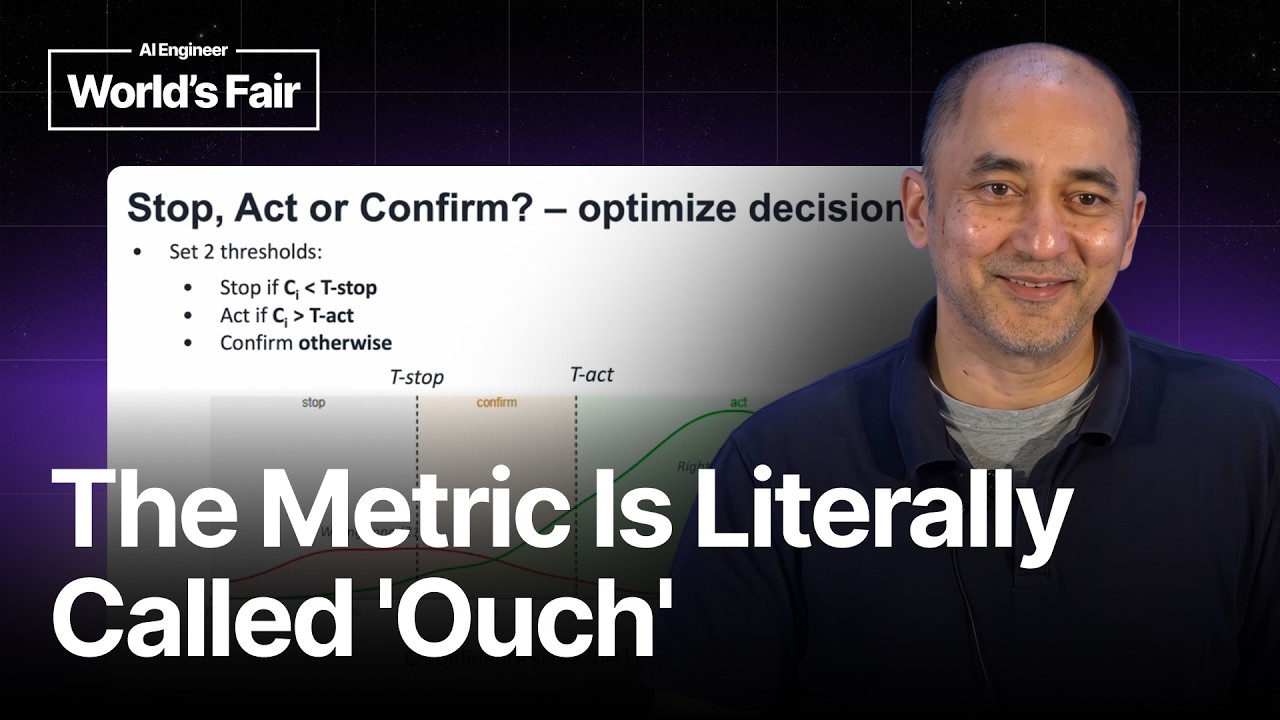
Act, Confirm, or Stop? Smarter behavior for AI assistants, wearables & robots — Amit Desai, Roku

The presentation argues that improving voice AI user experience requires focusing on a second, often neglected dimension: system behavior under uncertainty. While increasing accuracy (Knob One) is critical, the system's ability to intelligently decide what to do when it is unsure (Knob Two) can yield greater user satisfaction. This is quantified using the Outcome User Cost Heuristic (OUCH), which minimizes the total user effort by assigning differential costs to various bad outcomes (e.g., playing the wrong song vs. simply stating 'I did not understand').

Key takeaways

  1. The Two Knobs of Voice AI Improvement 0:03

    User satisfaction can be improved by increasing technical accuracy (Knob One) or by optimizing the system's decision-making process when confidence is low (Knob Two). The latter is often overlooked.

  2. The Outcome User Cost Heuristic (OUCH) 0:10

    Instead of treating all errors equally, OUCH minimizes the total user cost by quantifying the relative pain of different bad outcomes (e.g., the effort required to stop a wrong song vs. the time taken to hear 'Sorry, I did not understand').

  3. Adding Conversational Behavior 0:13

    Introducing a third behavior—confirming the guess out loud (e.g., 'Did you mean ABC?')—splits the confidence range into three regions (Stop, Confirm, Act) and further lowers the overall user cost.

Watch on YouTube Full article

Introducing Gemini Robotics 2 thumbnail

· 39:14

Introducing Gemini Robotics 2

Google DeepMind introduced Gemini Robotics 2, a new suite of models designed to provide the intelligence layer for general-purpose robotics. The system enables whole-body understanding and reasoning, allowing robots to perform complex tasks like cleaning a garage or folding laundry based on natural language prompts. Key advancements include enhanced dexterity, multi-robot collaboration capabilities, and leveraging Gemini's multimodal world understanding by adding 'actions' as a modality.

Key takeaways

  1. Whole-Body Intelligence 2:10

    Gemini Robotics 2 enables models to understand the entire robot's position in space and reason about complex, multi-step tasks (e.g., cleaning a garage), moving beyond simple object manipulation.

  2. Enhanced Dexterity 4:05

    The models significantly improve dexterity, allowing robots to perform intricate daily tasks such as folding laundry or precisely unscrewing objects using high-DOF hands.

  3. Multi-Robot Collaboration 5:01

    A new capability allows the robot intelligence to understand when and how to call other robots to accelerate tasks or perform actions in parallel.

  4. Availability and Deployment 25:39

    The Embodied Reasoning (ER) model will be available via AI Studio and the Gemini Enterprise Agents Platform. An on-device version is also available through a trusted tester program.

Watch on YouTube Full article