Topic

Foundation Models

All digests tagged Foundation Models

Stanford CS229 Machine Learning | Spring 2026 | Lecture 12: Representation Learning thumbnail

· 1:15:57

Stanford CS229 Machine Learning | Spring 2026 | Lecture 12: Representation Learning

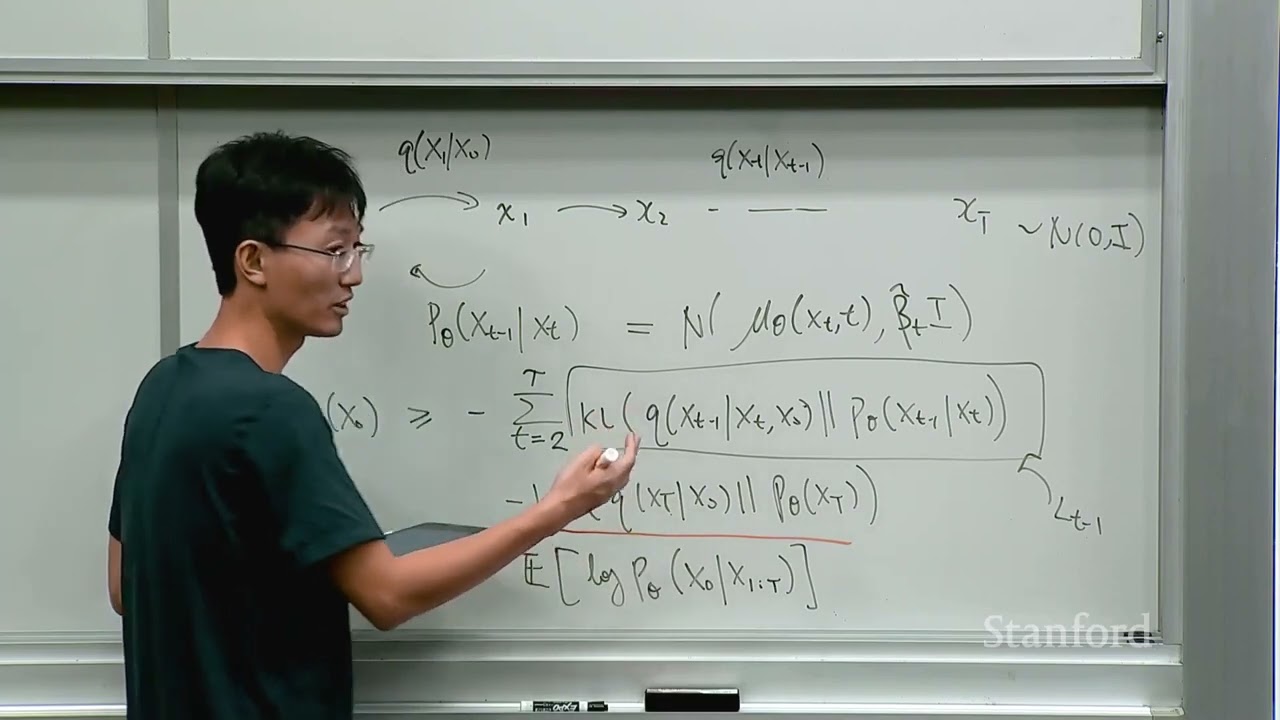
The lecture provides a deep dive into advanced generative and adaptation techniques, covering Diffusion Models, Foundation Model paradigms, and Representation Learning. Key technical focus areas include deriving the loss function for diffusion models by comparing true and predicted mean reconstructions ($\mu_{ ilde{t}, t}$ vs $\mu_{ heta, t}$). For large language models (LLMs), the discussion highlights the shift toward using massive unlabelled data for pre-training and adapting via zero-shot or few-shot methods. Finally, it details advanced parameter efficiency techniques like Linear Probing and Low-Rank Adaptation (LoRA), which are crucial for managing memory and compute when deploying large models across multiple users.

Key takeaways

  1. Diffusion Model Training Objective 33:55

    The training objective is derived from the lower bound on $\log p_ heta(x_0)$, simplifying to minimizing a sum of terms ($\mathcal{L}_{t-1}$) that compares the mean predicted reconstruction ($\mu_{ heta, t}$) with the true process mean ($\mu_{ ilde{t}, t}$). This loss function is used to train the model to predict noise/reconstruct missing information at each time step.

  2. Foundation Model Paradigm Shift 1:02:00

    Modern LLMs utilize a paradigm shift involving pre-training on massive unlabelled data and adapting via zero-shot or few-shot learning, reducing the need for collecting extensive downstream labeled datasets. The goal is to build a general foundation that can be adapted to unlimited tasks.

  3. Low-Rank Adaptation (LoRA) Efficiency 1:15:00

    To adapt massive pre-trained models without changing all parameters ($\theta$), LoRA restricts the weight update matrix $\Delta W$ to a low rank ($A B$). This significantly reduces the number of trainable parameters and is critical for memory efficiency, especially when serving multiple users.

Watch on YouTube Full article

Causal Models Need Causal Data - Xaira’s X-Cell model (Bo Wang & Ci Chu) thumbnail

· 1:29:47

Causal Models Need Causal Data - Xaira’s X-Cell model (Bo Wang & Ci Chu)

Xaira Therapeutics introduced X-Cell, a novel 4.9-billion-parameter diffusion language model designed as a virtual cell foundation model of biology. The model is trained on X-Atlas/Pisces—a massive dataset spanning 25.6 million single cells across 16 biological contexts and generated via the Perturb-seq platform. The core breakthrough lies in shifting from descriptive (observational) data to causal (interventional) data, allowing the model to predict how a cell will respond to genetic perturbations it has never encountered. This capability is crucial for advancing drug discovery by moving beyond trial-and-error methods.

Key takeaways

  1. Causality vs. Correlation in Biology 20:07

    Observational atlases (descriptive data) can describe biology, but they are fundamentally underpowered to learn causality. To predict the outcome of an intervention (e.g., knocking down a gene), causal data—generated through high-throughput perturbation screens—is required.

  2. X-Cell Architecture and Training 1:03:27

    X-Cell utilizes a diffusion language model approach, which treats gene expression prediction as an iterative 'editing' process rather than an autoregressive one. This architecture allows it to generate high-dimensional transcriptomic data by refining noisy representations until they minimize loss against the ground truth.

  3. Data Generation Scale and Engineering 1:16:47

    The model is powered by Perturb-seq, a technique combining high-throughput CRISPR perturbation with single-cell RNA sequencing. This process generates massive 2D datasets (perturbation on one axis, gene expression on the other) across millions of cells while minimizing batch effects.

  4. Generalization and Translational Potential 1:25:07

    X-Cell demonstrated impressive generalization by accurately predicting perturbation responses in active T-cells, even when the model was only trained on resting T-cell data. This suggests the potential to predict novel biology in unseen contexts.

Watch on YouTube Full article