Topic

Artificial Intelligence

All digests tagged Artificial Intelligence

Robot Demos Are Easy. Reliability Is Hard — Jason Ma, Dyna Robotics thumbnail

· 26:42

Robot Demos Are Easy. Reliability Is Hard — Jason Ma, Dyna Robotics

Dyna Robotics focuses on developing highly robust, generalist robotic policies for commercial deployment, arguing that high reliability is more critical than high performance in demos. The company utilizes a 'research and deployment flywheel' to build foundation models, achieving a 99.4% success rate in complex tasks like napkin folding over 24 hours. Key technical advancements include a 'pre-training data pyramid' (over 200,000 hours) and the use of reward models for scalable supervision, allowing the system to detect and recover from errors in long-horizon tasks.

Key takeaways

  1. The Reliability Gap in Robotics 10:10

    Achieving a high success rate (e.g., 99.4%) over extended periods (24 hours) is necessary for commercial viability, as standard models often stall at 80–90% success rates, making repeated tasks highly improbable.

  2. The Research and Deployment Flywheel 2:00

    Dyna Robotics combines frontier research with active commercial deployments to gather high-quality data, which informs and sharpens the focus of their model development, ensuring the product solves real-world problems.

  3. Scalable Error Recovery via Reward Models 18:59

    Instead of relying on manual oversight, the team developed reward models that score the robot's progress during complex tasks. Dips in this score signal a mistake, enabling targeted data collection and a human-in-the-loop active learning cycle for robust error recovery.

  4. Generalization Across Sites

    The model architecture is designed to generalize, allowing deployment at new customer sites (e.g., a laundromat, Red Bull events) without requiring site-specific fine-tuning or additional data.

Watch on YouTube Full article

🔬 Google's AI Scientist Started as an Attempt to Automate Kaggle — John Platt, Google Fellow thumbnail

· 2:01:26

🔬 Google's AI Scientist Started as an Attempt to Automate Kaggle — John Platt, Google Fellow

John Platt discusses Google's Empirical Research Assistance (ERA), an AI system designed to accelerate scientific discovery by mapping complex scientific problems into 'scorable tasks.' ERA combines Large Language Models (LLMs) with advanced search techniques like Monte Carlo Tree Search and Upper Confidence Bound (UCB) to iteratively propose and refine code that maximizes a defined score. The discussion highlights the critical distinction between descriptive models (what science aims for, allowing extrapolation based on physical laws) and purely predictive statistical models. The system's power lies in its ability to automate the initial coding and hypothesis generation, allowing human experts to focus on the high-level scientific creativity and defining the correct scoring function.

Key takeaways

  1. ERA: Automating Scientific Hypothesis Generation 20:20

    ERA maps scientific problems into 'scorable tasks,' allowing the system to iteratively propose and mutate code to maximize a defined score. This process moves beyond traditional machine learning by leveraging LLMs' vast prior knowledge and combining it with algorithmic search (Monte Carlo research) to solve problems like estimating CO2 concentrations or predicting wildfire boundaries.

  2. The Importance of Scientific Rigor and Domain Expertise 28:20

    Platt emphasizes that while AI is a powerful tool, human input remains crucial for defining the correct scoring function and maintaining scientific rigor. He warns against 'reward hacking' and the risks associated with overfitting, noting that the ability to distinguish between predictive and descriptive models is a core human task.

  3. AI's Role in Climate and Earth Science 1:03:20

    AI is being applied to complex, non-stationary problems like climate modeling and contrail warming. For instance, ERA helped solve a counterfactual problem—estimating the effect of contrails on outgoing longwave radiation—by finding a simple model that previously went unnoticed.

  4. The Future of Scientific Computing 1:50:00

    The field is undergoing a 'phase change,' moving from specialized, single-problem models to general AI toolchains. The optimal approach for young scientists is to combine deep domain expertise (scientific taste) with the ability to utilize and experiment with multiple advanced tools.

Watch on YouTube Full article

What is Jev? The AI that Can't Talk Back (and why that's a good thing) thumbnail

· 33:02

What is Jev? The AI that Can't Talk Back (and why that's a good thing)

Jev is a new general-purpose AI classifier from TypeSafe that reads complex text and outputs only a single, predefined choice, eliminating the need for generative text. This capability allows developers to solve 'semi-deterministic' problems—those requiring judgment but yielding structured outcomes—at a fraction of the cost and speed of traditional Large Language Models (LLMs). The video outlines four architectural patterns for integrating Jev into existing software, positioning it as a crucial new primitive alongside deterministic code and LLMs.

Key takeaways

  1. Jev's Core Functionality

    Jev is a classifier that takes complex text input but is restricted to selecting from a predefined list of possible answers, making it fundamentally different from LLMs that generate sentences. This restriction is its primary advantage.

  2. Market Adoption and Value

    Jev was the fastest-adopted model in Vercel's AI gateway history, suggesting that the ability to classify cheaply and quickly is a highly valuable, unmet need in the industry.

  3. The Power of Classification 2:00

    Jev enables 'semi-deterministic' processes—where judgment is required (e.g., assessing customer dissatisfaction) but the output is a simple choice (e.g., 'High Risk,' 'Low Priority').

  4. Cost and Speed Advantage 22:00

    Jev offers massive cost and speed gains compared to LLMs. For example, one developer reported a 34x cost reduction and six times speed increase when using Jev for tax document classification.

  5. Architectural Patterns 26:40

    Jev can be used in four ways: 1) Classifying messy input for existing software; 2) Acting as a filter for large problem spaces (e.g., immunology research); 3) Choosing the next step in an AI workflow (outer loop orchestration); and 4) Interpreting user intent in real-time interfaces (e.g., spreadsheets).

Watch on YouTube Full article

A Worm With 302 Neurons Inspired Their Architecture — Ramin Hasani, Liquid AI thumbnail

· 1:09:52

A Worm With 302 Neurons Inspired Their Architecture — Ramin Hasani, Liquid AI

Liquid AI presents a comprehensive view of the next generation of AI architectures, moving beyond pure Transformer models. Their approach is inspired by biological systems, specifically the continuous-time dynamics of worms, leading to the development of Liquid Neural Networks (LNNs). The company emphasizes a 'meta AI' system that systematically searches for hybrid, hardware-aware architectures (e.g., combining convolutions, attention, and LNN elements) to achieve high quality while minimizing memory and latency. A major focus is enabling reliable, high-intelligence deployment at the edge (on-device, in cars, and on laptops), addressing critical needs for privacy, cost efficiency, and air-gapped capabilities.

Key takeaways

  1. Biological Inspiration and Continuous Dynamics 1:55

    Liquid AI's foundational research is inspired by the worm's nervous system, which uses simple first-order differential equations. This leads to Liquid Neural Networks (LNNs), which are continuous-time, differentiable systems, allowing for backpropagation and learning while maintaining biological fidelity. (01:15-02:00)

  2. Architectural Search for Efficiency 4:20

    Instead of committing to a single architecture, Liquid uses a meta AI system to search for optimal hybrid architectures. This search optimizes four criteria: no sacrifice on quality, minimizing memory consumption, minimizing latency, and maximizing computation speed, making the models hardware-aware. (04:20-05:30)

  3. Edge and On-Device Intelligence 8:20

    The company is focused on bringing high-quality intelligence outside of data centers (e.g., cars, laptops, mobile devices). This is driven by cost considerations and the need for enhanced privacy, enabling local, air-gapped capabilities. (08:20-09:30)

  4. The Future of AI: Multimodality and Adaptability 12:40

    Future research focuses on massively multimodal systems (audio, vision, text, DNA) and achieving 'adaptive intelligence'—systems that can combine forward and backward passes simultaneously, moving beyond static training paradigms. (12:40-13:30)

Watch on YouTube Full article

The US–China AI Arms Race Isn't Real But The Lobbying Is. My Guest Worked Both Sides. thumbnail

· 48:24

The US–China AI Arms Race Isn't Real But The Lobbying Is. My Guest Worked Both Sides.

The discussion argues that the framing of the US-China AI competition as a zero-sum 'arms race' is a core misconception (02:54). Instead, the intelligence generated by AI is becoming 'ambient' and commoditized through open-source, open-weight models, making it impossible to monopolize. The future value of AI will shift from building the largest models (e.g., 10 trillion parameter models) to applying specialized, smaller models (e.g., 10 billion parameter models) for specific societal betterment, such as drug discovery or infrastructure improvement. The ultimate opportunity lies in leveraging AI's productivity gains to foster global cooperation and human-centric activities, rather than military competition.

Key takeaways

  1. The AI Arms Race is a Misconception 1:31

    The belief that AI is a zero-sum contest with a single winner is flawed. The commoditization of high-quality intelligence via open-source and open-weight models means that intelligence is becoming ambient and impossible to hoard, much like electricity was (09:01).

  2. Focus on Specialization, Not Scale 16:49

    The misconception is that the race is to build the biggest, most super AI model. The more efficient approach is to use smaller, specialized models (e.g., a 10 billion parameter model) tailored for specific tasks, allowing for better resource allocation into societal needs like hospitals and infrastructure (16:49).

  3. The Future Requires High-Dimensional Skills 18:30

    Young people should focus on developing a broad, T-shaped experience set—combining wide reading (history, philosophy, sociology) with deep, end-to-end technical skills (designing, building, deploying, and sunsetting a system). Specialization alone is insufficient because AI can now provide answers that require critical judgment to validate (11:10).

  4. Cooperation is the Path Forward 33:20

    The most likely path is not conflict, but a global shift toward cooperation, modeled after historical events like the Marshall Plan. Redirecting spending from military spending to global development (especially the Global South) is necessary to stabilize the economy and prevent a collapse (2000).

Watch on YouTube Full article

Seattle DGX Spark Hackathon Winners Spotlight thumbnail

· 40:58

Seattle DGX Spark Hackathon Winners Spotlight

This summary covers the NVIDIA DGX Spark Hackathon winners, spotlighting two advanced local AI applications: Kerberos, a shared spatial-awareness system for search-and-rescue (SAR) teams, and VELA, a voice-first, consent-controlled healthcare action system. Both projects demonstrate the power of running complex, multi-agent AI workflows entirely on local hardware (NVIDIA GB10), ensuring data privacy and real-time action capability.

Key takeaways

  1. Local AI for Privacy and Reliability 22:40

    Both winning systems (Kerberos and VELA) are designed to run entirely on the NVIDIA GB10, ensuring that sensitive data (e.g., medical records, live camera feeds) remains local and is not transmitted to the cloud, addressing critical security concerns in healthcare and SAR.

  2. Agentic Workflows for Complex Tasks 25:40

    The projects utilize multi-agent architectures (e.g., VELA's system) where specialized agents (like Parakeet for speech recognition, Neatron for reasoning, and Magpie for speech output) collaborate to perform complex, multi-step tasks, moving beyond simple chatbots to actionable outcomes.

  3. Shared Situational Awareness in SAR 3:40

    Kerberos creates a shared live map for SAR, integrating data from multiple sources (drones, robots, body cameras) to track responders, map searched areas, and pinpoint casualties or hazards, even indoors where GPS fails.

Watch on YouTube Full article

AI Simplified: 6 Concepts You Need to Know About Modern AI thumbnail

· 8:49

AI Simplified: 6 Concepts You Need to Know About Modern AI

The video simplifies modern AI by detailing six essential concepts: Large Language Models (LLMs), Model Training/Tuning, Retrieval Augmented Generation (RAG), AI Agents, Model Context Protocol (MCP), and System Prompts. The explanation uses human analogies to show how these components—from the core 'brain' (LLM) to the 'central nervous system' (MCP)—are integrated to create sophisticated systems capable of reasoning, accessing external knowledge, and taking autonomous actions.

Key takeaways

  1. Artificial Intelligence (AI)

    A subfield of computer science focused on matching or exceeding human intelligence in a machine. The core function is generating content using probabilities to predict output based on input, described as 'autocomplete on steroids.'

  2. Large Language Models (LLMs)

    The foundational component or 'brain' of the AI system where core intelligence and reasoning capabilities reside. It is responsible for generative AI outputs (words, images, sounds).

  3. RAG (Retrieval Augmented Generation) 3:35

    A method to extend the LLM's knowledge base by integrating trusted external sources (e.g., research papers or product documentation). This process helps reduce 'hallucinations'—confident errors made by the AI.

  4. AI Agents 5:20

    An advanced system where a model autonomously uses external tools (e.g., writing code, searching the web, reading/writing databases) to achieve specific goals, giving the AI 'hands and feet.'

  5. Model Context Protocol (MCP) 6:20

    The orchestration layer that acts as the central nervous system for an AI agent. MCP connects the model's reasoning to the external tools, coordinating actions.

  6. System Prompts 7:30

    A set of guiding principles or constraints given to the model that dictates its behavior and ethical boundaries. This prevents misuse (like prompt injections) without requiring constant, expensive retraining.

Watch on YouTube Full article

The mathematics of AI uncertainty thumbnail

· 44:42

The mathematics of AI uncertainty

The discussion explores the critical role of quantifying uncertainty—a fundamental human trait often missing from current AI models—as key to building truly intelligent and reliable systems. Zoubin Ghahramani argues that for an AI system to make safe decisions in complex real-world scenarios (like self-driving cars or medical diagnosis), it must possess a sense of its own limitations, moving beyond mere 'correctness' to explicit measures of 'confidence.' The mathematical framework for achieving this is Bayesian inference, which allows systems to update beliefs and quantify uncertainty using evidence. Advances in fields like weather forecasting (GenCast) and protein folding (AlphaFold) demonstrate the power of incorporating probabilistic ensembles into deep learning architectures.

Key takeaways

  1. The Necessity of Uncertainty Quantification

    True intelligence requires a system that can represent, update, and utilize its own uncertainty to make decisions under limited perception. This is crucial for safety-critical applications like self-driving cars (0:00 - 7:45).

  2. Distinguishing Types of Uncertainty 12:05

    There are different types of uncertainty: aleatoric (inherent randomness, e.g., a pedestrian turning) and epistemic (uncertainty in the model's knowledge due to lack of data/experience, e.g., an unseen scenario). Systems must be able to differentiate these for appropriate decision-making (7:45 - 9:40).

  3. Bayesian Inference as a Model for Learning 16:10

    Bayes' rule provides a formal, mathematically rigorous way to update prior beliefs into posterior beliefs when new evidence is observed. This process models both human perception and continuous learning (16:10 - 23:00).

  4. Architectural Improvements for Reliability

    Modern AI systems, particularly LLMs, often lack explicit probabilistic representation of confidence; they are 'overconfident' when wrong. Incorporating uncertainty through techniques like ensemble forecasting (GenCast) or visualizing prediction variance (AlphaFold) is essential for building trustworthy AGI (35:00 - 42:00).

Watch on YouTube Full article

Stripe buys OpenRouter, Ramp’s AI Index & IBM’s OpenAI deal thumbnail

· 35:52

Stripe buys OpenRouter, Ramp’s AI Index & IBM’s OpenAI deal

The AI market is shifting from a focus on model superiority to infrastructure orchestration and governance. Key developments include IBM establishing itself as an enterprise AI integrator through partnerships with both OpenAI and Anthropic (1:01). Stripe's acquisition of OpenRouter positions token routing as the critical 'profitability infrastructure,' suggesting that controlling the flow of compute decisions is more valuable than developing models themselves (11:46). Furthermore, data from Ramp suggests a market maturity where businesses are moving away from per-seat AI spending toward measuring cost per unit work and implementing rigorous FinOps practices to manage escalating token costs (22:39).

Key takeaways

  1. IBM's Enterprise Orchestration Strategy 2:12

    IBM is positioning itself as a neutral enterprise AI orchestrator by forming partnerships with both OpenAI and Anthropic. This strategy aims to provide clients with choice, utilizing IBM’s proprietary Granite models alongside external leaders for governance and integration within legacy systems (1:01).

  2. The Rise of the Model Router as Infrastructure 11:42

    Stripe's acquisition of OpenRouter is framed as a bet on 'profitability infrastructure.' Since models are becoming cheaper, the value shifts to the routing layer—the ability to manage and optimize token traffic across multiple providers (11:46). This allows Stripe to act as a payment gateway for autonomous AI agents.

  3. AI Spending Shifts from Per-Seat to Unit Cost 23:30

    Ramp's data indicates that the era of unmetered, per-employee AI experimentation is ending. CFOs now demand measurable unit economic payback (e.g., cost per resolved support ticket) rather than simply approving broad AI software budgets (22:39).

Watch on YouTube Full article

Trading Desks to Clinical Trials: Parallels in Applied Vertical AI — Ayush Bhardwaj, Allos AI thumbnail

· 20:02

Trading Desks to Clinical Trials: Parallels in Applied Vertical AI — Ayush Bhardwaj, Allos AI

The talk outlines a structured methodology for building and iterating in applied vertical AI, arguing that model infrastructure and APIs are commodities. The true 'moat' lies not in the technology itself, but in proprietary data and deep domain expertise. The process requires narrowing the problem scope, curating unique datasets (like failed experiments or trade theses), and crucially, integrating a human domain expert ('the user') to create an endless learning loop that guides prompt refinement and error analysis.

Key takeaways

  1. The Moat is Domain Expertise 12:30

    In vertical AI, the competitive advantage does not come from the model (e.g., Claude or ChatGPT) or the infrastructure; it comes from proprietary data and domain expertise which must be curated by human experts.

  2. Focus on Narrow Tasks 6:35

    When formulating a problem for an AI agent, do not try to solve everything at once. Break down complex tasks into very narrow, specific steps (e.g., ranking stocks based on IT capital expenditure in US equities).

  3. The Importance of Proprietary Data 8:00

    Generic data sources are insufficient. The most valuable assets are proprietary datasets that are expensive to acquire or withheld by industry players (e.g., failed clinical trials, internal trade theses).

  4. Hire the User, Not Just the Model 15:30

    The single most critical step is hiring a domain expert ('the user'). This person guides the tool by curating sources, refining prompts, and performing judgment—a process that transforms generic AI tools into industry-specific assets.

Watch on YouTube Full article

AI & Data Science Periodic Tables: How They Work Together thumbnail

· 13:21

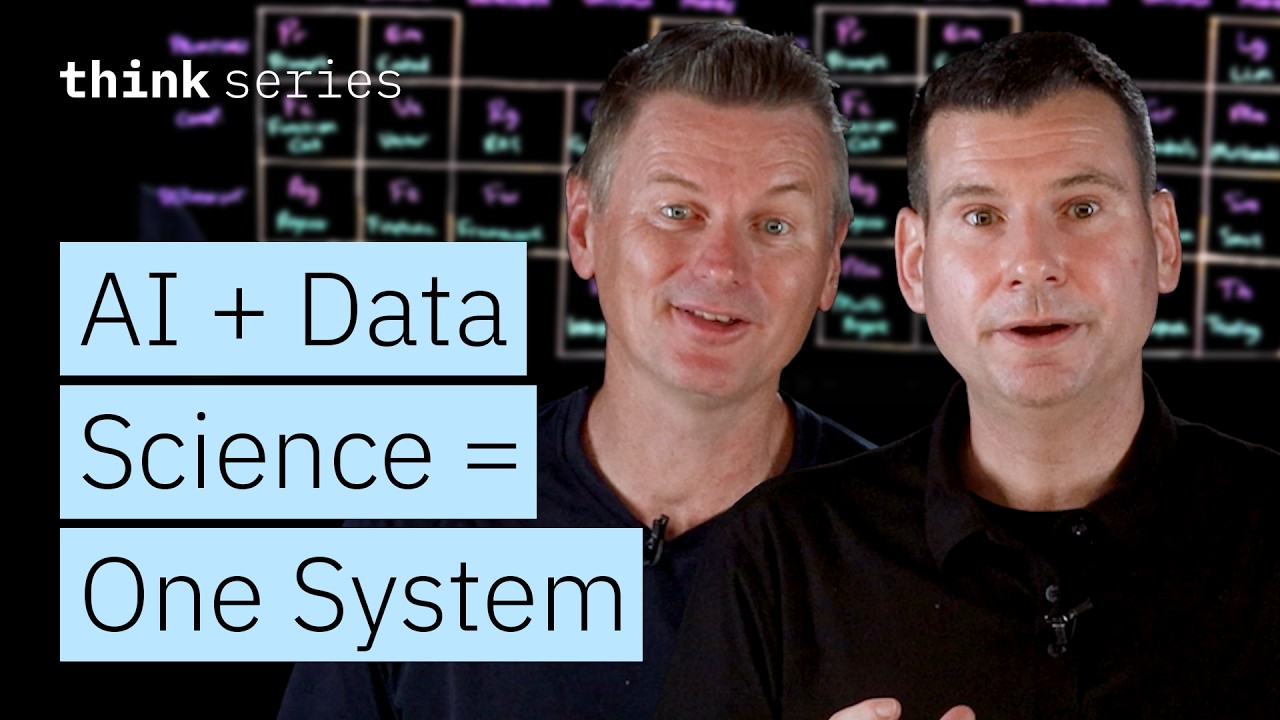
AI & Data Science Periodic Tables: How They Work Together

The video details the synergistic relationship between Data Science and Artificial Intelligence (AI), presenting both disciplines using 'Periodic Tables' as a conceptual framework. It emphasizes that modern AI applications are built upon robust data science foundations. A comprehensive example—Document Q&A—is used to illustrate a full pipeline, detailing how elements like Extract Transform Load (ET), Data Ingest (DI), and Data Cleansing (CD) prepare the data, which is then processed by AI components such as Embeddings (EM), Retrieval Augmented Generation (RAG), and Guardrails (GR). The process can be completed into a continuous loop using Drift Detection (DR) and Synthetic Data generation for continuous system improvement.

Key takeaways

  1. AI relies on foundational data science work 0:25

    The speaker notes that all advancements in AI sit atop the groundwork laid by data science, creating a feedback loop where models inform how data is prepared for future use. (0:15-0:30)

  2. Data Science Pipeline Stages 1:38

    The Data Science periodic table defines five groups across the top (Acquisition, Preparation, Modeling, Generation, Evaluation) and tracks data maturity through rows: Raw Data $\rightarrow$ Prepared Data $\rightarrow$ Model Data $\rightarrow$ Validated Insight. (1:30-2:25)

  3. AI Pipeline Core Elements 2:40

    The AI periodic table features groups like Retrieval and Orchestration, with core primitives including Prompt, Embed, and LLM. Key components include embeddings (encoding info into numbers) and RAG (coordinating retrieval). (2:35-3:40)

  4. The Full Document Q&A Pipeline 3:30

    Building a system requires combining elements from both tables. The process moves linearly through data preparation (ET $\rightarrow$ DI $\rightarrow$ CD $\rightarrow$ ST $\rightarrow$ EN $\rightarrow$ GO) and then AI processing (EM $\rightarrow$ Vx $\rightarrow$ RAG $\rightarrow$ PR $\rightarrow$ LG $\rightarrow$ GR). (4:30-6:20)

  5. Closing the Loop for Continuous Improvement 6:20

    To prevent the system from being a one-way street, the pipeline is closed using Data Drift (DR) detection and Synthetic Data generation. This allows the embedding model to fine-tune itself continuously based on failing patterns. (6:40-7:50)

Watch on YouTube Full article

Intelligence + Continual Learning = Expertise — Yu Su, NeoCognition thumbnail

· 19:43

Intelligence + Continual Learning = Expertise — Yu Su, NeoCognition

The talk distinguishes between 'Intelligence' (the capacity to reason through unfamiliar problems from available context) and 'Expertise' (accumulated, situated competence). While modern LLM agents excel at symbolic tasks like coding because code is a structured language-native world, they struggle in heterogeneous real-world digital environments. The speaker posits that this difficulty represents a modern Moravec's paradox. To scale AI beyond basic capability, systems must implement continual learning to acquire specialized expertise for each 'microworld,' leading toward 'unbounded expertise from bounded intelligence.'

Key takeaways

  1. Intelligence vs. Expertise Distinction 3:50

    Intelligence is the ability to reason through novel problems given context, while expertise is accumulated competence that allows for efficient action and judgment in a specific domain (e.g., recognizing constraints beyond just finding a shared calendar slot).

  2. The Coding Agent Advantage 5:26

    Coding is an ideal first market for LLM agents because code is already symbolic and structured, providing clear tests and rewards. Leaving this 'privileged world of code' introduces significant brittleness.

  3. The Role of Continual Learning 10:44

    Continual learning is defined as the adaptive compression of experience into reusable structures for future behavior. It is presented as the critical bridge needed to transition from raw intelligence (brute-forcing solutions) to specialized expertise (compressing the search space).

Watch on YouTube Full article

Locknote: Reasons to be Cheerful: 0, 1, 2 - Emmz Rendle - NDC Copenhagen 2026 thumbnail

· 57:04

Locknote: Reasons to be Cheerful: 0, 1, 2 - Emmz Rendle - NDC Copenhagen 2026

The talk presents a highly optimistic overview of technological progress across multiple domains, arguing that advancements in AI, quantum computing, and biotechnology are solving complex global problems. While addressing concerns about job displacement and climate change, the speaker emphasizes that these technologies—such as specialized LLMs (Gemma 4, Qwen 3.6) for code generation or CRISPR for personalized medicine—are tools that enhance human capability rather than replace it entirely. The presentation also touches on hardware advancements like shared memory architectures and post-quantum cryptography standards.

Key takeaways

  1. AI in Diagnostics and Genomics 5:20

    AI models are revolutionizing medicine by analyzing complex data sets, such as MRI scans (sub-millimeter slice images) to flag issues for radiologists. Furthermore, DNA/RNA analysis can detect hereditary disease risks and enable custom per-patient cancer treatments.

  2. Quantum Computing Threat and Solution 12:30

    The advent of powerful quantum computers (e.g., those capable of running Shor's algorithm) will render current classical cryptography (RSA, Diffie-Hellman, EDCSA) obsolete. The industry is responding by adopting post-quantum cryptography standards approved by NIST, specifically mentioning Dilithium and Kyber.

  3. AI for Software Productivity 17:30

    LLMs are not replacing programmers but acting as a new programming paradigm. They can generate functional code that is safe to put into production, allowing developers to focus on engineering the system's logic rather than manual typing.

  4. Advancements in Robotics and Automation 23:20

    Robotics are advancing through LLM-driven operating systems (like Gemini Robotics 1.5) that allow robots to reason through steps necessary for tasks, enabling scalable deployment across multiple units.

  5. Sustainable Energy and Climate Solutions 31:40

    New technologies include solar windows (generating electricity while visible) and 'solar canals,' which use floating panels over irrigation channels to prevent water evaporation and generate power.

Watch on YouTube Full article

Day1 room4 video6 thumbnail

· 56:48

Day1 room4 video6

This technical critique challenges the prevailing narratives surrounding Generative AI (GenAI), arguing that much of the current hype is based on flawed binary thinking and overblown expectations. The speaker advises build engineers to treat AI claims skeptically, focusing instead on measurable improvements rather than revolutionary declarations. Key concerns include the environmental cost, the risk of data surveillance capitalism, and the practical limitations of concepts like 'human in the loop' when optimizing complex systems.

Key takeaways

  1. Critique of Binary Thinking

    The discussion around AI is often poorly framed using binary oppositions (e.g., good/bad, for/against), which reduces a complex issue to mere tribal classification rather than substantive technical discussion.

  2. AI as an Abstraction 17:15

    Intelligence is an abstraction, not a physical quantity. Comparing machine intelligence directly to human intelligence ('Can we make a machine smarter than humans?') is conceptually flawed because the comparison lacks measurable essence.

  3. The Flaw of 'Human in the Loop' 39:10

    Relying on human verification ('human in the loop') is often a copout designed to diffuse worries about automation. Humans are poor at white-collar quality checkpoints and cannot reconcile the conflicting goals of efficiency and safety.

  4. The Danger of Surveillance Capitalism 51:40

    The true business model for major tech companies is not selling AI services, but selling influence. The ultimate risk involves the collection of intimate data (e.g., retina scans) to modify behavior and opinions.

Watch on YouTube Full article

Leopold Aschenbrenner's Warning Signal Apple Completely Missed thumbnail

· 12:15

Leopold Aschenbrenner's Warning Signal Apple Completely Missed

The video analyzes two contrasting investment strategies for Artificial Intelligence: Leopold Aschenbrenner's highly leveraged 'Situational Awareness' thesis and Apple's long-term hardware approach. The discussion highlights how external financial pressures (like Federal Reserve rate calls) can impact high-leverage AI bets, while simultaneously emphasizing that Apple's focus on chips designed for local inference provides a strong, multi-decade competitive advantage in the AI race.

Key takeaways

  1. Aschenbrenner's Thesis and Leverage Risk

    Leopold Aschenbrenner built his success on a thesis of predicting AI investments by reasoning back from compute requirements. His high returns were amplified by leverage, leading to significant pressure when the market faced volatility (e.g., after SK Hynix IPO).

  2. Citadel's Market Intervention 8:27

    Following AI trade pressure and a note predicting Federal Reserve rate hikes (which makes volatile assets less attractive), Citadel Capital stepped in to buy out Aschenbrenner’s entire public equities book, allowing them to enter the AI trade at a discount.

  3. Apple's Hardware Advantage 10:49

    Unlike short-term investment plays, Apple's strategy is focused on 20-30 year hardware longevity. Their chips are optimized for local inference (running AI models directly on the device), positioning them as a default winner regardless of which large model or open-source framework dominates.

Watch on YouTube Full article

First Steps Toward Automated AI Research — Richard Socher, CEO Recursive AI thumbnail

· 20:24

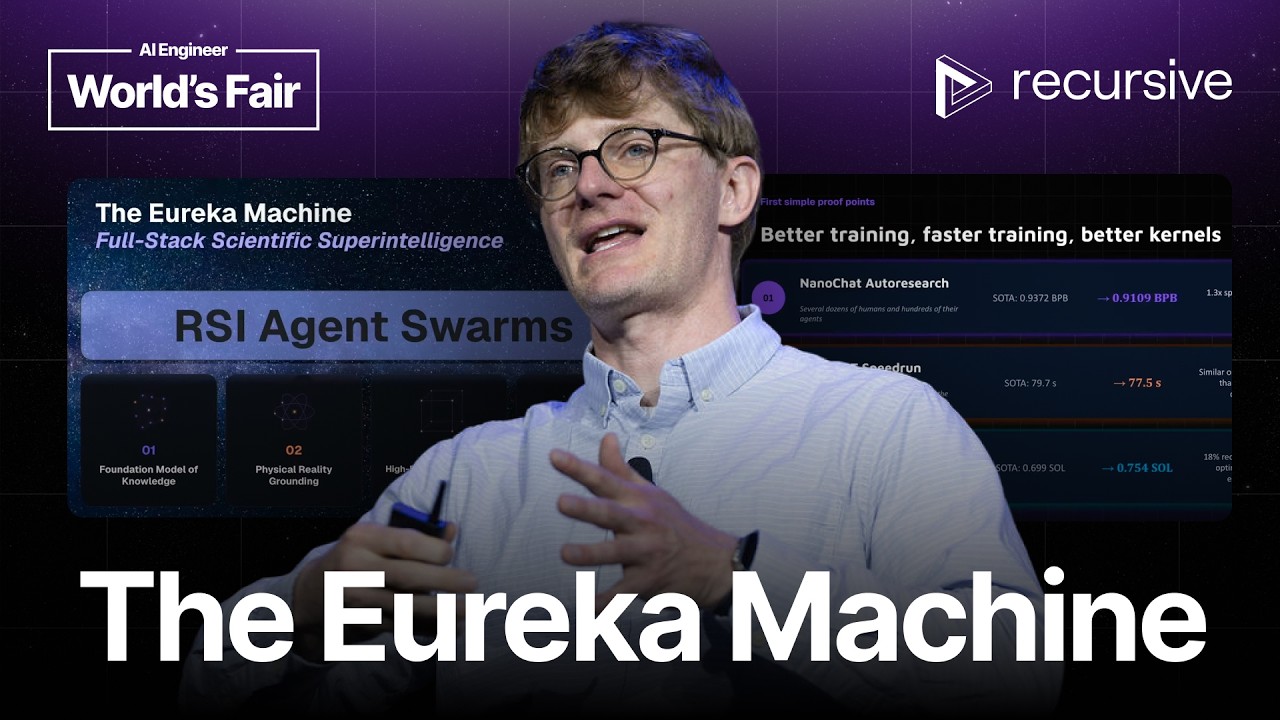
First Steps Toward Automated AI Research — Richard Socher, CEO Recursive AI

Richard Socher proposes the concept of the 'Eureka machine,' a system designed to automate scientific discovery across all fields—from physics and biology to economics. Drawing parallels with evolution and Popper's philosophy of science, he argues that humanity is at an inflection point where Artificial Intelligence (AI) can achieve Recursive Self-Improvement (RSI). This process involves building systems that improve their own code and architecture over long time horizons, accelerating scientific progress far beyond current human capacity.

Key takeaways

  1. The Eureka Machine Goal 15:07

    The ultimate goal is to build a machine that automates the entire process of scientific discovery. This requires integrating knowledge (scientific data), simulation, physical experimentation, and an agent swarm to manage all inputs.

  2. Evolutionary Analogy for Progress

    Scientific progress is viewed as an open-ended evolutionary process. Just as biology evolved over billions of years, technology and AI are expected to undergo rapid, exponential shifts (S-curves) leading to massive human flourishing.

  3. The Necessity of RSI

    AI progress is accelerating because modern AI can code. The next major step involves building a system with Recursive Self-Improvement (RSI)—an AI that has self-awareness of its shortcomings and autonomously updates its entire architecture, moving beyond manual processes.

Watch on YouTube Full article

Why AI Makes the Humanities More Important Than Ever thumbnail

· 14:32

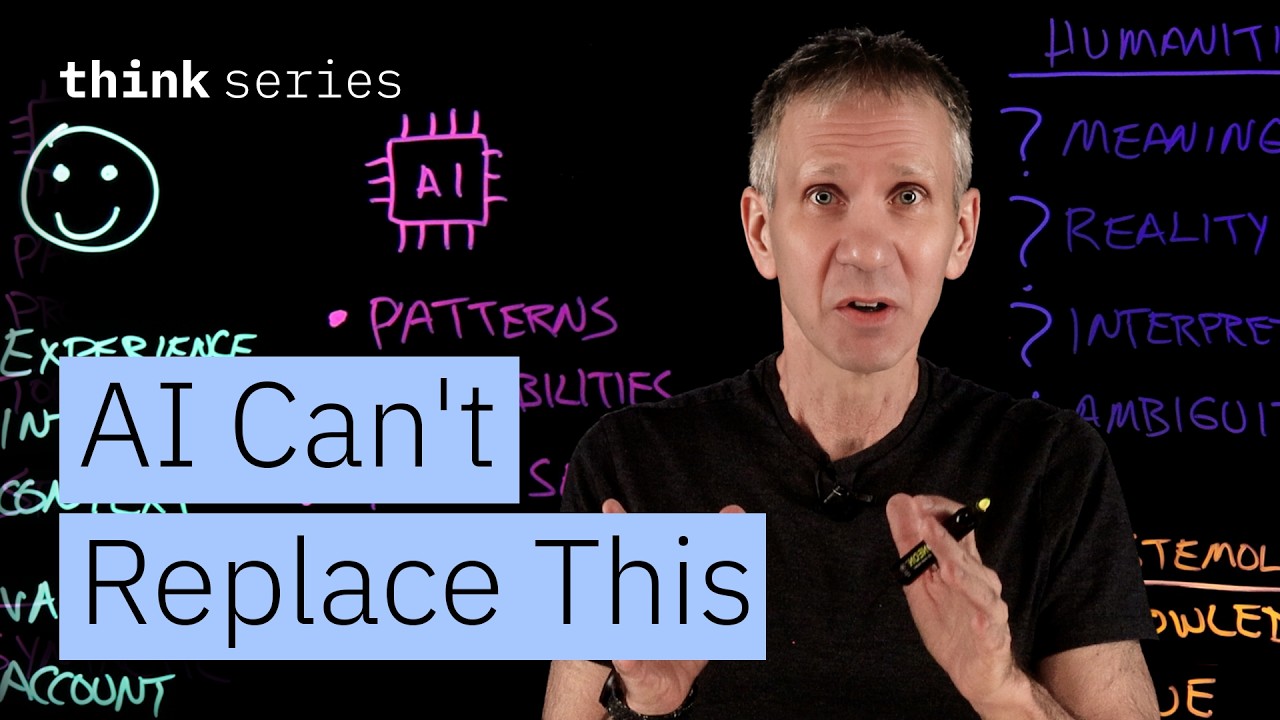
Why AI Makes the Humanities More Important Than Ever

While advanced AI systems excel at generating fluent language by predicting statistical patterns (syntactic), they lack inherent understanding of human intent, ethics, or context (semantic). The video argues that fundamental humanistic disciplines—such as philosophy, history, and rhetoric—are crucial for providing the necessary judgment, ethical grounding, and critical interpretation required to use AI responsibly. In an AI-driven world, technical fluency is insufficient; the most valuable skill becomes critical thinking and interpretive judgment.

Key takeaways

  1. AI operates on patterns, not understanding 7:40

    Large Language Models (LLMs) function by predicting token sequences based on statistical correlations, meaning they are fundamentally syntactic. They do not inherently possess lived experience or semantic understanding of truth or value.

  2. The user is the critical interpreter 11:55

    AI systems shift the need for interpretation rather than eliminating it. The human must act as the active participant who interprets the AI's output, making decisions and taking action based on that interpretation.

  3. Prompting is a form of system control 13:40

    The quality of an AI output is highly dependent on the prompt (input). Structuring prompts, defining constraints, and clearly expressing intent are practical applications of rhetoric and discourse analysis, making this skill an operational competence in AI systems.

Watch on YouTube Full article

Local Agentic Theory For Mobile Games — Shafik Quoraishee & Joanne Song, The New York Times thumbnail

· 18:04

Local Agentic Theory For Mobile Games — Shafik Quoraishee & Joanne Song, The New York Times

The presentation outlines 'Local Agentic Theory' for mobile games, arguing that the future of AI gaming lies in decentralized, on-device agents rather than centralized cloud models. These local agents use advanced techniques (like LLM reasoning over game state) to provide highly personalized experiences. Furthermore, this approach allows accessibility features to move beyond static toggles, enabling real-time, dynamic tuning of gameplay difficulty and interaction controls based on the user's live context (e.g., tracking eye gaze or shaky taps).

Key takeaways

  1. Local Computation is Essential for Mobile AI 4:09

    Running AI locally minimizes latency, avoids expensive cloud inference calls, and ensures privacy by keeping computation within the device's security zone. This allows advanced AI features to function reliably even without constant internet connectivity (e.g., in a subway tunnel).

  2. Agentic Systems vs. Reinforcement Learning (RL) 7:36

    While RL models train by changing weights through cycles, an agentic system uses language models and in-context learning to reason over the game's state space. This allows for a more dynamic loop that adapts to new situations using local device functionality.

  3. The Device Budget Constraint 13:39

    Local agents must operate within strict resource budgets: time (fitting planning into a single 16ms frame for 60Hz refresh rates), space (managing model weights and state history compression), and energy (optimizing processing to prevent rapid battery drain).

  4. Accessibility as a Graded Dial, Not Toggles

    Traditional fixed-state games are limited by static menus. The proposed model uses international standards like WCAG 2.2 to build dynamic player states. Agents can actively monitor user input (e.g., tracking eye gaze or analyzing shaky taps) and dynamically adjust controls—such as resizing targets or injecting exit routes from focus traps—to meet the player's real-time needs.

Watch on YouTube Full article

I Cut the Internet and Let AI Read the File I Could Never Upload. It Caught the Leak. thumbnail

· 14:04

I Cut the Internet and Let AI Read the File I Could Never Upload. It Caught the Leak.

This video details methods for running AI models locally on sensitive documents while completely disconnected from the internet ('air-gapping'). The core problem addressed is data leakage risk when uploading proprietary or PII-containing files to cloud AI providers. Solutions range from using open-source tools like LM Studio with downloaded, local models (e.g., GPT-OSS Safeguard 20B) to sophisticated enterprise methods utilizing Azure and LoRA for fine-tuning within a controlled boundary.

Key takeaways

  1. Local AI Processing Capability

    It is possible to run downloaded, open-weight models on a laptop with Wi-Fi disabled. These local models can scan documents for private material (PII, financial data, legal notes) and mask it without sending any data over the network.

  2. Enterprise Adoption of Local AI

    Large companies like Discovery Bank and Bayer are implementing specialized, fine-tuned models (on-premise/Azure) to handle confidential information. This approach allows for faster processing while keeping proprietary data within a controlled boundary.

  3. The Risk of Cloud Dependence 5:13

    Even if an AI model claims it did not look at a file, the logs may show that the entire repository was uploaded to the provider (e.g., Grok build leak), emphasizing the need for hard guardrails like air-gapping.

  4. LoRA and Enterprise Tuning

    Microsoft uses Low-Rank Adaptation (LoRA) to fine-tune models by adjusting only a subset of parameters, allowing large clients to create highly specialized models that outperform general cloud providers for specific tasks.

Watch on YouTube Full article

Build Your Own App In Just 30 Minutes! Full Course with Andrew Ng thumbnail

· 25:58

Build Your Own App In Just 30 Minutes! Full Course with Andrew Ng

This course teaches build-engineering principles for modern software development by leveraging AI tools (like ChatGPT or Gemini). Instead of writing code manually, users learn 'prompting'—the art of giving precise instructions to an AI system to generate functional web applications (HTML files). The process emphasizes iterative refinement and mastering five key building blocks: Goal, Input, Layout, Special Features, and Output. By following this framework, users can build complex tools, such as a birthday card generator or a ping pong game, with minimal coding experience.

Key takeaways

  1. The Power of Prompting 4:30

    Creating software in the AI era involves telling the AI what to do (prompting) rather than typing out code. The more specific and precise the prompt, the more predictable the resulting application will be.

  2. The Five Building Blocks of Prompts 6:10

    To build effective prompts, consider these five components: 1) The Goal (what to create), 2) User Input (data the user provides), 3) Layout (arrangement of parts), 4) Special Features (additional functionality), and 5) Output (the desired result format).

  3. Iterative Development and Troubleshooting 11:20

    Software development is an iterative process. If the initial AI-generated app has bugs or needs improvement, users must continue the conversation with specific instructions (e.g., 'Nothing happens when I click on the generate card button. Can you fix it for me?').

Watch on YouTube Full article