Topic

Agent Systems

All digests tagged Agent Systems

Agents' next frontier: agent-to-agent and network effects — Jean-Denis Greze, Town thumbnail

· 21:17

Agents' next frontier: agent-to-agent and network effects — Jean-Denis Greze, Town

The talk reframes multi-agent systems not as 'agent-to-agent' interactions, but fundamentally as a search problem: ensuring that an LLM's context window contains the optimal information for a tool call. The primary technical barrier to achieving this ideal state—a single agent with access to all world information—is not context length, but privacy and security. Greze outlines five strategies (Shared Trust Boundaries, Custom Tools, Shared Silos, Human Conduit, Black Box) that attempt to approximate the optimal outcome while managing data leakage risks.

Key takeaways

  1. Reframing Agents as Search Problems 2:00

    Most LLM systems are best viewed as search problems. The goal is engineering the system so that the context window contains the precise information needed before a tool call, maximizing the LLM's ability to return the best result.

  2. The Privacy Constraint (Coase Theorem) 5:24

    The ideal state is one agent with access to all world information. However, privacy acts as a transaction cost, preventing this perfect data aggregation, which the Coase theorem highlights.

  3. Shared Silos and Sweeper Agents 13:59

    A promising approach is creating shared silos (e.g., wikis) where a 'sweeper AI' automatically identifies and moves information from private spaces into public, company-wide knowledge bases.

  4. The Black Box Approach

    This advanced method allows an LLM (in a 'black box' agent) to query multiple silos without pinging every human. It only asks the data owners for approval at the final moment of information sharing.

  5. The Future: Auto Mode

    The frontier is 'auto mode,' where LLMs are trusted to automatically determine if a disclosure is low-sensitivity and can be shared without explicit human approval, scaling with model capacity.
Watch on YouTube Full article

Knowledge Systems: The New GTM Stack — Jeffrey Wang, Exa thumbnail

· 18:49

Knowledge Systems: The New GTM Stack — Jeffrey Wang, Exa

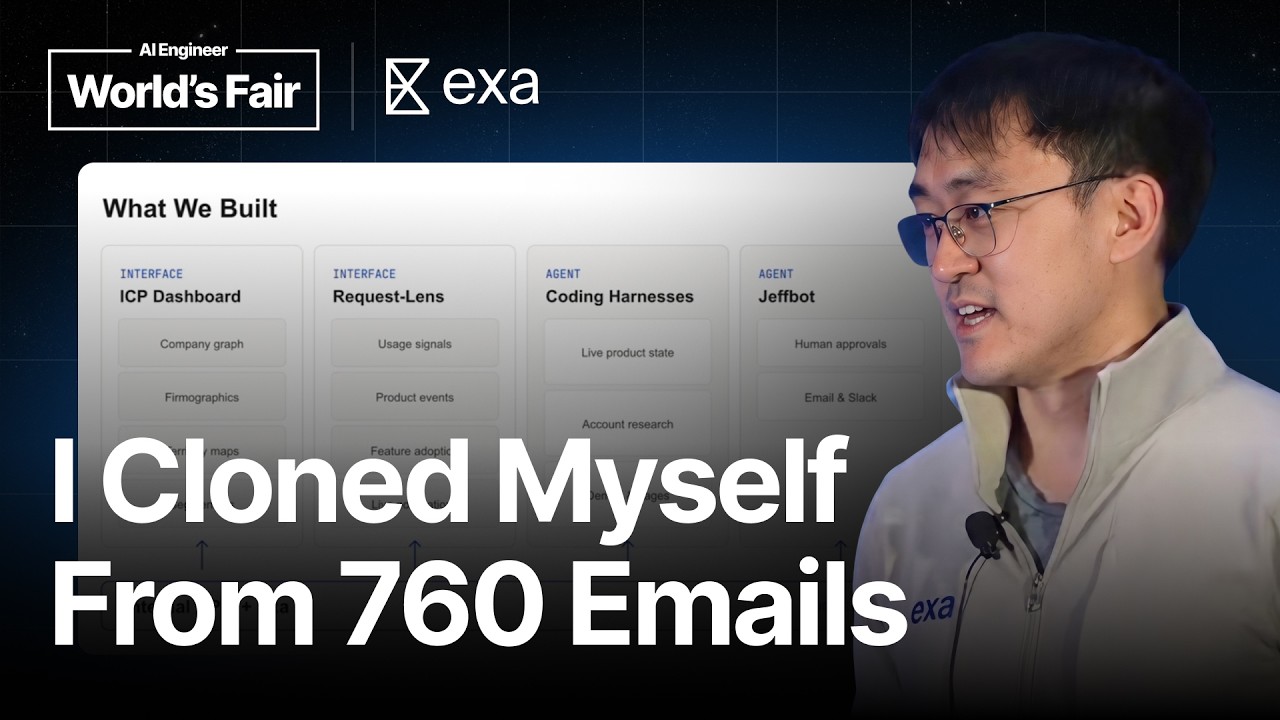
Jeffrey Wang argues that Go-To-Market (GTM) strategy must be treated as an AI engineering problem. The core thesis is that GTM is fundamentally a data problem, requiring the creation of a 'live model of your world' that autonomous agents can act upon. He details systems like Exa (a search engine for agents), the ICP dashboard for classifying the Total Addressable Market (TAM), and Request Lens for real-time customer signal detection. Key architectural principles include making the system API-first, recognizing that consistent UIs still complement flexible chatbots, and prioritizing arbitrary customizability over rigid build vs. buy decisions.

Key takeaways

  1. GTM as a Data Problem 4:56

    The goal is to build a live model of the world—combining internal data (customer usage) with external data (web activity, company information)—that agents can programmatically act on. This shifts GTM from a purely sales function to an engineering challenge.

  2. Agent-First Requires API-First 16:59

    For any agent system (whether it's a GUI or a chatbot) to access data, the underlying systems must expose robust programmatic interfaces (APIs). This is critical for enabling agents to function.

  3. System Components: ICP Dashboard & Request Lens 8:38

    The ICP dashboard uses Exa's embeddings over the internet to classify every company in the TAM and estimate anticipated spend. Request Lens provides real-time alerts when significant customer signals occur (e.g., signups, search surges).

  4. The Value of AI Cloning (Jeffbot) 13:42

    An agent can be trained on historical data to mimic a user's professional style and decision-making. Jeffbot was built by analyzing 760 emails and hundreds of past decisions, creating 'evals' to calibrate its judgment against the founder’s own behavior.

Watch on YouTube Full article

Intelligence + Continual Learning = Expertise — Yu Su, NeoCognition thumbnail

· 19:43

Intelligence + Continual Learning = Expertise — Yu Su, NeoCognition

The talk distinguishes between 'Intelligence' (the capacity to reason through unfamiliar problems from available context) and 'Expertise' (accumulated, situated competence). While modern LLM agents excel at symbolic tasks like coding because code is a structured language-native world, they struggle in heterogeneous real-world digital environments. The speaker posits that this difficulty represents a modern Moravec's paradox. To scale AI beyond basic capability, systems must implement continual learning to acquire specialized expertise for each 'microworld,' leading toward 'unbounded expertise from bounded intelligence.'

Key takeaways

  1. Intelligence vs. Expertise Distinction 3:50

    Intelligence is the ability to reason through novel problems given context, while expertise is accumulated competence that allows for efficient action and judgment in a specific domain (e.g., recognizing constraints beyond just finding a shared calendar slot).

  2. The Coding Agent Advantage 5:26

    Coding is an ideal first market for LLM agents because code is already symbolic and structured, providing clear tests and rewards. Leaving this 'privileged world of code' introduces significant brittleness.

  3. The Role of Continual Learning 10:44

    Continual learning is defined as the adaptive compression of experience into reusable structures for future behavior. It is presented as the critical bridge needed to transition from raw intelligence (brute-forcing solutions) to specialized expertise (compressing the search space).

Watch on YouTube Full article