Knowledge Systems: The New GTM Stack — Jeffrey Wang, Exa
Summary
Jeffrey Wang argues that Go-To-Market (GTM) strategy must be treated as an AI engineering problem. The core thesis is that GTM is fundamentally a data problem, requiring the creation of a 'live model of your world' that autonomous agents can act upon. He details systems like Exa (a search engine for agents), the ICP dashboard for classifying the Total Addressable Market (TAM), and Request Lens for real-time customer signal detection. Key architectural principles include making the system API-first, recognizing that consistent UIs still complement flexible chatbots, and prioritizing arbitrary customizability over rigid build vs. buy decisions.
Key takeaways
-
GTM as a Data Problem
4:56
The goal is to build a live model of the world—combining internal data (customer usage) with external data (web activity, company information)—that agents can programmatically act on. This shifts GTM from a purely sales function to an engineering challenge.
-
Agent-First Requires API-First
16:59
For any agent system (whether it's a GUI or a chatbot) to access data, the underlying systems must expose robust programmatic interfaces (APIs). This is critical for enabling agents to function.
-
System Components: ICP Dashboard & Request Lens
8:38
The ICP dashboard uses Exa's embeddings over the internet to classify every company in the TAM and estimate anticipated spend. Request Lens provides real-time alerts when significant customer signals occur (e.g., signups, search surges).
-
The Value of AI Cloning (Jeffbot)
13:42
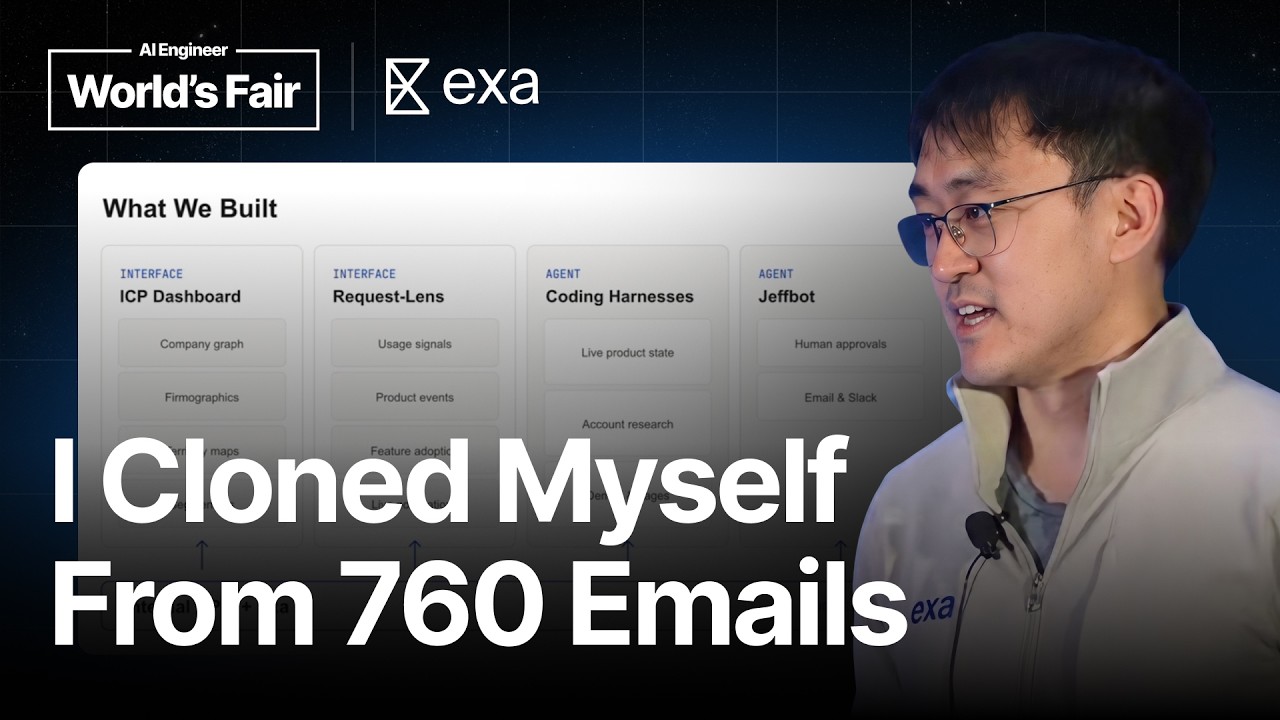
An agent can be trained on historical data to mimic a user's professional style and decision-making. Jeffbot was built by analyzing 760 emails and hundreds of past decisions, creating 'evals' to calibrate its judgment against the founder’s own behavior.
Technical details
-
Exa Architecture
580s
Exa is described as a 'search engine for agents.' Technically, it functions by taking the internet and training embeddings to provide arbitrarily powerful semantic filtering and slicing of data.
-
Agent Capabilities
1029s
Agents can be used across various workflows, such as account executives building demos or drafting communications (e.g., Jeffbot drafting Slack messages). The system must manage security boundaries; for instance, Jeffbot has full read/write access when called by the founder, but others are limited to drafting.
-
Decision Modeling
822s
To create a sophisticated agent clone (like Jeffbot), one must analyze historical artifacts—specifically decisions made in Slack and email—and generate 'evals' to calibrate the agent’s judgment.
Mentioned resources
- Exa
- Cursor
- Cognition
Channel & topics
Watch on YouTube · Back to latest
This independent, AI-assisted summary is provided for commentary and informational purposes. It may contain errors or omit important context. Please watch the original video for the creator's complete presentation. Video, thumbnail, and related copyrights belong to their respective owners.