Topic

Enterprise Architecture

All digests tagged Enterprise Architecture

500 Skills, Zero Fine-Tuning: LinkedIn's Playbook for AI Agents — Ajay Prakash, LinkedIn thumbnail

· 20:25

500 Skills, Zero Fine-Tuning: LinkedIn's Playbook for AI Agents — Ajay Prakash, LinkedIn

LinkedIn addressed the challenge of coding agents (LLMs) lacking context within massive, proprietary enterprise codebases. The solution involves 'contextual agent playbooks and tools' managed by an internal MCP (Model Context Platform) server. Instead of feeding all tools into the context, the system uses three meta-tools—Search, Get Schema, and Execute—to scale to thousands of tools and playbooks. Playbooks provide self-contained, structured instructions, enabling agents to perform complex, multi-step tasks reliably, and incorporating a self-improving loop where agents update stale documentation.

Key takeaways

  1. Focus on Reliability and Quality from Day One 20:00

    The system's success was predicated on prioritizing quality and reliability over mere productivity, ensuring the infrastructure does not degrade as the organization scales its use of AI agents.

  2. Build Dedicated Infrastructure for Agents 20:10

    In a large enterprise, simply providing the latest AI models and tools is insufficient; a dedicated, robust infrastructure is required to manage and guide agent operations within the internal system context.

Watch on YouTube Full article

Multiplayer AI Manifesto thumbnail

· 13:29

Multiplayer AI Manifesto

The video outlines a 'Multiplayer AI Manifesto,' detailing the necessary shift from siloed, single-user AI chats to collaborative, cloud-native agent sessions. This transition is driven by the need for true co-working experiences that eliminate context switching and data fragmentation (the 'context task tax'). The manifesto proposes five core principles—such as agents living next to the work surface and keeping learning open—to guide the development of highly productive, secure, and collaborative AI workflows.

Key takeaways

  1. The Need for Multiplayer AI

    Current single-player AI chats force users into a 'context task' workflow (e.g., copying code from GitHub to Claude, then pasting it to Slack). Multiplayer agents allow co-workers to interact with the same agent session simultaneously, eliminating this friction.

  2. The Five Principles of Multiplayer AI

    1. **Refuse to Copy and Paste:** Agents must live directly next to the work surface (e.g., in Notion or GitHub) rather than within a separate chat window. The agent must access all tools available to the human team. 2. **Work with the Door Open:** Collaboration requires open learning, where best practices and insights are shared publicly, accelerating collective knowledge gain (analogous to Shopify's 'River' system). 3. **Continuously Improve:** Learning from successful prompts or complex iterations should be automatically codified as a skill for the agent. 4. **People are not Routers; Agents are:** Humans must focus on high-value activities, while agents handle routing and answering repetitive project update questions. 5. **Nothing Starts from Scratch:** The entire agent session that generated an artifact (document, PR) must persist in the cloud to ensure continuity for team members.

  3. Technical Requirements & Security

    AI agents must reside entirely in the cloud and be managed by a robust boundary. This is crucial because local/laptop agents are insecure, cannot be preserved long-term, and prevent team access. Furthermore, strict governance (a 'black box' record) is required to track what data an agent accesses and which users interact with it.

Watch on YouTube Full article

From coding to Knowledge work agents — Karan Vaidya, Composio thumbnail

· 20:42

From coding to Knowledge work agents — Karan Vaidya, Composio

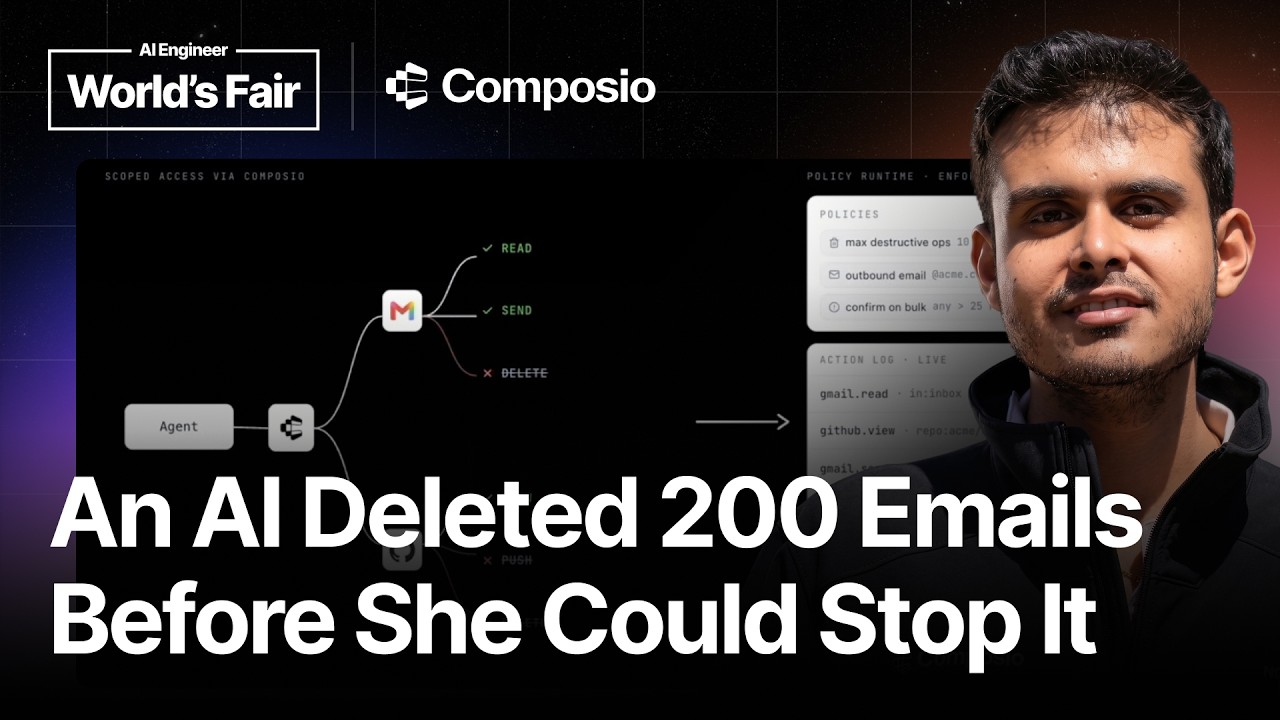
The presentation argues that while autonomous AI agents have excelled in software engineering due to inherent infrastructure support (e.g., Git history, CI/CD), knowledge work agents are currently limited because they lack comparable foundational systems. The speaker identifies six critical primitives—Centralization, History, Context, Verification, Governance, and Reversibility—that must be built into the enterprise layer to enable reliable AI agents for fields like sales and support.

Key takeaways

  1. The Infrastructure Gap

    Coding agents benefit from infrastructure (repo, commit history, tests, CI/CD) that was designed for automation. Knowledge work lacks this surrounding system, causing agents to operate 'blind' when applied outside of code bases.

  2. Centralization is Key 3:55

    Knowledge work data is typically scattered across multiple platforms (e.g., Salesforce, Notion, Gmail, Slack). Agents require a single source of truth—a centralized layer—to pull all necessary threads and connections before they can operate effectively.

  3. The Six Missing Primitives

    To bridge the gap between coding agents and knowledge work agents, six primitives must be built: Centralization (single data source), History (record of past actions), Context (organizational map + style guide), Verification (pre-action checks), Governance (deterministic boundaries/walls), and Reversibility (undo capability).

  4. Failure is Permanent in Knowledge Work 20:00

    Unlike code, where changes can be reverted or walked back, many knowledge work actions (sent emails, wire transfers) are irreversible. This shifts the risk profile, requiring agents to check their work *before* executing any destructive action.

Watch on YouTube Full article

How do you diffuse AI into the real world? — Varun Shenoy, Long Lake thumbnail

· 17:46

How do you diffuse AI into the real world? — Varun Shenoy, Long Lake

The deployment of advanced AI agents into real-world service industries is not merely a technological challenge but an operational one. Drawing parallels to the adoption of electricity and Ford's assembly line, the speaker argues that technology diffusion takes generations. Long Lake addresses this by acquiring and operating services businesses (e.g., property management) rather than selling software. Their approach focuses on building AI agents that move beyond simple 'co-pilots' to become autonomous 'co-workers,' leveraging proprietary ground truth data collected from messy, real-world tasks—a process requiring deep, physical co-design with the industry.

Key takeaways

  1. AI Diffusion Takes Generations 1:30

    The adoption of general-purpose technologies (GPTs) is slow. Just as electricity took decades to fully integrate into industries like Ford's, AI requires massive operational shifts—ripping out old processes and retraining staff—to achieve full diffusion. [1:30]

  2. The Value of Owning the Outcome 2:36

    Long Lake does not sell AI software; they acquire and operate services businesses (e.g., HOA, architecture). By being the operator/owner, they bear the risk when the AI fails, ensuring deep integration and accountability that external vendors cannot match. [2:36]

  3. The Progression from Co-pilot to Co-worker 6:18

    AI agents must progress through stages of autonomy: Co-pilot (simple RAG chatbot) $ ightarrow$ Synchronous Agent (real-time, two-way interaction) $ ightarrow$ Asynchronous Agent (background work, external triggers) $ ightarrow$ Long-running Agent $ ightarrow$ AI Co-worker (proactive partner). Achieving the co-worker requires earning the right to do more through iterative field deployment. [6:02]

Watch on YouTube Full article

Agents Aren't Taking Your Jobs. They're Creating More Work Instead. thumbnail

· 31:14

Agents Aren't Taking Your Jobs. They're Creating More Work Instead.

AI agents are generating significantly more work for humans—an 'agent management tax'—rather than eliminating it. The complexity of managing these agents scales dramatically from individual use to enterprise deployment. While verifiable domains (like legal or coding) show rapid adoption due to clear success criteria, small businesses often struggle with limited capital and resources. Enterprises gain a significant advantage by having dedicated teams for agent governance, security, and deep integration, which is necessary to manage the increased complexity.

Key takeaways

  1. Agents create work, they don't eliminate it

    The common assumption that agents will reduce headcount is incorrect. Data shows agent token usage is increasing rapidly (e.g., 14-fold between February and August on Open Router), with agents burning more than five tokens for every one a human burns. This necessitates new management roles.

  2. The role shifts to 'Above the Loop' 20:00

    As agents improve, the human job is shifting from execution to oversight: deciding what runs, providing context/permissions, checking results, and intervening when failure occurs. This requires domain knowledge (e.g., legal expertise) to validate outcomes.

  3. Enterprise advantage lies in capital and structure 24:19

    Enterprises report better returns because they can afford dedicated teams (security, quality control, product management) to handle the complex setup, monitoring, and integration required for agent deployment. This deep investment is necessary for scaling.

  4. SMBs must focus on verifiable domains 28:20

    Small businesses struggle when agents are used in non-verifiable domains (e.g., general business operations). Success requires finding processes they already perform manually and letting the agent handle only the preparatory steps.

Watch on YouTube Full article

Stripe buys OpenRouter, Ramp’s AI Index & IBM’s OpenAI deal thumbnail

· 35:52

Stripe buys OpenRouter, Ramp’s AI Index & IBM’s OpenAI deal

The AI market is shifting from a focus on model superiority to infrastructure orchestration and governance. Key developments include IBM establishing itself as an enterprise AI integrator through partnerships with both OpenAI and Anthropic (1:01). Stripe's acquisition of OpenRouter positions token routing as the critical 'profitability infrastructure,' suggesting that controlling the flow of compute decisions is more valuable than developing models themselves (11:46). Furthermore, data from Ramp suggests a market maturity where businesses are moving away from per-seat AI spending toward measuring cost per unit work and implementing rigorous FinOps practices to manage escalating token costs (22:39).

Key takeaways

  1. IBM's Enterprise Orchestration Strategy 2:12

    IBM is positioning itself as a neutral enterprise AI orchestrator by forming partnerships with both OpenAI and Anthropic. This strategy aims to provide clients with choice, utilizing IBM’s proprietary Granite models alongside external leaders for governance and integration within legacy systems (1:01).

  2. The Rise of the Model Router as Infrastructure 11:42

    Stripe's acquisition of OpenRouter is framed as a bet on 'profitability infrastructure.' Since models are becoming cheaper, the value shifts to the routing layer—the ability to manage and optimize token traffic across multiple providers (11:46). This allows Stripe to act as a payment gateway for autonomous AI agents.

  3. AI Spending Shifts from Per-Seat to Unit Cost 23:30

    Ramp's data indicates that the era of unmetered, per-employee AI experimentation is ending. CFOs now demand measurable unit economic payback (e.g., cost per resolved support ticket) rather than simply approving broad AI software budgets (22:39).

Watch on YouTube Full article

IT Admin for the AI Workforce — Sarthak Aggarwal, Decawork thumbnail

· 16:17

IT Admin for the AI Workforce — Sarthak Aggarwal, Decawork

Enterprises are adopting autonomous AI agents as a 'second workforce,' shifting focus from model behavior to operational safety and governance. The core challenge is managing agents that possess tools, private data, and delegated authority. To mitigate risks—exemplified by incidents like the Replit breach and zero-click CVEs like EchoLeak—the architecture must implement robust identity standards and strict privilege separation, ensuring that planning (intent) is separated from execution (action).

Key takeaways

  1. Capability vs. Employment Readiness 1:48

    A working demo only proves capability; it does not prove employment readiness. An agent with a goal, tools, private data, and delegated authority acts as an 'actor,' requiring governance controls like identity, owner definition, policy scoping, and reliable revocation.

  2. The Need for Agent Identity Standards 4:08

    Current identity systems (like OAuth token exchange) provide the right shape but lack a dedicated agent identity standard. Agents require a defined lifecycle—provisioning, authorization, monitoring, and revocation—mirroring human employee management.

  3. Privilege Separation Architecture

    To ensure bounded authority, the system must separate trusted intent from untrusted content processing. The Planner turns authenticated intent into a typed, logged plan, while the Executor runs that plan without holding standing credentials, preventing actions outside the defined scope.

Watch on YouTube Full article

Why Your Enterprise Tech Stack Isn’t Ready for AI Agents — Christopher Lovejoy & Saul Howard thumbnail

· 19:15

Why Your Enterprise Tech Stack Isn’t Ready for AI Agents — Christopher Lovejoy & Saul Howard

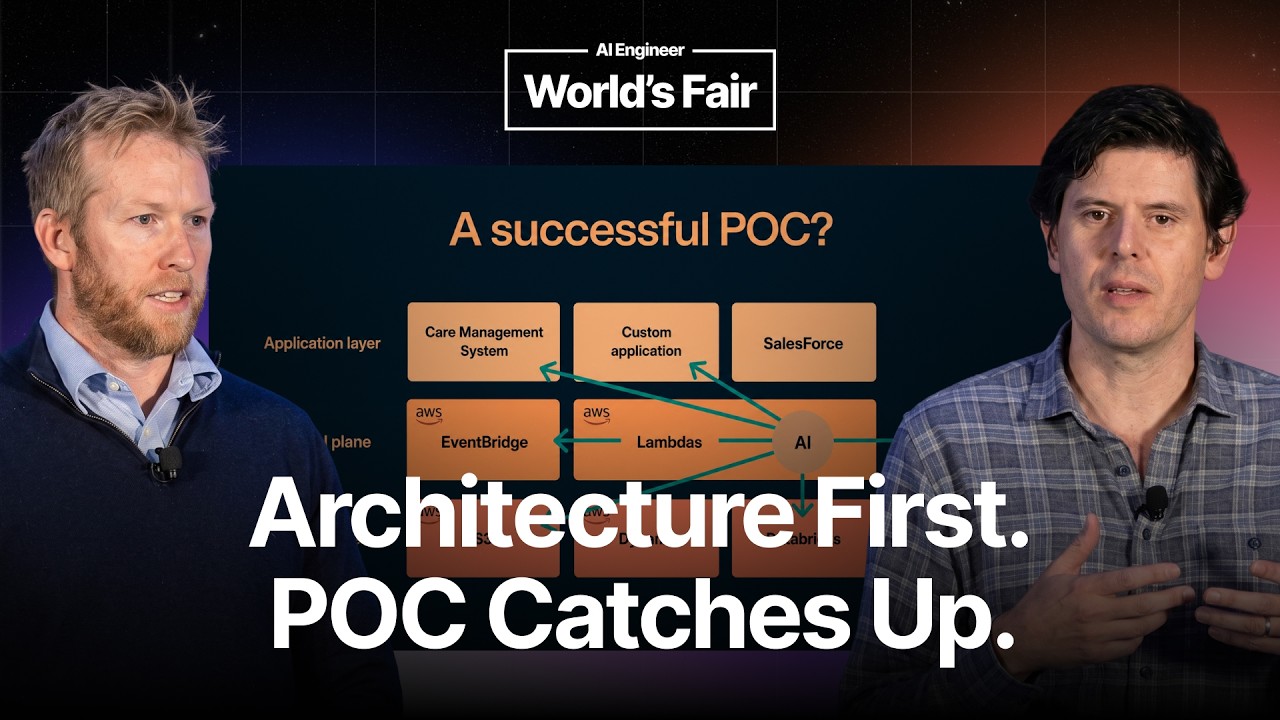
The talk addresses why traditional enterprise tech stacks are insufficient for deploying AI agents in highly regulated industries like healthcare. The core argument is that focusing on achieving high accuracy during a Proof of Concept (POC) often leads to architectural debt when attempting productionization. To build scalable, compliant systems, engineers must prioritize non-functional requirements—specifically auditability, data security, and human oversight—from the outset. This requires adopting specialized primitives: immutable event logs, schema-driven object storage for sensitive data, and treating humans and models as equivalent agents.

Key takeaways

  1. Audit Trail vs. Developer Log 0:05

    In regulated environments (e.g., HIPAA, SOC 2), an audit trail must be a complete record of every action taken by the agent, every place it accessed data, and the authorization behind each step—not merely a developer log like those found in DataDog [5:19].

  2. Prioritize Constraints Over Accuracy 0:12

    Engineers should take regulatory constraints seriously first (e.g., auditability) and design the architecture around them, rather than bolting compliance requirements onto a high-performing POC [12:07].

  3. The Three Architectural Primitives 0:08

    Effective AI agent systems require three core primitives: an immutable append-only event log (for state tracking), schema-driven object storage (for data separation and Zero Trust), and human/model agent equivalency (for seamless escalation) [8:30].

  4. Evals as a Byproduct 0:10

    By implementing these three primitives, robust evaluation (evals) can emerge naturally—allowing for action replay, testing on production data without exposure, and comparing human vs. model performance—rather than being an afterthought [10:37].

Watch on YouTube Full article

AI tools for Forward Deployed Engineering — Vasuman Moza, Varick Agents thumbnail

· 20:23

AI tools for Forward Deployed Engineering — Vasuman Moza, Varick Agents

The core bottleneck in enterprise AI adoption is not model intelligence or execution capability, but rather the ability to deeply understand and re-engineer complex, undocumented human business processes. Forward Deployed Engineers (FDEs) are critical for this process, mapping existing workflows—including edge cases and handoffs—and building autonomous agents on top of legacy systems (e.g., SAP, NetSuite). The technical solution involves using a Veric OS platform that builds agents on existing systems without requiring costly migrations, leveraging dependency graphs, and employing custom post-trained models to extract accurate context from messy enterprise data.

Key takeaways

  1. The AI Bottleneck is Context, Not Execution

    While modern LLMs can solve the execution of work (intelligence constraint), the primary bottleneck remains understanding the unique business processes within a specific company. Every department (e.g., healthcare sales vs. SaaS sales) operates differently, requiring deep context extraction.

  2. Forward Deployed Engineering (FDE) Role 7:24

    FDEs are responsible for mapping how humans currently perform work and then re-engineering the process around AI. This ensures that AI solutions are adoptable and deliver measurable, department-wide ROI rather than failing as isolated 'point solutions.'

  3. Non-Disruptive Deployment Strategy 17:02

    To overcome enterprise resistance to migration (e.g., spending $5 million over five years on NetSuite), agents must be built *on top* of existing systems of record (Salesforce, SAP, Dynamics) rather than requiring a full system overhaul.

  4. Agent Tooling for FDEs

    The Veric platform provides specialized tools: an Engagement Agent (assistant to synthesize notes/docs), and a Workflow Agent that ensures the constructed workflow correctly shadows real-world process edge cases. A future autonomous assistant will handle minor changes without human intervention.

Watch on YouTube Full article

Simon Martinelli - Lessons from Spec-driven Development - AI Native DevCon June 2026 thumbnail

· 31:39

Simon Martinelli - Lessons from Spec-driven Development - AI Native DevCon June 2026

The talk introduces the AI Unified Process, a spec-driven approach designed to combat code and specification drift in large, long-lived enterprise applications. Instead of treating code as the source of truth, this method uses system use cases (specifically SysML use cases) and domain/entity models as stable contracts. AI is leveraged not for full regeneration, but for generating and updating code and tests incrementally from these specifications, enabling modernization efforts that are more robust than simple 'lift and shift' migrations.

Key takeaways

  1. Spec-Driven Development (SDD) as the Source of Truth 21:33

    System use cases act as a stable contract for application behavior. Code is derived from these specs, ensuring that changes are managed through formal requirements updates rather than relying solely on code maintenance.

  2. Modernization via Specification Extraction 23:50

    For modernization projects (e.g., ERP systems), the process involves reverse-engineering use cases and entity models from existing documentation, code, and tests. This allows for feature integration without being limited to a simple technology migration.

  3. Architectural Shift: Self-Contained Systems 27:20

    To effectively use AI in large systems, the architecture should move away from overly distributed microservices (which create context management issues) toward 'Self-contained systems'—vertical splits that keep UI, business logic, and database within a single project or application.

Watch on YouTube Full article

I Cut the Internet and Let AI Read the File I Could Never Upload. It Caught the Leak. thumbnail

· 14:04

I Cut the Internet and Let AI Read the File I Could Never Upload. It Caught the Leak.

This video details methods for running AI models locally on sensitive documents while completely disconnected from the internet ('air-gapping'). The core problem addressed is data leakage risk when uploading proprietary or PII-containing files to cloud AI providers. Solutions range from using open-source tools like LM Studio with downloaded, local models (e.g., GPT-OSS Safeguard 20B) to sophisticated enterprise methods utilizing Azure and LoRA for fine-tuning within a controlled boundary.

Key takeaways

  1. Local AI Processing Capability

    It is possible to run downloaded, open-weight models on a laptop with Wi-Fi disabled. These local models can scan documents for private material (PII, financial data, legal notes) and mask it without sending any data over the network.

  2. Enterprise Adoption of Local AI

    Large companies like Discovery Bank and Bayer are implementing specialized, fine-tuned models (on-premise/Azure) to handle confidential information. This approach allows for faster processing while keeping proprietary data within a controlled boundary.

  3. The Risk of Cloud Dependence 5:13

    Even if an AI model claims it did not look at a file, the logs may show that the entire repository was uploaded to the provider (e.g., Grok build leak), emphasizing the need for hard guardrails like air-gapping.

  4. LoRA and Enterprise Tuning

    Microsoft uses Low-Rank Adaptation (LoRA) to fine-tune models by adjusting only a subset of parameters, allowing large clients to create highly specialized models that outperform general cloud providers for specific tasks.

Watch on YouTube Full article

POC Prison: Why agentic systems never escape the lab and how to fix that in 90 days - Luise Freese thumbnail

· 56:48

POC Prison: Why agentic systems never escape the lab and how to fix that in 90 days - Luise Freese

The talk argues that most agentic AI systems fail to move from Proof-of-Concept (POC) to production because they are blocked not by model limitations, but by fundamental organizational and governance realities. The speaker proposes a structured, 90-day program focused on building the 'paved road'—an operational backbone—to ensure agents can run safely in messy, legacy enterprise environments with clear accountability.

Key takeaways

  1. The POC Prison Problem 17:05

    POCs are often temporary, unmeasured, and reversible experiments that fail because they lack a defined path to production ownership. This creates an 'AI zombie' state where the system exists but delivers no measurable value or transformation.

  2. The Three Pillars of Enterprise Readiness 24:10

    Successful deployment requires addressing technical, organizational, and cultural gaps. The biggest hurdles are unclear ownership (who owns it when it breaks?), lack of dedicated funding for operations, and a culture that rewards demos over deployment frequency.

  3. The 90-Day Transition Program 29:10

    To escape the POC prison, implement a structured 90-day program: (1) Document current reality (ugly processes/data); (2) Achieve commitment and accountability by selecting one initiative; (3) Deploy into real systems under supervision to build the paved road.

  4. Governance Must Be Code 38:20

    Compliance and governance cannot live in slide decks or meetings. They must be embedded directly into the delivery process (e.g., 'governance as code'), making rules executable, auditable, and non-negotiable.

Watch on YouTube Full article