Why Your Enterprise Tech Stack Isn’t Ready for AI Agents — Christopher Lovejoy & Saul Howard
Summary
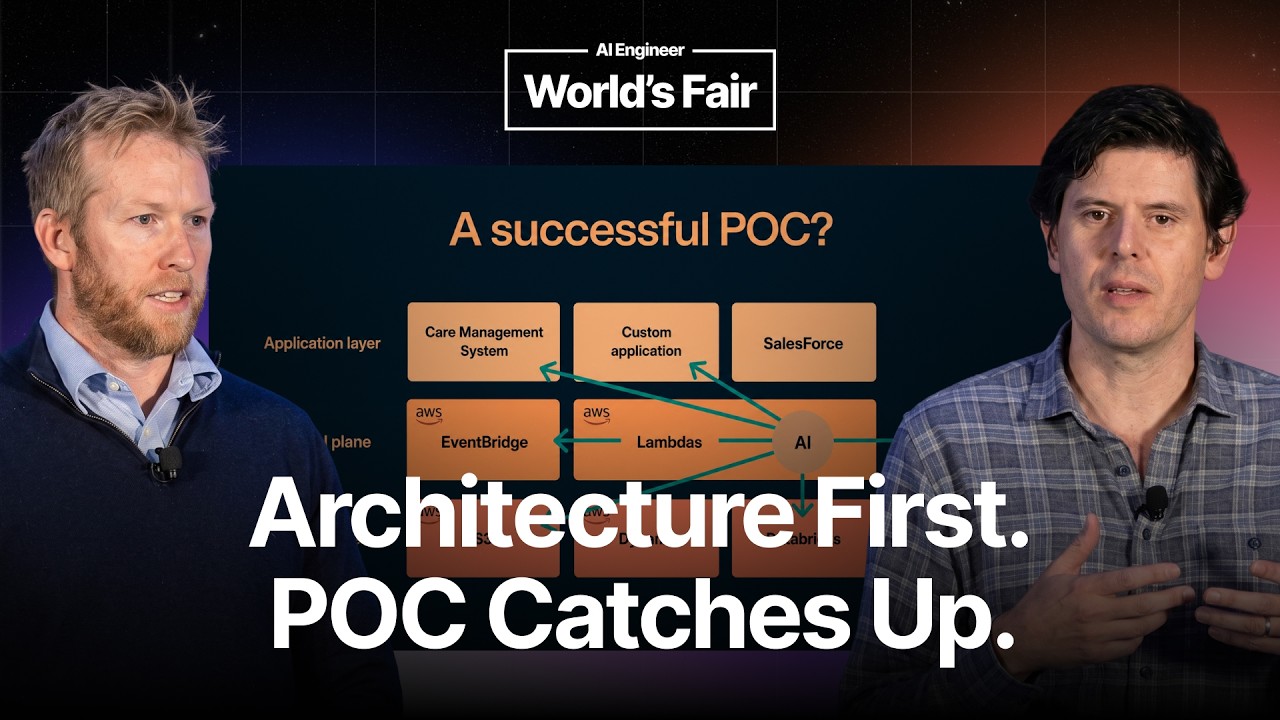
The talk addresses why traditional enterprise tech stacks are insufficient for deploying AI agents in highly regulated industries like healthcare. The core argument is that focusing on achieving high accuracy during a Proof of Concept (POC) often leads to architectural debt when attempting productionization. To build scalable, compliant systems, engineers must prioritize non-functional requirements—specifically auditability, data security, and human oversight—from the outset. This requires adopting specialized primitives: immutable event logs, schema-driven object storage for sensitive data, and treating humans and models as equivalent agents.
Key takeaways
-
Audit Trail vs. Developer Log
0:05
In regulated environments (e.g., HIPAA, SOC 2), an audit trail must be a complete record of every action taken by the agent, every place it accessed data, and the authorization behind each step—not merely a developer log like those found in DataDog [5:19].
-
Prioritize Constraints Over Accuracy
0:12
Engineers should take regulatory constraints seriously first (e.g., auditability) and design the architecture around them, rather than bolting compliance requirements onto a high-performing POC [12:07].
-
The Three Architectural Primitives
0:08
Effective AI agent systems require three core primitives: an immutable append-only event log (for state tracking), schema-driven object storage (for data separation and Zero Trust), and human/model agent equivalency (for seamless escalation) [8:30].
-
Evals as a Byproduct
0:10
By implementing these three primitives, robust evaluation (evals) can emerge naturally—allowing for action replay, testing on production data without exposure, and comparing human vs. model performance—rather than being an afterthought [10:37].
Technical details
-
Immutable Event Logging (Event Sourcing)
5s
Adopting a transaction log or event sourcing pattern makes auditability trivial, as the system's source of truth is a complete, immutable, append-only record of all events. The trade-off is that writes are easy, but reads require reconstructing views from the sequence of events [6:19].
-
Schema-Driven Object Storage & Data Separation
7s
Sensitive data (like PHI) should reside in schema-driven object storage, separate from the event log. The events only contain references to these immutable blobs. This separation allows developers to debug agent steps without accessing the sensitive health data itself, and enables Zero Trust principles by requiring agents to use tokens for point-of-use access [7:28].
-
Human Agent Equivalency
9s
To handle dynamic escalation, the system must define a wide definition of 'agent' that encompasses both LLMs and humans. This ensures any action taken by an agent can be performed or understood by a human counterpart, maintaining continuity in the decision chain [9:45].
-
Zero Trust Architecture
8s
By segregating object storage from the event stream, Zero Trust principles can be enforced. Agents must bear tokens to access data at the point of use, preventing unauthorized lateral data flow within the system [8:30].
Mentioned resources
- Anterior
- Epic
- Salesforce
Channel & topics
Watch on YouTube · Back to latest
This independent, AI-assisted summary is provided for commentary and informational purposes. It may contain errors or omit important context. Please watch the original video for the creator's complete presentation. Video, thumbnail, and related copyrights belong to their respective owners.