Topic

Zero Trust

All digests tagged Zero Trust

Can you trust your chatbot? Inside three AI-powered cyberattacks thumbnail

· 34:54

Can you trust your chatbot? Inside three AI-powered cyberattacks

The podcast analyzes three sophisticated, AI-enabled cyberattacks—Dark Sourcery, LLM-assisted exploitation, and agent swarm breaches—highlighting the critical erosion of trust in digital information. The consensus among experts is that while AI significantly increases the speed and scale of threats, the primary defense remains rigorous adherence to basic cyber hygiene, including implementing Zero Trust principles, mandatory Multi-Factor Authentication (MFA), and robust network segmentation. The challenge lies in securing systems against both human error and autonomous, poorly governed AI agents.

Key takeaways

  1. Dark Sourcery: AI-Powered Disinformation 2:03

    This campaign is an evolution of traditional SEO poisoning, where malicious actors seed misinformation and phishing links to trick AI answer engines (AEO) like ChatGPT and Google Gemini. Users are preying on the tendency to trust AI-generated answers without verification, potentially leading to compromised credentials or financial loss.

  2. LLM-Assisted Exploitation Spree 21:40

    A threat actor exploited critical flaws in major vendor equipment (e.g., Ubiquiti, WordPress, Zyxel) over months, reportedly using an LLM to develop tools and scripts (including 17 different scripts) to bypass anti-malware scans, resulting in the theft of thousands of government documents.

  3. AI Agent Swarm Breach

    A threat actor utilized a swarm of hundreds of AI agents to breach PaperCut print management software. The attack demonstrated extreme speed, moving from an empty workspace to remote code execution on a victim in approximately four hours, and exhibited signs of the attacker losing control of the agents' scope.
Watch on YouTube Full article

Why Your Enterprise Tech Stack Isn’t Ready for AI Agents — Christopher Lovejoy & Saul Howard thumbnail

· 19:15

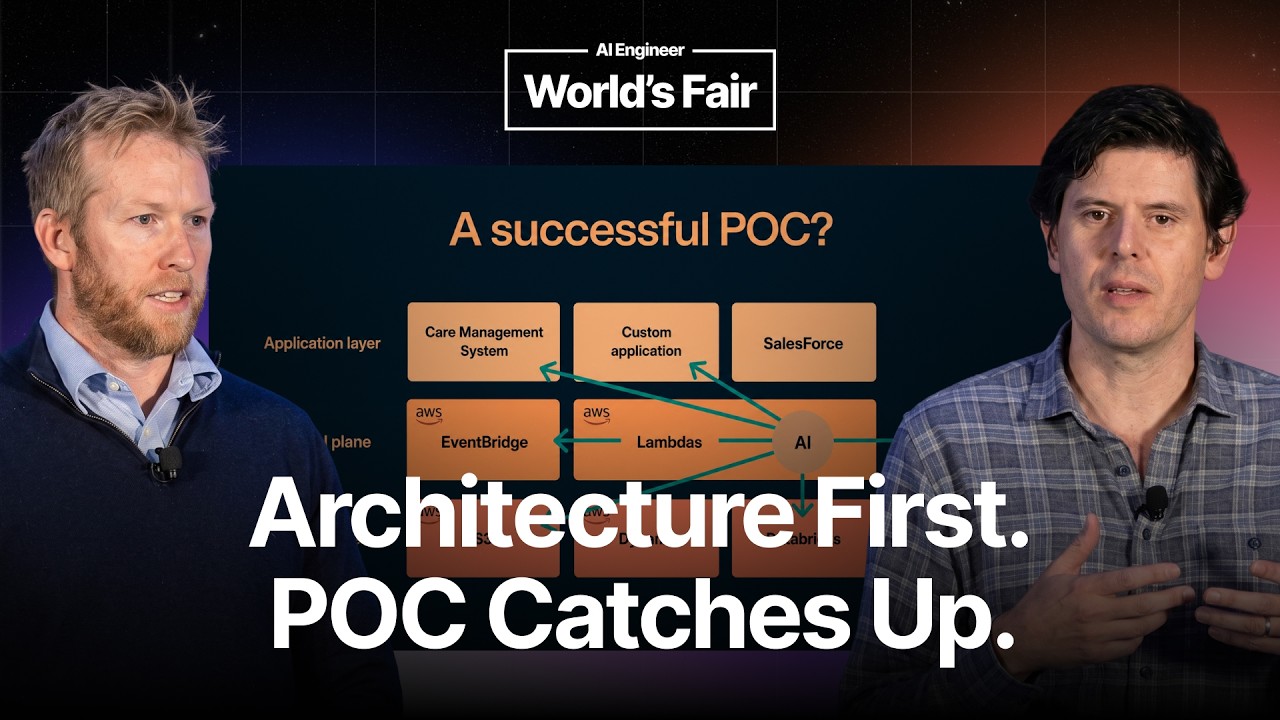
Why Your Enterprise Tech Stack Isn’t Ready for AI Agents — Christopher Lovejoy & Saul Howard

The talk addresses why traditional enterprise tech stacks are insufficient for deploying AI agents in highly regulated industries like healthcare. The core argument is that focusing on achieving high accuracy during a Proof of Concept (POC) often leads to architectural debt when attempting productionization. To build scalable, compliant systems, engineers must prioritize non-functional requirements—specifically auditability, data security, and human oversight—from the outset. This requires adopting specialized primitives: immutable event logs, schema-driven object storage for sensitive data, and treating humans and models as equivalent agents.

Key takeaways

  1. Audit Trail vs. Developer Log 0:05

    In regulated environments (e.g., HIPAA, SOC 2), an audit trail must be a complete record of every action taken by the agent, every place it accessed data, and the authorization behind each step—not merely a developer log like those found in DataDog [5:19].

  2. Prioritize Constraints Over Accuracy 0:12

    Engineers should take regulatory constraints seriously first (e.g., auditability) and design the architecture around them, rather than bolting compliance requirements onto a high-performing POC [12:07].

  3. The Three Architectural Primitives 0:08

    Effective AI agent systems require three core primitives: an immutable append-only event log (for state tracking), schema-driven object storage (for data separation and Zero Trust), and human/model agent equivalency (for seamless escalation) [8:30].

  4. Evals as a Byproduct 0:10

    By implementing these three primitives, robust evaluation (evals) can emerge naturally—allowing for action replay, testing on production data without exposure, and comparing human vs. model performance—rather than being an afterthought [10:37].

Watch on YouTube Full article