Topic

Salesforce

All digests tagged Salesforce

How AI Agents Let GTM Teams Scale — Justin Joyce, Cloudflare thumbnail

· 19:15

How AI Agents Let GTM Teams Scale — Justin Joyce, Cloudflare

Justin Joyce details how Cloudflare utilizes a three-pillar approach powered by AI agents to solve scaling issues in traditional Go-To-Market (GTM) operations. The core problem—that manual processes and knowledge gaps limit efficiency—is addressed by building self-service capabilities, automating data analysis, and proactively pushing insights to users. This framework allows non-technical staff to query complex data using 'skill files' and enables reps to access expert-level information via an internal agentic workspace (Cloudflare OS).

Key takeaways

  1. The GTM Scaling Problem 5:20

    Traditional GTM processes suffer from the 'context gap' (switching between different customer calls) and the 'expert gap' (inconsistent execution among reps), leading to significant inefficiency. Back-office teams often rely on manual work in Excel or limited dashboards, which fail to meet all operational needs.

  2. Pillar 1: Scaling Analysis via Skill Files 10:53

    To empower non-SQL users, the team built role-specific 'skill files.' These allow business users to ask questions of data directly and quickly, eliminating bottlenecks that previously required a dedicated data engineer. This capability is used both for back-office analysis and building GTM skills.

  3. Pillar 2: Scaling Insight (Pushing the Story) 15:00

    Instead of forcing users to search dashboards, insights are proactively delivered through synthetic weekly summaries. This is achieved by transforming data dimensions (time, manager, metric) and using a multi-agent workflow: a first draft agent, a second reviewer agent for veracity checks, and a third 'tone agent' that crafts the message, ensuring risks and opportunities are weighted equally.

  4. Pillar 3: Self-Service via Cloudflare OS 17:15

    The internal tool, Cloudflare OS, is an agentic workspace running on Workers and Durable Objects. It allows GTM teams to perform complex tasks—such as building QBR decks, account plans, or forecast briefs—by interacting with curated expert skills without needing manual intervention.
Watch on YouTube Full article

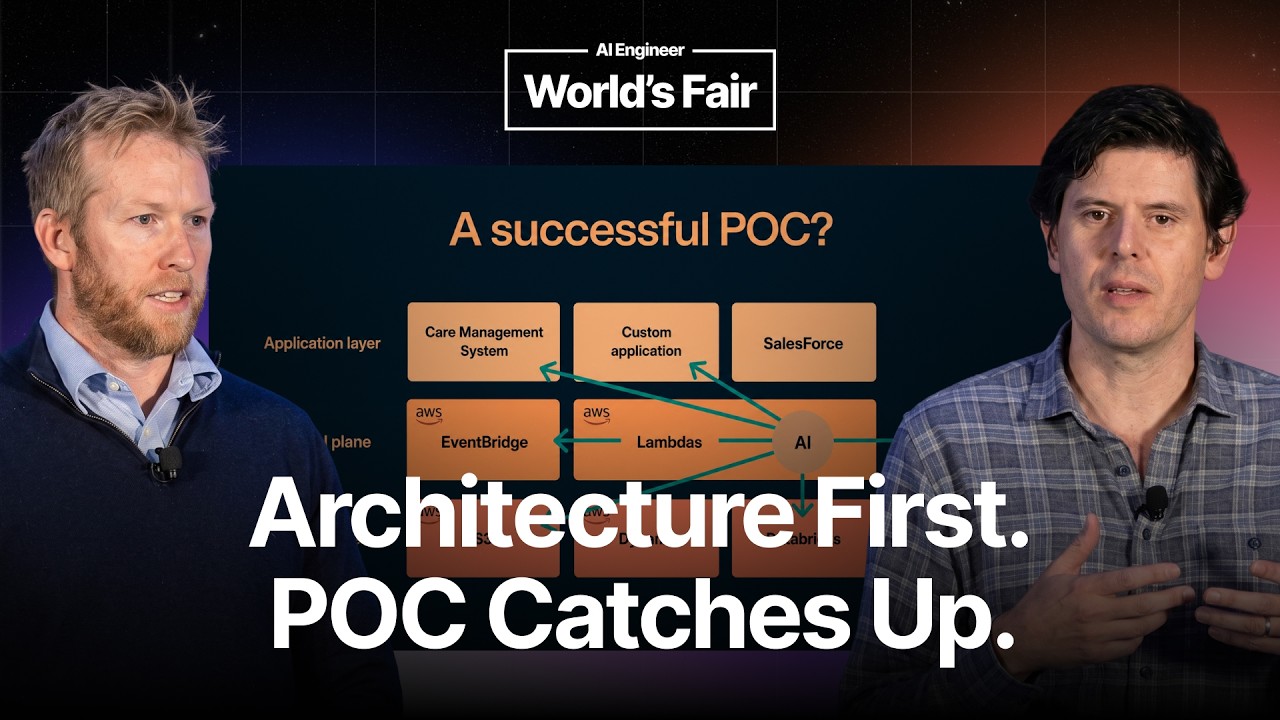
Why Your Enterprise Tech Stack Isn’t Ready for AI Agents — Christopher Lovejoy & Saul Howard thumbnail

· 19:15

Why Your Enterprise Tech Stack Isn’t Ready for AI Agents — Christopher Lovejoy & Saul Howard

The talk addresses why traditional enterprise tech stacks are insufficient for deploying AI agents in highly regulated industries like healthcare. The core argument is that focusing on achieving high accuracy during a Proof of Concept (POC) often leads to architectural debt when attempting productionization. To build scalable, compliant systems, engineers must prioritize non-functional requirements—specifically auditability, data security, and human oversight—from the outset. This requires adopting specialized primitives: immutable event logs, schema-driven object storage for sensitive data, and treating humans and models as equivalent agents.

Key takeaways

  1. Audit Trail vs. Developer Log 0:05

    In regulated environments (e.g., HIPAA, SOC 2), an audit trail must be a complete record of every action taken by the agent, every place it accessed data, and the authorization behind each step—not merely a developer log like those found in DataDog [5:19].

  2. Prioritize Constraints Over Accuracy 0:12

    Engineers should take regulatory constraints seriously first (e.g., auditability) and design the architecture around them, rather than bolting compliance requirements onto a high-performing POC [12:07].

  3. The Three Architectural Primitives 0:08

    Effective AI agent systems require three core primitives: an immutable append-only event log (for state tracking), schema-driven object storage (for data separation and Zero Trust), and human/model agent equivalency (for seamless escalation) [8:30].

  4. Evals as a Byproduct 0:10

    By implementing these three primitives, robust evaluation (evals) can emerge naturally—allowing for action replay, testing on production data without exposure, and comparing human vs. model performance—rather than being an afterthought [10:37].

Watch on YouTube Full article