Topic

Workflow Automation

All digests tagged Workflow Automation

Anthropic's CCA Exam as a Field-Guide for Agentic Engineering — Frank Coyle, UC Berkeley thumbnail

· 20:08

Anthropic's CCA Exam as a Field-Guide for Agentic Engineering — Frank Coyle, UC Berkeley

The presentation uses Anthropic's Claude Certified Architect (CCA) exam structure to guide engineers through agentic AI best practices by focusing on anti-patterns. Key principles include mastering 'agentic loops' over simple sequences, ensuring specialized subagents only have limited tools, and rigorously managing context via techniques like forking and compaction to prevent groupthink and token overflow.

Key takeaways

  1. Prioritize Looping Mechanisms 12:30

    Agentic workflows should leverage loops (e.g., `while true`) rather than simple sequences, as looping provides the necessary power for complex computation, paralleling the foundational concepts of Turing completeness.

  2. Use Stop Reasons for Control 7:40

    Instead of blindly using an agent's response, robust workflows must branch logic based on the model's `stop reason`. This is crucial because the LLM cannot execute tools; it only provides parameters that external code must run.

  3. Specialize Agents and Tools 15:30

    Avoid 'overloading' a single agent with all available tools. Specialized subagents, each equipped with one or two specific tools, are significantly more effective and maintain focus.

  4. Manage Context Isolation

    To prevent context pollution and 'groupthink,' isolate subtask outputs (e.g., using a 'context fork') so that only necessary summaries return to the main thread, preventing unbounded context growth.

Watch on YouTube Full article

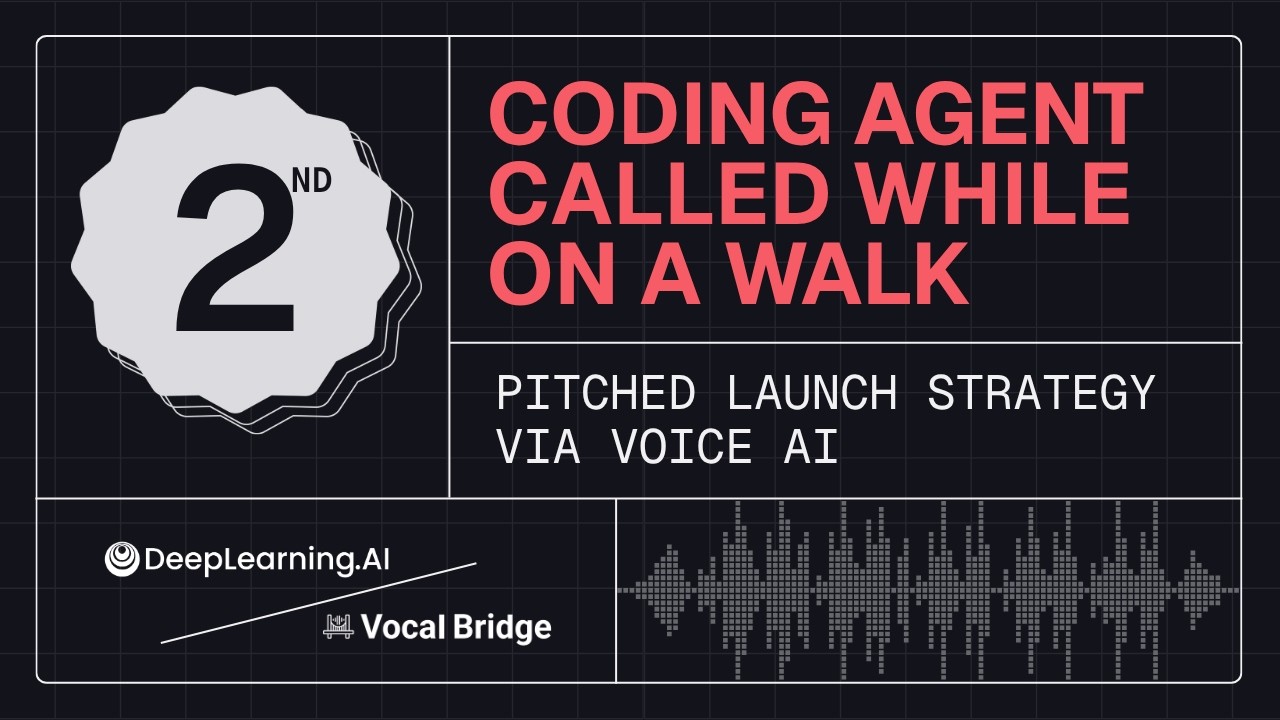
2nd Place Winner: Coding Agent Calls Developer to Pitch Launch Strategy thumbnail

· 5:12

2nd Place Winner: Coding Agent Calls Developer to Pitch Launch Strategy

The video demonstrates an autonomous AI agent designed for product positioning strategy that operates while the developer is away (AFK). The agent handles routine tasks but utilizes a defined escalation matrix to call the human developer only when faced with non-reversible, high-stakes decisions. This process not only facilitates real-time discussion via voice call but also ensures all resulting decisions and follow-up action items are automatically logged back into the project documentation for transparency.

Key takeaways

  1. Autonomous AFK Operation

    The agent is instructed to run autonomously, completing all tasks it can handle without human intervention. It also checks working hours to prevent calling outside designated times.

  2. Strategic Escalation Matrix 1:40

    When the agent reaches a critical decision point (e.g., Lead on Value vs. Lead on Price), it triggers an escalation, presenting structured options and recommendations rather than asking for generic input.

  3. Decision Logging and Transparency

    Following the human decision (e.g., 'Lead on Value'), the agent automatically logs the approved decision and creates a follow-up task (e.g., 'follow up in 7 days') directly into the project files, ensuring decisions are never lost within transcripts.

Watch on YouTube Full article

From complex docs to decision ready context for agentic financial workflows thumbnail

· 1:05:19

From complex docs to decision ready context for agentic financial workflows

The webinar details how LlamaIndex enables the creation of sophisticated document agents for financial services by transforming complex, unstructured data (PDFs, images, etc.) into accurate, decision-ready context. The platform provides a comprehensive workflow—including parsing, extraction, and indexing—to automate historically manual processes in areas like Private Equity deal analysis, corporate lending, and mortgage servicing. Key features include advanced layout analysis for tables/charts, cross-document reconciliation, and robust human-in-the-loop validation.

Key takeaways

  1. Context is the foundation of agentic workflows 3:55

    Successful AI agents are highly dependent on accurate context. The platform's mission is to make previously untapped, unstructured data accessible by providing high accuracy and low cost in document processing.

  2. Three core financial use cases demonstrated 10:30

    The solution covers Private Equity (LBO modeling from deal room dumps), Corporate Lending (processing credit packets like ABL agreements and financials), and Mortgage Servicing (analyzing loan packages including deeds of trust, appraisals, and disclosures).

  3. Workflow relies on multi-stage processing 11:45

    The process moves from document arrival through intelligent classification/splitting $\rightarrow$ optimal parsing (LlamaParse) $\rightarrow$ targeted extraction (LlamaExtract) $\rightarrow$ cross-validation and grounding, culminating in a structured output for downstream modeling.

Watch on YouTube Full article

Perception Agents — Antje Barth, Amazon AGI Lab thumbnail

· 21:45

Perception Agents — Antje Barth, Amazon AGI Lab

Current AI agents excel at discrete tasks like clicking or calling APIs but fail in complex, end-to-end knowledge work because they lack reliable perception and verification capabilities. The talk introduces 'Perception Agents,' which close the architectural gap by enabling agents to perceive rendered UIs (not just underlying code), maintain shared context, and verify their own output against design specs or user flows, mimicking human collaboration.

Key takeaways

  1. The Gap in Agent Capability

    Current agents struggle with end-to-end workflows because the 'real work' lives within the seams of multiple applications. While they can perform individual steps, they cannot manage the full process reliability required for critical tasks (e.g., deleting a database).

  2. The Need for Reliability and Verification 3:50

    Unlike code, which is verifiable through unit tests, most knowledge work is 'messy' and lacks easy verification methods. This lack of verifiability is the primary hurdle to building trust in agents.

  3. Perception Agents: Closing the Loop 7:40

    A perception agent must perceive the screen (rendered layout, state) like a human, not just scrape code. They must complete the loop by observing results to confirm if actions succeeded, rather than simply firing off commands.

  4. Shared Context and Multimodal Perception 10:40

    Perception is more than just visual input; it includes understanding context from sources like audio transcripts. The goal is to build agents that react in real-time, similar to human collaboration, without the back-and-forth of prompt/response cycles.

Watch on YouTube Full article

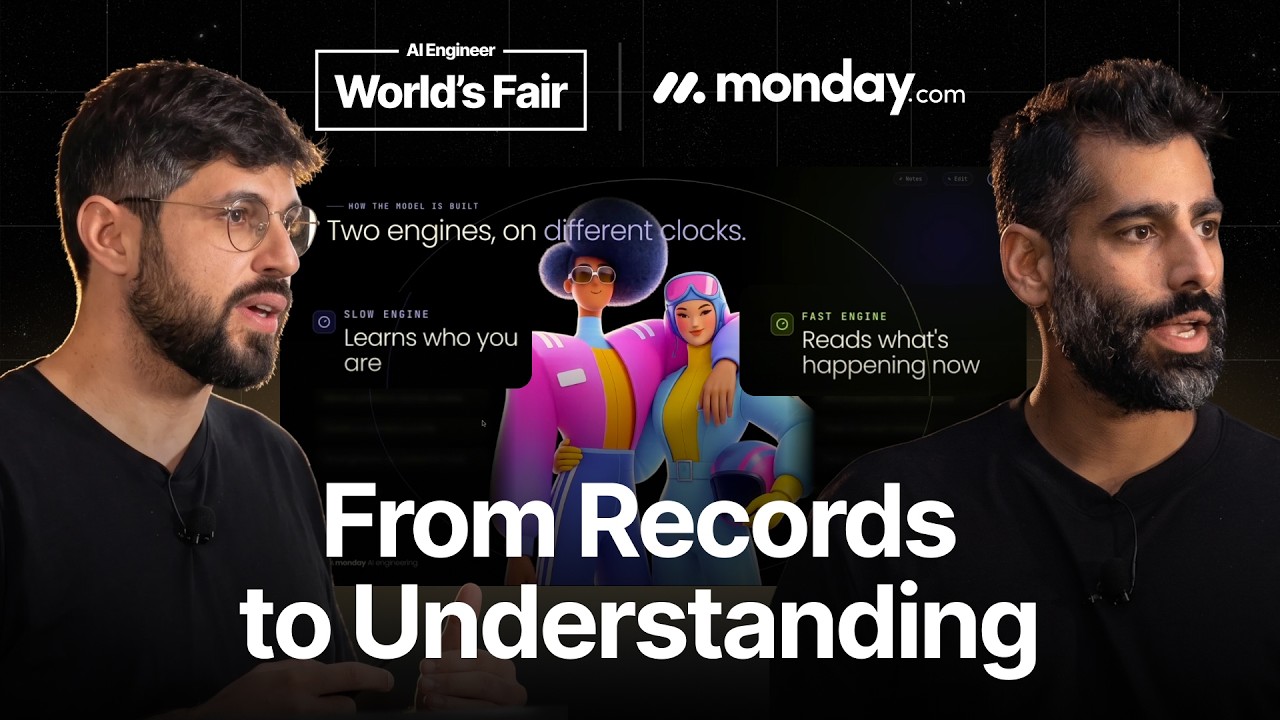
From Systems of Record to Systems of Context — Omri Bruchim, monday.com thumbnail

· 15:58

From Systems of Record to Systems of Context — Omri Bruchim, monday.com

The talk outlines a fundamental shift in enterprise software from 'Systems of Record'—which merely log what happened—to 'Systems of Context,' which actively understand the meaning and connections between data points. monday.com addresses this challenge by building a 'Monday world model' using two distinct, precomputed engines: a slow engine for durable, long-term user profiling (who you are) and a fast engine for real-time signals (what is urgent today). This architecture mirrors both the brain's hippocampus/neocortex function and the Lambda data architecture, ensuring that AI agents can reason on deep context rather than just retrieving disconnected data.

Key takeaways

  1. The Problem: Data vs. Understanding

    Current AI assistants have access to vast amounts of data (boards, emails, Slack messages) but often fail because the core problem is not retrieval (data availability), but 'understanding'—the ability to connect disparate pieces of information and determine true user priority.

  2. The Solution: System of Context

    Instead of just logging events, the system must build a context layer ahead of time. This 'Monday world model' allows AI agents (like Sidekick/Psyche) to understand not only *what* happened but *why* it matters and *who* is affected.

  3. Architectural Design: Two Engines 13:35

    The context layer is built using two engines running on different time windows. The slow engine mines weeks of activity to build a durable profile of user patterns and goals, while the fast engine processes recent data for live signals and immediate urgency.

  4. Resilience and Intelligence

    This dual-engine approach provides resilience; if one source fails, the system degrades gracefully. Furthermore, it allows the AI to understand when to be proactive (notify) and when to remain silent.

Watch on YouTube Full article

Get started with the Interactions API thumbnail

· 8:51

Get started with the Interactions API

The Interactions API is now generally available and serves as a unified interface for interacting with various Gemini models and agents. It simplifies complex interactions—ranging from synchronous model calls to multi-step agent workflows in remote environments—by providing a single API endpoint. The API supports stateful operations by allowing users to pass the previous interaction ID, enabling iterative refinement of outputs (e.g., image editing) without re-uploading source data.

Key takeaways

  1. Unified Model Access 0:10

    The Interactions API provides easy access to all Gemini models and agents through a single interface, simplifying development across various Google AI capabilities.

  2. Stateful Interactions 4:05

    The API is stateful; developers can pass the previous interaction ID to build upon prior results, which is crucial for iterative processes like image editing or complex data processing.

  3. Advanced Capabilities 0:18

    New features include managed agents, background execution tool improvements, Deep Research, and media generation (e.g., Nano banana for images, Lyriq 3 for music, TTS for speech).

Watch on YouTube Full article

Antigravity Arcade: From prompt to game in minutes thumbnail

· 8:53

Antigravity Arcade: From prompt to game in minutes

The video details 'Antigravity Arcade,' a system that leverages AI skills and workflows to allow users to generate functional web games from simple ideas without writing code. The solution covers both the front-end game generation process—which enforces visual consistency using specialized AI skills (e.g., ensuring retro aesthetics, handling physical input)—and a robust back-end deployment pipeline for hosting these user-generated games on physical arcade cabinets.

Key takeaways

  1. AI-Powered Game Generation 3:30

    Antigravity uses modular 'skills' to guide the AI agent, preventing context window bloat and ensuring adherence to organizational best practices (e.g., consistent retro aesthetic, specific key mappings) when generating game code.

  2. Consistent Development Workflow 4:13

    The project enforced consistency by using a starting template built with Phaser JS's game engine, which included skills for visual guidelines (black background, CRT shader) and input handling to ensure cross-platform compatibility.

  3. Secure Deployment Pipeline 6:45

    A custom deployer CLI tool handles the deployment of user code to physical arcade cabinets. This process uses a Unix setuid model API to securely read sensitive API tokens without exposing them to the end-user or agent, followed by Cloud Run validation and GCS storage.

  4. Automated Game Moderation 8:02

    Upon successful upload, an Eventarc trigger spins up a Cloud Run function that validates the game. If approved, Firestore increments a counter, issuing a sequential ID for moderation via a web app.

Watch on YouTube Full article

PLANS For Fable 5: Rebuilding My /Plan Skill for Mythos Class Models thumbnail

· 1:02:49

PLANS For Fable 5: Rebuilding My /Plan Skill for Mythos Class Models

This deep-dive devlog details the rebuilding of a comprehensive `/plan` meta skill (`PlanF3`) designed for next-generation Large Language Models (LLMs) like Fable 5 and Mythos class models. The core thesis is that superior engineering results depend on rigorous, upfront planning—a concept termed 'great planning is great engineering.' By investing heavily in structured templates, the speaker creates a meta skill that forces agents to output highly detailed, standardized plans in HTML format, thereby improving performance over speed or cost (the 'trade-off trifecta'). The resulting plan acts as a living artifact for the entire codebase, integrating complex workflows like image generation and agent-to-agent communication.

Key takeaways

  1. The Importance of Planning in Agentic Engineering 2:00

    Planning is identified as the single most critical tool an engineer has. The speaker warns against outsourcing thinking or planning to models, arguing that detailed, structured plans are necessary for end-to-end control and reliable results at scale.

  2. The PlanF3 Meta Skill Architecture 4:00

    The new skill is designed to be a 'meta skill'—a prompt that creates other prompts or skills. It mandates structured output in HTML format, which is preferred for its ability to convey rich information and utilize tokens efficiently across the 'trifecta' of users: human engineers, engineering teams, and AI agents.

  3. Structured Planning as an Artifact 7:30

    The plan is treated as a living artifact containing mandatory sections like Purpose, Problem, Solution (P/S/R), Relevant Files (existing and new), Implementation Phases (with embedded checklists), Testing Strategy, and detailed Metadata Headers (tracking agent name, session ID, back/forward references).

  4. Advanced Workflow Integration 11:20

    The skill is modularized into dedicated workflows: `create plan`, `update plan`, `update references`, `build plan`, and `image generation`. This structure allows for complex, multi-step processes (e.g., running a build cycle that updates status markers in the plan).

Watch on YouTube Full article