Topic

Context Management

All digests tagged Context Management

Anthropic's CCA Exam as a Field-Guide for Agentic Engineering — Frank Coyle, UC Berkeley thumbnail

· 20:08

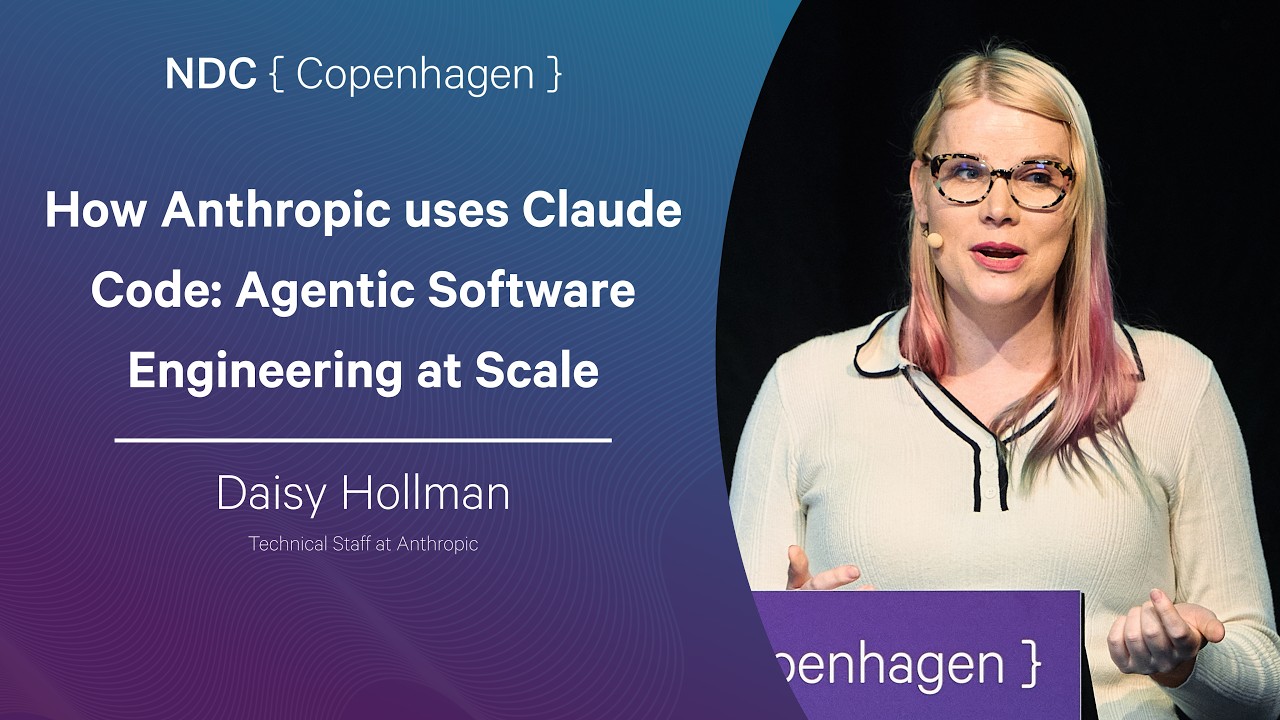
Anthropic's CCA Exam as a Field-Guide for Agentic Engineering — Frank Coyle, UC Berkeley

The presentation uses Anthropic's Claude Certified Architect (CCA) exam structure to guide engineers through agentic AI best practices by focusing on anti-patterns. Key principles include mastering 'agentic loops' over simple sequences, ensuring specialized subagents only have limited tools, and rigorously managing context via techniques like forking and compaction to prevent groupthink and token overflow.

Key takeaways

  1. Prioritize Looping Mechanisms 12:30

    Agentic workflows should leverage loops (e.g., `while true`) rather than simple sequences, as looping provides the necessary power for complex computation, paralleling the foundational concepts of Turing completeness.

  2. Use Stop Reasons for Control 7:40

    Instead of blindly using an agent's response, robust workflows must branch logic based on the model's `stop reason`. This is crucial because the LLM cannot execute tools; it only provides parameters that external code must run.

  3. Specialize Agents and Tools 15:30

    Avoid 'overloading' a single agent with all available tools. Specialized subagents, each equipped with one or two specific tools, are significantly more effective and maintain focus.

  4. Manage Context Isolation

    To prevent context pollution and 'groupthink,' isolate subtask outputs (e.g., using a 'context fork') so that only necessary summaries return to the main thread, preventing unbounded context growth.

Watch on YouTube Full article

Managed Deep Agents explained in 20 minutes thumbnail

· 18:17

Managed Deep Agents explained in 20 minutes

Managed Deep Agents provides an integrated framework to simplify the entire lifecycle of building, running, and deploying AI agents into production. It addresses the complexity of agent infrastructure by bundling the open-source Deep Agents harness with necessary components like durable execution, context management (via Context Hub), sandboxes, and scheduling capabilities, allowing developers to move from local business logic directly to a scalable, managed deployment on LangSmith.

Key takeaways

  1. Agent Architecture Components

    An agent requires three layers: 1) Business Logic (provided by the user, e.g., prompts/tools); 2) Harness (orchestrates context and passes data to the model); and 3) Infrastructure (runtime, sandboxes, etc.). Managed Deep Agents bundles these into a seamless package.

  2. Production Readiness 2:05

    The framework handles complex production requirements such as durable execution, fault tolerance, streaming, queueing, run cancellation, and rollbacks, which are necessary when moving agents from local development to cloud serving.

  3. Decoupled Context Management 5:05

    Context (instructions and skills) is stored in the dedicated Context Hub. This allows non-developers to edit and maintain agent context via a UI without requiring code changes or redeployments, significantly improving collaboration.

  4. Deployment Workflow 10:30

    The process involves initializing the project using `MDA innit research assistant`, defining components (e.g., tools in `tools/search.py`), and deploying via `MDA deploy`. This pushes context to Context Hub and creates a deployment on LangSmith.

Watch on YouTube Full article

How Harmonic 4x'd User Retention by Building on Deep Agents thumbnail

· 16:25

How Harmonic 4x'd User Retention by Building on Deep Agents

Harmonic transitioned its natural language interface, Scout, from a brittle query parsing graph to an architecture built on Deep Agents and a simple model-plus-tools loop. This shift quadrupled week one to week four user retention. The core technical lesson is that robust agent design requires managing context via a 'harness contract,' ensuring that all artifacts (like visualizations or large search result sets) are visible to the model—either in the message list or offloaded through file system tools—to prevent the UX from becoming an invisible black box.

Key takeaways

  1. Deep Agents significantly boost retention 2:04

    Switching to Deep Agents resulted in a fourfold increase in week one to week four user retention for Scout. (1:24)

  2. The agent architecture simplified from graphs to loops 4:01

    Scout evolved from complex, multi-node query parsing graphs (LangGraph) into a simpler model and tools loop, mediated by middleware. (2:41)

  3. Context management is handled by the harness 8:16

    Deep Agents manage context overload using mechanisms like compaction for long message lists and file system abstraction to store large results, returning only pointers to the model. (4:56)

  4. UX must respect the agent's context contract 11:44

    For a product UX to be useful, any rendered element (e.g., charts) must either reside in the message list or be discoverable by the model via tools/file system pointers; otherwise, it is invisible to the agent. (7:04)

Watch on YouTube Full article

I Stopped Installing Claude Skills. Here's What I Do Instead. thumbnail

· 16:57

I Stopped Installing Claude Skills. Here's What I Do Instead.

The video provides an advanced deep dive into AI agent skills (used by models like ChatGPT, Claude, and Codex), arguing that these 'superpowers' are often misunderstood. Skills are not traditional apps; they are sets of instructions that must be designed to be both readable by humans for auditing and highly functional for the AI agent during runtime. The speaker emphasizes moving beyond simply collecting skills and instead focusing on structured development, conflict resolution across multiple skills, and utilizing specialized tools like a 'Skill Builder' to ensure reliable, production-grade performance.

Key takeaways

  1. Skills are not applications (apps)

    A skill is simply a set of instructions for the AI agent. Unlike apps, skills do not load their full functionality upfront; only the name and description are loaded initially. The full instruction set is only invoked when the task matches the description, making loading order critical.

  2. The Core Reframing: Dual Audience Design 3:25

    Skills must be written for two audiences simultaneously: the AI agent (for utility) and the human developer (for readability and auditing). If humans cannot read them, developers cannot understand what is being given to the AI.

  3. Auditing and Conflict Resolution

    As agents accumulate many skills (e.g., 25+), conflicts can dull the results because the AI averages out competing instructions. Advanced builders must audit their setup to resolve these performance degradations.

  4. The Role of Structured Development

    To ensure reliability, developers should use tools (like the 'Skill Builder') that enforce best practices for skill files, ensuring clarity in the front matter and structure while maintaining human readability.

Watch on YouTube Full article

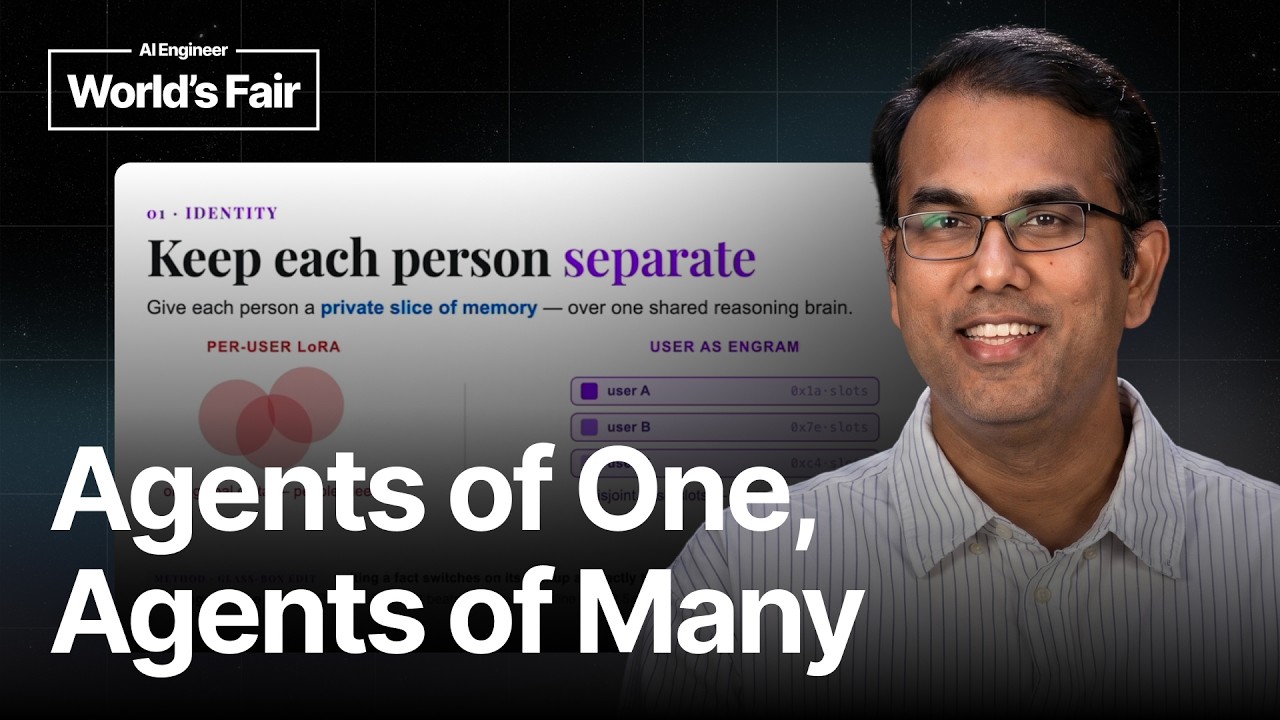
Wearing the Agent: From Group Chats to Glasses — Sai Krishna Rallabandi thumbnail

· 19:09

Wearing the Agent: From Group Chats to Glasses — Sai Krishna Rallabandi

The talk addresses the architectural shift required for agentic systems moving from single-user deployments to complex group chats and wearable devices. The speaker argues that these multi-user environments fundamentally break single-user assumptions, necessitating a complete redesign of memory management and security layers. Key challenges include preventing information leaks when multiple skills collide (security) and efficiently curating evolving conversations over long periods without context bloat (memory).

Key takeaways

  1. Group Settings Break Single-User Assumptions

    Agents designed for one user fail in group settings because the complexity of tracking multiple participants, maintaining privacy, and managing shared information requires unique architectural solutions.

  2. Security Must Be Designed at the Action Surface 12:24

    Instead of trying to guard all input (which is impossible due to vast surface areas like web pages, emails, and GitHub issues), security must focus on designing a deterministic guard layer that monitors actions—specifically when the agent reads or exports variables (e.g., bash variables) before taking action.

  3. Memory Requires Atomic Information Extraction

    Traditional memory methods are insufficient for groups. The system must move beyond storing raw conversation logs and instead extract high-value, atomic facts from the discussion. This requires designing sophisticated auto-raters to determine relevance, hierarchy, and temporal importance.

Watch on YouTube Full article