Topic

Codex

All digests tagged Codex

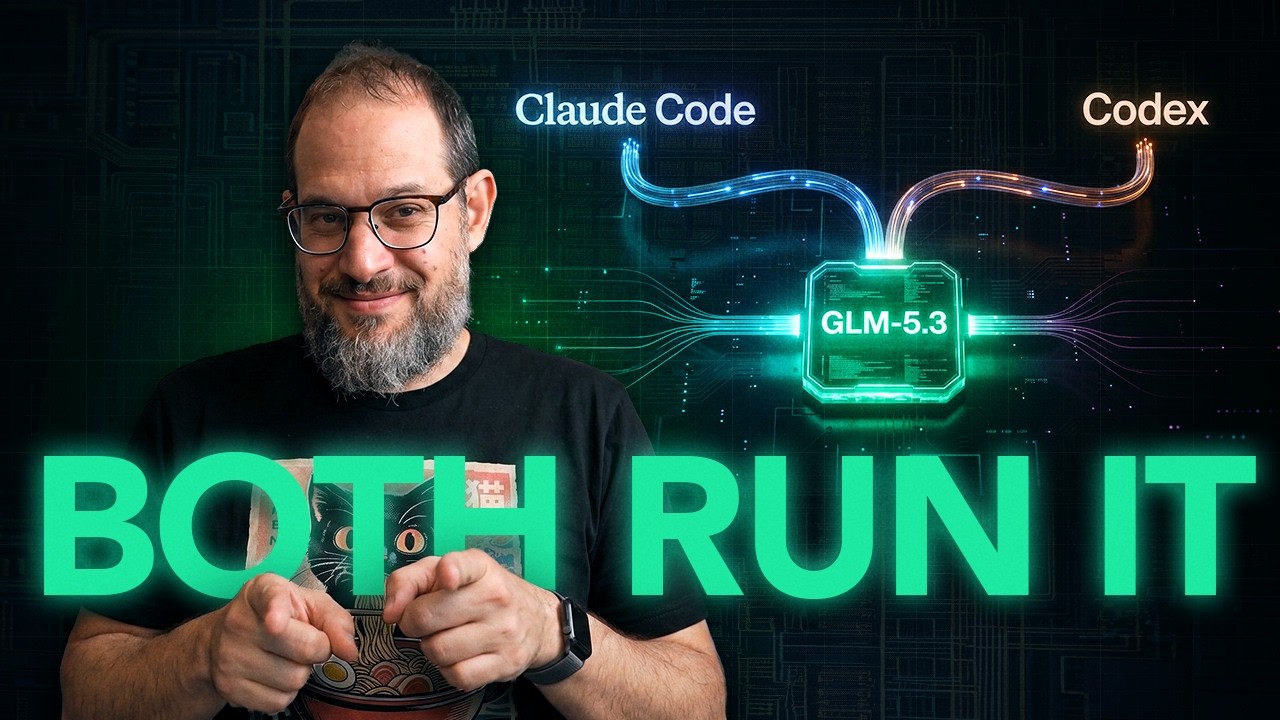
GLM 5.3 in Claude Code Is A Game Changer! thumbnail

· 20:49

GLM 5.3 in Claude Code Is A Game Changer!

This guide details how to integrate the GLM-5.3 model into existing AI coding harnesses like Claude Code and Codex, enabling significant cost savings by using a cheaper model without rebuilding the entire workflow. The speaker emphasizes that successful model switching depends less on the model itself and more on maintaining 'Project Context Hygiene'—ensuring critical project rules, standards, and definitions of done are stored in portable files rather than residing only within ephemeral conversation history.

Key takeaways

  1. Model Switching vs. Harness Integrity

    The primary goal is to use a cheaper model (e.g., GLM-5.3, starting at $18/month) without abandoning the established workflow or 'harness' of tools like Claude Code or Codex. The savings must be calculated against the fully loaded cost, including retries and review time.

  2. The Four Components of AI Coding Work

    A coding job involves four distinct elements: the Model (reasoning engine), the Harness/Tool (e.g., Claude Code, Codex; which provides file reading and command execution), Project Context (portable files like `Claude.markdown` containing rules/standards), and Conversation (temporary session history). Changing the model does not automatically transfer all four components.

  3. Best Practice for Model Handoff 20:09

    To minimize loss of context when switching models, always treat the transition as a new or carefully handed-off job. Instead of relying on old conversation history, create an explicit 'handoff file' that documents the goal, current state, relevant files, constraints, and definition of done for the receiving model.

Watch on YouTube Full article

Unlock Agent Autonomy: The Runtime for AI-Native Systems — Tushar Jain, Docker thumbnail

· 22:50

Unlock Agent Autonomy: The Runtime for AI-Native Systems — Tushar Jain, Docker

The talk addresses the critical shift from making AI agents more intelligent to making them safer and more autonomous. The core challenge is that as agents investigate complex issues (like latency spikes), their required access expands at runtime, significantly widening the 'blast radius.' The speaker proposes a new runtime layer designed to manage this complexity by enforcing three pillars: **Containment** (running the agent in an untrusted boundary while controls remain outside), **Scoped Capabilities** (providing only the minimum necessary access for a specific task), and **Intent-Based Access** (determining if the requested action aligns with the original user intent). This runtime must be portable across all environments (local, cloud, VPC) and models.

Key takeaways

  1. The Shift from Intelligence to Safety

    The next major challenge in agent development is not intelligence, but safety. Traditional software had fixed permissions; autonomous agents change their required access at runtime, necessitating a fundamental shift in security architecture.

  2. The Danger of Expanding Scope 5:12

    When an agent investigates a problem (e.g., latency spike), it sequentially requests access to logs, GitHub history, and Slack. Each step expands the trust boundary, leading to a single process with excessive, accumulated permissions.

  3. The Three Pillars of Safe Autonomy 10:24

    A proposed runtime layer must implement: 1) **Containment** (controls outside the agent's boundary); 2) **Scoped Capabilities** (providing granular access per task, not accumulating them); and 3) **Intent-Based Access** (validating if a sudden request—like email access during an incident investigation—is correct or should be escalated).

  4. Portability and Orchestration 22:38

    The runtime must be omnipresent, working across different models (Anthropic, Claude, Open Code), multiple harnesses, and environments (local machine, cloud VPC). The speaker demonstrated that the same secure sandbox can run locally or in the cloud, and these sandboxes can be composed for parallel execution and orchestration.

Watch on YouTube Full article

OpenAI’s Plan to Make ChatGPT the Everything App — Akshay Nathan, OpenAI thumbnail

· 1:10:57

OpenAI’s Plan to Make ChatGPT the Everything App — Akshay Nathan, OpenAI

Akshay Nathan discusses OpenAI's strategy to transition ChatGPT from a general chatbot into an 'Everything App' for knowledge workers. The core thesis is that AI will blur the lines between roles (engineering, design, strategy), making the bottleneck less about capability and more about ideas and taste. This shift is manifested in the unified product experience, ChatGPT Work, which leverages a shared agent harness to enable complex tasks like generating artifacts, interacting with local files, and managing persistent memory across different domains.

Key takeaways

  1. The Bottleneck of Innovation 2:03

    As AI makes building accessible to almost anyone, the primary bottleneck shifts from technical capability (how much can be built) to ideas and taste. Product development must focus on closing the loop by grounding new ideas in user feedback or observed friction [0:123].

  2. The Super App Strategy (ChatGPT Work) 12:40

    OpenAI is merging its agent experiences (Codex, ChatGPT) into a unified product to prevent users from being 'boxed in' by specific tools. This strategy aims to provide maximum flexibility and power regardless of the user's current task or domain [13:40].

  3. Redefining Productivity 48:30

    Productivity is defined as giving users leverage to accomplish things they couldn't before. The focus shifts from measuring traditional proxies (like code commits or story points) to assessing the user's ability to achieve a specific, desired goal [48:30].

  4. Motion vs. Progress 52:50

    A critical warning for teams is the tendency to conflate 'motion' (activity and tooling) with actual 'progress.' Progress requires a highly prescriptive and deliberate view of what success looks like, which must guide development efforts [52:30].

Watch on YouTube Full article

Robert Overweg - One Brain, No Filtering - AI Native DevCon June 2026 thumbnail

· 31:25

Robert Overweg - One Brain, No Filtering - AI Native DevCon June 2026

The presentation details a 'One Brain' concept—a centralized, AI-native knowledge management layer designed to eliminate information silos and improve decision-making by weaving together research, client context, and operational data. The system uses an orchestrator (OpenClaw) and structured vaults to allow agents to access and synthesize organizational knowledge in real time, shifting focus from manual file retrieval to idea generation and proactive insights.

Key takeaways

  1. Shift from File Search to Idea Synthesis 5:40

    The core value lies in moving beyond searching for specific files; the system allows users to search for 'ideas' or 'contacts.' Agents can interpret natural language queries (e.g., asking about CI/CD steps) and provide contextually accurate answers based on stored knowledge.

  2. Structured Knowledge Flow 7:10

    Knowledge is categorized into 'company knowledge' (new developments, research wikis) and the 'creation pipeline.' Information must be promoted to a central vault from various sources (e.g., Obsidian notes, meeting transcripts) to gain grounding in reality before being shared widely.

  3. Scaling and Security Challenges 17:32

    While the system is powerful, scaling remains a challenge, particularly regarding data segregation (permissions) across different client or team buckets. The local setup on one person's laptop was initially used for testing, but enterprise rollout requires careful consideration of security boundaries.

Watch on YouTube Full article