Topic

OpenClaw

All digests tagged OpenClaw

Exo: Harnesses should see their own code and logs — Alex Krentsel thumbnail

· 47:11

Exo: Harnesses should see their own code and logs — Alex Krentsel

Exo is presented as a novel agent harness designed for fully recursive self-improvement (RSI). Unlike previous agents that only allow modification in specific areas (like memory or skills), Exo's architecture enables the agent to safely and incrementally modify all aspects of itself—including its own code, context construction policy, and tools—at runtime. This is achieved by decomposing the agent into three isolated layers: the Executor (policy/decision-making), the Exo Harness (state management/secrets), and the Sandbox (isolated execution environment). The system's ability to operate in this same medium as its output code is argued to be the key differentiator enabling true RSI.

Key takeaways

  1. Shift from Model Weights to Agent Harnesses 3:50

    The industry focus is shifting from improving LLM model weights (the 'brain') to optimizing the agent harness and tooling ('the body'). The harness provides critical structure, allowing for improvements in efficiency, cost reduction, and task performance.

  2. Full Recursive Self-Improvement (RSI) 2:33

    Exo is designed to be fully recursive, meaning it can operate on any aspect of itself—from prompts or memory to the basic harness policy. This capability allows the system to improve its own architecture and logic without external human intervention.

  3. Architectural Separation for Safety 10:38

    The agent is decomposed into three distinct layers: the Executor (stateless policy), the Exo Harness (state/secrets), and the Sandbox (isolated execution). This separation ensures that self-modification can occur safely, preventing data leaks or loss of history.

  4. Cost Optimization via Self-Improvement 30:40

    Exo demonstrated the ability to autonomously rearchitect its own Discord adapter at runtime, scoping down context assembly from across multiple threads. This resulted in a verified 96% decrease in API call costs.

Watch on YouTube Full article

Grok Bot Is The First AI Agent You Just Install. Is It Worth $200? thumbnail

· 18:56

Grok Bot Is The First AI Agent You Just Install. Is It Worth $200?

Grokbot is presented as a consumer multi-agent product that significantly lowers the barrier to entry for AI automation, making advanced agent capabilities accessible to non-technical users. The system operates on a single, dedicated cloud computer (the security perimeter), which allows agents to seamlessly integrate with services like email and calendars through simple authorization processes. While the subscription cost is high ($200/month), its value proposition lies in its ability to automate complex business functions—such as building a storefront or managing an entire workflow—that would otherwise require significant manual effort.

Key takeaways

  1. Simplified Agent Integration

    Grokbot solves the 'agent signup pain point' by centralizing authorization. Users authorize services (e.g., email, calendar) once within one conversation with one bot; this authorization applies across all other bots and services used on the platform. This process uses remote login screens rather than requiring plain text passwords.

  2. Centralized Security Perimeter 2:00

    The entire system operates within one dedicated cloud computer (located in Silicon Valley), establishing a single security perimeter. Adding more agents does not increase this risk, providing greater confidence than systems relying on multiple scattered machines.

  3. High-Value Automation Bots 8:10

    Recommended bots include the 'Superdoerbot' (which proactively works on real tasks like drafting presentations based on calendar events) and the 'Business In a Box' bot, which helps users build and manage an entire business using AI agents.

  4. Technical Accessibility 0:10

    Grokbot is designed to be non-technical ('No code, just install'), crossing the chasm that previously required users to understand complex agent setups (like those needed for OpenClaw or Codex).

Watch on YouTube Full article

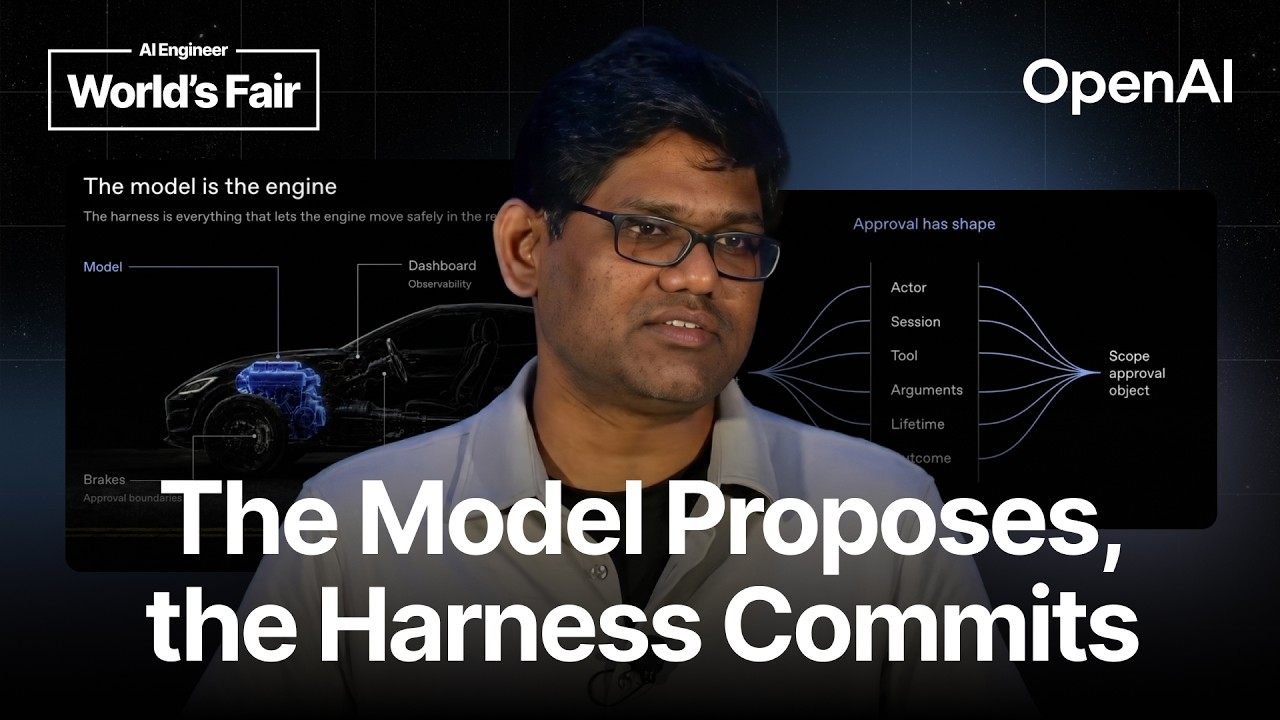
Your Agent Didn't Fail. Your Harness Did. — Vinoth Govindarajan, OpenAI thumbnail

· 18:26

Your Agent Didn't Fail. Your Harness Did. — Vinoth Govindarajan, OpenAI

The talk argues that most production failures in AI agents are not due to model hallucination or poor reasoning, but rather 'harness failures'—flaws in the underlying system architecture. The core principle is establishing a clear boundary: while a model can only propose an action, the surrounding harness must own the state transition, enforce ordered commits, and provide verifiable proof (the receipt) that the action was successfully executed and observed by the user.

Key takeaways

  1. Model Proposes, Harness Commits, Receipt Proves 4:06

    The model generates capability; the harness provides control. The system must own state transitions, enforce ordered mutations, and use a receipt to prove that an action was executed and visible to the user.

  2. Own the State, Order the Mutation, Prove the Action 5:20

    These three principles are critical for reliable agent systems. A fact must have a single owner (system of record) and a clear replay path; mutable state requires one ordered commit path.

  3. The Run Receipt Audit

    To audit an agent system, ask five questions: What woke it up (trigger)? What state did it inherit? Which authority did it use? What executed? And what evidence survived?

Watch on YouTube Full article

OpenAI’s Plan to Make ChatGPT the Everything App — Akshay Nathan, OpenAI thumbnail

· 1:10:57

OpenAI’s Plan to Make ChatGPT the Everything App — Akshay Nathan, OpenAI

Akshay Nathan discusses OpenAI's strategy to transition ChatGPT from a general chatbot into an 'Everything App' for knowledge workers. The core thesis is that AI will blur the lines between roles (engineering, design, strategy), making the bottleneck less about capability and more about ideas and taste. This shift is manifested in the unified product experience, ChatGPT Work, which leverages a shared agent harness to enable complex tasks like generating artifacts, interacting with local files, and managing persistent memory across different domains.

Key takeaways

  1. The Bottleneck of Innovation 2:03

    As AI makes building accessible to almost anyone, the primary bottleneck shifts from technical capability (how much can be built) to ideas and taste. Product development must focus on closing the loop by grounding new ideas in user feedback or observed friction [0:123].

  2. The Super App Strategy (ChatGPT Work) 12:40

    OpenAI is merging its agent experiences (Codex, ChatGPT) into a unified product to prevent users from being 'boxed in' by specific tools. This strategy aims to provide maximum flexibility and power regardless of the user's current task or domain [13:40].

  3. Redefining Productivity 48:30

    Productivity is defined as giving users leverage to accomplish things they couldn't before. The focus shifts from measuring traditional proxies (like code commits or story points) to assessing the user's ability to achieve a specific, desired goal [48:30].

  4. Motion vs. Progress 52:50

    A critical warning for teams is the tendency to conflate 'motion' (activity and tooling) with actual 'progress.' Progress requires a highly prescriptive and deliberate view of what success looks like, which must guide development efforts [52:30].

Watch on YouTube Full article

Robert Overweg - One Brain, No Filtering - AI Native DevCon June 2026 thumbnail

· 31:25

Robert Overweg - One Brain, No Filtering - AI Native DevCon June 2026

The presentation details a 'One Brain' concept—a centralized, AI-native knowledge management layer designed to eliminate information silos and improve decision-making by weaving together research, client context, and operational data. The system uses an orchestrator (OpenClaw) and structured vaults to allow agents to access and synthesize organizational knowledge in real time, shifting focus from manual file retrieval to idea generation and proactive insights.

Key takeaways

  1. Shift from File Search to Idea Synthesis 5:40

    The core value lies in moving beyond searching for specific files; the system allows users to search for 'ideas' or 'contacts.' Agents can interpret natural language queries (e.g., asking about CI/CD steps) and provide contextually accurate answers based on stored knowledge.

  2. Structured Knowledge Flow 7:10

    Knowledge is categorized into 'company knowledge' (new developments, research wikis) and the 'creation pipeline.' Information must be promoted to a central vault from various sources (e.g., Obsidian notes, meeting transcripts) to gain grounding in reality before being shared widely.

  3. Scaling and Security Challenges 17:32

    While the system is powerful, scaling remains a challenge, particularly regarding data segregation (permissions) across different client or team buckets. The local setup on one person's laptop was initially used for testing, but enterprise rollout requires careful consideration of security boundaries.

Watch on YouTube Full article

The Blueprint for Autonomous Work Agents | Gavriel Cohen, NanoClaw thumbnail

· 23:15

The Blueprint for Autonomous Work Agents | Gavriel Cohen, NanoClaw

This discussion explores the architecture and deployment of autonomous work agents, focusing on how they can function as 'second brain' knowledge management systems. The speaker details a shift in agent adoption strategy—from centralized 'agent factories' to personalized assistants for individual employees. Architecturally, secure deployment requires robust isolation models (e.g., running each agent in its own container) and strict credential handling via proxy vaults to mitigate risks like prompt injection.

Key takeaways

  1. Agent Adoption Strategy Shift 12:48

    The most effective way for businesses to introduce agents is by providing each person with their own personal assistant, as this manages the learning curve associated with prompting and utilizing complex AI tools. (10:58)

  2. The Killer Use Case: Second Brain 14:30

    For autonomous agents today, the most valuable use case is the 'second brain' model—where the agent collects and builds an internal knowledge graph or wiki (e.g., LLM Wiki) from unstructured data rather than just providing ready-made output. (12:30)

  3. Agent Architecture Security Principles 16:10

    Secure deployment requires three key elements: running each agent in its own isolated container; ensuring agents have no credentials in their environment to prevent leakage from prompt injection; and proxying all outgoing requests through a vault for credential management. (14:50)

Watch on YouTube Full article

Autonomous Agents at Work: From OpenClaw Hype to Enterprise Reality thumbnail

· 42:20

Autonomous Agents at Work: From OpenClaw Hype to Enterprise Reality

Autonomous agents represent a significant shift from simple chat interfaces to systems that actively perform actions. To transition these agents from experimental hype (like the OpenClaw movement) to reliable enterprise production models, organizations must implement rigorous governance and control frameworks. PwC outlines a comprehensive approach focusing on risk classification, establishing a minimum control stack (Identity, Input/Output Controls, Auditability), and implementing multi-faceted evaluation processes across Quality, Performance, Safety, Cost, and Business Impact.

Key takeaways

  1. 3-Tier Work Classification for Risk Management 1:45

    Agents must be classified based on the potential blast radius: 1) Reversible work (e.g., ticket enrichment); 2) Sensitive work (affecting system stability, requiring tighter controls); and 3) Consequential work (touching legal or customer policy documents, highest risk).

  2. The Minimum Control Stack for Production Agents 4:00

    Before deployment, four non-negotiable controls must be in place: Agent Identity (credentials treated as first-class data with strict expiration/authorization); Input Controls (guardrails against prompt injection and ensuring tool allow-listing); Output Controls (limiting tool calls, retries, and preventing toxic output); and Auditability.

  3. Five Pillars of Agent Auditability 5:10

    Auditing must go beyond simple logging. A comprehensive framework requires monitoring Quality (using LLM-as-judge), Performance (focusing on P99 latency), Safety (PII redaction/filters), Cost (tracking expenditure at the run level), and Business Impact (logging the agent's chain of thought decision process).

  4. Ownership and Architecture are Paramount 8:00

    Engineers must maintain ownership over the system architecture, even if AI generates the code. The core logic and blueprints must be human-owned to ensure accountability and proper review processes.

Watch on YouTube Full article