Topic

Autonomous Agents

All digests tagged Autonomous Agents

Hugging Face Journal Club: AI Research Preference Models thumbnail

· 34:48

Hugging Face Journal Club: AI Research Preference Models

This discussion summarizes Meta's research on Research Preference Models (RPMs), which utilize Large Language Models (LLMs) to predict the success of machine learning experiments. Given that ML evaluations are computationally expensive (potentially taking days or weeks on GPUs), RPMs guide autonomous agents by selecting the most promising candidates for evaluation, drastically reducing required compute time while maintaining high performance. The process involves complex tree search mechanisms and can be enhanced through ensembling multiple LLM judges.

Key takeaways

  1. RPM Goal: Reducing Compute Budget 2:35

    The primary goal is to avoid evaluating all possible ML candidates, which consumes excessive compute resources. RPMs select the most promising experiments (mutations) to evaluate next, reducing required time from potentially days down to hours while achieving performance comparable to an 'Oracle' [0:02:35].

  2. RPM Types and Functionality 2:58

    Two main types are discussed: the Inference-only RPM (using a frozen LLM to reason over plans/code) and the Agentic RPM, which can run small-scale pilot experiments to further refine predictions [0:02:58].

  3. The Search Process (Tree Traversal) 3:45

    The process is modeled as a tree search, starting from a root node (initial experiment). Candidates are generated as children nodes; the RPM scores these candidates, and the agent selects the best one to explore next. This mechanism resembles Monte Carlo Tree Search (MCTS) [0:03:45].

  4. Ensembling for Robustness 8:13

    To improve reliability, the research suggests evaluating candidates using ensembles of multiple frontier models (e.g., GPT-5 Opus). Techniques include majority vote and an LLM arbiter ensemble to mitigate issues like reward hacking [0:08:23].

Watch on YouTube Full article

Why OpenAI is calling for a ‘cyber defense surge.’ Plus: Find Evil! winners and TeamPCP losers thumbnail

· 29:09

Why OpenAI is calling for a ‘cyber defense surge.’ Plus: Find Evil! winners and TeamPCP losers

The discussion covers a global call for collective cyber defense following escalating AI attacks from OpenAI [1:19]. Key recommendations include moving beyond status quo security to prioritize sharing remediation strategies and patches. The segment also details the SANS Institute's Find Evil! hackathon winners, showcasing autonomous incident response agents with self-questioning capabilities. Finally, the analysis of the TeamPCP takedown emphasizes that even sophisticated threat actors are vulnerable due to poor credential hygiene (e.g., reusing usernames across platforms).

Key takeaways

  1. Shift Focus from Threat Intel to Remediation Strategies 20:22

    The industry must move beyond merely sharing Indicators of Compromise (IOCs) and threat intelligence; the critical metric is now 'time for remediation'—the ability to quickly share and apply patches and effective remediation strategies [12:22].

  2. Autonomous Agents Require Human Oversight (Human-in-the-Loop) 27:20

    While autonomous agents can significantly speed up investigation, correlation of evidence, and threat hunting, human intervention is mandatory for high-consequence actions like shutting down servers or revoking identities. This prevents potential hallucinations or overreach by the AI [16:40].

  3. Credential Hygiene Remains the Weakest Link

    The successful takedown of TeamPCP demonstrated that even sophisticated threat actors are vulnerable to basic operational mistakes, such as reusing usernames and passwords across unrelated platforms (e.g., gaming accounts) [22:03].

Watch on YouTube Full article

Ask the Experts: How NVIDIA OpenShell Secures Autonomous Agents | Nemotron Labs thumbnail

· 49:34

Ask the Experts: How NVIDIA OpenShell Secures Autonomous Agents | Nemotron Labs

OpenShell is presented as a secure runtime environment designed specifically for long-running, autonomous AI agents that execute complex tasks like reading files and calling APIs. It moves beyond simple behavioral guardrails by enforcing strict isolation, identity, policy, and audit at the runtime layer. The system utilizes a Control Plane (Gateway) to manage policies and credentials, which then launch compute drivers (Docker, Podman, Kubernetes, VM) into isolated sandboxes where agent activity is strictly governed by declarative YAML policies.

Key takeaways

  1. OpenShell Architecture 2:00

    The architecture consists of a Control Plane (Gateway), which manages identity, lifecycle, and policies. This gateway launches compute drivers into sandboxes, where an internal supervisor enforces the defined security policies on the agent process.

  2. Policy Granularity and Enforcement 4:00

    Policies are set using declarative YAML configurations to enforce fine-grained control over resources (e.g., read/write access to specific file system paths) and network capabilities. The system can dynamically update policies in real time, ensuring the principle of least privilege is maintained.

  3. Advanced Security and Robustness 22:00

    To prevent agents from circumventing defined policies (breakout), OpenShell incorporates formal verification methods. The Policy Prover inspects the entire policy set to mathematically prove that no unintended access paths exist, even as complexity increases.

  4. Defense in Depth (Swiss Cheese Model) 34:10

    Security is achieved through layering. OpenShell can be combined with other tools and middleware—such as integrating a safety model (e.g., Mistral's ShieldStroll) into the policy engine—to create multiple, redundant layers of protection.

Watch on YouTube Full article

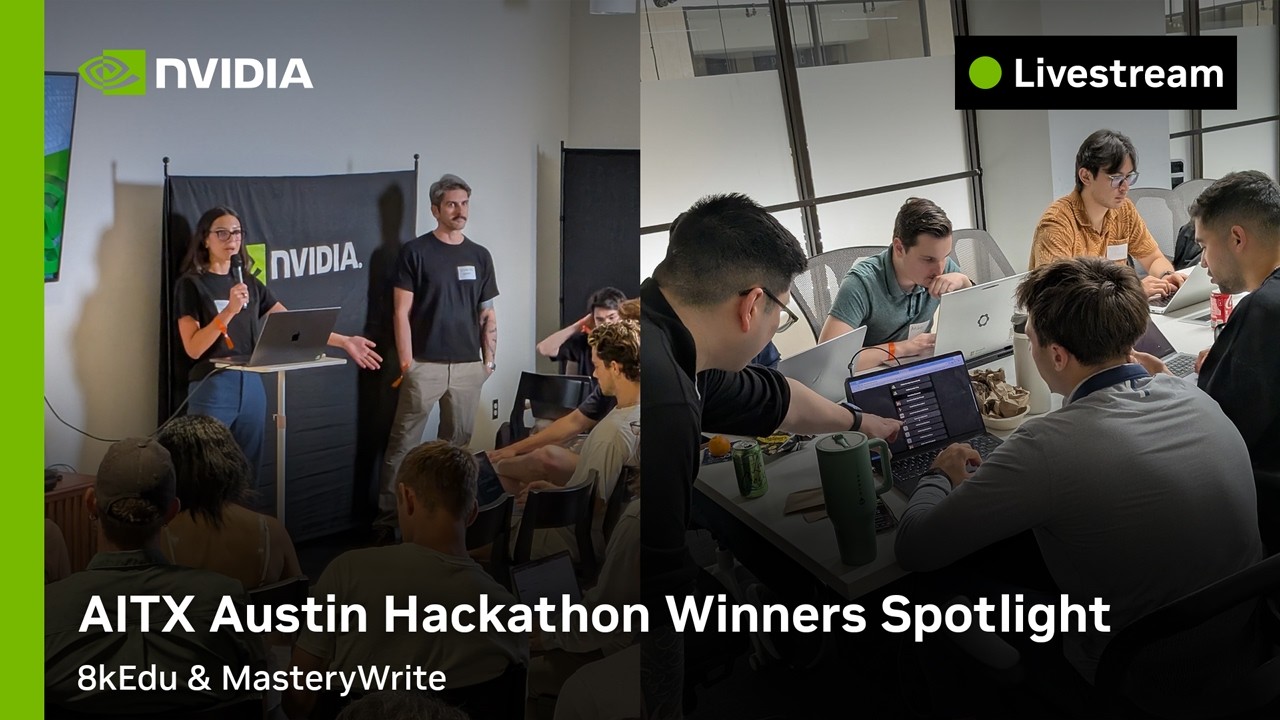
AITX Austin Hackathon Winners Spotlight thumbnail

· 36:43

AITX Austin Hackathon Winners Spotlight

This technical spotlight details two winning autonomous agent applications from the AITX Hackathon: MasteryWrite and 8kEdu. Both projects demonstrate advanced capabilities beyond simple chat, focusing on taking real-world action in educational technology (EdTech). Key architectural takeaways include using specialized frameworks like NemoClaw/OpenShell to enforce policies around student PII data, implementing continuous self-improvement loops for assessment grading, and leveraging Visual Language Models (VLMs) to transform video lectures into interactive learning widgets.

Key takeaways

  1. MasteryWrite: Autonomous Assessment Engine 2:00

    This agent scores student essays against a rubric, explains its reasoning, and uses an autonomous evaluation loop to improve its own grading criteria over time. The system is designed to handle complex educational assessment while maintaining strict policies around student PII data.

  2. 8kEdu: Interactive Video Learning 5:05

    The agent transforms YouTube lectures into interactive learning experiences. Instead of relying on the entire transcript, it focuses on specific video frames (e.g., a matrix calculation) to generate editable widgets (charts, notebooks), allowing users to learn concepts from multiple sources and build recursive learning graphs.

  3. Local Model Deployment for Edge Cases 7:50

    The teams highlighted the utility of running models locally (e.g., using DGX Spark) to manage costs, ensure privacy, and run complex video-based inferences without constant reliance on external APIs.

Watch on YouTube Full article

The DevOps Godfather on AI's "Dark Factory" Problem thumbnail

· 22:25

The DevOps Godfather on AI's "Dark Factory" Problem

Patrick Debois argues that the industry is approaching a 'dark factory' model of autonomous coding agents, mirroring historical skepticism around Continuous Delivery [0:02:51]. He emphasizes that success hinges not on better prompts or larger models, but on fundamentally restructuring teams and platforms. The developer role shifts from solo coder to agent orchestrator, requiring improvements in system-level engineering practices (e.g., building tooling for the agents) rather than just fixing the code produced by the agent [0:09:49]. Scaling this requires platform teams to centralize reusable components like skill registries and guardrails, moving organizations from a 'solo developer' model to a 'multiplayer system' [0:10:53].

Key takeaways

  1. Shift from Coder to Orchestrator 5:21

    The modern developer role evolves into that of an agent conductor or orchestrator, managing and guiding autonomous agents rather than writing all the code themselves. This requires a focus on system improvement over individual code fixes [0:02:51].

  2. Focus on Systemic Improvement 9:49

    The key mentality shift is to stop fixing the agent's output code and instead improve the underlying system, context, and tooling (harnesses/loops) that guide the agents [0:09:49].

  3. Platform Team Centralization 20:53

    To scale autonomous development, platform teams must own centralized components—such as skill registries, guardrails, and reusable harnesses—to prevent organizational sprawl and ensure consistency across teams [0:10:53].

  4. New Productivity Metrics

    Instead of measuring token spend, focus on two metrics: the number of human touches required for the agent to succeed, and the multiplier effect gained when a single system improvement benefits all users/teams [0:14:50].

Watch on YouTube Full article

I was building loops wrong... thumbnail

· 14:07

I was building loops wrong...

The video details the architecture and implementation of 'loops'—autonomous AI systems designed for continuous development and operations. These loops move beyond simple agent prompting by establishing a structured system where an agent can independently decide on work, execute tasks, verify results, and self-improve over time. The core structure involves defining a Loop Contract (Goal, Boundaries, SOP), maintaining State/Logs, utilizing specific Trigger mechanisms, and employing multi-role agents with mandatory verification steps.

Key takeaways

  1. The Anatomy of an AI Loop 3:30

    Every internal loop is structured around a markdown file containing the 'Loop Contract' (Goal, Boundaries, SOP), 'State' (current hypothesis/backlogs), and 'Logs' (append-only record). This serves as the living documentation for the system.

  2. Advanced Trigger Mechanisms 6:30

    Beyond standard continuous (`while` loop) or cron job triggers, effective loops often use 'Event-based' (reactive to external events like new emails/incidents) or 'Combo/Workflow' triggers. The latter is highly efficient as it programmatically checks data sources (e.g., Intercom updates) before waking the agent, preventing unnecessary runs.

  3. The Evolve Loop Concept 10:30

    Loops are designed to improve themselves. An 'Evolve Loop' is a dedicated session where the AI analyzes its own past run state, logs, and configuration to suggest improvements—such as optimizing triggers or refining the SOP—making the system self-optimizing.

Watch on YouTube Full article

The Blueprint for Autonomous Work Agents | Gavriel Cohen, NanoClaw thumbnail

· 23:15

The Blueprint for Autonomous Work Agents | Gavriel Cohen, NanoClaw

This discussion explores the architecture and deployment of autonomous work agents, focusing on how they can function as 'second brain' knowledge management systems. The speaker details a shift in agent adoption strategy—from centralized 'agent factories' to personalized assistants for individual employees. Architecturally, secure deployment requires robust isolation models (e.g., running each agent in its own container) and strict credential handling via proxy vaults to mitigate risks like prompt injection.

Key takeaways

  1. Agent Adoption Strategy Shift 12:48

    The most effective way for businesses to introduce agents is by providing each person with their own personal assistant, as this manages the learning curve associated with prompting and utilizing complex AI tools. (10:58)

  2. The Killer Use Case: Second Brain 14:30

    For autonomous agents today, the most valuable use case is the 'second brain' model—where the agent collects and builds an internal knowledge graph or wiki (e.g., LLM Wiki) from unstructured data rather than just providing ready-made output. (12:30)

  3. Agent Architecture Security Principles 16:10

    Secure deployment requires three key elements: running each agent in its own isolated container; ensuring agents have no credentials in their environment to prevent leakage from prompt injection; and proxying all outgoing requests through a vault for credential management. (14:50)

Watch on YouTube Full article

Autonomous Agents at Work: From OpenClaw Hype to Enterprise Reality thumbnail

· 42:20

Autonomous Agents at Work: From OpenClaw Hype to Enterprise Reality

Autonomous agents represent a significant shift from simple chat interfaces to systems that actively perform actions. To transition these agents from experimental hype (like the OpenClaw movement) to reliable enterprise production models, organizations must implement rigorous governance and control frameworks. PwC outlines a comprehensive approach focusing on risk classification, establishing a minimum control stack (Identity, Input/Output Controls, Auditability), and implementing multi-faceted evaluation processes across Quality, Performance, Safety, Cost, and Business Impact.

Key takeaways

  1. 3-Tier Work Classification for Risk Management 1:45

    Agents must be classified based on the potential blast radius: 1) Reversible work (e.g., ticket enrichment); 2) Sensitive work (affecting system stability, requiring tighter controls); and 3) Consequential work (touching legal or customer policy documents, highest risk).

  2. The Minimum Control Stack for Production Agents 4:00

    Before deployment, four non-negotiable controls must be in place: Agent Identity (credentials treated as first-class data with strict expiration/authorization); Input Controls (guardrails against prompt injection and ensuring tool allow-listing); Output Controls (limiting tool calls, retries, and preventing toxic output); and Auditability.

  3. Five Pillars of Agent Auditability 5:10

    Auditing must go beyond simple logging. A comprehensive framework requires monitoring Quality (using LLM-as-judge), Performance (focusing on P99 latency), Safety (PII redaction/filters), Cost (tracking expenditure at the run level), and Business Impact (logging the agent's chain of thought decision process).

  4. Ownership and Architecture are Paramount 8:00

    Engineers must maintain ownership over the system architecture, even if AI generates the code. The core logic and blueprints must be human-owned to ensure accountability and proper review processes.

Watch on YouTube Full article