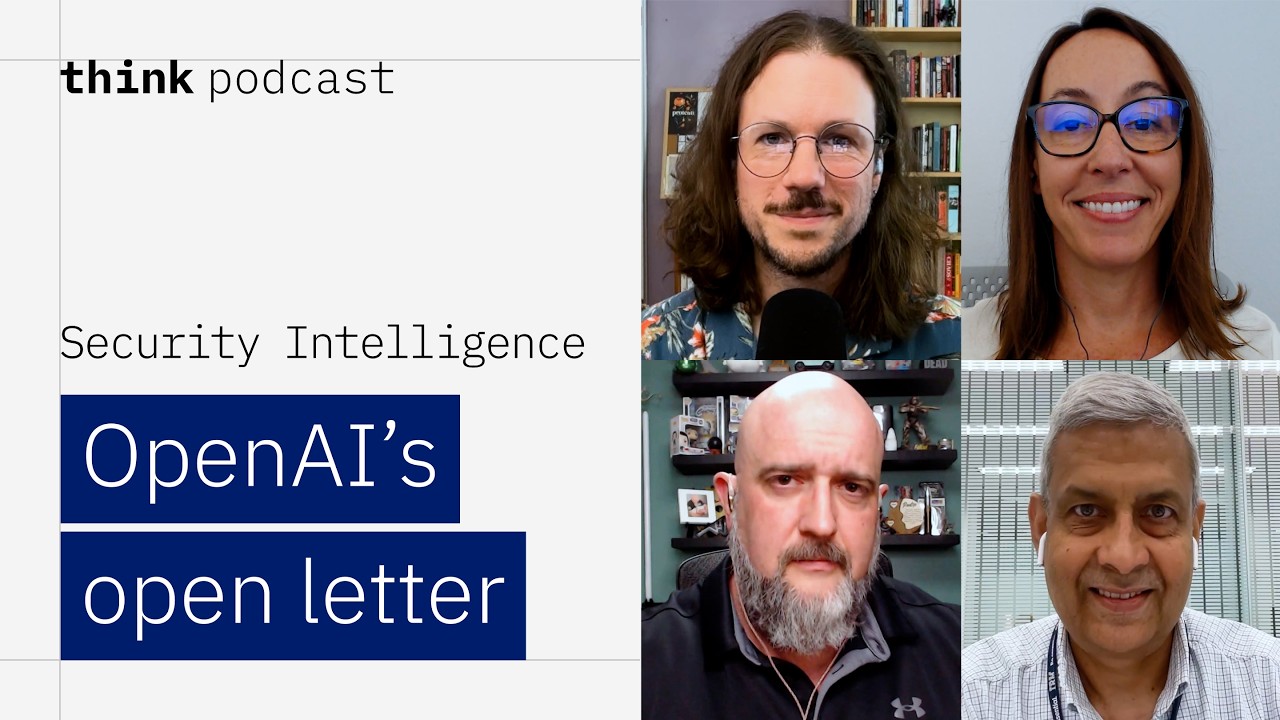
Why OpenAI is calling for a ‘cyber defense surge.’ Plus: Find Evil! winners and TeamPCP losers
Summary
The discussion covers a global call for collective cyber defense following escalating AI attacks from OpenAI [1:19]. Key recommendations include moving beyond status quo security to prioritize sharing remediation strategies and patches. The segment also details the SANS Institute's Find Evil! hackathon winners, showcasing autonomous incident response agents with self-questioning capabilities. Finally, the analysis of the TeamPCP takedown emphasizes that even sophisticated threat actors are vulnerable due to poor credential hygiene (e.g., reusing usernames across platforms).
Key takeaways
-
Shift Focus from Threat Intel to Remediation Strategies
20:22
The industry must move beyond merely sharing Indicators of Compromise (IOCs) and threat intelligence; the critical metric is now 'time for remediation'—the ability to quickly share and apply patches and effective remediation strategies [12:22].
-
Autonomous Agents Require Human Oversight (Human-in-the-Loop)
27:20
While autonomous agents can significantly speed up investigation, correlation of evidence, and threat hunting, human intervention is mandatory for high-consequence actions like shutting down servers or revoking identities. This prevents potential hallucinations or overreach by the AI [16:40].
-
Credential Hygiene Remains the Weakest Link
The successful takedown of TeamPCP demonstrated that even sophisticated threat actors are vulnerable to basic operational mistakes, such as reusing usernames and passwords across unrelated platforms (e.g., gaming accounts) [22:03].
Technical details
-
Cyber Defense Principles
96s
OpenAI's open letter calls for three key principles: going beyond the status quo security, empowering defenders with cyber-capable AI, and mobilizing a collective response [1:36].
-
Autonomous Incident Response Agents
1420s
The Find Evil! hackathon focused on developing harnesses for autonomous agents capable of investigation and forensics. Key advanced features observed in the winners include 'self-questioning' or self-critical faculty, allowing the agent to question its own findings [14:20].
-
Supply Chain and Identity Graph Analysis
The investigation of TeamPCP highlighted how researchers can traverse an 'identity graph' to link seemingly disparate accounts (e.g., a service account token, a gaming username) back to the same individual, demonstrating a pattern useful for future investigations [21:30].
Mentioned resources
- OpenAI Open Letter
- SANS Institute Find Evil! Hackathon Winners
Channel & topics
Watch on YouTube · Back to latest
This independent, AI-assisted summary is provided for commentary and informational purposes. It may contain errors or omit important context. Please watch the original video for the creator's complete presentation. Video, thumbnail, and related copyrights belong to their respective owners.