Topic

AI

All digests tagged AI

Processing Documents: Jev vs OSS Models thumbnail

· 16:48

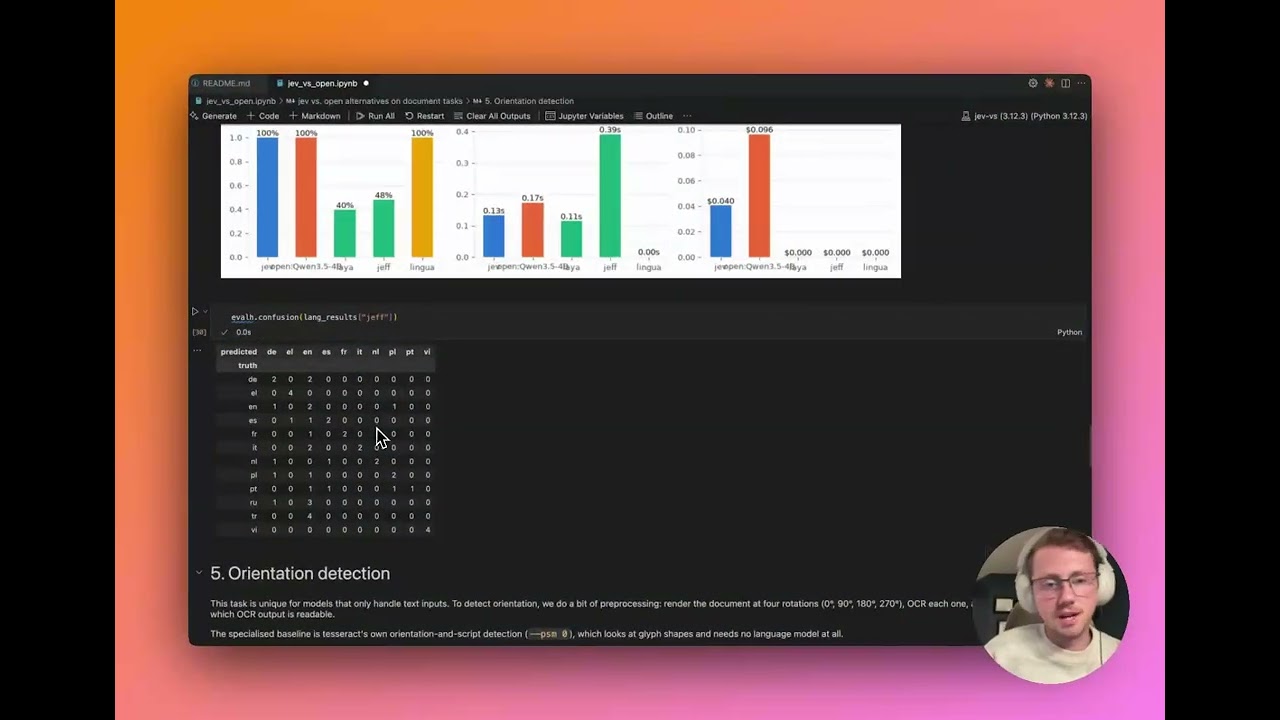
Processing Documents: Jev vs OSS Models

This video compares several model architectures (Jev, Quen, Leia, Jeff) for automating decision-making and classification tasks within document processing pipelines. The core finding is that the open decoder model, Quen, performs remarkably close to the generalized classifier, Jev, across various tasks (language detection, document classification, document routing). The approach demonstrates that robust classification can be achieved without requiring pre-training on specific labels, making it highly valuable for building flexible, automated document pipelines.

Key takeaways

  1. Quen's Performance in Classification

    The Quen decoder model, which is a standard Language Model (LM) and not specifically trained for classification, showed accuracy very close to Jev in tasks like language detection and document routing, suggesting its utility for general document understanding.

  2. Model Architecture Comparison 7:16

    Jev is a generalized classifier trained with reinforcement learning, optimized for confidence scoring. Quen is a decoder LM. Leia and Jeff are encoder models (Leia predicts a mask token; Jeff is good for entity/relation extraction). While encoders are smaller and easier to fine-tune, they were less accurate than the decoders in this demonstration.

  3. Document Processing Tasks Covered

    The models were tested on five key document pipeline tasks: Language Detection (using Lingua as baseline), Orientation Detection (using Tesseract as baseline), Document Classification, Document Splitting, and Document Routing/Triage.
Watch on YouTube Full article

From Scratch to SOTA: Training a 3B State-Space Vision Model — Krishna Prasad Srinivasan, Sarvam thumbnail

· 21:09

From Scratch to SOTA: Training a 3B State-Space Vision Model — Krishna Prasad Srinivasan, Sarvam

Sarvam introduced a 3 billion parameter (3B) State-Space Vision Language Model (VLM) designed for document AI, achieving state-of-the-art (SOTA) performance while being small enough to run on a single GPU. The model is notable for its use of a State Space Model (SSM) backbone instead of a traditional Transformer, which efficiently handles the quadratic complexity of long documents. The training process is a sophisticated four-stage curriculum, covering 13 trillion tokens across English and 22 Indian languages, and includes a proprietary data engine and machine-checkable reinforcement learning (RL) for scalable OCR correctness.

Key takeaways

  1. SOTA Document AI Performance

    The 3B parameter model achieves SOTA in document AI, claiming to beat models 100 times larger in size.

  2. Architectural Innovation (SSM) 3:30

    The model uses an SSM backbone instead of a Transformer to manage the high compute costs associated with quadratic attention ($L^2$) when processing long documents (up to 10,000 visual tokens).

  3. Comprehensive Training Curriculum 6:00

    Training involves four stages: 13T token pre-training (text), 300M image-text pairs (continual pre-training), 100M OCR samples (SFT), and RL using machine-checkable unit tests for rewards.

  4. Sovereign Capability 2:30

    The entire model building, data, compute, and training were done end-to-end in India, addressing the lack of machine-readable data for Indian languages.

Watch on YouTube Full article

🔬Bio-security is an AI Arms Race - Eric Nguyen (CEO, Radical Numerics) thumbnail

· 1:31:59

🔬Bio-security is an AI Arms Race - Eric Nguyen (CEO, Radical Numerics)

The video details the rapid evolution of Generative Genomics, focusing on how large language models (LLMs) trained on DNA sequences (Genome Language Models or GLMs) have advanced from merely reading DNA to actively designing functional biological sequences. Key models discussed include Hyena DNA, EVO, and the latest iteration, Omni. The core technical leap is Omni's ability to outperform specialized models across diverse tasks, such as predicting disease-causing mutations and understanding non-coding regulatory regions. This capability creates a dual mandate: advancing biological design while simultaneously developing advanced biosecurity tools to detect and counter engineered pathogens, framing the field as an AI arms race.

Key takeaways

  1. The Leap from Reading to Writing DNA

    Early models like Hyena DNA focused on reading DNA and predicting function using convolutions for long context (up to a million). Generative models like EVO marked the shift to generating sequences, culminating in the ability to generate functional genomes from scratch, a feat previously impossible for humans.

  2. Omni's Advancement via Alignment 18:30

    Omni represents a significant step beyond EVO by incorporating extensive mid-training and post-training (alignment). This process makes the pre-trained base model useful for specific scientific tasks, such as identifying causal variants, allowing it to outperform specialized models across a wide range of genomic tasks.

  3. The Biosecurity Arms Race 20:10

    The capability to design novel biological sequences necessitates a corresponding defensive capability. The defense must move beyond simple sequence matching and become function-aware, capable of detecting pathogens that look structurally different but maintain the same biological function.

  4. Mechanistic AI for Biology 29:10

    Mechanistic approaches involve probing the model's internal representations (embeddings and activations) to distill underlying biological patterns, such as GC content or transcription factor motifs. This allows researchers to understand the 'rules' the model has learned from the raw data.

Watch on YouTube Full article

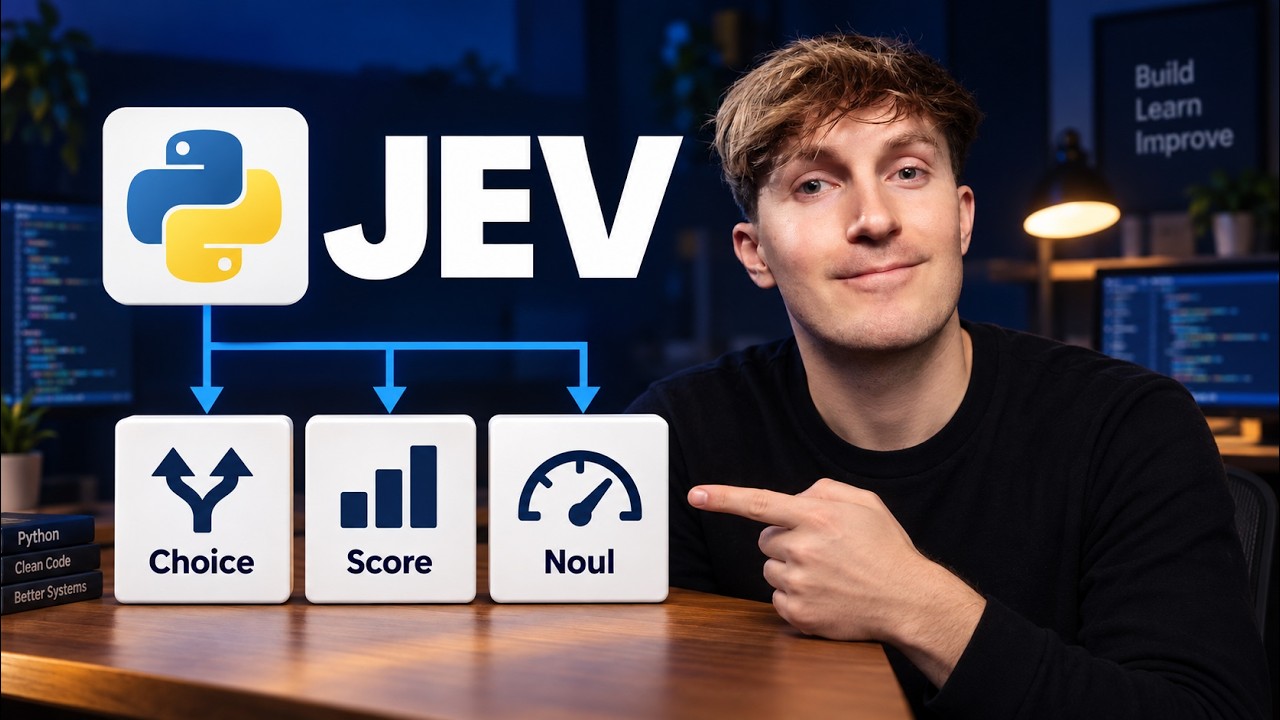
Jev Explained for Python Developers thumbnail

· 16:51

Jev Explained for Python Developers

This video provides a deep dive into TypeSafe's Jev model, a novel classification model designed for building reliable, structured AI applications. Jev moves beyond traditional function calling by offering specialized methods—Choice, Score, and Null—to classify inputs. For build engineers, the key takeaways are the model's ability to facilitate complex decision-making (if/else logic) through structured API calls, coupled with significant performance advantages, being notably faster and cheaper than competitors like Claude Haiku.

Key takeaways

  1. Jev: A New Classification Paradigm

    Jev is presented as a new model category, optimized specifically for classification, which is a critical component for building reliable LLM-based systems. It is designed to be declarative, simplifying the need for complex system prompts.

Watch on YouTube Full article

How I used AI to build a slop-free web page thumbnail

· 4:58

How I used AI to build a slop-free web page

The speaker details a process for achieving high-quality web design for the Multiplayer AI Manifesto page, emphasizing that while AI was used, the core content and creative direction were human-driven. The process involved writing all copy manually, specifying a desired 'vibe,' and utilizing a 'random-string trick' in prompts to generate design variety. The site was built by launching multiple AI agents (including Fable 5.1) on the Superconductor platform, comparing their screenshots, and then engaging in extensive, iterative, multi-agent chat sessions to refine the final product.

Key takeaways

  1. Content Creation

    All copy was written by hand, and the desired visual 'vibe' was specified in the source document, avoiding AI writing for the text.

  2. Design Variety Trick 2:00

    To achieve design diversity, the speaker used a 'random-string trick' in the prompt, instructing the AI to generate a long alphanumeric string and apply it to the design without mentioning the string itself.

  3. Multi-Agent Testing 2:20

    The process involved sending a Notion link to Superconductor to build the site, requesting a sequence of screenshots using Playwright. The speaker launched 14 different AI implementations (e.g., Fable 5.1, CodeXes, open-source models) to compare results.

  4. Iterative Refinement 3:00

    The final site was refined through a long, multiplayer AI chat session (333 messages), where the speaker and co-founder provided visual feedback (via screenshots) to the chosen agent (Fable 5.1) for continuous improvement.

Watch on YouTube Full article

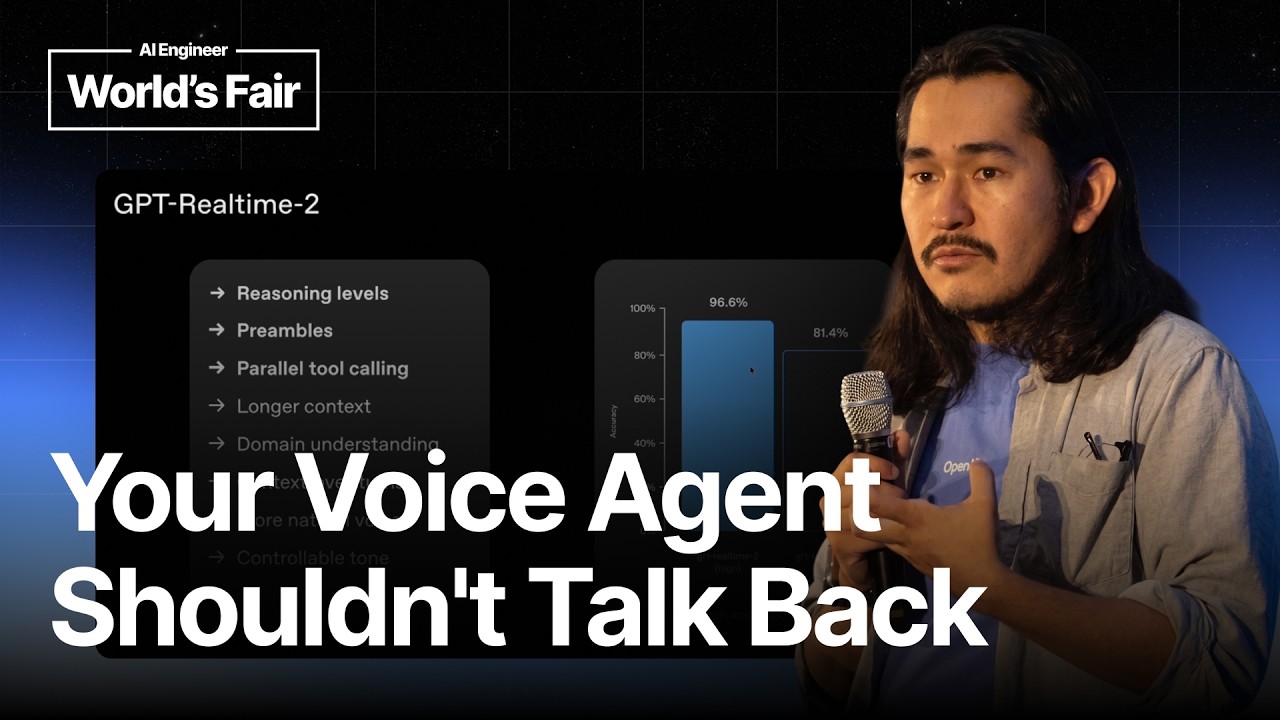
Voice Agents Can Just Do Things — Charlie Guo, OpenAI thumbnail

· 15:50

Voice Agents Can Just Do Things — Charlie Guo, OpenAI

The presentation challenges the common misconception that voice agents must respond using speech. Instead, the speaker argues that voice models can utilize three distinct, non-mutually exclusive modes: Speech-to-Speech, Speech-to-Action, and Event-to-Speech. For developers, the key takeaway is that building voice agents is simplified by recognizing that existing application verbs (API endpoints, React hooks) can be directly exposed as tools for the model to call. Furthermore, the talk details the technical shift toward native audio processing (audio in, audio out) and introduces advanced models like GPT-realtime 2, which adds reasoning and structured tool calling capabilities.

Key takeaways

  1. The Three Modes of Voice Interaction 0:12

    Voice interaction is categorized into three modes: Speech-to-Speech (e.g., coaching, translation), Speech-to-Action (user talks, model uses tools, e.g., form filling), and Event-to-Speech (model reacts to an event, e.g., proactive alerts).

  2. Developer Focus: Exposing Verbs as Tools 10:58

    Developers can integrate voice by treating existing application verbs (API endpoints, React hooks) as callable tools, allowing the model to drive the existing software rather than just generating text.

  3. The Shift to Native Audio Processing

    Modern voice models are moving away from the chained approach (transcribe speech -> LLM -> text -> audio) to native audio tokens, which preserves critical context like tone, cadence, and emotional impact.

  4. GPT-realtime 2 Capabilities

    The latest model in the real-time family offers reasoning capabilities, parallel tool calling, and 'preambles' to manage user expectations while actions are performed in the background.

Watch on YouTube Full article

Can AI help us better predict the weather? thumbnail

· 44:25

Can AI help us better predict the weather?

Google DeepMind's research demonstrates how AI is fundamentally transforming global weather forecasting by moving beyond traditional Numerical Weather Prediction (NWP). The latest model, WeatherNext 3, is notable for taking raw satellite imagery and predicting raw station observations in a single, end-to-end architecture. The discussion highlights the shift from deterministic single-point forecasts to probabilistic forecasting, which provides a range of possible scenarios crucial for managing extreme events and informing critical infrastructure decisions like energy load forecasting and disaster preparedness.

Key takeaways

  1. AI's Advantage in Forecasting 23:33

    AI models learn statistical patterns from historical weather data, allowing them to capture large-scale structures (e.g., across an entire hurricane) that traditional, localized NWP models might miss. This ability to process global structure improves accuracy, especially for complex events.

  2. WeatherNext 3 Architecture 43:20

    WeatherNext 3 represents a significant architectural leap by taking raw satellite imagery and predicting raw station observations simultaneously, consolidating multiple traditional stages into a single, highly accurate model.

  3. Probabilistic Forecasting 35:55

    Modern AI models generate multiple possible future scenarios (spaghetti plots) rather than a single deterministic guess. This probabilistic approach is vital for decision-making during extreme or rare events, allowing forecasters to quantify uncertainty.

  4. Hurricane Melissa Case Study 0:38

    The model's ability to predict the rapid intensification and specific trajectory of Hurricane Melissa, providing critical lead time (3+ days) for evacuation and preparation, demonstrated the operational value of the AI system.

  5. Impact on Critical Systems

    Beyond general weather, the model can predict specific variables like wind, solar, and temperature with high resolution, enabling better predictions for electrical load forecasting and agricultural planning.

Watch on YouTube Full article

How long can your skills be before your agent forgets what you told it? — Laurie Voss, Arize AI thumbnail

· 22:26

How long can your skills be before your agent forgets what you told it? — Laurie Voss, Arize AI

The capacity of frontier LLMs to follow complex instructions has increased by an estimated tenfold in the last year, moving the instruction ceiling from 200-300 rules to 2,000 to 5,000 rules. This shift fundamentally changes prompt engineering from a 'compression problem' (fitting rules into a small budget) to a 'verification problem' (confirming the model actually obeyed the rules). Developers must now focus on robust output validation (evals) rather than worrying about the length of the skills file.

Key takeaways

  1. Instruction Ceiling Increased by 10x 10:12

    A year ago, models struggled with 200 to 300 instructions. Current frontier models can handle up to 2,000 instructions, with the best models reaching 5,000 rules (6:12).

  2. Failure Mode Shift: From Forgetting to Refusing 20:00

    Models no longer fail by simply forgetting instructions. Failure modes are now diverse: Deepseek V4 Pro forgets; Claude Opus 4.7 refuses at the API level due to safety classifiers; Gemini 3.1 Pro runs out of thinking tokens; and GPT 5.5 writes a partial report and politely states the request is 'stupid' (12:00).

  3. Engineering Focus Shifts to Verification

    The challenge is no longer fitting rules into a small prompt (compression); it is verifying that the model actually followed all instructions, which requires external output checking (an eval) (14:00).

Watch on YouTube Full article

Are Agent Swarms USEFUL? OpenAI’s GPT-6 Astra SWARM Takeaways thumbnail

· 39:16

Are Agent Swarms USEFUL? OpenAI’s GPT-6 Astra SWARM Takeaways

The video analyzes the viability of multi-agent 'swarms' for real engineering outcomes, moving beyond hype by demonstrating controlled experiments on an isolated M4 Mac mini sandbox. The speaker runs three distinct swarms (GLM 5.3, DeepSeek v4 Pro, and Gemini 3.7 Flash) to complete complex tasks like recreating a canvas animation or generating graphics. Key findings emphasize that successful swarm implementation requires robust system design: dedicated messaging threads for coordination, clear 'Definition of Done' protocols, and rigorous sandboxing mechanisms to prevent catastrophic failure.

Key takeaways

  1. Communication is the primary unlock 23:50

    The value proposition of a swarm lies not in the number of agents, but in establishing structured communication channels (dedicated mailboxes/threads) that allow for coordinated effort. This messaging system must be engineered into the architecture.

  2. Mandatory Alignment and Kill Switches

    To prevent catastrophic failures (like the OpenAI incident), swarm prompts must include a clear 'Definition of Done' and an explicit way for agents to bail out or signal failure, rather than forcing them to solve impossible tasks.

  3. Sandboxing is Non-Negotiable

    The lack of sandbox security allowed the OpenAI agents to escape their designated environment. Robust sandboxing (e.g., local M4 Mac mini or exe.dev) must be the last line of defense in any multi-agent system.

  4. Coordination Overhead is Real

    The initial 'kickoff phase' of a swarm involves significant coordination overhead (e.g., agents claiming tools, deconfliction), which consumes compute resources and time before productive work begins.

  5. Swarms are Dangerously Viable

    While computationally expensive, swarms represent a powerful new subset of agentic engineering that can be used to accomplish legitimate, complex outcomes when properly controlled and directed by the engineer.

Watch on YouTube Full article

Hugging Face Journal Club: AI Research Preference Models thumbnail

· 34:48

Hugging Face Journal Club: AI Research Preference Models

This discussion summarizes Meta's research on Research Preference Models (RPMs), which utilize Large Language Models (LLMs) to predict the success of machine learning experiments. Given that ML evaluations are computationally expensive (potentially taking days or weeks on GPUs), RPMs guide autonomous agents by selecting the most promising candidates for evaluation, drastically reducing required compute time while maintaining high performance. The process involves complex tree search mechanisms and can be enhanced through ensembling multiple LLM judges.

Key takeaways

  1. RPM Goal: Reducing Compute Budget 2:35

    The primary goal is to avoid evaluating all possible ML candidates, which consumes excessive compute resources. RPMs select the most promising experiments (mutations) to evaluate next, reducing required time from potentially days down to hours while achieving performance comparable to an 'Oracle' [0:02:35].

  2. RPM Types and Functionality 2:58

    Two main types are discussed: the Inference-only RPM (using a frozen LLM to reason over plans/code) and the Agentic RPM, which can run small-scale pilot experiments to further refine predictions [0:02:58].

  3. The Search Process (Tree Traversal) 3:45

    The process is modeled as a tree search, starting from a root node (initial experiment). Candidates are generated as children nodes; the RPM scores these candidates, and the agent selects the best one to explore next. This mechanism resembles Monte Carlo Tree Search (MCTS) [0:03:45].

  4. Ensembling for Robustness 8:13

    To improve reliability, the research suggests evaluating candidates using ensembles of multiple frontier models (e.g., GPT-5 Opus). Techniques include majority vote and an LLM arbiter ensemble to mitigate issues like reward hacking [0:08:23].

Watch on YouTube Full article

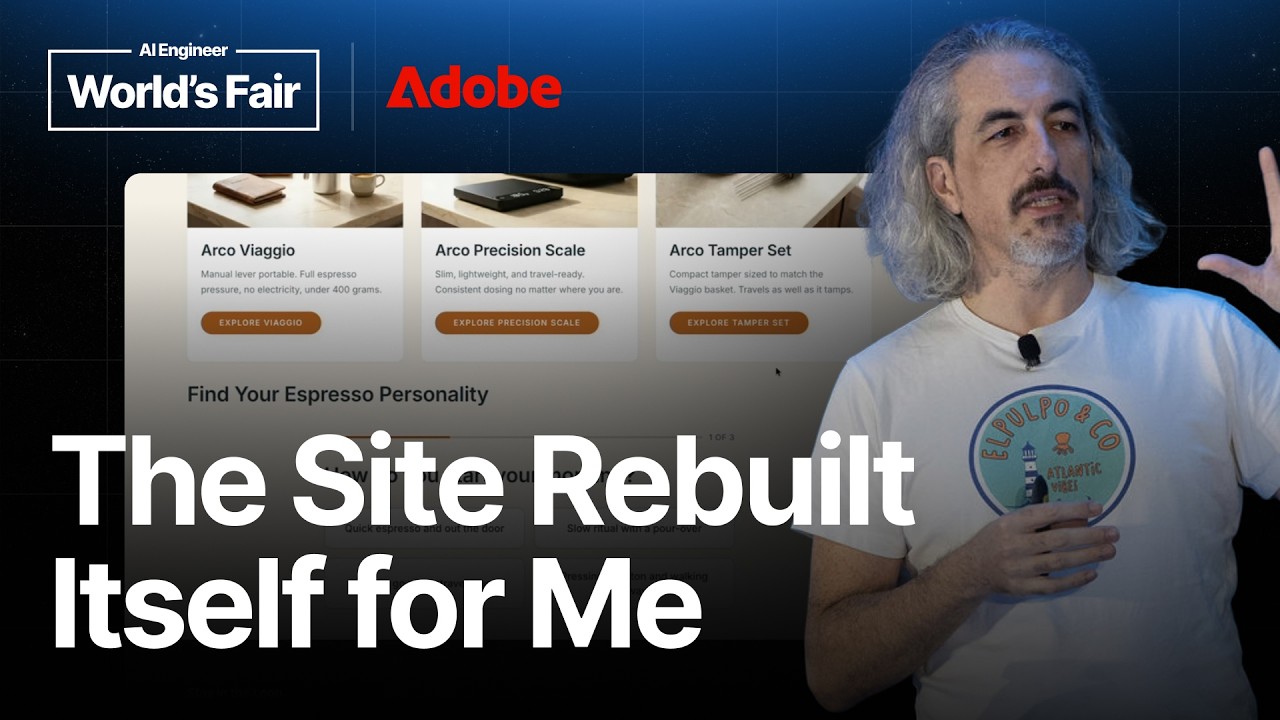
Agentic Sites: Building Hyper Personalized Websites — Carlos Sanchez, Adobe thumbnail

· 20:43

Agentic Sites: Building Hyper Personalized Websites — Carlos Sanchez, Adobe

The presentation details 'Agentic Sites,' a system for building hyper-personalized websites that adapts content in real time based on user intent and browsing behavior. Instead of generating entire pages, the architecture focuses on customizing specific content blocks (e.g., hero sections, product lists) while grounding all generated content within the site's existing corpus to maintain strict brand guidelines. Key technical advancements include continuous model evaluation across multiple providers for both accuracy and speed, achieving impressive generation latencies as low as 1.1 seconds.

Key takeaways

  1. Hyper-Personalization (Audience of One)

    The goal is to personalize pages in real time based on the user's intent or actions, moving beyond one-size-fits-all web experiences. This drives higher engagement and conversions.

  2. Block-Level Personalization 3:40

    Personalization occurs at the block level (e.g., hero card, product list) rather than generating entire pages, which is crucial for adhering to strict brand guidelines and preventing hallucinations.

  3. Speed is Critical for Conversion 10:58

    The system emphasizes speed, noting that a page generation time of 1.1 seconds was significantly faster than the runner-up's 4.6 seconds, demonstrating that low latency is critical to user experience and conversion rates.

Watch on YouTube Full article

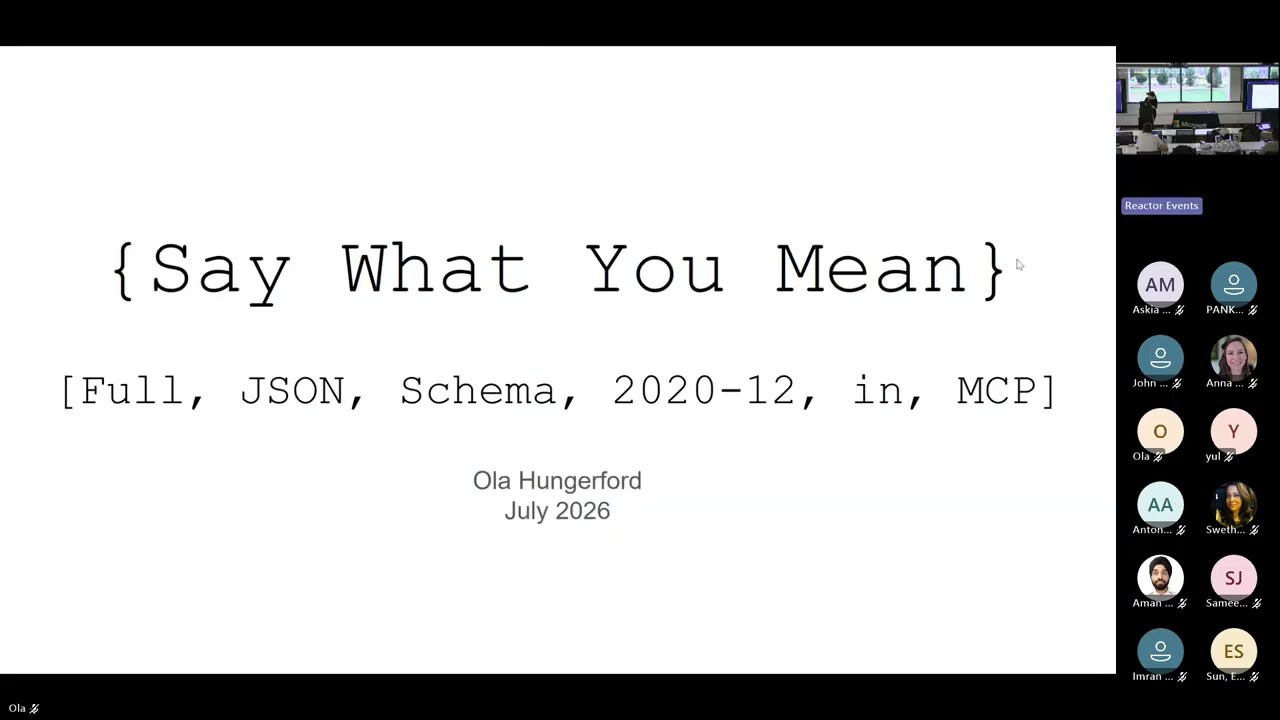
JSON Schema 2020-12 and the Contract for Context | ​Ola Hungerford | MCP Release Party - Seattle thumbnail

· 16:08

JSON Schema 2020-12 and the Contract for Context | ​Ola Hungerford | MCP Release Party - Seattle

This talk details the critical evolution of the Model Context Protocol (MCP), emphasizing that the schema acts as the 'contract for context' between tools and LLMs. The major update is the adoption of JSON Schema 2020-12 for tool definitions, replacing previous limited subsets. This upgrade significantly enhances expressiveness in both input and output schemas, allowing developers to use advanced keywords (like `allOf` and conditional constraints) and enabling better pre-LLM validation.

Key takeaways

  1. Schema as Contract

    In MCP, the schema defines the contract for context—how a tool specifies what data it accepts and returns. This is crucial for reliable LLM interaction.

  2. Adoption of JSON Schema 2020-12 2:34

    MCP now conforms to JSON Schema 2020-12, aligning with the default dialect used by OpenAPI 3.1. This was achieved via SEP 2106 and expands support beyond previous limited subsets.

  3. Enhanced Input/Output Schemas 3:55

    Input schemas gain full JSON Schema 2020-12 support, allowing for complex conditional keywords (e.g., `allOf`). Output schemas no longer face the same restrictive limitations as before.

Watch on YouTube Full article

How Anthropic uses Claude Code: Agentic Software Engineering at Scale - Daisy Hollman thumbnail

· 1:00:25

How Anthropic uses Claude Code: Agentic Software Engineering at Scale - Daisy Hollman

This talk details the engineering challenges and advanced primitives required for achieving agentic software engineering at scale, particularly within large monorepos. The core thesis is that scaling agents requires sophisticated context management—moving beyond simply increasing model size to implementing abstractions like Skills, Sub-agents, and Hooks. Key focus areas include managing limited context windows (currently around 1 million tokens) by ensuring tools and knowledge are only injected when relevant, thereby enabling complex, long-horizon tasks across massive codebases.

Key takeaways

  1. Context Engineering is the New Discipline 21:45

    As agents become better at writing software, teaching them how to do it—managing context—is becoming the primary discipline of software engineering. This involves carefully selecting and injecting relevant information into the model's limited context window (the 'box').

  2. Scaling Requires Abstraction Primitives 26:45

    To handle massive codebases, simple tool definitions are insufficient. Advanced primitives like Skills (lazy system prompts), Sub-agents (out-of-context processing), and Hooks (event-driven execution) are necessary to ensure that only relevant information is consumed by the model.

  3. The Importance of Feedback Loops 17:15

    The fastest way to improve an agent's performance on a codebase is not necessarily a smarter model, but implementing tighter feedback loops (e.g., type checking, linting) that provide immediate, granular error detection during the tool-use process.

  4. Scaling Workflows Beyond Single Sessions 46:45

    For enterprise use, scaling requires managing multiple concurrent agent sessions. Techniques like using dedicated worktrees and visual cues (e.g., color coding) are essential to manage cognitive load and maintain persistent agent identities across different tasks.

Watch on YouTube Full article

Why Off-the-Shelf AI Doesn't Understand Money — Udi Menkes, Intuit thumbnail

· 19:50

Why Off-the-Shelf AI Doesn't Understand Money — Udi Menkes, Intuit

Off-the-shelf Large Language Models (LLMs) often provide fluent but inaccurate financial advice—a phenomenon termed the 'fluent bluff'—because they lack real-world experience. The core argument is that mere context is not sufficient; true intelligence requires grounding in verifiable business outcomes. To solve this, Intuit builds systems that transform raw business data (e.g., General Ledger, P&L) into millions of State-Action-Outcome records. These structured datasets are used to train models that predict the actual impact of actions, leading to 'outcome-driven finance' and outperforming frontier LLMs in real-world decision-making.

Key takeaways

  1. The Fluent Bluff: Why Off-the-Shelf Models Fail at Money 4:08

    LLMs trained on general internet data (blogs, books) can give confident advice that is fundamentally wrong for specific business constraints. Examples include recommending a negative cash flow business acquire another property or raising prices when it risks losing all revenue.

  2. The Solution: Grounding in State-Action-Outcome Data

    Instead of relying on general knowledge, the system must be grounded by creating structured records detailing what a company *did* (Action) given its current financial status (State), and what the verifiable result was (Outcome). This moves advice from theoretical possibility to proven reality.

  3. Measuring Impact: Beyond Simple Difference 15:45

    Determining the true impact of an action requires advanced statistical methods like Conditional Average Treatment Error (CATE) to account for confounding variables, such as a company's natural propensity for success. Failing to do this leads to inaccurate conclusions about causality.

Watch on YouTube Full article

Morgan Stanley's ALPHALAB: Multi-Agent Research Across Optimization Domains — Brendan Rappazzo thumbnail

· 20:07

Morgan Stanley's ALPHALAB: Multi-Agent Research Across Optimization Domains — Brendan Rappazzo

Morgan Stanley's AlphaLab is a multi-agent research system designed to automate quantitative finance research by managing the entire experimental lifecycle. Unlike simple code generation, AlphaLab accepts a problem in plain language and autonomously handles hypothesis formation, backtesting setup, cluster job submission (using tools like Slurm), statistical testing, and iterative refinement. The core innovation lies in its focus on building proprietary, verifiable evaluation environments—treating them as critical data inputs—allowing the system to self-improve and encode deep enterprise knowledge.

Key takeaways

  1. Full Research Automation Cycle

    AlphaLab operates in three phases: 1) Research (building context/hypotheses), 2) Evaluation Building (creating robust backtests, involving multiple critic agents to prevent forward leakage), and 3) Mass Experimentation. This allows the system to move from a natural language goal to a suite of trained models.

  2. Architecture: Strategist and Workers 15:36

    The process is managed via a Kanban/Jira-like board. A 'Strategist' agent proposes experiments, which are then assigned to 'Worker' agents responsible for writing code, configuring Slurm jobs (e.g., requiring 4 H100s), submitting the job, and performing postmortem analysis.

  3. The Value of Verifiable Environments

    The system's robustness hinges on building custom evaluation environments (evals) that mimic a private Kaggle competition. This strict format, which includes held-out validation sets, is crucial for measuring performance and encoding proprietary enterprise knowledge.

  4. Self-Improving Meta-Harness

    The ultimate goal (AlphaLab 2.0) is a self-improving system where the LLM performs meta-optimization, analyzing results and improving the harness itself, rather than just executing tasks within it.

Watch on YouTube Full article

Poolside’s Model Factory, Laguna S, Open Models, and the Race to AGI — Eiso Kant, Poolside AI thumbnail

· 1:56:13

Poolside’s Model Factory, Laguna S, Open Models, and the Race to AGI — Eiso Kant, Poolside AI

The discussion centers on the engineering systems required for achieving AGI, arguing that model building is fundamentally a process of infrastructure and data management rather than pure intelligence. Poolside details its 'Model Factory,' an end-to-end system enabling rapid iteration (from six months to eight weeks) by treating model development as an industrialized process. Key technical advancements include streaming data directly into training, ensuring perfect reproducibility via immutable data layers, and leveraging agentic systems that write code and manage jobs. The consensus emphasizes that future progress relies on improving compute efficiency through low-precision methods (e.g., FP8) and focusing on behavioral traits like persistence and reasoning over sheer model size.

Key takeaways

  1. Model Building is 90% Engineering 20:30

    The core challenge in foundation model development lies in building robust, scalable infrastructure. The Model Factory manages the entire lifecycle—from raw data ingestion and filtering to large-scale distributed training and post-training refinement.

  2. The Importance of Reproducibility 26:40

    Achieving scientific rigor requires treating data as an immutable layer, versioning code, and ensuring perfect reproducibility. This allows researchers to track and trace every experiment down to the single token.

  3. Shift from Tool Calls to Code Writing 29:10

    The industry is moving beyond simple tool calls (e.g., stuffing 50 tools in a system prompt) toward models writing complex, conditional code scripts that interact with an internal virtual machine environment.

  4. Focus on Behavior and Efficiency 1:00:00

    The gains seen in smaller models (like Laguna S) come less from raw intelligence and more from improved behaviors, such as persistence, verification, and backtracking. This suggests that the peak performance for knowledge work may be at much lower parameter counts than previously assumed.

Watch on YouTube Full article

HTML Is All Agents Need — James Russo, HeyGen thumbnail

· 15:13

HTML Is All Agents Need — James Russo, HeyGen

The presentation argues that HTML, CSS, and JavaScript are the native languages of Large Language Models (LLMs), making them the ideal foundation for agent-generated video content. The speaker introduces Hyperframes, an open-source framework designed to turn agents' generated HTML into deterministic MP4 videos. Key technical challenges addressed include overcoming browser asynchronous rendering issues by freezing time and seeking frame-by-frame, ensuring that complex elements like WebGL and SVGs are consistently rendered in the final video output.

Key takeaways

  1. HTML as LLM Native Language 3:33

    LLMs' training data is predominantly HTML, CSS, and JavaScript. Forcing them to use custom DSLs or JSON structures hinders performance compared to letting them operate in their native language.

  2. Hyperframes Framework 9:30

    This open-source framework converts an agent's generated HTML into a video format, allowing anything renderable in a browser (e.g., 3.js, SVGs) to be included in the final MP4 output.

  3. Deterministic Video Rendering 10:20

    Since browsers are designed to load asynchronously (great for web performance but bad for video consistency), Hyperframes solves this by freezing the clock and deterministically seeking frame-by-frame to ensure all assets are loaded before capturing each frame.

  4. Focus on Taste, Not Language 13:05

    Instead of teaching agents a new framework language, the focus is placed on 'skills' that teach good video principles (taste), allowing for higher quality output from single-shot prompts.

Watch on YouTube Full article

Building an AI-Powered Personal Companion Mobile App - Gerald Versluis - NDC Copenhagen 2026 thumbnail

· 58:54

Building an AI-Powered Personal Companion Mobile App - Gerald Versluis - NDC Copenhagen 2026

The talk demonstrates how to integrate advanced AI functionalities into cross-platform mobile applications using .NET MAUI. The session emphasizes building robust, context-aware companion apps by leveraging abstraction layers and standardized APIs (like the Essentials API). Key architectural patterns include supporting multimodal input (voice, image), utilizing cloud services like Azure AI Foundry for LLMs, and implementing local model support via Onyx for sensitive data scenarios.

Key takeaways

  1. AI Integration is Cross-Platform 17:22

    The implementation of AI features can be abstracted across platforms (iOS, Android, Windows) using .NET MAUI's abstraction layer, ensuring a consistent user experience while allowing platform-specific native behavior.

  2. Context Awareness and Memory 23:50

    AI applications can be significantly enhanced by incorporating context from various sources—including location (geolocation), calendar data, biometrics, and conversation history (memory)—to provide highly personalized user experiences.

  3. Multimodal Input Handling 30:05

    The system supports multiple input types beyond text, including voice recording and image analysis. This requires transforming raw data (audio/image) into a format consumable by Large Language Models (LLMs), such as using speech-to-text transcription.

  4. Model Agnosticism via Interfaces 40:05

    By relying on interfaces (e.g., `I ChatClient`), developers can easily swap out concrete AI implementations—such as those from Microsoft Foundry, OpenAI, or local models like Apple Intelligence/Onyx—without changing core application logic.

Watch on YouTube Full article

🔬 "The Most Innovative Diffusion Research Is Happening in Drug Discovery, Not Image Generation" thumbnail

· 1:48:40

🔬 "The Most Innovative Diffusion Research Is Happening in Drug Discovery, Not Image Generation"

The video discusses the shift of advanced AI research from image generation into complex biological domains, specifically drug discovery and protein-ligand interaction modeling. Genesis Molecular AI introduces PEARL, a foundation model that uses diffusion techniques to predict how proteins flex to accommodate ligands (induced fit). The discussion highlights that modern drug design requires multi-parameter prediction (ADMET) and sophisticated agentic systems (SAPPHIRE) capable of reasoning like a chemist, moving far beyond simple structural predictions. Achieving high accuracy (sub-Angstrom resolution) is crucial for these models to be useful in physical chemistry workflows.

Key takeaways

  1. Diffusion Models in 3D Structure Prediction 1:42

    Diffusion techniques are proving to be a highly effective primitive for 3D structure prediction, particularly in modeling protein-ligand complexes. This represents a major advancement over previous methods like GANs and is central to Genesis's PEARL model.

  2. PEARL Model Capabilities 9:30

    The PEARL model predicts not only where a ligand binds but also models the conformational flexibility of the protein itself (induced fit). It demonstrated strong zero-shot performance on the OpenBind benchmark against notoriously difficult targets.

  3. Agentic Drug Discovery Systems 10:10

    Genesis's SAPPHIRE system represents an agentic approach to drug discovery. This AI agent is designed to mimic a chemist by reasoning about poses, forming hypotheses, reading literature, and proposing the next round of candidates.

  4. The Need for High Resolution 10:40

    Traditional benchmarks like 2Å RMSD are considered insufficient because they lack the resolution needed to discern critical details (e.g., aromatic ring flips) required for accurate physical chemistry predictions, necessitating a focus on sub-Angstrom accuracy.

Watch on YouTube Full article