Channel

Dave Ebbelaar

Digests from Dave Ebbelaar — Dave Ebbelaar videos on AI automation, agents, and practical AI development.

· 2:37:48

Build a Document Review App in 3 Hours (Python, React, Azure)

This video provides an end-to-end guide for building a sophisticated document review application designed for invoice and receipt processing. The solution utilizes a modern monorepo architecture, integrating Python (FastAPI) for the backend logic, React for the frontend UI, and Microsoft Azure services (Document Intelligence and Azure OpenAI) for core AI capabilities. The process demonstrates creating a robust, multi-stage pipeline that handles document classification, data extraction, business rule validation, and general ledger account suggestion.

Key takeaways

  1. Hybrid Document Processing Pipeline

    The application uses a hybrid approach by combining specialized pre-trained models (Azure Document Intelligence) for high accuracy/low cost extraction with general LLMs (Azure OpenAI) for complex tasks like classification and suggesting General Ledger accounts. This ensures robustness against edge cases.

  2. Structured Data Modeling

    Pydantic is used extensively to enforce strict schemas on extracted data, transforming raw JSON output into predictable Python objects for reliable business logic application.

  3. Modular Pipeline Design Pattern

    The backend implements a chainable pipeline pattern (Classification -> Extraction -> Validation -> GL Suggestion). This modular design allows individual steps to be easily added, swapped, or removed without breaking the overall workflow.

  4. Enterprise Cloud Setup

    The entire system is designed for enterprise readiness by utilizing Azure services and demonstrating deployment via Azure Container Apps (ACA), emphasizing best practices for production environments.

Watch on YouTube Full article

· 30:13

How to Go From Data Scientist to AI Engineer (I Did This)

This roadmap guides individuals transitioning from Data Science or Machine Learning into AI Engineering. The core message is that the role shifts focus from statistical modeling in notebooks to becoming a full-stack software engineer capable of building reliable, production-grade AI systems. Key areas covered include closing the software engineering gap (OOP, structured Python projects), mastering LLM backends (FastAPI, Pydantic, Docker), and implementing advanced techniques like Retrieval Augmented Generation (RAG), evaluation (Evals), and guardrails.

Key takeaways

  1. The AI Engineer Shift 0:59

    AI Engineering requires moving beyond Jupyter notebooks to structured Python projects using OOP principles, Git, testing, debugging, logging, and environment management. The focus shifts from pure research to building reliable systems around pre-trained models.

  2. Data Science Advantage 2:00

    Individuals with a DS/ML background have an advantage because they are trained in statistical thinking (distributions, error analysis) which is critical for making non-deterministic LLM outputs reliable in production.

  3. The Importance of Production Backends 5:29

    To build deployable systems, learn to use FastAPI and Pydantic for API creation. Containerization using Docker and persistent data storage with PostgreSQL are essential steps.

  4. Advanced AI Techniques 7:30

    Mastering RAG (Retrieval Augmented Generation) requires understanding vector databases (e.g., using the PGvector extension in PostgreSQL). Furthermore, implementing Evals and Guardrails is crucial for quantifying performance and preventing issues like prompt injection.

Watch on YouTube Full article

· 16:33

The Best AI Automation Stack to Learn in 2026

The video outlines a comprehensive five-layer stack for building production-ready AI automation and engineering solutions. The recommended architecture emphasizes foundational software engineering principles—backend, database, frontend, AI models, and infrastructure—rather than relying solely on high-level no-code tools. Core technologies include Python/FastAPI/Celery for the backend, Postgres/Supabase for data storage, React/Vite/ShadCN UI for the frontend, and cloud providers (AWS, Azure, GCP) or specialized services for model integration and deployment.

Key takeaways

  1. Focus on Foundational Layers

    To build a career in AI engineering, understanding how to integrate core components—backend, database, frontend, AI layer, and infrastructure—is more valuable than mastering specific high-level tools.

  2. Backend Core Stack

    Python is the recommended language. FastAPI serves as the API entry point (handling GET/POST/PUT/DELETE webhooks), while Celery manages background workers and scheduled cron jobs, ensuring robustness and scalability.

  3. Database Recommendation 7:15

    Postgres is recommended as the primary database layer. Supabase is suggested as a wrapper around Postgres that simplifies authentication and provides an out-of-the-box admin GUI.

  4. Frontend Stack 12:00

    The recommended frontend stack is React (industry standard UI library), Vite (development server/bundler), and ShadCN UI (a component library for rapid, customizable development).

  5. Deployment Strategy

    For custom deployments, the industry standard is using Docker. For ease of use, platforms like Railway are recommended to simplify deployment setup (e.g., deploying FastAPI/Celery and React code). Advanced options include container services from major cloud providers or dedicated VPS hosting.

Watch on YouTube Full article

· 3:51:50

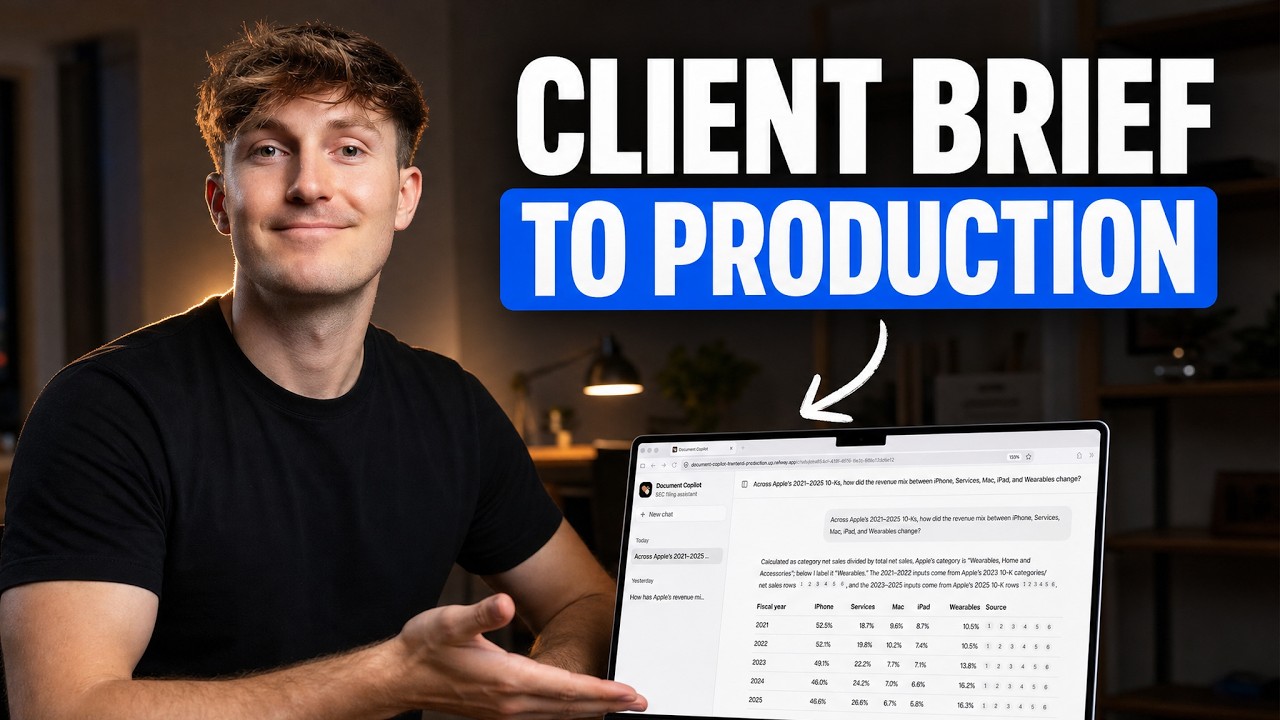
Build a Full-Stack GenAI Project in 4 Hours (FastAPI, React, Supabase)

This tutorial provides an end-to-end guide for building a production-grade Retrieval Augmented Generation (RAG) application—a Document Copilot. The project uses SEC filings data and demonstrates the complete AI engineering workflow: from initial client brief analysis to setting up the full stack (FastAPI, React/TypeScript, Supabase Postgres with pgvector). Key phases covered include database schema design using SQLAlchemy/Alembic, implementing user authentication via Supabase Auth, building a front-end chat interface, and establishing a robust document ingestion pipeline that converts messy HTM files into structured Markdown chunks for vector embedding.

Key takeaways

  1. Full Stack GenAI Architecture 30:45

    The system is designed as a mono repo using FastAPI (backend) and React/TypeScript (frontend), connected via Supabase Postgres, which utilizes the pgvector extension for efficient vector storage and retrieval.

  2. Data Ingestion Pipeline 3:44:09

    Raw SEC filings (HTM format) are processed using Dockling to convert them into clean Markdown. This structured data is then chunked, embedded via OpenAI, and stored in the database for RAG retrieval.

  3. Database Management

    The project utilizes SQLAlchemy and Alembic for defining models (Users, Documents, Chunks, Messages) and managing schema migrations, ensuring a structured development process.

Watch on YouTube Full article