Topic

Document Processing

All digests tagged Document Processing

Processing Documents: Jev vs OSS Models thumbnail

· 16:48

Processing Documents: Jev vs OSS Models

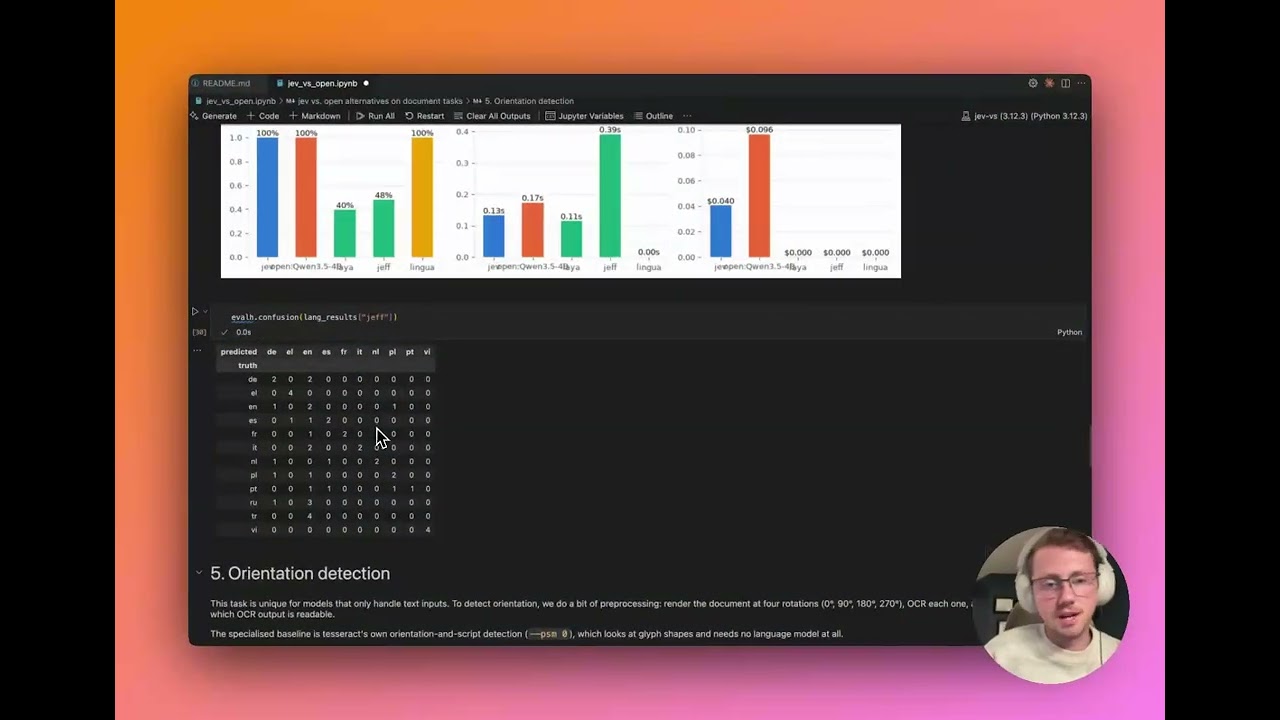
This video compares several model architectures (Jev, Quen, Leia, Jeff) for automating decision-making and classification tasks within document processing pipelines. The core finding is that the open decoder model, Quen, performs remarkably close to the generalized classifier, Jev, across various tasks (language detection, document classification, document routing). The approach demonstrates that robust classification can be achieved without requiring pre-training on specific labels, making it highly valuable for building flexible, automated document pipelines.

Key takeaways

  1. Quen's Performance in Classification

    The Quen decoder model, which is a standard Language Model (LM) and not specifically trained for classification, showed accuracy very close to Jev in tasks like language detection and document routing, suggesting its utility for general document understanding.

  2. Model Architecture Comparison 7:16

    Jev is a generalized classifier trained with reinforcement learning, optimized for confidence scoring. Quen is a decoder LM. Leia and Jeff are encoder models (Leia predicts a mask token; Jeff is good for entity/relation extraction). While encoders are smaller and easier to fine-tune, they were less accurate than the decoders in this demonstration.

  3. Document Processing Tasks Covered

    The models were tested on five key document pipeline tasks: Language Detection (using Lingua as baseline), Orientation Detection (using Tesseract as baseline), Document Classification, Document Splitting, and Document Routing/Triage.

Watch on YouTube Full article

Build a Document Review App in 3 Hours (Python, React, Azure) thumbnail

· 2:37:48

Build a Document Review App in 3 Hours (Python, React, Azure)

This video provides an end-to-end guide for building a sophisticated document review application designed for invoice and receipt processing. The solution utilizes a modern monorepo architecture, integrating Python (FastAPI) for the backend logic, React for the frontend UI, and Microsoft Azure services (Document Intelligence and Azure OpenAI) for core AI capabilities. The process demonstrates creating a robust, multi-stage pipeline that handles document classification, data extraction, business rule validation, and general ledger account suggestion.

Key takeaways

  1. Hybrid Document Processing Pipeline

    The application uses a hybrid approach by combining specialized pre-trained models (Azure Document Intelligence) for high accuracy/low cost extraction with general LLMs (Azure OpenAI) for complex tasks like classification and suggesting General Ledger accounts. This ensures robustness against edge cases.

  2. Structured Data Modeling

    Pydantic is used extensively to enforce strict schemas on extracted data, transforming raw JSON output into predictable Python objects for reliable business logic application.

  3. Modular Pipeline Design Pattern

    The backend implements a chainable pipeline pattern (Classification -> Extraction -> Validation -> GL Suggestion). This modular design allows individual steps to be easily added, swapped, or removed without breaking the overall workflow.

  4. Enterprise Cloud Setup

    The entire system is designed for enterprise readiness by utilizing Azure services and demonstrating deployment via Azure Container Apps (ACA), emphasizing best practices for production environments.

Watch on YouTube Full article