Topic

LLM Integration

All digests tagged LLM Integration

Hugging Face's MCP Server: Only 62K of 10M Calls Matter thumbnail

· 9:44

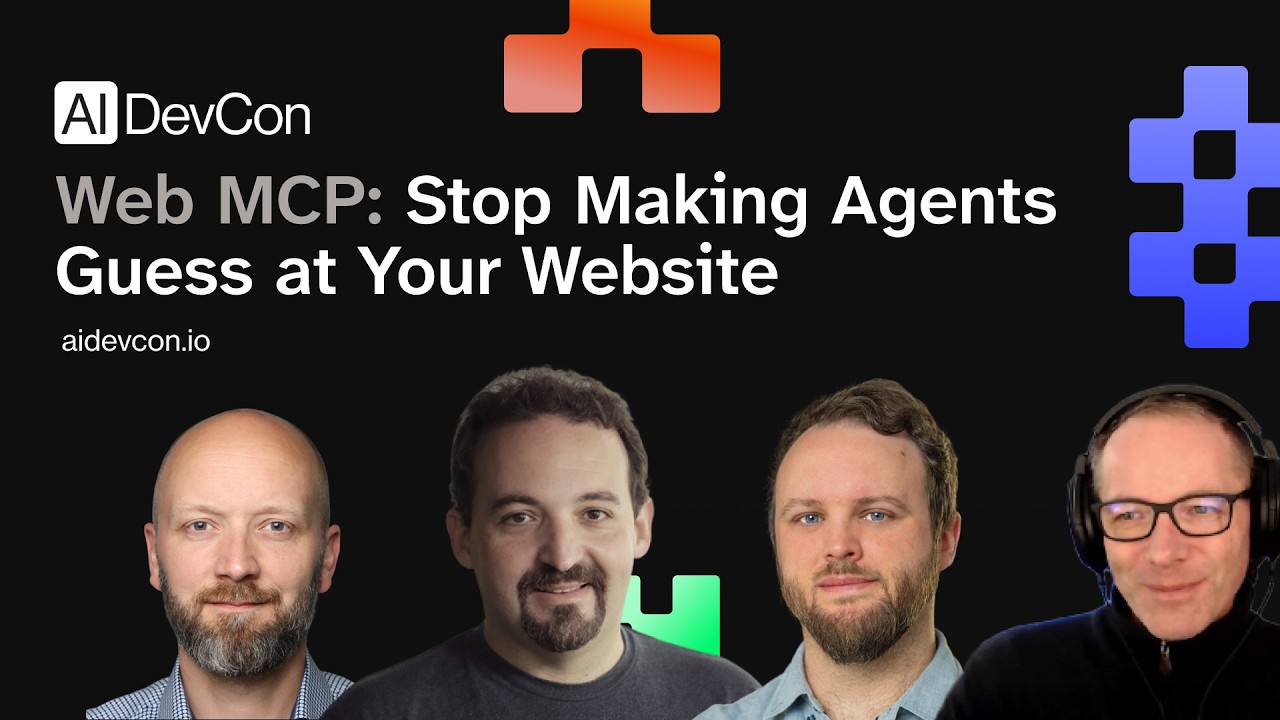
Hugging Face's MCP Server: Only 62K of 10M Calls Matter

The video discusses the significant overhead and limitations inherent in current AI agent protocols, particularly the Model Call Protocol (MCP). Speakers highlight that complex agent interactions are often hampered by chatty, stateful handshakes and reliance on visual/pixel-based inference (the 'guessing game'). Solutions proposed include implementing Web MCP, which allows front ends to expose capabilities rather than just pixels, and building robust guardrails and validation logic directly into the protocol's plumbing (using lifecycle hooks) to prevent agents from reinventing existing components or making unauthorized calls.

Key takeaways

  1. Protocol Overhead is High 2:07

    A stateful MCP handshake is highly chatty. For every 10 million protocol messages, 1.2 million are 'initialize' events, but only 62,000 are actual tool calls, indicating significant protocol overhead (00:02:07).

  2. Web MCP Shifts Focus from Pixels to Capabilities 2:32

    Current web agents operate by observing screenshots, DOM, or accessibility trees, which is inefficient and consumes excessive tokens. Web MCP proposes letting the front end expose defined capabilities instead of relying on pixel-level guessing (00:02:32).

  3. Guardrails Must Live in the Plumbing 4:57

    Since developers cannot control what an LLM agent decides to call, guardrails must be implemented in the protocol's plumbing (e.g., using lifecycle hooks before or after a tool call) to validate outputs, such as ensuring an email is in a client's custom domain (00:04:57).

Watch on YouTube Full article

The Search Engine for the Agentic Web — Will Bryk, Exa thumbnail

· 17:49

The Search Engine for the Agentic Web — Will Bryk, Exa

The talk introduces Exa, a search engine designed specifically for AI agents, arguing that traditional search engines (like Google) are fundamentally flawed because they are built for human recommendation rather than precise information retrieval. The core premise is that as AI systems become ubiquitous, the volume of searches issued by machines will surpass human searches by a thousandfold by 2026. Exa addresses this by providing a high-quality, customizable search API that enables agents to perform complex, database-like queries over the world's information, moving beyond simple keyword matching.

Key takeaways

  1. AI Search Volume Prediction

    The speaker predicts that in 2026, the number of searches issued by AI systems will exceed those issued by humans. This volume is expected to increase by a thousandfold in the following years, necessitating a specialized search infrastructure.

  2. The Flaw of Recommendation Engines 5:10

    Mainstream search engines are designed as recommendation engines, meaning they prioritize suggesting related content (e.g., 'shirts with stripes' when 'shirts without stripes' is queried) rather than providing exact, database-level answers. AI agents require the opposite: perfect retrieval.

  3. The Perfect Search Thought Experiment 10:05

    The ideal search involves running a Language Model (LLM) over a complex query and a document pair to determine a match. While this is highly accurate, scaling it to a trillion documents costs millions per query, making cost-optimization the primary engineering challenge.

  4. The Business Catalyst 13:45

    The company's business model was catalyzed when external users requested programmatic API access to their search engine, proving the need for an AI-focused search API, rather than just a consumer product.

Watch on YouTube Full article

Agents & Arbiters - An Adventurer’s Guide to Multi-Agent Collaboration with LangGraph.js - Guy Royse thumbnail

· 59:56

Agents & Arbiters - An Adventurer’s Guide to Multi-Agent Collaboration with LangGraph.js - Guy Royse

The talk introduces multi-agent collaboration using LangGraph.js as an advanced pattern for building complex, interactive systems that move beyond fragile, scripted logic. Instead of anticipating every user action with nested `if` statements, the system uses autonomous agents (LLMs) to contribute perspectives and make decisions. The architecture is built around a graph structure that orchestrates specialized nodes—including routers, experts, arbiters, and committers—to manage state changes and generate coherent responses.

Key takeaways

  1. Agent Definition 24:28

    An agent is defined as an LLM with a system prompt defining its purpose, coupled with a collection of tools that allow it to interact with the world. These agents are composable within a graph structure.

  2. Graph Workflow Components 34:05

    The system uses an orchestration workflow (router, classifier, agents, arbiter, committer) to manage complex interactions. The router determines which specialized nodes are relevant for a given input, and the arbiter reconciles conflicting suggestions from multiple agents.

  3. Conditional Edges 38:38

    Conditional edges allow the graph's flow to be determined by an LLM's reasoning over the current state, enabling patterns like the Supervisor pattern and the ReAct (Reasoning and Acting) cycle. This is crucial for dynamic decision-making.

  4. State Persistence and Memory 48:50

    To solve context loss, the architecture utilizes a dedicated Agent Memory Server (a library/Docker image) that automatically compacts message history and extracts long-term facts asynchronously, providing continuous memory across sessions.

Watch on YouTube Full article

The Agentic Commerce Stack — Ahnaf Prio, Best Buy thumbnail

· 20:38

The Agentic Commerce Stack — Ahnaf Prio, Best Buy

The talk outlines the architectural shift required for 'Agentic Commerce,' moving beyond brittle browser automation (like DOM reading or screenshotting) toward standardized protocols. The core solution involves defining specific primitives—such as MCP, A2A, ACP, UCP, and AP2—that allow AI agents to interact directly with merchant APIs without triggering fraud alarms. Successful implementation requires rigorous testing using behavioral and protocol compliance 'evals.'

Key takeaways

  1. Agentic Commerce Scope 2:08

    Approximately 45% of all agent sessions on major platforms (e.g., ChatGPT, Google Gemini) are related to shopping, indicating a massive market opportunity ($7B to $65B by 2030).

  2. Failure of Early Agents 5:08

    Early attempts using screenshots and reading the DOM were slow, clunky, and brittle. Furthermore, automated browser actions often trigger fraud alarms at the payment stage.

  3. The Need for Standardization 7:36

    To scale, commerce must standardize its primitives. Instead of relying on search catalogs, merchants should provide structured product feeds to protocols like ACP and UCP. The process involves the agent calling a merchant checkout API directly (no browser needed).

  4. Payment Mandates with AP2 16:41

    Autonomous payments require more than just tokens. AP2 (Agentic Payment Protocol) is an extension that mandates defining the authorizing party, a spend ceiling, and a revocation URL.

  5. Testing with Evals

    Building agentic commerce requires intense testing (evals) focused on behavior, protocol compliance, and latency benchmarks. Failure to test can lead to agents being misused in production (e.g., asking programming questions).

Watch on YouTube Full article

HTML Is All Agents Need — James Russo, HeyGen thumbnail

· 15:13

HTML Is All Agents Need — James Russo, HeyGen

The presentation argues that HTML, CSS, and JavaScript are the native languages of Large Language Models (LLMs), making them the ideal foundation for agent-generated video content. The speaker introduces Hyperframes, an open-source framework designed to turn agents' generated HTML into deterministic MP4 videos. Key technical challenges addressed include overcoming browser asynchronous rendering issues by freezing time and seeking frame-by-frame, ensuring that complex elements like WebGL and SVGs are consistently rendered in the final video output.

Key takeaways

  1. HTML as LLM Native Language 3:33

    LLMs' training data is predominantly HTML, CSS, and JavaScript. Forcing them to use custom DSLs or JSON structures hinders performance compared to letting them operate in their native language.

  2. Hyperframes Framework 9:30

    This open-source framework converts an agent's generated HTML into a video format, allowing anything renderable in a browser (e.g., 3.js, SVGs) to be included in the final MP4 output.

  3. Deterministic Video Rendering 10:20

    Since browsers are designed to load asynchronously (great for web performance but bad for video consistency), Hyperframes solves this by freezing the clock and deterministically seeking frame-by-frame to ensure all assets are loaded before capturing each frame.

  4. Focus on Taste, Not Language 13:05

    Instead of teaching agents a new framework language, the focus is placed on 'skills' that teach good video principles (taste), allowing for higher quality output from single-shot prompts.

Watch on YouTube Full article

Why I switched to Pi... thumbnail

· 15:19

Why I switched to Pi...

The video provides a deep technical comparison of coding agents, arguing that Pi Agent offers superior flexibility for building complex agentic systems compared to competitors like Cloud Code and CodeX. Its core strength lies in its 'extension' system, which allows users to programmatically modify the agent's entire harness—including tools, contexts, hooks, and even the UI—making it ideal for advanced build engineering projects and product development.

Key takeaways

  1. Pi Agent's Core Advantage 3:30

    Unlike other agents where modifications are limited by their SDK/CLI structure, Pi Agent's design philosophy allows the harness to adapt to the user. This flexibility enables deep customization across tools, contexts, and hooks.

  2. Extensibility and Customization 5:40

    Pi Agents can be extended using new extension files (written by humans or agents) to add custom tools (e.g., clipboard access), modify system prompts, or implement complex logic like permission gates.

  3. Advanced System Building 10:30

    The Pi Agent SDK can be used not just as a coding agent but as an entire product scaffold. This includes packages for the AI SDK, agent loop management, and task scheduling (upgrader package), enabling the creation of complex, autonomous systems like 'Post AI'.

  4. Web Deployment Considerations 13:40

    When deploying a Pi Agent to a web-hosted environment (non-local file system), developers must manually manage session state and wrap default tools (like `read` or `bash`) within user-specific sandboxes, even if using the SDK.

Watch on YouTube Full article

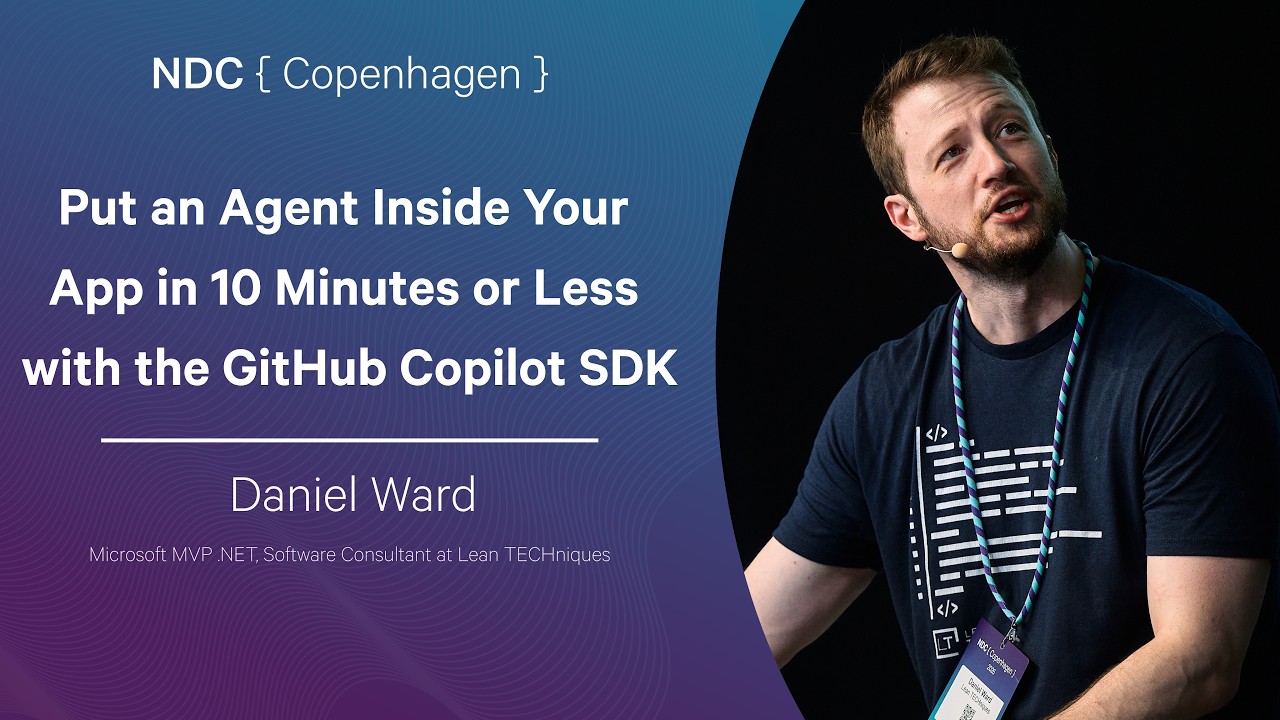
Put an Agent Inside Your App in 10 Minutes or Less with the GitHub Copilot SDK - Daniel Ward thumbnail

· 57:28

Put an Agent Inside Your App in 10 Minutes or Less with the GitHub Copilot SDK - Daniel Ward

This talk demonstrates how to rapidly embed custom AI agents into existing applications using the GitHub Copilot SDK. The session covers agent architecture—defining an agent as an LLM augmented with tools and a looping mechanism—and provides two coding demos (in C#) showing basic functionality like weather queries, streaming responses, and creating custom tools. For build engineers, the focus is on advanced use cases such as automated incident response (generating suggested fixes and opening Pull Requests from production logs) and building comprehensive daily briefing systems that integrate multiple enterprise services (Jira, Teams, GitHub).

Key takeaways

  1. Agent Architecture 17:53

    An AI agent is fundamentally an LLM combined with external tools and a looping mechanism. The LLM handles the creative analysis, while the tools allow it to perform deterministic actions (e.g., fetching web data or querying APIs).

  2. Copilot SDK Functionality 3:35

    The Copilot SDK is an open-source library that allows calling GitHub Copilot (or other LLMs like Anthropic/OpenAI) from code. It supports multiple languages (TypeScript, Python, Go, C#, etc.) and provides granular control over sessions, including event handling (`onEvent`) for streaming responses.

  3. Automated Incident Response 51:01

    A powerful use case is connecting production errors to automated fixes. The process involves the SDK collecting logs, using Copilot to suggest a fix based on stack traces, and then programmatically opening a draft Pull Request (PR).

  4. Reliability vs. Prompting 53:21

    For repeatable, mission-critical workflows (like daily reports), using deterministic code with the SDK is significantly more reliable than relying solely on prompt chaining, as failures in a chain compound exponentially.

Watch on YouTube Full article

Universal 3.5 Pro Demo: Smarter Speech-to-Text with Contextual Awareness thumbnail

· 10:07

Universal 3.5 Pro Demo: Smarter Speech-to-Text with Contextual Awareness

This demo introduces Universal 3.5 Pro, an advanced Speech-to-Text (STT) model designed to significantly boost transcription accuracy through enhanced contextual awareness. Key features include passing domain-specific prompts (e.g., 'cardiology consultation'), applying context to key terms to prevent misapplication, and supporting dynamic mid-call prompt updates via API calls. Furthermore, the model retains conversation history (agent context), allowing it to accurately transcribe user input even in poor audio conditions by understanding the situational flow of a voice agent interaction.

Key takeaways

  1. Contextual Prompting for Domain Accuracy

    Passing detailed information about the audio content (e.g., 'cardiology consultation between Dr. Smith and elderly patient regarding chest pain...') dramatically improves model accuracy within specific domains. The more specific the prompt, the better the results.

  2. Contextual Key Terms 2:00

    Unlike previous methods where key terms were applied blindly, Universal 3.5 Pro allows users to define what a key term represents (e.g., 'The user's name is Zachary Klebanoff'). This prevents the model from incorrectly applying terminology based solely on acoustic similarity.

  3. Dynamic Mid-Call Prompt Updates 2:55

    The prompt can be updated in real time via the API (not available in the playground demo). This is crucial for voice agents, allowing tool calls or external data to adjust the model's context mid-conversation.

  4. Conversation/Agent Context 3:30

    The model retains previous transcriptions and accepts LLM-generated responses from a voice agent as context. This provides situational awareness, improving accuracy even in poor audio conditions and reducing the Word Error Rate (WER) on voice agent datasets.

Watch on YouTube Full article