Topic

Agentic Commerce

All digests tagged Agentic Commerce

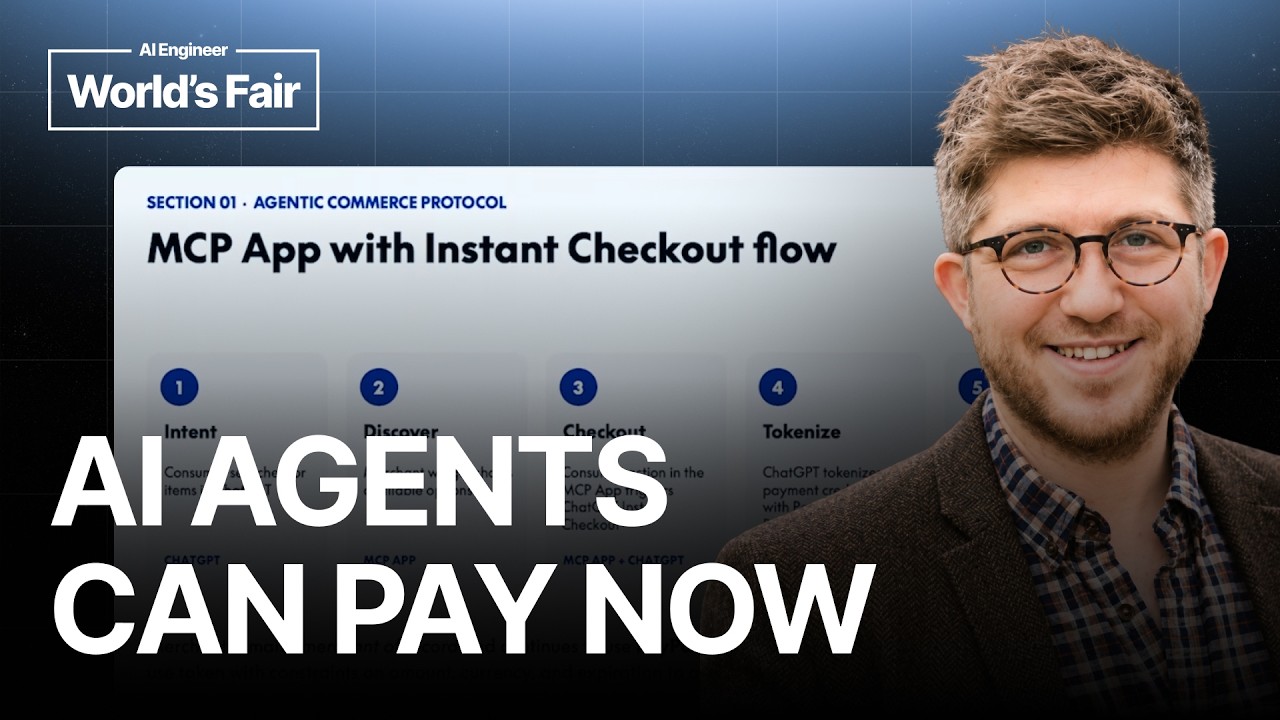
How AI Agents Pay: Checkout in ChatGPT and Google AI Mode — Sam Parsons, PayPal thumbnail

· 14:52

How AI Agents Pay: Checkout in ChatGPT and Google AI Mode — Sam Parsons, PayPal

This talk details three methods for merchants to accept payments initiated by AI agents, addressing the challenge of 'agentic commerce.' PayPal Enterprise Payments (formerly Braintree) demonstrates how merchants can integrate with protocols like the Agentic Commerce Protocol (ACP) for ChatGPT and the Universal Commerce Protocol (UCP) for Google AI Mode. The core technical focus is on maintaining PCI compliance through tokenization while providing merchants with varying degrees of UI control, ranging from embedded MCP apps to external checkout handoffs.

Key takeaways

  1. Three Paths to Agentic Payments 1:47

    Merchants can accept payments via three paths: 1) Instant Checkout in ChatGPT using the Agentic Commerce Protocol (ACP) and an embedded MCP app; 2) Google AI Mode using the Universal Commerce Protocol (UCP) and Google Pay; or 3) Using an MCP app with an external checkout page for maximum merchant control.

  2. Tokenization and PCI Scope 10:00

    Tokenization is critical for security, allowing the user to exchange a real payment credential (e.g., credit card number) for a token. This process keeps sensitive card details out of the agent and the merchant's PCI scope, with PayPal Enterprise Payments handling the tokenization.

  3. MCP App Functionality 3:27

    An MCP (Merchant Control Panel) app allows merchants to embed custom UI (HTML, JavaScript) directly into the agent's interface (e.g., ChatGPT, Claude), giving them control over the user experience and discovery phase.

Watch on YouTube Full article

Keyword Search Is Dying. Is Your Catalog Ready for AI Agents? — PayPal thumbnail

· 16:05

Keyword Search Is Dying. Is Your Catalog Ready for AI Agents? — PayPal

The e-commerce landscape is shifting from the 'search era' (keyword-based) to the 'intent era' and eventually the 'delegation era,' driven by AI agents. Traditional product catalogs, optimized for SEO and human search, are insufficient for agentic commerce. Merchants must adopt a hybrid data strategy that combines the precision of keyword matching with the breadth of semantic understanding. Successful implementation requires enriching product data with structured, high-quality content (e.g., attributes, buyer context, trust signals) rather than simply adding more unstructured text.

Key takeaways

  1. The Evolution of Commerce 5:01

    Shopping behavior is progressing from the Search Era (keywords) to the Intent Era (expressing needs in natural language) and finally to the Delegation Era (humans delegating tasks to agents).

  2. Catalog Readiness for Agents 12:20

    Existing catalog specifications (syndicated for ads/SEO) were not built for AI agents. Agents require product data that is optimized for deep, semantic discovery, not just human search.

  3. Hybrid Search is Optimal

    The ideal search mechanism combines the precision of keyword search (literal matching) with the breadth of semantic search (matching based on meaning/intent).

  4. Content Quality Over Quantity

    Enrichment is highly beneficial, especially for merchants with thin catalogs. However, adding unstructured boilerplate text or excessive context can dilute the signal and cause agents to hallucinate.

Watch on YouTube Full article

Beyond the Lethal Trifecta: Agentic Commerce on the Open Internet — David Levine, Kiduna Club thumbnail

· 21:40

Beyond the Lethal Trifecta: Agentic Commerce on the Open Internet — David Levine, Kiduna Club

The presentation outlines the concept of 'agentic commerce'—a full economy on the open internet powered by autonomous agents. The speaker argues that current platforms are extractive and limited by the 'lethal trifecta': private data, untrusted content, and agent ability to act (3:54). To solve this, he proposes using decentralized legal structures like DUNA (Decentralized Unincorporated Nonprofit Association) for organizational standing and cryptographic tokens (JWTs) for verifiable identity. He details how agents can be built as software-defined organizations ('Kiduna'), enabling them to own assets, enter agreements, and operate with full auditability on the blockchain.

Key takeaways

  1. The Lethal Trifecta 6:34

    The combination of private data (e.g., bank info, logins), untrusted content from the open internet, and agents' ability to take actions is what currently prevents true agentic commerce (3:54).

  2. DUNA Legal Standing 8:10

    A DUNA (Decentralized Unincorporated Nonprofit Association) provides legal standing for an organization composed of intelligent agents, allowing it to own property, enter agreements, and raise capital without distributing profits as securities (4:50).

  3. Agentic Identity via JWTs 11:45

    Agents establish identity, authority, and boundaries using cryptographic tokens like JWTs. This allows the organization's registration (e.g., with a Secretary of State) to act as a verifiable domain name system for agents, providing an audit trail on the blockchain (6:39).

  4. Governance via Decision Markets 13:30

    Instead of traditional voting, organizations should use 'decision markets' (similar to prediction markets) where members trade pass/fail tokens on proposed policies. This method is argued to lead to better decisions by aligning agents with a shared purpose and value system (8:10).

Watch on YouTube Full article

Agent Spending Without Controls — Rodrigo Coelho & Pranav Maheshwari, Edge & Node thumbnail

· 20:48

Agent Spending Without Controls — Rodrigo Coelho & Pranav Maheshwari, Edge & Node

The video outlines the critical need for a dedicated infrastructure layer—specifically focusing on micropayments and compliance controls—to enable agentic commerce. While Large Language Models (LLMs) and agents can transact at machine speed, traditional payment rails were designed for human decision loops. The speaker argues that as AI agents become more powerful through paid Machine Capability Platforms (MCPs), the system must incorporate robust compliance layers to handle sanctions screening and prevent overspending, making governance a prerequisite for enterprise adoption.

Key takeaways

  1. Agentic Payments Require Paid Infrastructure 5:15

    Agents are becoming increasingly powerful by utilizing specialized, often paid, MCP servers. The speaker argues that relying on free services is unsustainable; agents require an aggregator/skill file (like Ampersend) to manage payments in the background, enabling transactions with a payment gateway.

  2. Traditional Rails Fail at Machine Speed 7:00

    Existing financial systems assume a human 'in the loop' for decision-making. Agents transact around the clock at machine speed, necessitating new protocols that can handle high-volume, automated payments and compliance checks.

  3. Compliance is the Enterprise Bottleneck 9:02

    For large enterprises to adopt agentic systems (handling trillions of dollars), a mandatory compliance layer must be implemented. This layer verifies counterparty identity, screens for sanctions, and prevents malicious transactions, which is currently lacking in automated agent workflows.

Watch on YouTube Full article

Teaching agents to pay — Anna Spysz, Stripe thumbnail

· 19:10

Teaching agents to pay — Anna Spysz, Stripe

This talk introduces 'agent-to-commerce,' detailing how AI agents can move beyond research assistance to execute complex transactions on behalf of users. The infrastructure relies heavily on structured data protocols like the Universal Commerce Protocol (UCP) and requires merchants to publish a `merchant capabilities manifest` and JSON catalogs, rather than relying on traditional website browsing. Security is maintained through shared payment tokens, ensuring that the payment provider—not the agent or merchant—enforces transaction limits and guardrails.

Key takeaways

  1. Agent Discovery vs. Human Browsing 5:13

    Agents do not browse websites; they read structured data (JSON) from a `merchant capabilities manifest` to understand supported payment methods, endpoints, and product catalogs. This makes merchants 'agent-ready.'

  2. The Role of UCP in Transactions 5:40

    The Universal Commerce Protocol (UCP) acts as a shared language defining how agents initiate, update, complete, and cancel purchases across multiple merchants and agents.

  3. Security via Shared Payment Tokens 13:46

    During checkout, the agent receives and passes a 'shared payment token' (representing a raw card number or wallet). The seller only unwraps what is necessary, and the payment provider enforces all limits, mitigating risk.

Watch on YouTube Full article

The Agentic Commerce Stack — Ahnaf Prio, Best Buy thumbnail

· 20:38

The Agentic Commerce Stack — Ahnaf Prio, Best Buy

The talk outlines the architectural shift required for 'Agentic Commerce,' moving beyond brittle browser automation (like DOM reading or screenshotting) toward standardized protocols. The core solution involves defining specific primitives—such as MCP, A2A, ACP, UCP, and AP2—that allow AI agents to interact directly with merchant APIs without triggering fraud alarms. Successful implementation requires rigorous testing using behavioral and protocol compliance 'evals.'

Key takeaways

  1. Agentic Commerce Scope 2:08

    Approximately 45% of all agent sessions on major platforms (e.g., ChatGPT, Google Gemini) are related to shopping, indicating a massive market opportunity ($7B to $65B by 2030).

  2. Failure of Early Agents 5:08

    Early attempts using screenshots and reading the DOM were slow, clunky, and brittle. Furthermore, automated browser actions often trigger fraud alarms at the payment stage.

  3. The Need for Standardization 7:36

    To scale, commerce must standardize its primitives. Instead of relying on search catalogs, merchants should provide structured product feeds to protocols like ACP and UCP. The process involves the agent calling a merchant checkout API directly (no browser needed).

  4. Payment Mandates with AP2 16:41

    Autonomous payments require more than just tokens. AP2 (Agentic Payment Protocol) is an extension that mandates defining the authorizing party, a spend ceiling, and a revocation URL.

  5. Testing with Evals

    Building agentic commerce requires intense testing (evals) focused on behavior, protocol compliance, and latency benchmarks. Failure to test can lead to agents being misused in production (e.g., asking programming questions).

Watch on YouTube Full article