How AI Agents Pay: Checkout in ChatGPT and Google AI Mode — Sam Parsons, PayPal
Summary
This talk details three methods for merchants to accept payments initiated by AI agents, addressing the challenge of 'agentic commerce.' PayPal Enterprise Payments (formerly Braintree) demonstrates how merchants can integrate with protocols like the Agentic Commerce Protocol (ACP) for ChatGPT and the Universal Commerce Protocol (UCP) for Google AI Mode. The core technical focus is on maintaining PCI compliance through tokenization while providing merchants with varying degrees of UI control, ranging from embedded MCP apps to external checkout handoffs.
Key takeaways
-
Three Paths to Agentic Payments
1:47
Merchants can accept payments via three paths: 1) Instant Checkout in ChatGPT using the Agentic Commerce Protocol (ACP) and an embedded MCP app; 2) Google AI Mode using the Universal Commerce Protocol (UCP) and Google Pay; or 3) Using an MCP app with an external checkout page for maximum merchant control.
-
Tokenization and PCI Scope
10:00
Tokenization is critical for security, allowing the user to exchange a real payment credential (e.g., credit card number) for a token. This process keeps sensitive card details out of the agent and the merchant's PCI scope, with PayPal Enterprise Payments handling the tokenization.
-
MCP App Functionality
3:27
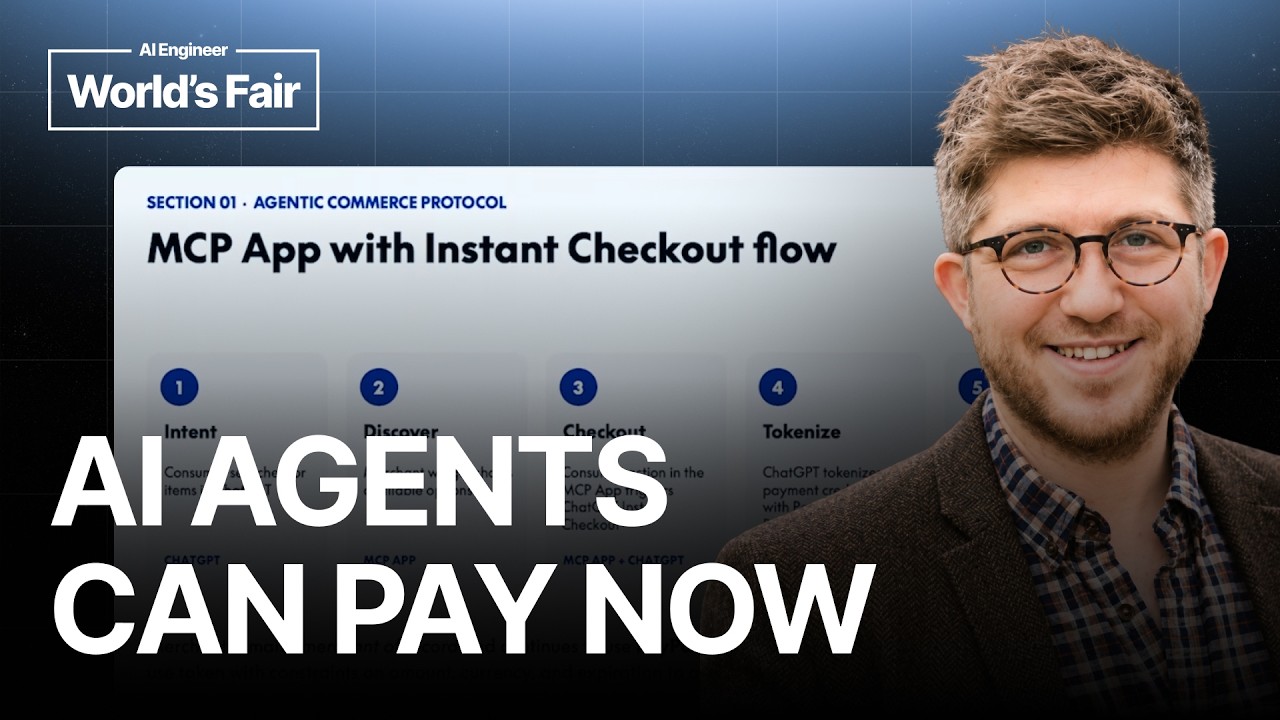
An MCP (Merchant Control Panel) app allows merchants to embed custom UI (HTML, JavaScript) directly into the agent's interface (e.g., ChatGPT, Claude), giving them control over the user experience and discovery phase.
Technical details
-
Agentic Commerce Protocols
140s
The industry utilizes protocols like the Agentic Commerce Protocol (OpenAI/ChatGPT) and the Universal Commerce Protocol (Google). These protocols are designed to facilitate payment flows within AI agents, with the specs being 'almost identical.'
-
Instant Checkout (ChatGPT/ACP)
207s
This flow uses an MCP app to provide an embedded UI for discovery and checkout within ChatGPT. The integration requires JavaScript code within the MCP app to trigger the checkout experience, and the merchant receives a token call to their MCP server for processing.
-
Google AI Mode (UCP)
451s
This flow is simpler for the merchant, requiring them to stand up endpoints rather than building a full MCP app experience. The agent creates a session, and the merchant's integration involves specifying details in a well-known JSON file for UCP.
-
Token Constraints
350s
Tokens generated are constrained by multiple parameters, including the specific merchant, a maximum dollar amount, a required currency, and an expiration date.
Mentioned resources
Channel & topics
Watch on YouTube · Back to latest
This independent, AI-assisted summary is provided for commentary and informational purposes. It may contain errors or omit important context. Please watch the original video for the creator's complete presentation. Video, thumbnail, and related copyrights belong to their respective owners.