Topic

API Design

All digests tagged API Design

AI Agents Aren't the Revolution. They're the Catalyst! thumbnail

· 10:14

AI Agents Aren't the Revolution. They're the Catalyst!

While AI agents are widely discussed, the speaker argues that they are not the revolution, but rather a powerful catalyst accelerating fundamental, long-lasting improvements across the technology ecosystem. The most significant shifts are occurring in data modernization, system interoperability, API standardization, and the democratization of technical expertise, which are foundational improvements that will persist regardless of the future of agents.

Key takeaways

  1. AI Agents as Catalysts

    The lasting impact of AI is not the agents themselves, but the systemic improvements they force, including data unification, system design modernization, and enhanced digital literacy.

  2. Data Layer Modernization

    AI adoption forces organizations to overhaul data foundations, making data more accessible, searchable, understandable, and reusable by breaking down silos.

  3. System Interoperability and APIs 5:09

    Agents expose system weaknesses, driving the need for APIs that are predictable, well-documented, and machine-readable. This accelerates the shift toward seamless, cross-system connectivity (e.g., MCP, A2A).

  4. Outcome-Based Thinking

    The rise of powerful agentic coding IDEs lowers the barrier to entry, shifting the focus from 'how' (implementation) to 'why' (defining goals and solving high-level problems).
Watch on YouTube Full article

Why We Made Jev — Diogo Almeida, TypeSafe Co-founder & CEO thumbnail

· 2:22:22

Why We Made Jev — Diogo Almeida, TypeSafe Co-founder & CEO

The video introduces Jev, a new class of AI model termed 'System One Models,' designed not for chat or general text completion, but for deep integration into software infrastructure. The core thesis is that AI's next wave of value lies in being a machine-native component optimized for 'intelligence per dollar.' The discussion emphasizes moving away from traditional methods like RLHF and public benchmarks, advocating instead for focusing on reliability, structured state, and decomposing complex tasks into small, measurable, and verifiable decisions.

Key takeaways

  1. System One Models (Jev) 18:40

    Jev is designed to be a large programmable model optimized for intelligence per dollar, intended for code consumption rather than text reply. This represents a shift from pre-trained LLMs (autocomplete) or RHF models (chatbot instruction following).

  2. Critique of Current AI Alignment Methods 26:40

    The speaker critiques RLHF (Reinforcement Learning from Human Feedback) and mode collapse, arguing that these methods are often misaligned with the needs of software engineering. He posits that reliability and robustness are more critical than simple determinism.

  3. The Importance of Decomposition 35:00

    To maximize reliability and power, developers should decompose AI workflows into many small, measurable decisions rather than relying on large, single system messages. This approach allows for programmatic verification and bug fixing.

  4. Anti-Benchmarking Stance 40:00

    The speaker argues that public benchmarks are 'extremely gameable' and antithetical to true intelligence. He stresses that long-term value must be measured by how the model performs within a specific, real-world workflow.

Watch on YouTube Full article

Jev Explained for Python Developers thumbnail

· 16:51

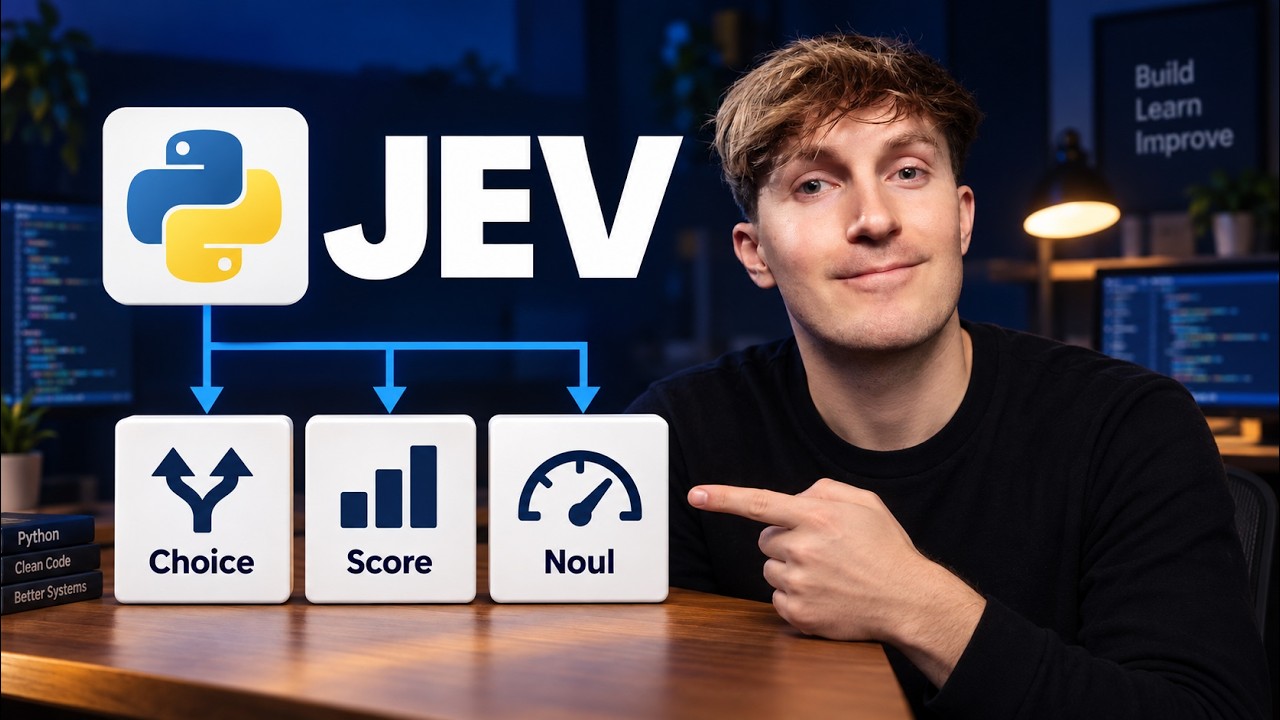
Jev Explained for Python Developers

This video provides a deep dive into TypeSafe's Jev model, a novel classification model designed for building reliable, structured AI applications. Jev moves beyond traditional function calling by offering specialized methods—Choice, Score, and Null—to classify inputs. For build engineers, the key takeaways are the model's ability to facilitate complex decision-making (if/else logic) through structured API calls, coupled with significant performance advantages, being notably faster and cheaper than competitors like Claude Haiku.

Key takeaways

  1. Jev: A New Classification Paradigm

    Jev is presented as a new model category, optimized specifically for classification, which is a critical component for building reliable LLM-based systems. It is designed to be declarative, simplifying the need for complex system prompts.

Watch on YouTube Full article

AI Agents Are Starting To Buy. Stripe Is Building How They Pay. thumbnail

· 30:49

AI Agents Are Starting To Buy. Stripe Is Building How They Pay.

The video explores the emerging economic infrastructure required for AI agents to become reliable, autonomous economic actors. The core argument is that the shift from human-driven commerce to agent-driven commerce necessitates fundamental changes in trust, billing, and fraud detection. Stripe, in particular, is building the necessary financial rails, moving the focus from simple transaction-level fraud to pre-transaction abuse, such as stealing tokens. Key architectural shifts include adopting usage-based and outcome-based pricing models, and developing sophisticated systems to manage agent autonomy and financial risk.

Key takeaways

  1. AI agents are fundamentally changing commerce, making the infrastructure the bottleneck. 0:20

    The current AI wave is shifting commerce from simple tasks to complex buying and selling. The challenge is building a system that can be 100% trusted when a computer (agent) is making purchase decisions on behalf of a user. (00:00, 02:00)

  2. Fraud prevention must evolve from transaction-level to pre-transaction abuse detection. 20:30

    Traditional fraud systems (like Radar) focus on the moment of transaction. However, the new threat involves 'stealing tokens' or abusing free credits *before* a transaction occurs, requiring a shift to identifying abusive or risky customers across the entire network. (07:57, 12:30)

  3. The future of billing requires moving beyond subscriptions to outcomes.

    The industry is moving toward outcome-based pricing, where customers pay for the delivered value (the outcome) rather than fixed subscriptions or raw resource costs (like GPU/inference cost). This requires complex billing stacks and machine-readable payment protocols. (03:27, 24:59)

  4. Agent autonomy requires a dedicated 'wallet' and explicit user approval rails.

    For agents to operate safely, a dedicated wallet (like Stripe Link) is needed to manage spending. Crucially, the user must maintain control, requiring explicit approval rails for spending, even if the agent is goal-motivated. (07:33, 32:00)

Watch on YouTube Full article

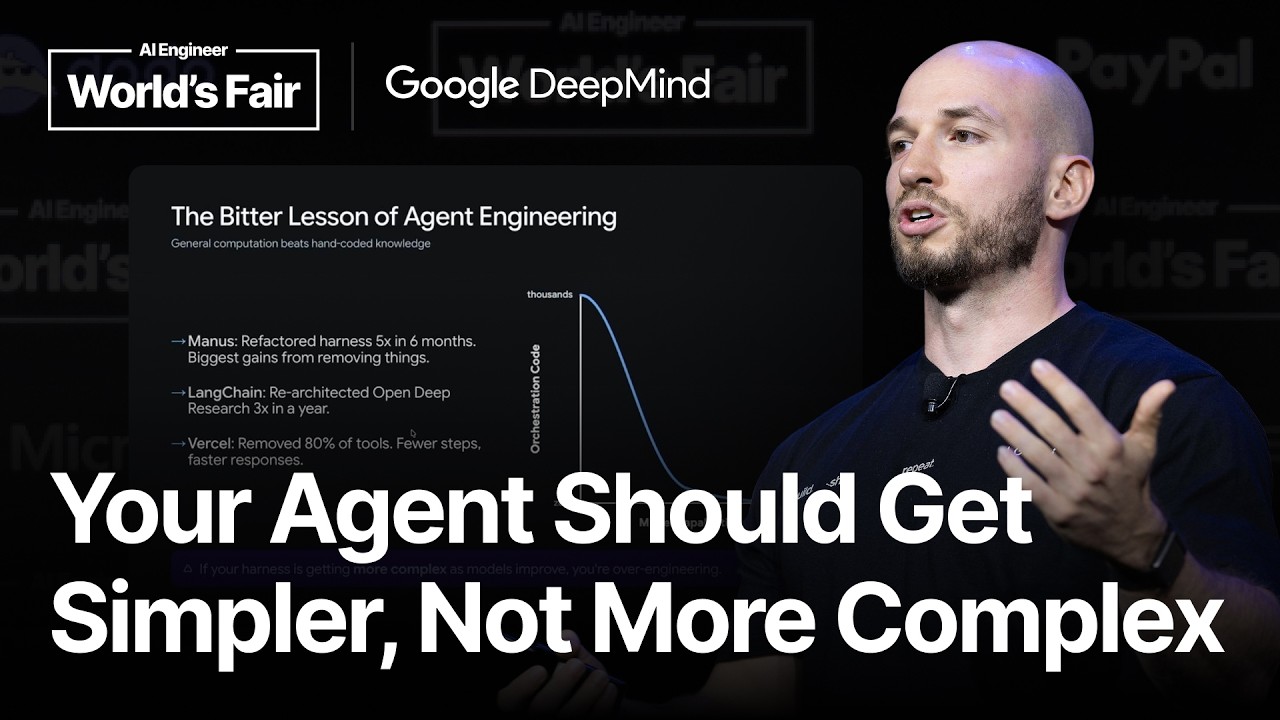
Agents Without Code: Skills, YAML, and Filesystems Replaced Python — Philipp Schmid, Google DeepMind thumbnail

· 18:28

Agents Without Code: Skills, YAML, and Filesystems Replaced Python — Philipp Schmid, Google DeepMind

The presentation details the evolution of LLM agents, demonstrating a shift from complex, brittle Python code loops to declarative, file-based definitions using system instructions and skills. The speaker shows that modern agent architectures, such as the Gemini API's anti-gravity agent, utilize a hosted sandbox and network proxy to manage state and credentials securely. This allows agents to operate using general-purpose tools (like GitHub CLI or Google Search) defined in files (e.g., `AGENTS.md`), drastically reducing the need for thousands of lines of custom orchestration code.

Key takeaways

  1. The Agent Evolution: Code to Files

    Agent development is moving away from writing explicit Python loops, JSON schemas, and tool routing logic. The core functionality is now expressed in files (Markdown/Skills) that define instructions, rules, and capabilities, allowing the model to use general tools.

  2. Server-Side State Management 14:02

    The new architecture handles complex tasks by moving loops, tool routing, session state, and context compaction to the server side, requiring only a single API call with new inputs.

  3. Security and Isolation 12:32

    A hosted sandbox and network proxy ensure that the agent never sees the actual credentials, injecting tokens only when outbound requests are made, and allowing domain restriction for enhanced security.

  4. Focus on Domain Logic 16:40

    The primary work for developers is now defining the domain instructions, rules, and evaluation criteria (the 'what'), rather than writing the infrastructure code (the 'how').

Watch on YouTube Full article

Workshop: Building and optimizing dictation features thumbnail

· 36:06

Workshop: Building and optimizing dictation features

This workshop details the architecture for building low-latency dictation features using AssemblyAI's APIs. The core strategy involves leveraging the Sync API—a single POST request—to achieve speed superior to traditional async or streaming methods. The process is optimized through three key stages: using key terms prompting for accuracy, implementing connection warming to minimize network overhead (DNS, TCP, TLS), and running a cleanup pass via LLM Gateway (e.g., Qwen3.5 4B Fast) to refine raw transcripts into polished, intent-preserving text. The goal is to deliver results on screen in under one second.

Key takeaways

  1. Sync API Preference 5:35

    The Sync API is preferred for dictation because it avoids the overhead of maintaining a WebSocket connection (streaming) and bypasses the inherent latency floor of traditional async endpoints, which is unsuitable for short, burst dictation sessions.

  2. Latency Optimization via Warming 11:40

    To minimize latency, it is critical to call a warm endpoint (`client.sync.warm`) while the user is recording. This pre-pays the networking costs (DNS, TCP, TLS handshake), ensuring the subsequent transcription request goes straight to inference.

  3. Cleanup Pass with LLM Gateway 18:20

    A cleanup step using an LLM (like Qwen3.5 4B Fast) is necessary to transform raw, spoken text (e.g., 'I think we should meet in 5 minutes') into polished, corrected text while preserving the original intent. This is achieved by prompting the model to act as a function in a pipeline, not an assistant.

  4. Upcoming Dictation API 30:00

    AssemblyAI is rolling out a dedicated Dictation API (`client.dictation.describe`) that will wrap the entire loop (STT + Cleanup) into a single, simplified call, making the process easier for developers.

Watch on YouTube Full article

MCP Apps: Give the Model Data, Give the User a UI — Dustin Mihalik, Indeed thumbnail

· 15:34

MCP Apps: Give the Model Data, Give the User a UI — Dustin Mihalik, Indeed

This talk details the architectural challenges of building Model-Composable Platform (MCP) applications for large language models (LLMs) like Claude and ChatGPT. The core thesis is that for a UI widget to function effectively, it must be treated as a data layer, not just a visual display. The speaker outlines three critical rules for developers: all displayed information must be provided as data to the model; the tool description must explicitly state that a UI exists; and, most importantly, data processing must be strictly separated from UI rendering to maintain model context and reasoning capability.

Key takeaways

  1. Data-First Design Principle

    When building MCP apps, developers must focus on defining the data the model needs to process before considering the UI. The UI should be viewed as a side effect or result of the model exploring the underlying data.

  2. Rule 1: Show the Model Everything 5:13

    Any information displayed to the user via the UI must also be provided as structured data to the model. Failing to do so creates a 'black box' that prevents the model from answering follow-up questions about the displayed content.

  3. Rule 2: Declare the UI in the Description 8:26

    The tool description must explicitly state that a UI exists. Otherwise, the model will attempt to narrate the results underneath the widget, leading to redundant and confusing output.

  4. Rule 3: Separate Data Processing from UI Rendering 13:39

    This rule supersedes the others. The architecture must split the job into two distinct tools: one for pure data retrieval (e.g., `search_jobs`) and a separate, dedicated tool for rendering the results (e.g., `render_jobs`). This allows the model to perform complex data exploration without being limited by the UI's single call.

Watch on YouTube Full article

Teaching agents to pay — Anna Spysz, Stripe thumbnail

· 19:10

Teaching agents to pay — Anna Spysz, Stripe

This talk introduces 'agent-to-commerce,' detailing how AI agents can move beyond research assistance to execute complex transactions on behalf of users. The infrastructure relies heavily on structured data protocols like the Universal Commerce Protocol (UCP) and requires merchants to publish a `merchant capabilities manifest` and JSON catalogs, rather than relying on traditional website browsing. Security is maintained through shared payment tokens, ensuring that the payment provider—not the agent or merchant—enforces transaction limits and guardrails.

Key takeaways

  1. Agent Discovery vs. Human Browsing 5:13

    Agents do not browse websites; they read structured data (JSON) from a `merchant capabilities manifest` to understand supported payment methods, endpoints, and product catalogs. This makes merchants 'agent-ready.'

  2. The Role of UCP in Transactions 5:40

    The Universal Commerce Protocol (UCP) acts as a shared language defining how agents initiate, update, complete, and cancel purchases across multiple merchants and agents.

  3. Security via Shared Payment Tokens 13:46

    During checkout, the agent receives and passes a 'shared payment token' (representing a raw card number or wallet). The seller only unwraps what is necessary, and the payment provider enforces all limits, mitigating risk.

Watch on YouTube Full article

The Missing Layer in Agentic AI — Giedrius Šteimantas, Oxylabs thumbnail

· 15:04

The Missing Layer in Agentic AI — Giedrius Šteimantas, Oxylabs

The video addresses a critical gap in agentic AI: the lack of robust infrastructure for interacting with the open web. The speaker argues that relying solely on large language models (LLMs) or general browser automation is inefficient, expensive, and unreliable. By applying principles from professional web scraping—specifically prioritizing cost control, validating content before processing, and using a browser only when absolutely necessary—the agent's performance can be dramatically improved across all stages of the purchase workflow.

Key takeaways

  1. The Core Problem in Agentic AI 13:55

    Many agents fail or waste resources because they assume an HTTP 200 status code means valid content. Feeding LLMs large HTML blocks containing CAPTCHAs or non-product data leads to wasted tokens (e.g., wasting 70% of tokens when only three out of ten pages are valid).

  2. Discovery Stage Optimization 9:50

    Instead of using a browser with a predefined list of retailers, the agent should use a dedicated search API. This approach returns compact JSON (<2,000 tokens), is fast (<700ms), and allows the agent to fan out queries across many popular search engines.

  3. Decision Stage Optimization

    The decision stage can be optimized by replacing browser scraping with a dedicated scraper API. This ensures only valid content is returned, fails loudly (with explicit errors on blocks), supports markdown, and allows parallel requests while billing only for successful results ('No cure, no pay').

  4. Checkout Stage Enhancement

    Since the checkout process requires highly dynamic interaction, a browser is necessary. The solution involves hardening the agent using Playwright MCP combined with an Oxylabs headless browser that provides stealth, residential proxy support, and geolocation capabilities.

Watch on YouTube Full article

The Agent Behind the Curtain: Building the Oz Cloud Agent Platform — Safia Abdalla, Warp thumbnail

· 20:51

The Agent Behind the Curtain: Building the Oz Cloud Agent Platform — Safia Abdalla, Warp

The presentation details the architecture and philosophy behind Warp's cloud agent platform, emphasizing that a successful developer tool must 'absorb complexity before it reaches the user.' The platform achieves this by providing structured environments (sandboxes) and flexible integration points (multi-harness support). Core functionality revolves around advanced agent orchestration—managing complex workflows across multiple sub-agents via both prompting (`/orchestrate`) and comprehensive API exposure. This approach allows non-developers to build sophisticated tooling on top of the system, significantly automating tasks like issue triage and pull request reviews in open-source repositories.

Key takeaways

  1. Platform Complexity Absorption 0:03

    A core principle is that platforms must hide underlying infrastructure complexity from the user. This includes managing where agents run (sandboxes) and supporting diverse developer preferences without fragmentation.

  2. Multi-Harness Support 0:05

    The platform accommodates various developer workflows and tools (harnesses), ensuring consistency by providing structured guardrails around the chosen tool, regardless of whether it is a custom or native solution.

  3. Agent Orchestration 0:08

    Since real engineering rarely fits into one prompt, agents are designed to orchestrate sub-agents for complex tasks. This can be triggered via a dedicated command (e.g., `/orchestrate`) or programmatically through the exposed API.

  4. API Composability 0:09

    All key primitives—including spinning up agents, managing compute environments, and handling artifacts—are exposed via a robust API. This allows external users (even non-engineers) to build custom tooling (e.g., Slack bots) on top of the platform.

Watch on YouTube Full article

1st Place Winner: Coding Agent Calls Developer to Resolve Code Block thumbnail

· 6:17

1st Place Winner: Coding Agent Calls Developer to Resolve Code Block

The demo showcases an advanced AI coding agent that autonomously handles a critical bug fix in a checkout API. When faced with a technical decision requiring human judgment—specifically, whether to maintain backward compatibility (Option A) or implement a clean refactor causing breaking changes (Option B)—the agent initiates an automated phone call to the developer for real-time guidance and execution.

Key takeaways

  1. Autonomous Agent Setup

    The setup involves running a coding agent via the Claude Code CLI, monitored by the Vocal Bridge dashboard, targeting a validation bug across five checkout API handlers (e.g., create order, apply coupon).

  2. Decision Point Triggered 3:26

    The agent identifies that fixing the bug requires a judgment call: Option A maintains backward compatibility but involves code duplication; Option B is a clean refactor but introduces a breaking change to the error format.

  3. Human-in-the-Loop Communication 1:52

    Instead of guessing, the agent initiates an outbound phone call (via VocalBridgeAI) to present the technical trade-offs and obtain a decision from the developer while they are away from their keyboard.

  4. Automated Execution

    Upon receiving the final verbal confirmation (Option B), the agent automatically executes the chosen path, logs the decision, and updates the code base without manual developer intervention.

Watch on YouTube Full article