Topic

Warp

All digests tagged Warp

The Agent Behind the Curtain: Building the Oz Cloud Agent Platform — Safia Abdalla, Warp thumbnail

· 20:51

The Agent Behind the Curtain: Building the Oz Cloud Agent Platform — Safia Abdalla, Warp

The presentation details the architecture and philosophy behind Warp's cloud agent platform, emphasizing that a successful developer tool must 'absorb complexity before it reaches the user.' The platform achieves this by providing structured environments (sandboxes) and flexible integration points (multi-harness support). Core functionality revolves around advanced agent orchestration—managing complex workflows across multiple sub-agents via both prompting (`/orchestrate`) and comprehensive API exposure. This approach allows non-developers to build sophisticated tooling on top of the system, significantly automating tasks like issue triage and pull request reviews in open-source repositories.

Key takeaways

  1. Platform Complexity Absorption 0:03

    A core principle is that platforms must hide underlying infrastructure complexity from the user. This includes managing where agents run (sandboxes) and supporting diverse developer preferences without fragmentation.

  2. Multi-Harness Support 0:05

    The platform accommodates various developer workflows and tools (harnesses), ensuring consistency by providing structured guardrails around the chosen tool, regardless of whether it is a custom or native solution.

  3. Agent Orchestration 0:08

    Since real engineering rarely fits into one prompt, agents are designed to orchestrate sub-agents for complex tasks. This can be triggered via a dedicated command (e.g., `/orchestrate`) or programmatically through the exposed API.

  4. API Composability 0:09

    All key primitives—including spinning up agents, managing compute environments, and handling artifacts—are exposed via a robust API. This allows external users (even non-engineers) to build custom tooling (e.g., Slack bots) on top of the platform.
Watch on YouTube Full article

LLM Knowledge Bases: a practical guide — Ben Holmes, Warp thumbnail

· 21:17

LLM Knowledge Bases: a practical guide — Ben Holmes, Warp

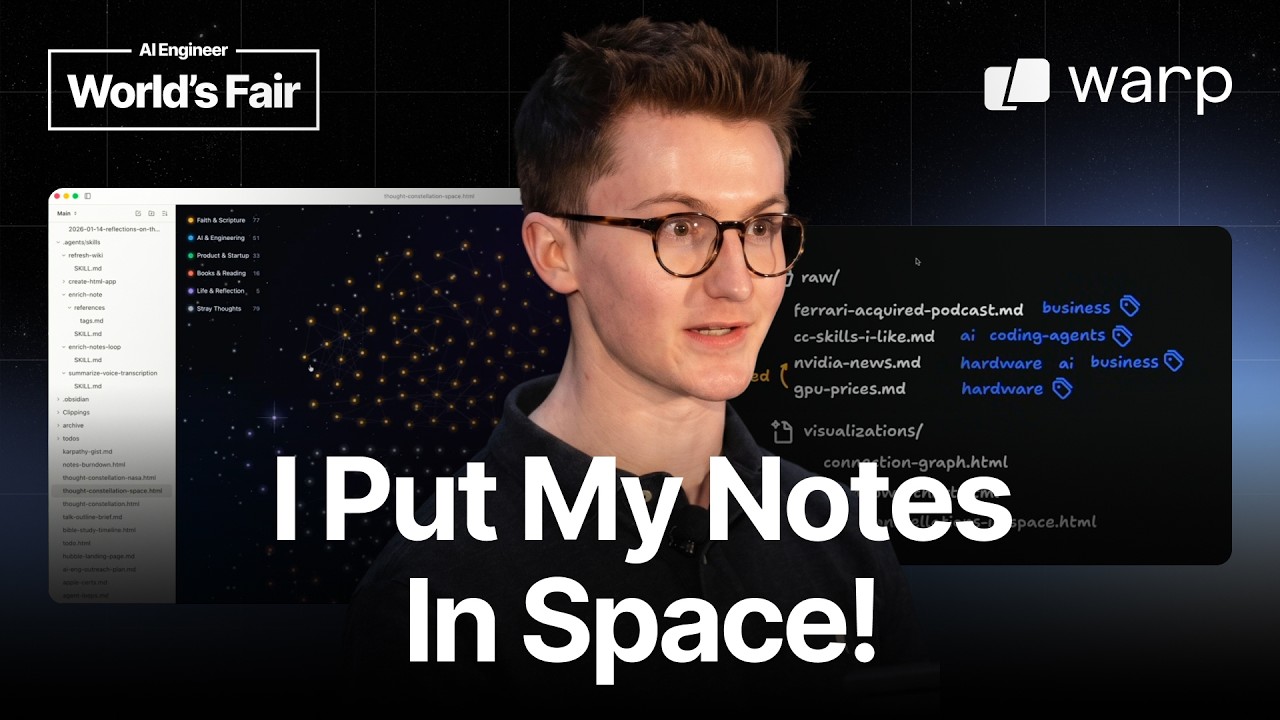
The talk outlines a comprehensive pipeline for transforming disorganized raw notes into structured, navigable LLM knowledge bases. The process begins with maximizing raw data capture via voice dictation (suggested over typing) and progresses through automated enrichment steps using AI agents. Key stages include enriching notes by adding timestamps, fixed-list tags, web research backlinks, generating wikis of People/Concepts/Sources, and finally visualizing the entire network structure using graph views. The entire system is designed to run on an automated schedule in a cloud sandbox environment.

Key takeaways

  1. Raw Data Capture Priority 5:25

    The most critical step for building a knowledge base is generating high volume of raw material. Voice dictation (approx. 200 words per minute) is presented as the fastest method for capturing thoughts, even if they are 'scrappy' or rambling.

  2. The Enrichment Pipeline 9:53

    Notes can be enriched using an agent skill (e.g., 'enrich note') to add structure: timestamps, tags from a fixed reference list (to prevent agents from inventing new categories), web-researched sources, and backlinks found via key term search.

  3. Automated Knowledge Generation 13:40

    The system can generate a wiki structure (People, Concepts, Organizations) from raw notes. This process is highly automated and can be scheduled to run in the background (e.g., daily), ensuring the knowledge base remains fresh.

  4. Automation and Scheduling 17:45

    To maintain the knowledge base, the entire flow must run on a schedule using cloud sandboxes (e.g., Oz.dev). The process involves syncing markdown files down, running the agent skill, and syncing the updated notes back up.

Watch on YouTube Full article