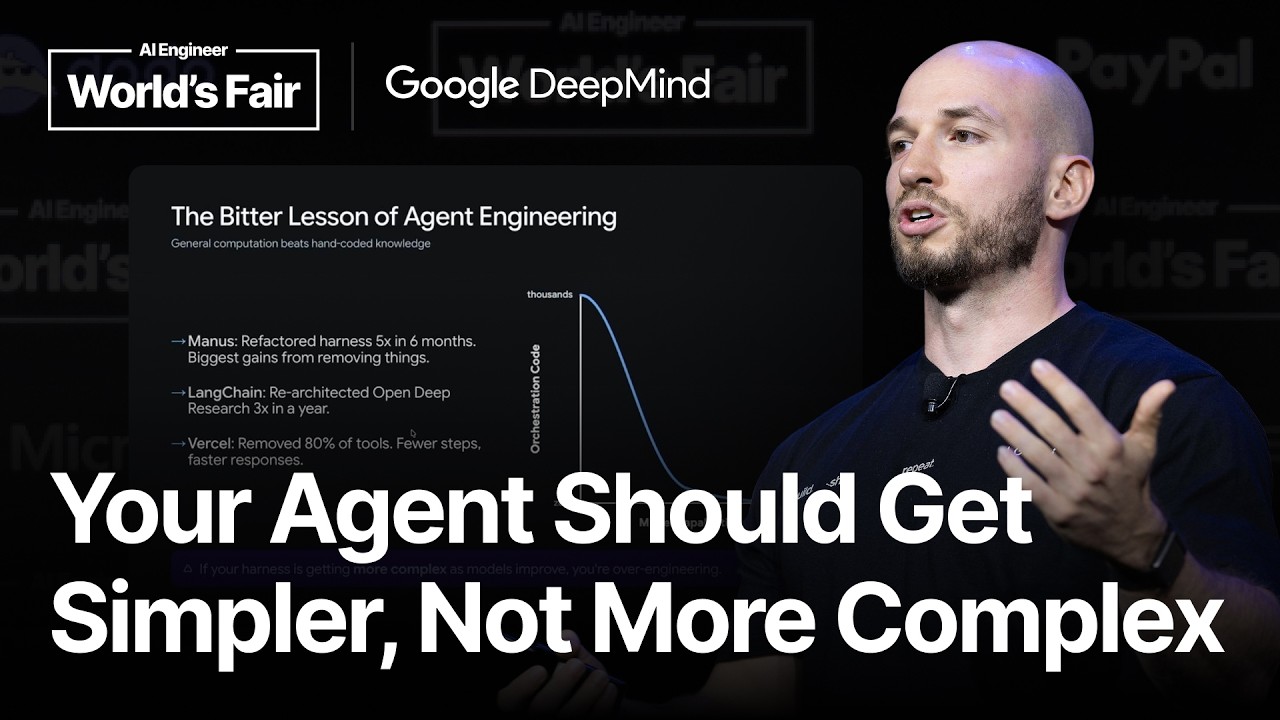
Agents Without Code: Skills, YAML, and Filesystems Replaced Python — Philipp Schmid, Google DeepMind
The presentation details the evolution of LLM agents, demonstrating a shift from complex, brittle Python code loops to declarative, file-based definitions using system instructions and skills. The speaker shows that modern agent architectures, such as the Gemini API's anti-gravity agent, utilize a hosted sandbox and network proxy to manage state and credentials securely. This allows agents to operate using general-purpose tools (like GitHub CLI or Google Search) defined in files (e.g., `AGENTS.md`), drastically reducing the need for thousands of lines of custom orchestration code.
Key takeaways
-
The Agent Evolution: Code to Files
Agent development is moving away from writing explicit Python loops, JSON schemas, and tool routing logic. The core functionality is now expressed in files (Markdown/Skills) that define instructions, rules, and capabilities, allowing the model to use general tools.
-
Server-Side State Management
14:02
The new architecture handles complex tasks by moving loops, tool routing, session state, and context compaction to the server side, requiring only a single API call with new inputs.
-
Security and Isolation
12:32
A hosted sandbox and network proxy ensure that the agent never sees the actual credentials, injecting tokens only when outbound requests are made, and allowing domain restriction for enhanced security.
-
Focus on Domain Logic
16:40
The primary work for developers is now defining the domain instructions, rules, and evaluation criteria (the 'what'), rather than writing the infrastructure code (the 'how').
