Agents Without Code: Skills, YAML, and Filesystems Replaced Python — Philipp Schmid, Google DeepMind
Summary
The presentation details the evolution of LLM agents, demonstrating a shift from complex, brittle Python code loops to declarative, file-based definitions using system instructions and skills. The speaker shows that modern agent architectures, such as the Gemini API's anti-gravity agent, utilize a hosted sandbox and network proxy to manage state and credentials securely. This allows agents to operate using general-purpose tools (like GitHub CLI or Google Search) defined in files (e.g., `AGENTS.md`), drastically reducing the need for thousands of lines of custom orchestration code.
Key takeaways
-
The Agent Evolution: Code to Files
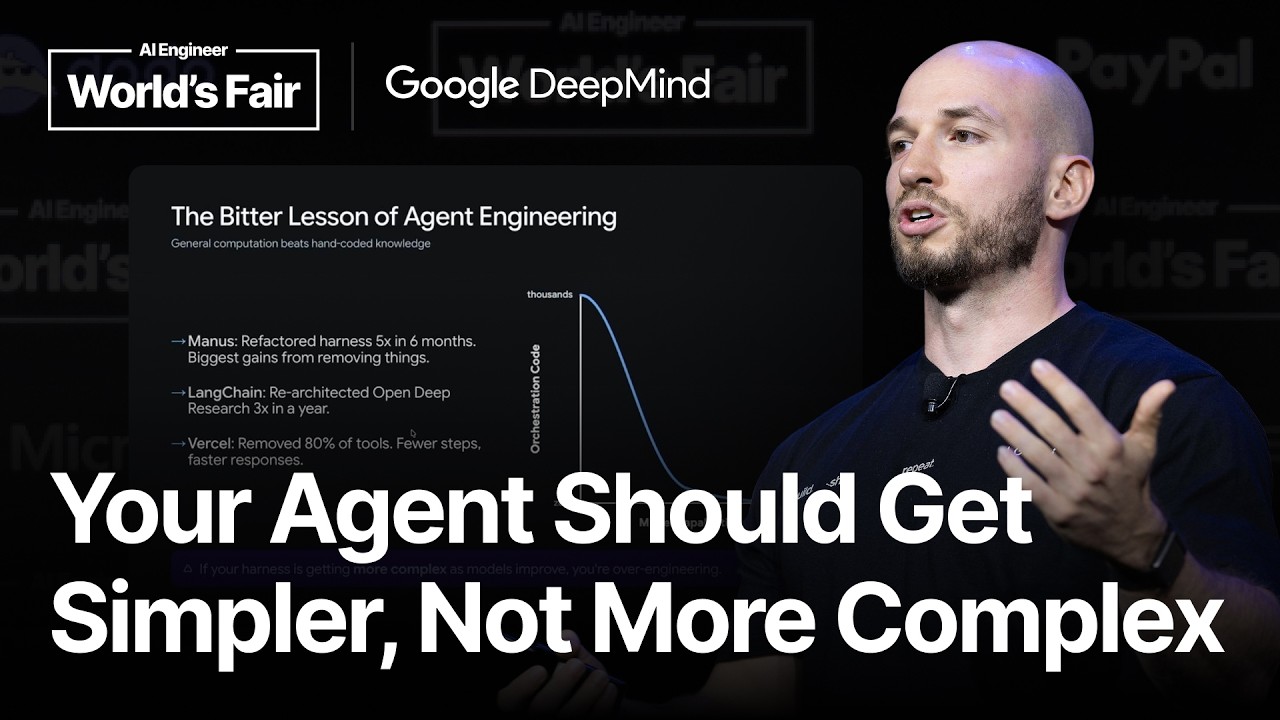
Agent development is moving away from writing explicit Python loops, JSON schemas, and tool routing logic. The core functionality is now expressed in files (Markdown/Skills) that define instructions, rules, and capabilities, allowing the model to use general tools.
-
Server-Side State Management
14:02
The new architecture handles complex tasks by moving loops, tool routing, session state, and context compaction to the server side, requiring only a single API call with new inputs.
-
Security and Isolation
12:32
A hosted sandbox and network proxy ensure that the agent never sees the actual credentials, injecting tokens only when outbound requests are made, and allowing domain restriction for enhanced security.
-
Focus on Domain Logic
16:40
The primary work for developers is now defining the domain instructions, rules, and evaluation criteria (the 'what'), rather than writing the infrastructure code (the 'how').
Technical details
-
Interactions API (Gemini API)
120s
This unified interface supports running models and agents, featuring server-side state management and background execution. It replaced the traditional turn-based conversation history with a 'steps' timeline (user input, reasoning, function call, function result).
-
Agent Architecture Shift
360s
The process moved from requiring explicit Python loops, defining JSON schemas, and writing tool implementations to using files (e.g., `AGENTS.md`) to provide system instructions and capabilities (Skills).
-
Sandbox Environment
752s
The anti-gravity agent runs within a hosted, isolated cloud sandbox, enabling it to execute bash commands and save files, while the network proxy secures credentials by injecting tokens on outbound requests.
-
Agent Definition
880s
Agents can be defined using a custom ID, system instruction, base agent, and environment, allowing existing code and configurations to be reused while leveraging the new API structure.
Mentioned resources
- Interactions API
- Gemini API
- GitHub CLI
- AGENTS.md
Channel & topics
Watch on YouTube · Back to latest
This independent, AI-assisted summary is provided for commentary and informational purposes. It may contain errors or omit important context. Please watch the original video for the creator's complete presentation. Video, thumbnail, and related copyrights belong to their respective owners.