Topic

GitHub CLI

All digests tagged GitHub CLI

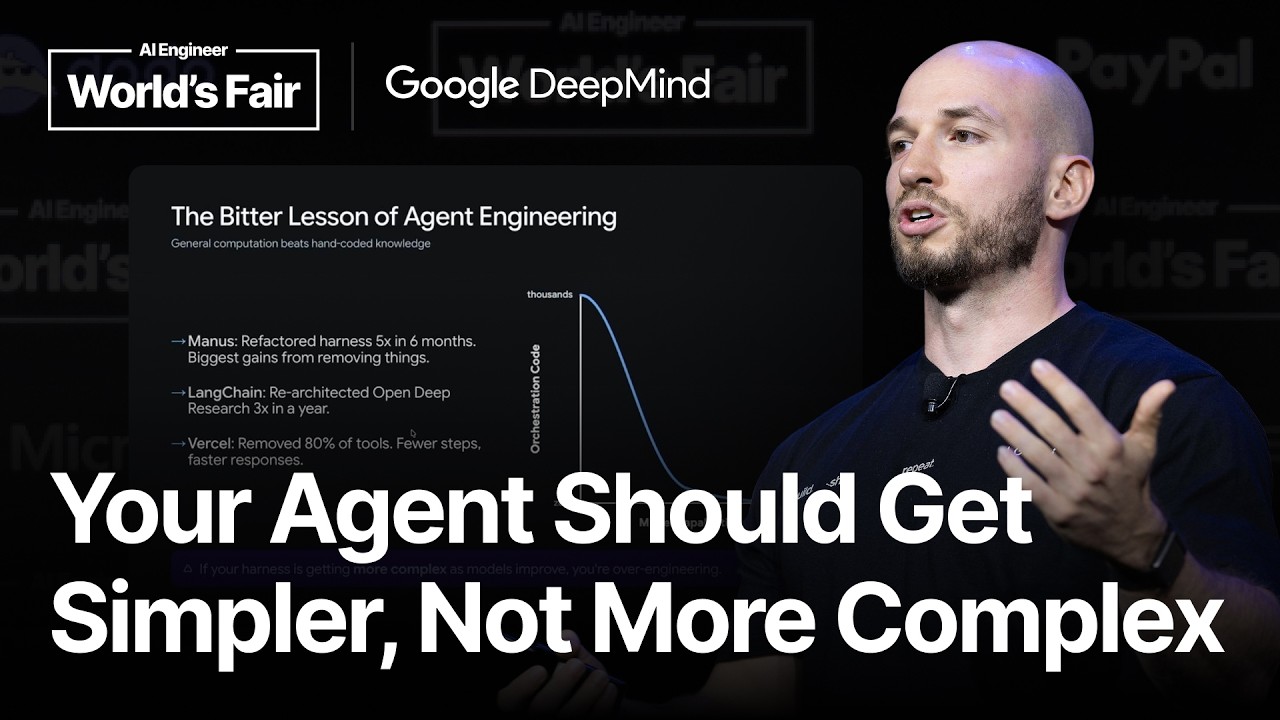
Agents Without Code: Skills, YAML, and Filesystems Replaced Python — Philipp Schmid, Google DeepMind thumbnail

· 18:28

Agents Without Code: Skills, YAML, and Filesystems Replaced Python — Philipp Schmid, Google DeepMind

The presentation details the evolution of LLM agents, demonstrating a shift from complex, brittle Python code loops to declarative, file-based definitions using system instructions and skills. The speaker shows that modern agent architectures, such as the Gemini API's anti-gravity agent, utilize a hosted sandbox and network proxy to manage state and credentials securely. This allows agents to operate using general-purpose tools (like GitHub CLI or Google Search) defined in files (e.g., `AGENTS.md`), drastically reducing the need for thousands of lines of custom orchestration code.

Key takeaways

  1. The Agent Evolution: Code to Files

    Agent development is moving away from writing explicit Python loops, JSON schemas, and tool routing logic. The core functionality is now expressed in files (Markdown/Skills) that define instructions, rules, and capabilities, allowing the model to use general tools.

  2. Server-Side State Management 14:02

    The new architecture handles complex tasks by moving loops, tool routing, session state, and context compaction to the server side, requiring only a single API call with new inputs.

  3. Security and Isolation 12:32

    A hosted sandbox and network proxy ensure that the agent never sees the actual credentials, injecting tokens only when outbound requests are made, and allowing domain restriction for enhanced security.

  4. Focus on Domain Logic 16:40

    The primary work for developers is now defining the domain instructions, rules, and evaluation criteria (the 'what'), rather than writing the infrastructure code (the 'how').

Watch on YouTube Full article

The fundamentals of Agentic Coding (AKA Vibe Coding) - Theodor René Carlsen - NDC Copenhagen 2026 thumbnail

· 15:42

The fundamentals of Agentic Coding (AKA Vibe Coding) - Theodor René Carlsen - NDC Copenhagen 2026

The talk demystifies 'agentic coding' by establishing a fundamental baseline for understanding AI-assisted development tools. The core concept is that these systems rely on three components: the models (the brain), the harnesses (the ability to act), and the tools (specific functions). Speakers emphasize that while the ecosystem moves rapidly, understanding this architecture—especially the feedback loop where the harness executes actions based on model intentions—is crucial for practitioners. A key recommendation is maintaining control by favoring open-source, customizable systems over locked-down, proprietary solutions.

Key takeaways

  1. The Three Pillars of AI Coding Tools 4:00

    AI coding tools fundamentally consist of three parts: the models (e.g., GPTs from OpenAI, Claude from Anthropic), the harnesses, and the tools. The model is the 'brain,' but the harness allows it to perform actions beyond text generation.

  2. Understanding Agent Functionality 5:10

    Agents operate using a combination of a configurable system prompt (initial instructions) and defined tools. The model generates an *intention* (text), which the harness executes (e.g., reading files, running terminal commands). The output is then fed back into the model, creating a critical feedback loop.

  3. The Importance of Openness and Control 11:10

    While proprietary tools (like Cloud Code) are powerful, speakers caution against losing control. The ability to customize the harness is vital for a healthy ecosystem; open-source solutions allow introspection and customization.

Watch on YouTube Full article