Topic

AGENTS.md

All digests tagged AGENTS.md

Your Coding Agent Deletes Its Memory After 30 Days thumbnail

· 9:25

Your Coding Agent Deletes Its Memory After 30 Days

The primary challenge in AI agent development is knowledge persistence: most learned information is lost when a session ends. The discussion outlines advanced strategies to build robust, long-term agent memory, moving beyond simple rule files like `AGENTS.md` or `CLAUDE.md`. Solutions include creating shared knowledge repositories, implementing a 'diary' to record the *rationale* behind decisions (not just who made them), and developing 'Super Agents' that process vast amounts of unstructured data to extract reusable skills and documentation.

Key takeaways

  1. Limitations of Simple Memory Files

    Storing agent memory solely in files (e.g., `CLAUDE.md`) is insufficient because the entire context must be loaded, potentially exposing sensitive information, and simple memory mechanisms can still be prone to duplication or forgetfulness.

  2. The Importance of Rationale (The Diary)

    Knowing *who* acted is merely attribution; the critical missing piece is knowing *why* the action made sense at the time. A dedicated 'diary' repository is needed to capture the reasoning and decision-making process, turning throwaway work into valuable lessons.

  3. Super Agents for Value Extraction

    To maximize the value of paid AI sessions, 'Super Agents' are proposed. These agents process codebases and multiple recorded sessions (VMs) to generate structured documentation, context, and reusable skills, preventing the loss of intellectual property.
Watch on YouTube Full article

Agents Without Code: Skills, YAML, and Filesystems Replaced Python — Philipp Schmid, Google DeepMind thumbnail

· 18:28

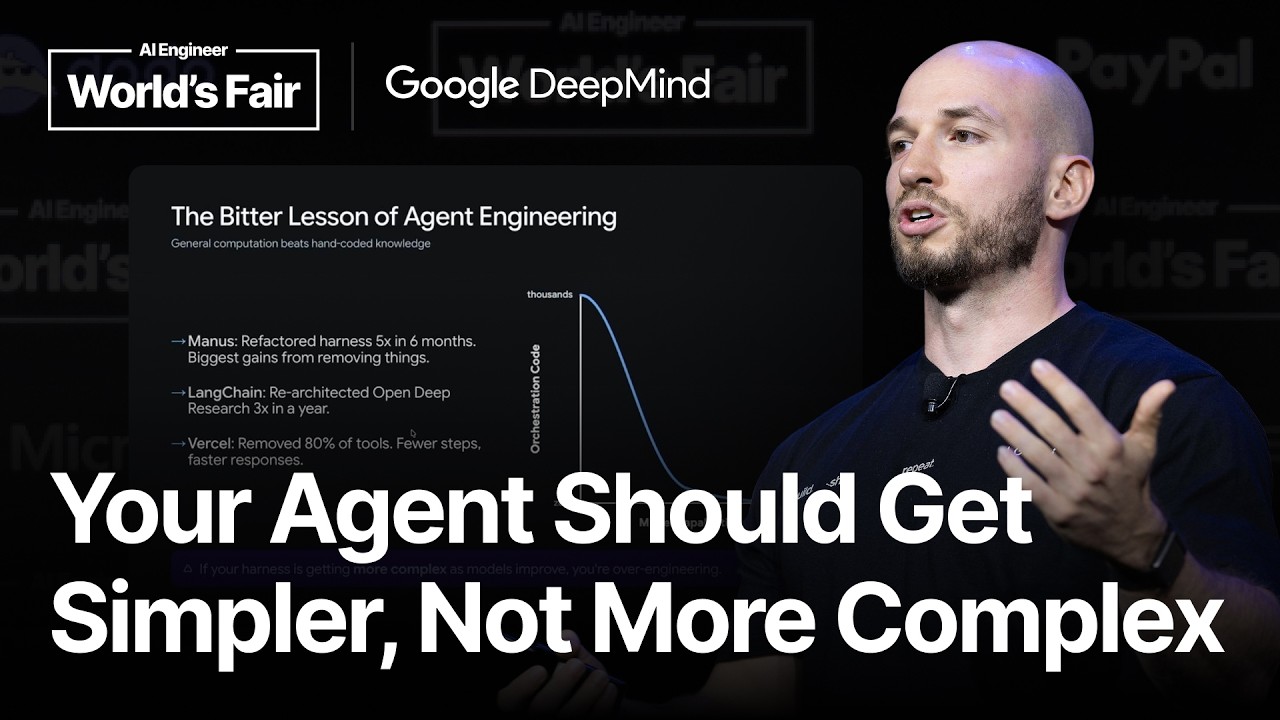
Agents Without Code: Skills, YAML, and Filesystems Replaced Python — Philipp Schmid, Google DeepMind

The presentation details the evolution of LLM agents, demonstrating a shift from complex, brittle Python code loops to declarative, file-based definitions using system instructions and skills. The speaker shows that modern agent architectures, such as the Gemini API's anti-gravity agent, utilize a hosted sandbox and network proxy to manage state and credentials securely. This allows agents to operate using general-purpose tools (like GitHub CLI or Google Search) defined in files (e.g., `AGENTS.md`), drastically reducing the need for thousands of lines of custom orchestration code.

Key takeaways

  1. The Agent Evolution: Code to Files

    Agent development is moving away from writing explicit Python loops, JSON schemas, and tool routing logic. The core functionality is now expressed in files (Markdown/Skills) that define instructions, rules, and capabilities, allowing the model to use general tools.

  2. Server-Side State Management 14:02

    The new architecture handles complex tasks by moving loops, tool routing, session state, and context compaction to the server side, requiring only a single API call with new inputs.

  3. Security and Isolation 12:32

    A hosted sandbox and network proxy ensure that the agent never sees the actual credentials, injecting tokens only when outbound requests are made, and allowing domain restriction for enhanced security.

  4. Focus on Domain Logic 16:40

    The primary work for developers is now defining the domain instructions, rules, and evaluation criteria (the 'what'), rather than writing the infrastructure code (the 'how').

Watch on YouTube Full article