Topic

Build Automation

All digests tagged Build Automation

Engineers… Your Software Factory NEEDS Agent Sandboxes to SCALE (exe.dev) thumbnail

· 37:15

Engineers… Your Software Factory NEEDS Agent Sandboxes to SCALE (exe.dev)

The video argues that traditional methods of running AI agents—such as allocating a small corner of a local machine or relying solely on containers/CI/CD—create bottlenecks. To achieve true scale and autonomy in an 'AI developer workflow' (ADW), the entire software factory must be moved into dedicated, isolated agent sandboxes (e.g., using exe.dev). This architecture enables complex workflows like running 'Best of N' comparisons across multiple model configurations while maintaining zero blast radius via disposable keys.

Key takeaways

  1. The Bottleneck Problem

    If an engineer is 'in the loop,' they are the bottleneck. True scaling requires moving beyond local compute limitations by giving every agent its own isolated computer, achieving isolation, scale, and autonomy.

  2. Three-Tier Architecture for Scale 23:25

    The recommended architecture involves an Out-loop orchestrator (on the engineer's machine), an In-sandbox orchestrator (on each VM), and the core Software Factory/ADW agents running inside the sandbox. This allows the top-level agent to kick off work and then go quiet, only requiring human intervention at planning and reviewing stages.

  3. Best of N Pattern 17:05

    Sandboxes enable running 'Best of N' patterns by simultaneously executing the same prompt/workflow across multiple agent configurations (e.g., Default, Frontier, Deepest, Open Weights), allowing for comparison and selection of the optimal outcome.

  4. Security and Isolation 27:50

    Sandboxes provide critical security by ensuring a 'bounded blast radius.' Agents use ephemeral resources, such as OpenRouter provisioning keys with hard spend caps, which are revoked upon teardown, preventing unauthorized access to production systems (e.g., AWS).

Watch on YouTube Full article

Always-on agents run production without the on-call tax — Justin Smith, Resolve AI thumbnail

· 24:56

Always-on agents run production without the on-call tax — Justin Smith, Resolve AI

The talk introduces the concept of 'always-on agents' designed to automate operational tasks in complex production environments, thereby reducing the burden of manual on-call work. While CI/CD handles baseline checks well, the biggest gap is monitoring non-alerted changes—such as feature flag rollouts or infrastructure updates—that require continuous context understanding. Background agents can run autonomously (on schedules, events, or messages) to perform deep analysis, root cause investigations, and proactive health checks across systems like Kafka pipelines.

Key takeaways

  1. The Operational Bottleneck 2:05

    A significant portion of an engineer's time (estimated at 70%) is spent running code in production—maintaining platforms, debugging incidents, and handling alerts—rather than writing it. This complexity increases with the velocity of change driven by AI.

  2. Background Agents vs. Incident Response 10:40

    While on-call agents handle immediate alerts and incidents, background agents address the 'long tail' of operational work—such as routine health checks, summarizing handoffs, or watching for subtle performance drifts (e.g., P99 drift) that don't trigger an alert.

  3. The Importance of Context 12:00

    Execution is easy; production context is hard. The value lies in building knowledge systems that can determine if a metric 'smells wrong' or understand the causal chain impact of a change, rather than just loading a dashboard.

Watch on YouTube Full article

1st Place Winner: Coding Agent Calls Developer to Resolve Code Block thumbnail

· 6:17

1st Place Winner: Coding Agent Calls Developer to Resolve Code Block

The demo showcases an advanced AI coding agent that autonomously handles a critical bug fix in a checkout API. When faced with a technical decision requiring human judgment—specifically, whether to maintain backward compatibility (Option A) or implement a clean refactor causing breaking changes (Option B)—the agent initiates an automated phone call to the developer for real-time guidance and execution.

Key takeaways

  1. Autonomous Agent Setup

    The setup involves running a coding agent via the Claude Code CLI, monitored by the Vocal Bridge dashboard, targeting a validation bug across five checkout API handlers (e.g., create order, apply coupon).

  2. Decision Point Triggered 3:26

    The agent identifies that fixing the bug requires a judgment call: Option A maintains backward compatibility but involves code duplication; Option B is a clean refactor but introduces a breaking change to the error format.

  3. Human-in-the-Loop Communication 1:52

    Instead of guessing, the agent initiates an outbound phone call (via VocalBridgeAI) to present the technical trade-offs and obtain a decision from the developer while they are away from their keyboard.

  4. Automated Execution

    Upon receiving the final verbal confirmation (Option B), the agent automatically executes the chosen path, logs the decision, and updates the code base without manual developer intervention.

Watch on YouTube Full article

My Super Simple Software Factory (For Agentic Engineers) thumbnail

· 29:53

My Super Simple Software Factory (For Agentic Engineers)

The video introduces the concept of a 'Software Factory'—an advanced system for agentic engineering that moves beyond relying solely on autonomous agents. The core thesis is that combining **Agents + Code** provides significantly more leverage and reliability than agents alone. This factory automates the entire Software Development Life Cycle (SDLC) by integrating deterministic code checks, ensuring repeatability, observability, and scalability across complex AI developer workflows.

Key takeaways

  1. Agents Plus Code is Superior

    The most significant advancement in agentic engineering is the combination of agents with explicit, deterministic code. This structure ensures reliability, cost control, and verifiable output, mitigating risks associated with pure AI orchestration.

  2. Three Core Design Principles 2:00

    The Super Simple Software Factory is built on three non-negotiable principles: **Observable** (full visibility into every phase, prompt, and cost breakdown); **Customizable** (using a single YAML config to control the core four elements: context, model, prompt, tool); and **Reusable** (deployable across any codebase via an `/install` command).

  3. Scaling Compute for Impact 3:50

    The system is designed to scale compute power by orchestrating complex, multi-step workflows (e.g., Plan $ ightarrow$ Build $ ightarrow$ Test $ ightarrow$ Review) that operate without constant human intervention.

Watch on YouTube Full article

The misaligned incentives behind AI coding agents thumbnail

· 50:16

The misaligned incentives behind AI coding agents

The conversation details how AI coding agents, exemplified by Devin, are fundamentally changing software engineering workflows. The industry is moving past simply training larger models and focusing intensely on optimizing cost-efficiency (token spend) and speed. Key technical advancements include the 'sidekick' agent architecture for achieving high price performance, developing advanced evaluation metrics like 'mergeability' via Frontier Code, and implementing proactive automation to shift human engineers into decision-making roles rather than routine coding tasks.

Key takeaways

  1. The Shift from Capability to Efficiency 8:36

    As agents mature, the bottleneck is shifting from model training size to running evaluations and managing costs. The focus has moved toward optimizing speed and cost rather than chasing the absolute best-performing frontier model for every task (5:56).

  2. The Role of Mergeability in Evaluation 14:01

    A critical gap in current evaluation benchmarks is 'mergeability'—determining if code, while technically correct, would improve the overall quality or maintainability of a codebase. Cognition developed Frontier Code to address this (8:41).

  3. Cost Optimization via Sidekick Architecture 35:46

    The 'sidekick' agent architecture allows for running both a high-quality, expensive model and a more price-performant model in parallel. This dual approach enables significant cost savings (up to 35% better price performance) without sacrificing quality (21:46).

  4. Proactive Automation and Productivity Guarantees

    Agents are moving from reactive task completion to proactive automation, handling tasks like triaging messages or suggesting fixes. This capability led Cognition to underwrite a $10 million productivity guarantee based on measuring 'productive engineering output' (46:51).

Watch on YouTube Full article

Is Anthropic STEALING Your Data? (While You PAY FOR IT) thumbnail

· 34:30

Is Anthropic STEALING Your Data? (While You PAY FOR IT)

While Anthropic's Terms of Service state that they do not own user outputs and are not 'stealing' data, the video argues that users pay twice: once with cash, and again with proprietary Intellectual Property (IP). The core risk is that AI labs use anonymized aggregate usage data to create a detailed 'market map,' allowing them to identify profitable vertical domains and subsequently compete directly with their customers. To mitigate this, engineers must prioritize 'AI sovereignty' by moving up the 'sovereignty ladder'—ideally by self-hosting open-weights models on rented GPUs to own the model, traces, and learning loop.

Key takeaways

  1. The Double Payment Model

    As noted by Satya Nadella, users pay for intelligence twice: once with money, and again with proprietary knowledge (IP) that must be revealed to make the AI useful. This IP is the primary asset at risk.

  2. Data Usage Creates a Market Map 3:38

    Anthropic and other model labs use anonymized aggregate data (via systems like Cleo) not for direct theft, but to build market intelligence. This map shows profitable trends in domains like coding, design, and life science, enabling the platforms to compete with their users.

  3. IP Agents vs. Commodity Agents 22:05

    Engineers must distinguish between 'commodity agents' (boilerplate/CRUD work) and 'IP agents' (unique business know-how, domain logic, or highly asymmetric workflows). Only the latter requires active defense against platform dependency risk.

  4. The Sovereignty Ladder Solution 28:46

    To protect IP, users must move up the sovereignty ladder: Tier 4 (Hybrid Private) is the optimal solution, involving running open-weights models on rented GPUs while owning the model and all traces/evals. This minimizes dependency risk from single AI labs.

Watch on YouTube Full article

Simon Obstbaum & Rob Willoughby - Why evals are hard and how we're solving it - AI Native DevCon Jun thumbnail

· 36:39

Simon Obstbaum & Rob Willoughby - Why evals are hard and how we're solving it - AI Native DevCon Jun

This session introduces advanced methods for evaluating AI agents, arguing that relying solely on 'output evals' (what came out) is insufficient. The focus must shift to 'trajectory evals,' which measure whether the agent followed the correct steps and utilized the right tools. By instrumenting agent behavior—specifically through structured skills and context—teams can significantly improve metrics like PR throughput, decrease cognitive complexity, and ensure adherence to unique organizational conventions (e.g., internal API choices or security policies).

Key takeaways

  1. Shift from Output Evals to Trajectory Evals 29:56

    Evaluating agents requires measuring not just the final output, but also whether the agent activated the correct skills and followed the intended workflow (trajectory) [0:35:46]. Separating activation, trajectory, and outcome is essential for optimizing performance.

  2. Structured Context Improves Code Quality 5:46

    The analysis shows that moving from unstructured (L1) to structured context (L3) significantly improves code quality metrics. Specifically, L2 and L3 teams show increased PR throughput, decreased revert rates, and lower cognitive complexity compared to L1 [0:58:46].

  3. Instruction Following is the Key Differentiator 6:32

    While task completion may remain high regardless of structure, 'instruction following' (grounded in skills) measures adherence to unique organizational rules. This metric shows the biggest lift and represents the value of encoding proprietary business IP into the agent's context [1:03:52].

  4. The System, Not Just the Model, Matters 10:52

    Performance is highly dependent on the entire system stack. Testing must account for the specific model harness (e.g., Opus 4 8 in Claude Code vs. OpenHands), as changing the harness can move scores by up to 100% [1:09:52].

Watch on YouTube Full article

Build a secure computer for your agent thumbnail

· 36:51

Build a secure computer for your agent

As agents evolve beyond simple Q&A to writing and executing complex code (e.g., data analysis, software engineering), they require an isolated, persistent computing environment. The session details the architecture of LangSmith Sandboxes, a solution designed to provide production-ready, secure execution by giving each agent its own disposable computer. This system addresses critical challenges like untrusted model-generated code, container escape vulnerabilities, and scaling limitations inherent in traditional local or vanilla container setups.

Key takeaways

  1. Production-Grade Isolation 20:45

    Sandboxes utilize hardware virtualized microVMs for kernel-level isolation, ensuring that malicious code cannot escape the environment (preventing issues like container escapes). This level of separation is necessary because agents run untrusted, model-generated code.

  2. Scalability and Performance 23:50

    The platform supports scaling from one to thousands of isolated sandboxes in parallel. Benchmarking shows a median spin-up time of approximately one second, making it suitable for high-volume, user-facing applications.

  3. Secure Credential Management 25:20

    The O proxy acts as a man-in-the-middle proxy controlling all egress from the VM. This ensures that credentials never touch the runtime, significantly mitigating risks associated with data exfiltration or malicious network calls.

  4. State Persistence and Resilience 27:10

    Sandboxes support persistent state across long-running, interruptible tasks. Users can snapshot and restore the entire environment (including file system and memory), allowing for rollbacks or forking to test multiple scenarios.

Watch on YouTube Full article

Responsibly Abandoning Open Source Projects - Jason Turner - NDC Copenhagen 2026 thumbnail

· 58:11

Responsibly Abandoning Open Source Projects - Jason Turner - NDC Copenhagen 2026

This talk outlines best practices for developing and maintaining open-source projects to ensure they can be responsibly abandoned or handed off years later without becoming 'legacy' or 'abandoned.' The core focus is on achieving a state of 'completeness' by implementing rigorous automation across the entire development lifecycle—from static analysis and comprehensive testing (including path coverage, fuzzing, and mutation testing) to simplified build processes. Key recommendations include automating all quality gates within CI/CD pipelines and minimizing technical debt related to tooling complexity.

Key takeaways

  1. Achieve 'Completed,' Not 'Abandoned' 20:30

    When concluding work on a project, aim for the status of 'completed' rather than 'abandoned.' This requires proactive measures like maintaining clear documentation and ensuring continuous automation.

  2. Automate All Quality Gates 29:55

    Implement automated checks for every possible tool (static analysis, dynamic analysis, formatting) to ensure consistency and reduce friction for future maintainers. This should be fully integrated into the build process.

  3. Prioritize Strong Typing 34:45

    Adopting strongly typed systems (e.g., using type hints in Python or dedicated types like `Point` and `Color`) makes code less prone to order-of-operations errors, significantly improving robustness.

  4. Minimize Build Setup Friction 32:10

    A new contributor should be able to set up the development environment and run all tests/analysis in a minimal number of steps (ideally five lines or less).

Watch on YouTube Full article

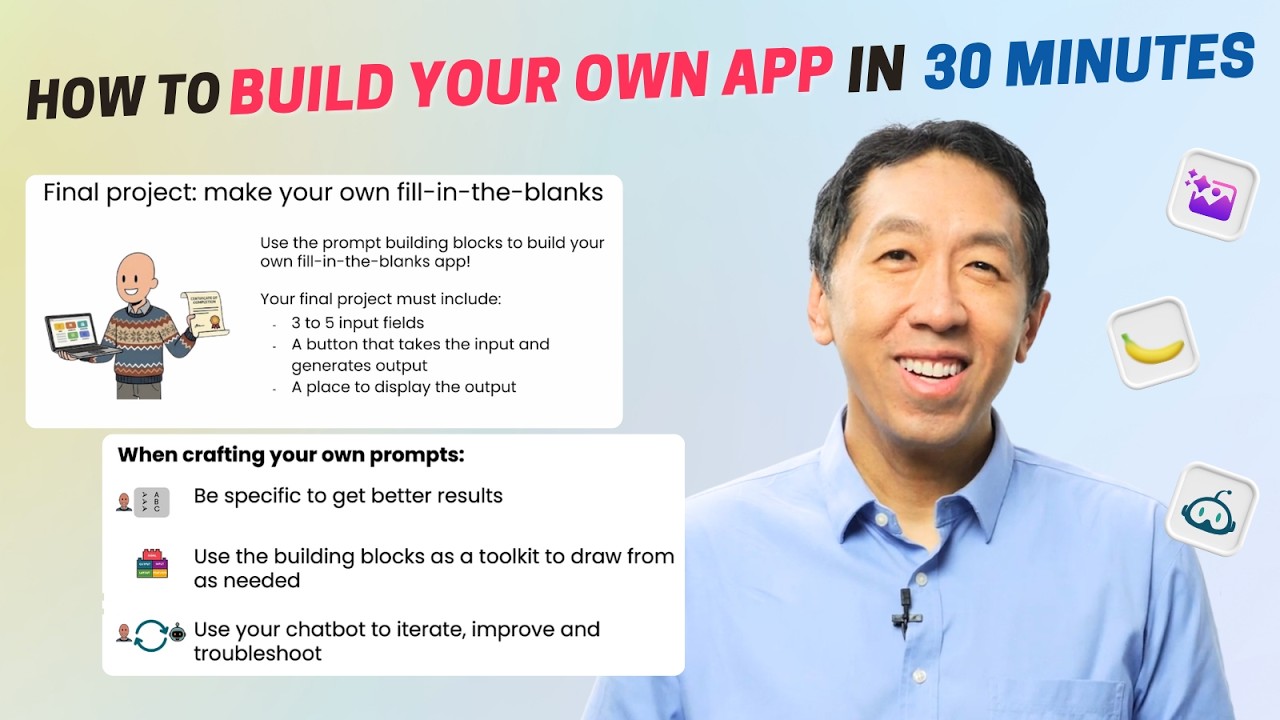
Build Your Own App In Just 30 Minutes! Full Course with Andrew Ng thumbnail

· 25:58

Build Your Own App In Just 30 Minutes! Full Course with Andrew Ng

This course teaches build-engineering principles for modern software development by leveraging AI tools (like ChatGPT or Gemini). Instead of writing code manually, users learn 'prompting'—the art of giving precise instructions to an AI system to generate functional web applications (HTML files). The process emphasizes iterative refinement and mastering five key building blocks: Goal, Input, Layout, Special Features, and Output. By following this framework, users can build complex tools, such as a birthday card generator or a ping pong game, with minimal coding experience.

Key takeaways

  1. The Power of Prompting 4:30

    Creating software in the AI era involves telling the AI what to do (prompting) rather than typing out code. The more specific and precise the prompt, the more predictable the resulting application will be.

  2. The Five Building Blocks of Prompts 6:10

    To build effective prompts, consider these five components: 1) The Goal (what to create), 2) User Input (data the user provides), 3) Layout (arrangement of parts), 4) Special Features (additional functionality), and 5) Output (the desired result format).

  3. Iterative Development and Troubleshooting 11:20

    Software development is an iterative process. If the initial AI-generated app has bugs or needs improvement, users must continue the conversation with specific instructions (e.g., 'Nothing happens when I click on the generate card button. Can you fix it for me?').

Watch on YouTube Full article