Topic

Developer Experience (DevEx)

All digests tagged Developer Experience (DevEx)

Codex Has Left The Laptop | DevDay 2026 thumbnail

· 22:01

Codex Has Left The Laptop | DevDay 2026

The presentation details the evolution of Codex from handling individual tasks to delegating complex, multi-stage problems to advanced agents. Key advancements include the launch of Codex Cloud, which allows agents to run tasks in managed, cloud-based environments, eliminating the need for local infrastructure upkeep. Furthermore, Codex is being integrated across multiple interfaces (CLI, Web, Slack, Teams), ensuring developers can use the same agent and tools regardless of where they are working.

Key takeaways

  1. Codex Cloud for Infrastructure Management 3:50

    Codex Cloud allows users to run tasks in managed environments, eliminating the need to maintain local machines or VPSs. The system automatically handles repository inspection, dependency setup, and writes necessary startup scripts and skills. It supports private resource access using mechanisms like Tailscale (VPN access) and OIDC, ensuring secure connectivity to non-public APIs.

  2. Omnichannel Agent Access 6:10

    The same core agent is now accessible across multiple platforms, including the desktop app, CLI, web interface, Slack, and Teams. This consistency allows developers to continue work (e.g., reviewing code, testing shaders) seamlessly across different interfaces.

  3. Enhanced Collaboration and Planning with Space 14:00

    The 'Space' feature centralizes planning and collaboration, allowing teams to share plans, get feedback, and let Codex continuously update progress directly within a document, keeping all team members synchronized on project status.

  4. Productivity with 'My Dot' 18:20

    The 'My Dot' feature acts as a personalized, ongoing agent extension of the developer. It can monitor specific channels, proactively review Pull Requests (PRs), and initiate full cloud tasks based on ongoing work, minimizing manual prompting.

Watch on YouTube Full article

The State of AI in Software Development: Data from 400+ Orgs — Justin Reock, DX thumbnail

· 19:09

The State of AI in Software Development: Data from 400+ Orgs — Justin Reock, DX

This presentation analyzes the impact of AI on developer productivity using data from 200,000 engineers. While AI has increased deployment frequency and code maintainability, the data reveals critical tensions: Change Confidence has dropped 6%, and PR size has significantly increased (from ~44 to 72 lines). The core finding is that code generation was never the bottleneck; instead, non-AI factors like meeting overhead and context switching are the primary constraints on value generation. DX proposes a measurement framework focusing on Utilization, Impact, and Cost, and emphasizes that improving foundational Developer Experience (DX) metrics—such as reliable CI and modular code—is crucial for maximizing agent efficiency.

Key takeaways

  1. Change Confidence vs. Maintainability 10:02

    Code maintainability has risen by nearly 4%, but Change Confidence has dropped 6%. This suggests developers feel more capable of understanding AI-generated code but are more hesitant to trust it, indicating a psychological shift in risk perception.

  2. PR Size and Incremental Delivery 11:42

    Average Pull Request (PR) size has increased from approximately 44 to 72 lines. This trend, coupled with a 10% drop in the perception of incremental delivery, suggests developers are consolidating changes, which increases the risk of bugs and makes code less portable.

  3. AI Efficiency by Role 14:02

    While junior engineers use AI the most, staff+ engineers are achieving comparable time savings while consuming fewer tokens, suggesting that deep architectural understanding is key to efficient AI utilization.

  4. The True Bottleneck

    The median increase in PR throughput was only about 7.7%, far from the expected 2x gain. The speaker asserts that time savings from AI are often outweighed by non-AI factors like meeting overhead and context switching, which are the true constraints on value generation.

  5. Agent Readiness Requires Good DX

    The speaker argues that improving foundational developer experience (DX) metrics—such as clear documentation, modular code, and reliable, non-flaky test suites—is necessary to build effective AI agents.

Watch on YouTube Full article

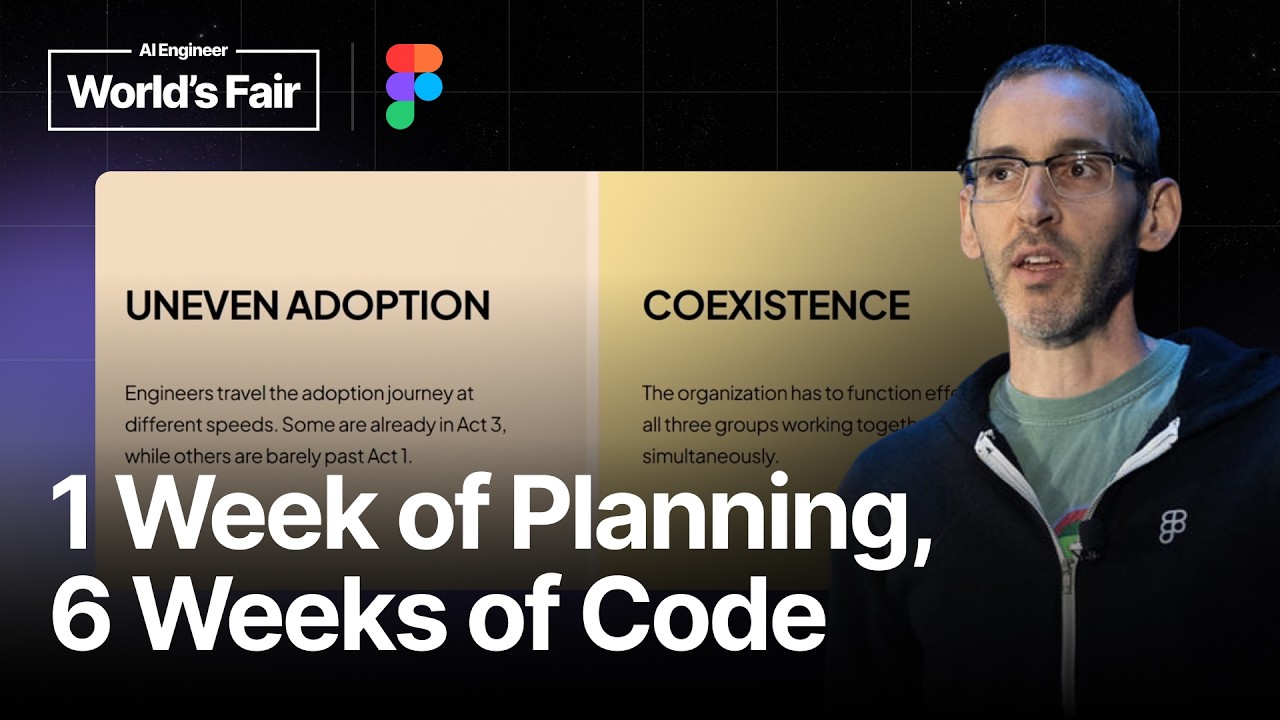
How to Get Your Org to Adopt Coding Agents (Without Shipping Garbage) — Eyal Blum, Figma thumbnail

· 17:43

How to Get Your Org to Adopt Coding Agents (Without Shipping Garbage) — Eyal Blum, Figma

The talk outlines Figma's strategy for safely adopting AI agents in a large-scale codebase. The core message is that successful adoption requires shifting focus from simply prompting agents to building robust verification mechanisms and structured planning processes. Key recommendations include making communication attention-aware (marking human vs. AI text) and structuring complex tasks using detailed plans, which are then broken down into small, independently verifiable components.

Key takeaways

  1. The Role of Skeptics in Adoption 5:25

    Best engineers, who hold institutional knowledge (the 'mental duct tape'), tend to be the slowest adopters because they are best positioned to spot failure modes and missing validation. Instead of forcing adoption, organizations should involve these skeptics by making them responsible for defining the roadmap to make AI safe.

  2. The Three Acts of AI Adoption 0:45

    AI adoption follows a three-act process: (1) Simple, successful use cases; (2) Applying practices to bigger problems where AI fails badly and trust breaks down; and (3) Building the real skill by implementing proper guardrails, context, and prompting for scale.

  3. Planning Over Prompting 10:30

    For complex features, spending significant time writing a detailed plan is more effective than simply prompting the agent. A good plan must start with a 'Why' (executive summary) and be broken down into small parts that can each be verified independently.

  4. Attention-Aware Communication

    Since human attention is scarce, it is crucial to build a culture of self-communication by explicitly marking what content was generated by AI versus what was written by a human (e.g., starting PR descriptions with a manual summary).

Watch on YouTube Full article

The Death of Developer Advocates — Stephanie Jarmak, Sourcegraph thumbnail

· 18:16

The Death of Developer Advocates — Stephanie Jarmak, Sourcegraph

Developer Relations (DevRel) is evolving from focusing solely on human developers to incorporating AI agents as primary users and recommenders. The core strategy must shift toward Generative Engine Optimization (GEO), ensuring that product documentation and tooling are machine-readable, highly discoverable in registries (like MCP), and directly address specific pain points encountered by autonomous agents.

Key takeaways

  1. The Agent as a New User Persona 10:40

    Agents interact with tools by calling APIs, reading documentation, and recovering from errors. They represent a critical new user base that must be measured for friction points (e.g., burning an entire turn on a guessed parameter) to improve the developer experience.

  2. Measuring Agent Interaction and Friction 8:56

    Benchmarking tools, such as CodeScaleBench, must track agent traces with and without product tooling. This data reveals where agents fail or struggle, allowing teams to fix underlying tool interaction issues.

  3. Shifting Focus to GEO (Generative Engine Optimization) 12:22

    The goal of DevRel is moving from Search Engine Optimization (SEO) to Generative Engine Optimization (GEO). Content must be structured, authoritative, and designed for agents to quote accurately when recommending a product.

  4. DevRel as an Interdisciplinary Function 15:15

    The role of DevRel is no longer confined to one department; it requires collaboration across Engineering (building agent interfaces/evals), Product (owning the end-to-end agentic experience), and Marketing (managing content funnels for agents).

Watch on YouTube Full article