
Topic

Figma

All digests tagged Figma

One Designer + AI. Hundreds of Deliverables. — Vincent Wendy, AI Engineer thumbnail

· 16:48

One Designer + AI. Hundreds of Deliverables. — Vincent Wendy, AI Engineer

This talk details how one designer managed the massive scale of deliverables (signage, stickers, landing pages, etc.) for a large conference (7,000 attendees, 140+ sponsors, 300+ speakers). The solution involves implementing a structured design system and automating workflows using AI agents (like Devin) and tools like Figma. The core methodology emphasizes shifting from manual, linear processes to highly automated, validated pipelines to solve the 'scale problem.'

Key takeaways

  1. The Five Pillars of Scaling Design 0:04

    To manage massive deliverables, the process must focus on: 1) Building a solid foundation (design system, typography, components); 2) Making designs reusable; 3) Automating workflows; 4) Validating output; and 5) Removing friction. (4:45)

  2. AI Agents for Automation 0:09

    AI agents (e.g., Devin) are used to automate complex tasks, such as generating speaker announcement graphics and trading cards for 300+ speakers, or pulling live schedule data and exporting it as PNGs. (9:16)

  3. Systemic QA and Validation 0:13

    AI can be used for visual quality assurance (QA), such as checking 140+ sponsor logos on a banner for missing assets or detecting visual inconsistencies on merchandise. (13:15)

  4. Thinking as a User 0:14

    The most critical shift is to think like an end-user (attendee) rather than a designer, focusing on handling exceptions and ensuring all elements (wayfinding, schedules) are interconnected. (14:21)
Watch on YouTube Full article

How to Get Your Org to Adopt Coding Agents (Without Shipping Garbage) — Eyal Blum, Figma thumbnail

· 17:43

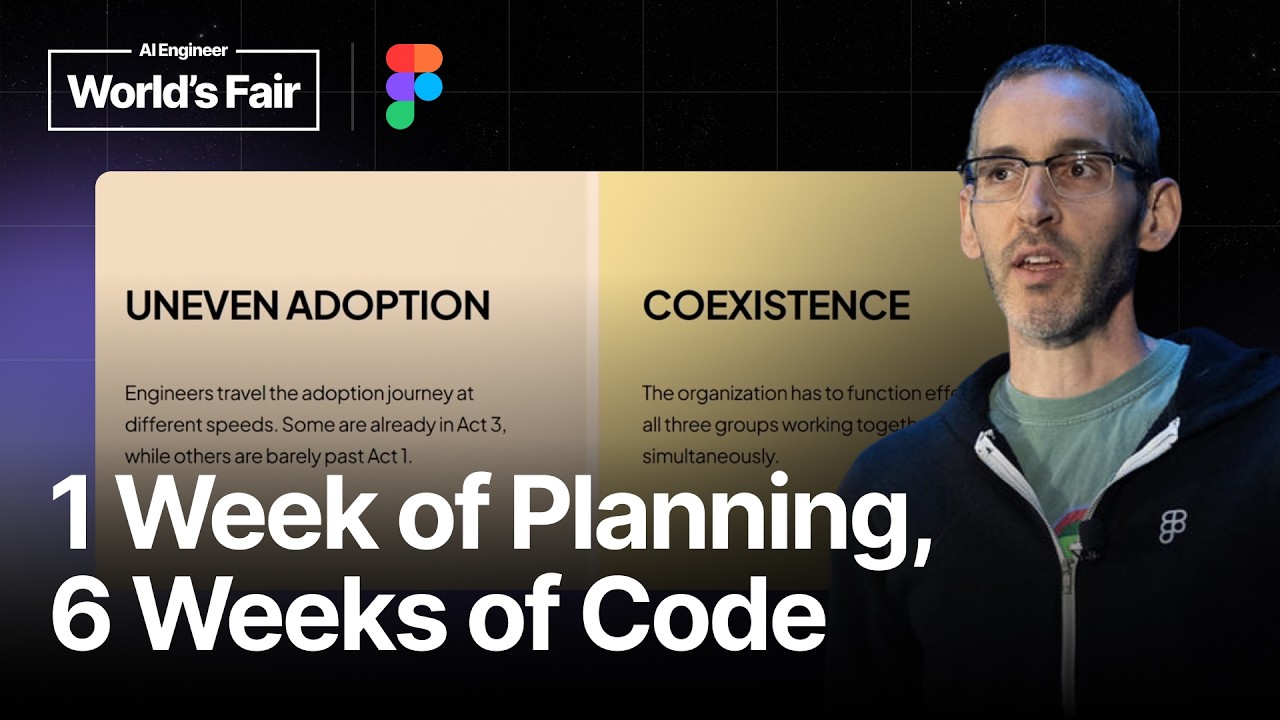
How to Get Your Org to Adopt Coding Agents (Without Shipping Garbage) — Eyal Blum, Figma

The talk outlines Figma's strategy for safely adopting AI agents in a large-scale codebase. The core message is that successful adoption requires shifting focus from simply prompting agents to building robust verification mechanisms and structured planning processes. Key recommendations include making communication attention-aware (marking human vs. AI text) and structuring complex tasks using detailed plans, which are then broken down into small, independently verifiable components.

Key takeaways

  1. The Role of Skeptics in Adoption 5:25

    Best engineers, who hold institutional knowledge (the 'mental duct tape'), tend to be the slowest adopters because they are best positioned to spot failure modes and missing validation. Instead of forcing adoption, organizations should involve these skeptics by making them responsible for defining the roadmap to make AI safe.

  2. The Three Acts of AI Adoption 0:45

    AI adoption follows a three-act process: (1) Simple, successful use cases; (2) Applying practices to bigger problems where AI fails badly and trust breaks down; and (3) Building the real skill by implementing proper guardrails, context, and prompting for scale.

  3. Planning Over Prompting 10:30

    For complex features, spending significant time writing a detailed plan is more effective than simply prompting the agent. A good plan must start with a 'Why' (executive summary) and be broken down into small parts that can each be verified independently.

  4. Attention-Aware Communication

    Since human attention is scarce, it is crucial to build a culture of self-communication by explicitly marking what content was generated by AI versus what was written by a human (e.g., starting PR descriptions with a manual summary).

Watch on YouTube Full article