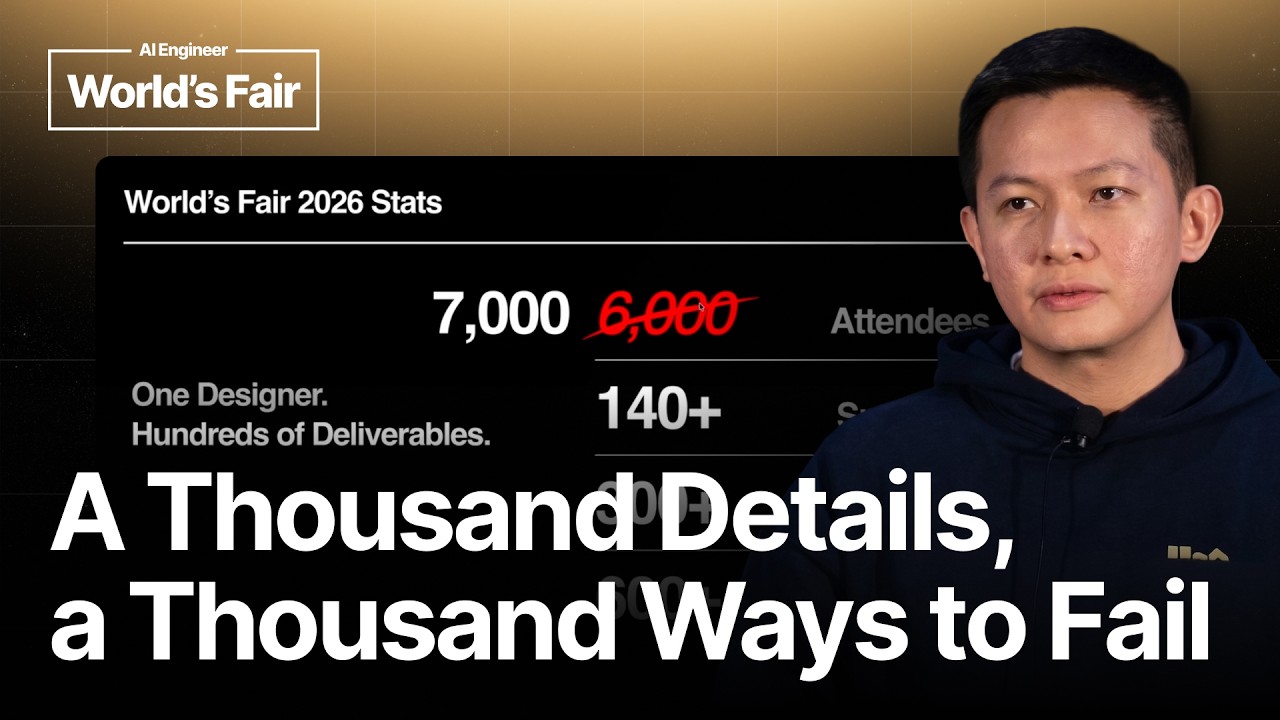
One Designer + AI. Hundreds of Deliverables. — Vincent Wendy, AI Engineer
This talk details how one designer managed the massive scale of deliverables (signage, stickers, landing pages, etc.) for a large conference (7,000 attendees, 140+ sponsors, 300+ speakers). The solution involves implementing a structured design system and automating workflows using AI agents (like Devin) and tools like Figma. The core methodology emphasizes shifting from manual, linear processes to highly automated, validated pipelines to solve the 'scale problem.'
Key takeaways
-
The Five Pillars of Scaling Design
0:04
To manage massive deliverables, the process must focus on: 1) Building a solid foundation (design system, typography, components); 2) Making designs reusable; 3) Automating workflows; 4) Validating output; and 5) Removing friction. (4:45)
-
AI Agents for Automation
0:09
AI agents (e.g., Devin) are used to automate complex tasks, such as generating speaker announcement graphics and trading cards for 300+ speakers, or pulling live schedule data and exporting it as PNGs. (9:16)
-
Systemic QA and Validation
0:13
AI can be used for visual quality assurance (QA), such as checking 140+ sponsor logos on a banner for missing assets or detecting visual inconsistencies on merchandise. (13:15)
-
Thinking as a User
0:14
The most critical shift is to think like an end-user (attendee) rather than a designer, focusing on handling exceptions and ensuring all elements (wayfinding, schedules) are interconnected. (14:21)
