How to Get Your Org to Adopt Coding Agents (Without Shipping Garbage) — Eyal Blum, Figma
Summary
The talk outlines Figma's strategy for safely adopting AI agents in a large-scale codebase. The core message is that successful adoption requires shifting focus from simply prompting agents to building robust verification mechanisms and structured planning processes. Key recommendations include making communication attention-aware (marking human vs. AI text) and structuring complex tasks using detailed plans, which are then broken down into small, independently verifiable components.
Key takeaways
-
The Role of Skeptics in Adoption
5:25
Best engineers, who hold institutional knowledge (the 'mental duct tape'), tend to be the slowest adopters because they are best positioned to spot failure modes and missing validation. Instead of forcing adoption, organizations should involve these skeptics by making them responsible for defining the roadmap to make AI safe.
-
The Three Acts of AI Adoption
0:45
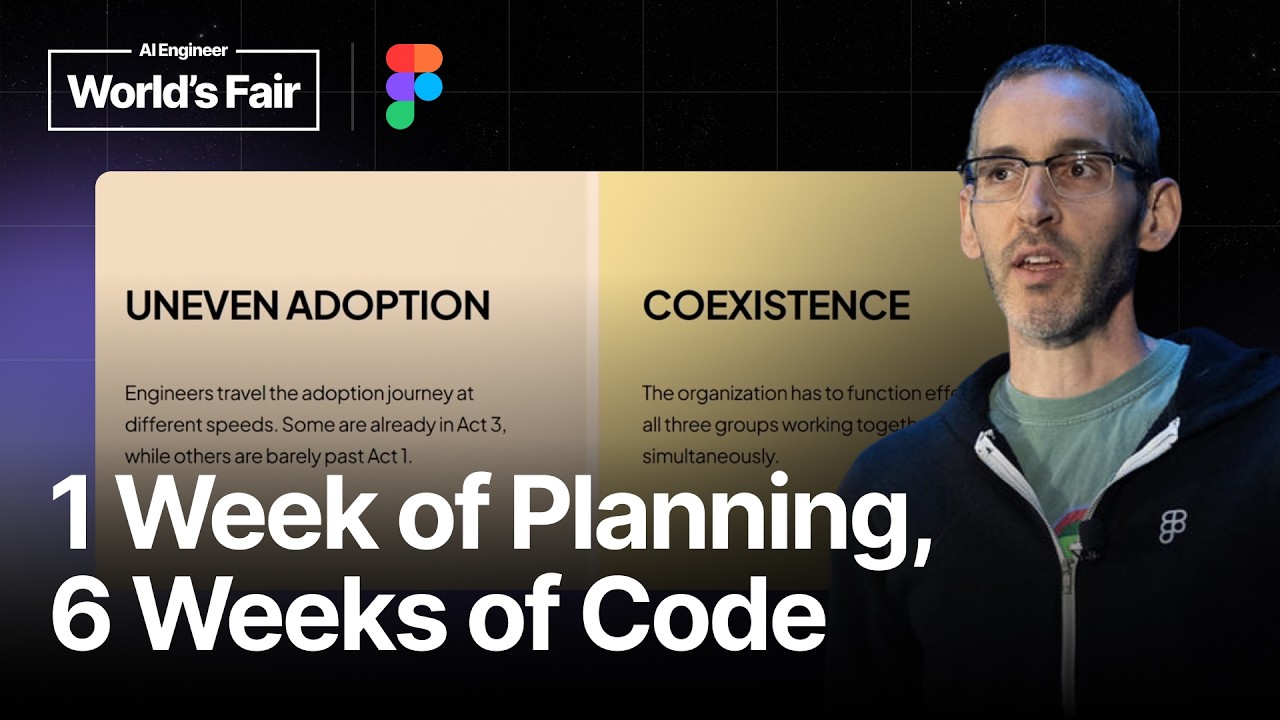
AI adoption follows a three-act process: (1) Simple, successful use cases; (2) Applying practices to bigger problems where AI fails badly and trust breaks down; and (3) Building the real skill by implementing proper guardrails, context, and prompting for scale.
-
Planning Over Prompting
10:30
For complex features, spending significant time writing a detailed plan is more effective than simply prompting the agent. A good plan must start with a 'Why' (executive summary) and be broken down into small parts that can each be verified independently.
-
Attention-Aware Communication
Since human attention is scarce, it is crucial to build a culture of self-communication by explicitly marking what content was generated by AI versus what was written by a human (e.g., starting PR descriptions with a manual summary).
Technical details
-
Testing Pyramid for Agent Review
490s
Move verification as far down the testing pyramid as possible. Use agents to review deterministic flows (linting, compiler checks, unit tests) based on encoded architectural standards. Human review should be reserved only for high-level functionality.
-
TDD Style Implementation
490s
When asking an agent to write code, using a Test-Driven Development (TDD) style (Red -> Green -> Red -> Green) yields better results than writing the code and then attempting to write tests afterward.
-
Deterministic Flow Encoding
380s
When an agent finds a useful pattern or solution, take time to encode it into a deterministic flow. This saves tokens, time, and ensures the process is repeatable without relying solely on LLM reasoning.
Mentioned resources
- Figma
Channel & topics
Watch on YouTube · Back to latest
This independent, AI-assisted summary is provided for commentary and informational purposes. It may contain errors or omit important context. Please watch the original video for the creator's complete presentation. Video, thumbnail, and related copyrights belong to their respective owners.