Topic

AI Adoption

All digests tagged AI Adoption

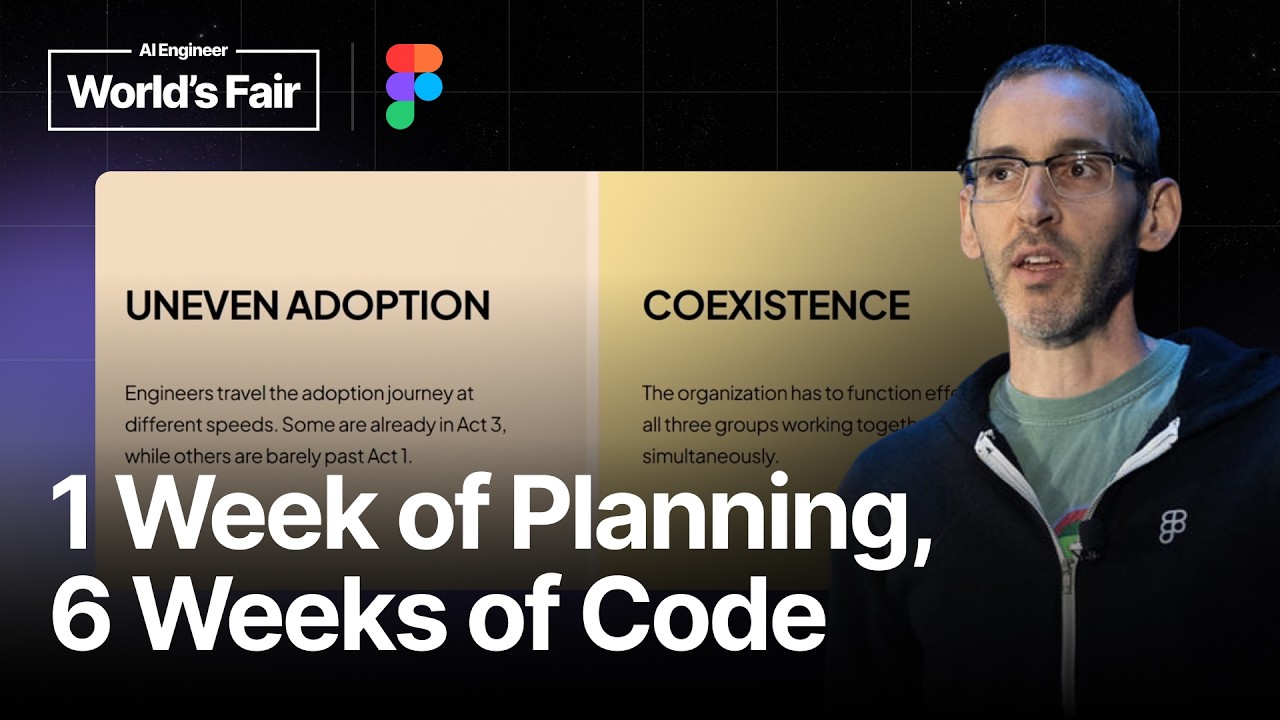
How to Get Your Org to Adopt Coding Agents (Without Shipping Garbage) — Eyal Blum, Figma thumbnail

· 17:43

How to Get Your Org to Adopt Coding Agents (Without Shipping Garbage) — Eyal Blum, Figma

The talk outlines Figma's strategy for safely adopting AI agents in a large-scale codebase. The core message is that successful adoption requires shifting focus from simply prompting agents to building robust verification mechanisms and structured planning processes. Key recommendations include making communication attention-aware (marking human vs. AI text) and structuring complex tasks using detailed plans, which are then broken down into small, independently verifiable components.

Key takeaways

  1. The Role of Skeptics in Adoption 5:25

    Best engineers, who hold institutional knowledge (the 'mental duct tape'), tend to be the slowest adopters because they are best positioned to spot failure modes and missing validation. Instead of forcing adoption, organizations should involve these skeptics by making them responsible for defining the roadmap to make AI safe.

  2. The Three Acts of AI Adoption 0:45

    AI adoption follows a three-act process: (1) Simple, successful use cases; (2) Applying practices to bigger problems where AI fails badly and trust breaks down; and (3) Building the real skill by implementing proper guardrails, context, and prompting for scale.

  3. Planning Over Prompting 10:30

    For complex features, spending significant time writing a detailed plan is more effective than simply prompting the agent. A good plan must start with a 'Why' (executive summary) and be broken down into small parts that can each be verified independently.

  4. Attention-Aware Communication

    Since human attention is scarce, it is crucial to build a culture of self-communication by explicitly marking what content was generated by AI versus what was written by a human (e.g., starting PR descriptions with a manual summary).


Watch on YouTube Full article

How to build an AI-Native Health Company — Dan Feng, Maven Clinic thumbnail

· 17:19

How to build an AI-Native Health Company — Dan Feng, Maven Clinic

The transition to an AI-native company requires a fundamental shift in process and culture, moving away from lengthy planning cycles toward rapid, iterative development. While building software is now fast (minutes), the expense lies in arguing requirements. Build engineers must adapt by adopting short-cycle planning (2–4 weeks) and implementing rigorous, multi-layered testing strategies to manage AI-specific risks like hallucination. Key process changes include limiting Pull Request (PR) size (capped near 500 lines) and running integration tests multiple times to ensure reliability.

Key takeaways

  1. Shift Planning Focus 10:32

    Instead of spending weeks or months finalizing requirements, focus on delivering value in the next two to four weeks. Long-term plans (1 year) should only serve as directional inspiration, not rigid commitments.

  2. Redefining Code Review

    Due to increased code output from AI tools, traditional code review must change. Engineers can self-certify simple PRs, and large features should be stacked into multiple smaller PRs (capped near 500 lines) to maintain meaningful review quality.

  3. AI Reliability Testing

    For GenAI solutions, failure modes must be categorized (tolerable vs. not acceptable). Critical processes require consensus among multiple models (e.g., using different LLMs to review the same receipt) and running integration tests many times, rather than just once.

Watch on YouTube Full article

Tammuz Dubnov - When Our PM Started Writing Code: What Merge Rate Taught Us About AI Adoption - AI N thumbnail

· 26:42

Tammuz Dubnov - When Our PM Started Writing Code: What Merge Rate Taught Us About AI Adoption - AI N

The shift toward 'AI native' organizations means that the primary bottleneck is no longer code generation speed but organizational alignment and handoff efficiency. The speaker argues that empowering non-technical decision-makers (PMs, Designers) with agentic tools allows them to execute work directly, collapsing gaps that previously required multiple sprints or lengthy coordination. Success in this transition is measured by the 'merge rate'—the percentage of Pull Requests (PRs) opened by non-technical users that successfully land in production.

Key takeaways

  1. Redefining AI Native 2:00

    AI native means that the person who cares about a feature has the authority and ability to execute the work, collapsing the traditional handover gap between PMs/Designers and Developers. The bottleneck shifts from coding speed to decision-making capacity.

  2. The Importance of Merge Rate 6:00

    Merge rate (the percentage of PRs that land in production) is the key metric for measuring if an organization is successfully adapting to AI-driven workflows. A high merge rate indicates trust and quality between non-technical contributions and the dev team.

  3. The Role of Guards and Architecture 11:20

    As organizations move fast, it is critical not to abandon engineering principles or 'guards' (like testing, architectural standards). The agent must be designed to learn the codebase deeply and maintain these constraints.

  4. Measuring Non-Technical Contributions 14:20

    To measure impact, track: 1) Count of PRs opened by non-technical individuals. 2) Merge rate (e.g., an average merge rate of 74% was cited). 3) Percentage of merged PRs that require zero developer intervention.

Watch on YouTube Full article