Topic

Web Development

All digests tagged Web Development

Hugging Face's MCP Server: Only 62K of 10M Calls Matter thumbnail

· 9:44

Hugging Face's MCP Server: Only 62K of 10M Calls Matter

The video discusses the significant overhead and limitations inherent in current AI agent protocols, particularly the Model Call Protocol (MCP). Speakers highlight that complex agent interactions are often hampered by chatty, stateful handshakes and reliance on visual/pixel-based inference (the 'guessing game'). Solutions proposed include implementing Web MCP, which allows front ends to expose capabilities rather than just pixels, and building robust guardrails and validation logic directly into the protocol's plumbing (using lifecycle hooks) to prevent agents from reinventing existing components or making unauthorized calls.

Key takeaways

  1. Protocol Overhead is High 2:07

    A stateful MCP handshake is highly chatty. For every 10 million protocol messages, 1.2 million are 'initialize' events, but only 62,000 are actual tool calls, indicating significant protocol overhead (00:02:07).

  2. Web MCP Shifts Focus from Pixels to Capabilities 2:32

    Current web agents operate by observing screenshots, DOM, or accessibility trees, which is inefficient and consumes excessive tokens. Web MCP proposes letting the front end expose defined capabilities instead of relying on pixel-level guessing (00:02:32).

  3. Guardrails Must Live in the Plumbing 4:57

    Since developers cannot control what an LLM agent decides to call, guardrails must be implemented in the protocol's plumbing (e.g., using lifecycle hooks before or after a tool call) to validate outputs, such as ensuring an email is in a client's custom domain (00:04:57).

Watch on YouTube Full article

How I used AI to build a slop-free web page thumbnail

· 4:58

How I used AI to build a slop-free web page

The speaker details a process for achieving high-quality web design for the Multiplayer AI Manifesto page, emphasizing that while AI was used, the core content and creative direction were human-driven. The process involved writing all copy manually, specifying a desired 'vibe,' and utilizing a 'random-string trick' in prompts to generate design variety. The site was built by launching multiple AI agents (including Fable 5.1) on the Superconductor platform, comparing their screenshots, and then engaging in extensive, iterative, multi-agent chat sessions to refine the final product.

Key takeaways

  1. Content Creation

    All copy was written by hand, and the desired visual 'vibe' was specified in the source document, avoiding AI writing for the text.

  2. Design Variety Trick 2:00

    To achieve design diversity, the speaker used a 'random-string trick' in the prompt, instructing the AI to generate a long alphanumeric string and apply it to the design without mentioning the string itself.

  3. Multi-Agent Testing 2:20

    The process involved sending a Notion link to Superconductor to build the site, requesting a sequence of screenshots using Playwright. The speaker launched 14 different AI implementations (e.g., Fable 5.1, CodeXes, open-source models) to compare results.

  4. Iterative Refinement 3:00

    The final site was refined through a long, multiplayer AI chat session (333 messages), where the speaker and co-founder provided visual feedback (via screenshots) to the chosen agent (Fable 5.1) for continuous improvement.

Watch on YouTube Full article

Generative UI... in Python? — Jeremiah Lowin, Prefect thumbnail

· 17:38

Generative UI... in Python? — Jeremiah Lowin, Prefect

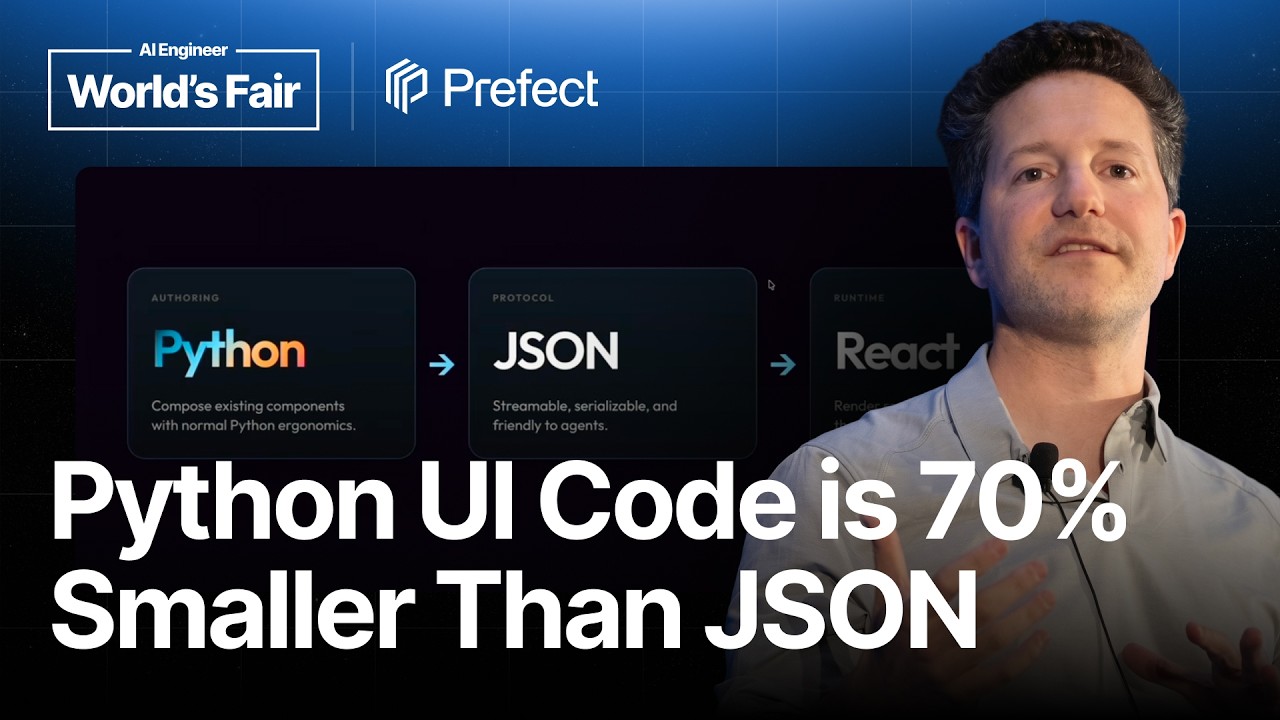
This talk introduces Prefect, a Python DSL designed to solve the challenge of delivering rich, interactive UIs within the MCP (Messaging/Communication Protocol) ecosystem. While MCP apps allow tools to bypass the agent and render full HTML/CSS/JS interfaces, the primary user base (Python engineers in enterprises) needed a way to build these UIs without writing complex frontend code. Prefect achieves this by allowing developers to compose UIs using Python context managers and classes, which are then serialized into a JSON protocol and rendered by a React app. A key optimization is streaming the Python code itself over the wire and executing it in a sandbox, resulting in a 70% reduction in size compared to streaming the JSON representation.

Key takeaways

  1. MCP Apps and Agent Bypass

    MCP apps are an extension of the MCP protocol that allows tool results to bypass the agent and be delivered directly to the user as a full UI (HTML, CSS, JavaScript), enabling rich, interactive experiences.

  2. The Prefect Solution 9:03

    Prefect is a Python DSL that allows developers to compose UIs by nesting components using context managers, avoiding the need to write traditional frontend code.

  3. The Core Pipeline 10:37

    The process involves using a Python DSL to build a declarative representation, which is serialized into a JSON protocol. This JSON is then rendered by a React app hosted as the MCP app.

  4. Efficiency Improvement 16:40

    The system was optimized to stream the Python representation of the UI over the wire and execute it in a sandbox, which was found to be approximately 70% smaller and more efficient than streaming the full JSON protocol.

Watch on YouTube Full article

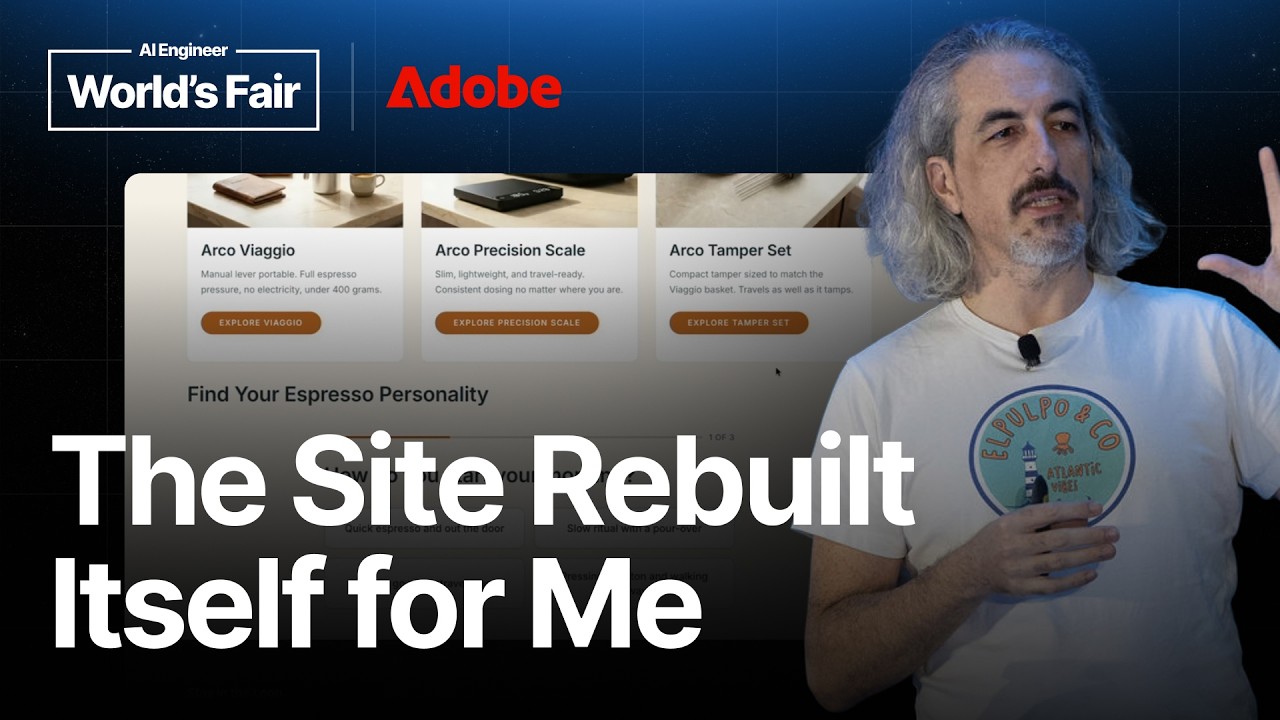
Agentic Sites: Building Hyper Personalized Websites — Carlos Sanchez, Adobe thumbnail

· 20:43

Agentic Sites: Building Hyper Personalized Websites — Carlos Sanchez, Adobe

The presentation details 'Agentic Sites,' a system for building hyper-personalized websites that adapts content in real time based on user intent and browsing behavior. Instead of generating entire pages, the architecture focuses on customizing specific content blocks (e.g., hero sections, product lists) while grounding all generated content within the site's existing corpus to maintain strict brand guidelines. Key technical advancements include continuous model evaluation across multiple providers for both accuracy and speed, achieving impressive generation latencies as low as 1.1 seconds.

Key takeaways

  1. Hyper-Personalization (Audience of One)

    The goal is to personalize pages in real time based on the user's intent or actions, moving beyond one-size-fits-all web experiences. This drives higher engagement and conversions.

  2. Block-Level Personalization 3:40

    Personalization occurs at the block level (e.g., hero card, product list) rather than generating entire pages, which is crucial for adhering to strict brand guidelines and preventing hallucinations.

  3. Speed is Critical for Conversion 10:58

    The system emphasizes speed, noting that a page generation time of 1.1 seconds was significantly faster than the runner-up's 4.6 seconds, demonstrating that low latency is critical to user experience and conversion rates.

Watch on YouTube Full article

Expose your site's actions to AI agents using WebMCP thumbnail

· 1:29

Expose your site's actions to AI agents using WebMCP

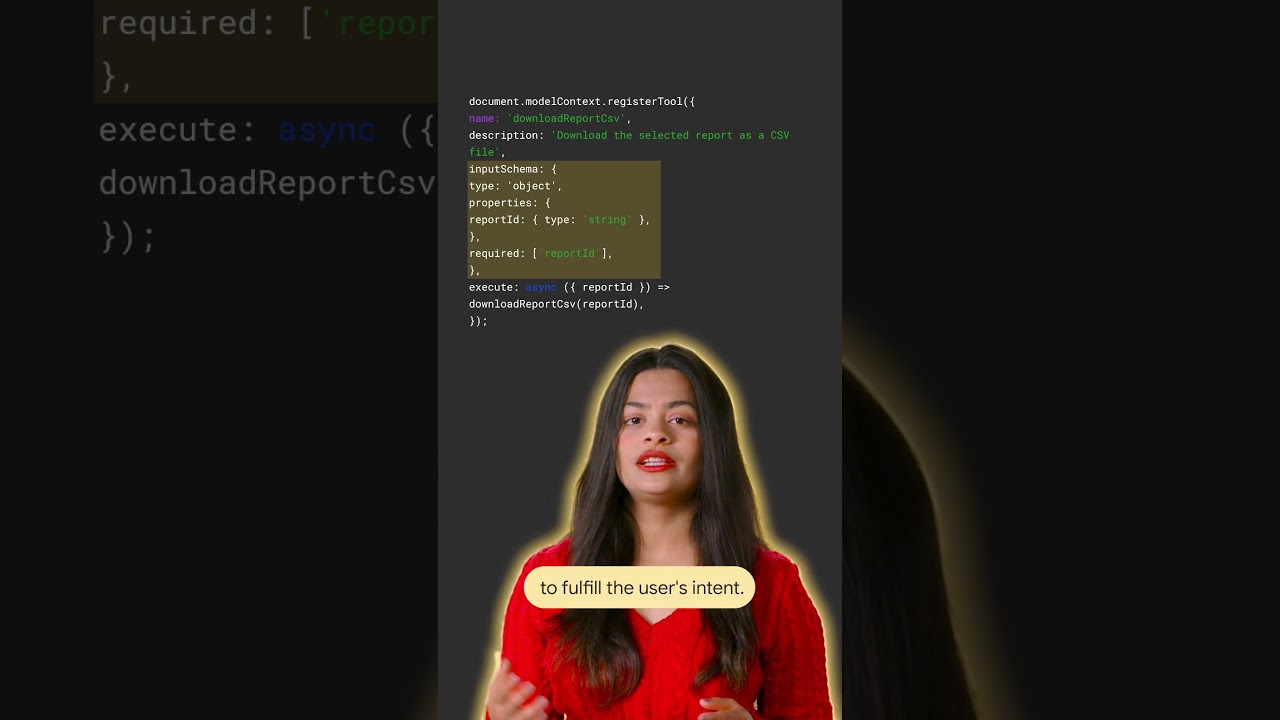
This talk introduces WebMCP (Web Manifest Capabilities Protocol), a method for web sites to expose their functional capabilities directly to AI agents. Instead of relying on agents to interpret the UI like a human, developers can register tools using plain JavaScript, defining explicit inputs and outputs via a schema. This allows agents to perform direct tool calls (e.g., 'Download report CSV') rather than attempting button interactions, significantly improving reliability for automated agent workflows.

Key takeaways

  1. Problem with Current AI Agent Interaction

    AI agents often fail or go off course because they misinterpret the visual interface (UI) of a website, forcing them to interact like a human user.

  2. WebMCP Solution: Exposing Capabilities

    WebMCP allows sites to explicitly expose what they can do. Developers register tools using plain JavaScript, providing a name, description, and function that performs the action.

  3. Reliable Agent Interaction via Schema

    By defining explicit inputs and outputs (the schema), agents can bypass guesswork. They discover capabilities and execute direct tool calls, such as calling 'Download report CSV' directly.

  4. Alternative Exposure Methods

    If JavaScript is not used, capabilities can be exposed by annotating supported HTML forms instead.

Watch on YouTube Full article

HTML Is All Agents Need — James Russo, HeyGen thumbnail

· 15:13

HTML Is All Agents Need — James Russo, HeyGen

The presentation argues that HTML, CSS, and JavaScript are the native languages of Large Language Models (LLMs), making them the ideal foundation for agent-generated video content. The speaker introduces Hyperframes, an open-source framework designed to turn agents' generated HTML into deterministic MP4 videos. Key technical challenges addressed include overcoming browser asynchronous rendering issues by freezing time and seeking frame-by-frame, ensuring that complex elements like WebGL and SVGs are consistently rendered in the final video output.

Key takeaways

  1. HTML as LLM Native Language 3:33

    LLMs' training data is predominantly HTML, CSS, and JavaScript. Forcing them to use custom DSLs or JSON structures hinders performance compared to letting them operate in their native language.

  2. Hyperframes Framework 9:30

    This open-source framework converts an agent's generated HTML into a video format, allowing anything renderable in a browser (e.g., 3.js, SVGs) to be included in the final MP4 output.

  3. Deterministic Video Rendering 10:20

    Since browsers are designed to load asynchronously (great for web performance but bad for video consistency), Hyperframes solves this by freezing the clock and deterministically seeking frame-by-frame to ensure all assets are loaded before capturing each frame.

  4. Focus on Taste, Not Language 13:05

    Instead of teaching agents a new framework language, the focus is placed on 'skills' that teach good video principles (taste), allowing for higher quality output from single-shot prompts.

Watch on YouTube Full article

Build Your Own App In Just 30 Minutes! Full Course with Andrew Ng thumbnail

· 25:58

Build Your Own App In Just 30 Minutes! Full Course with Andrew Ng

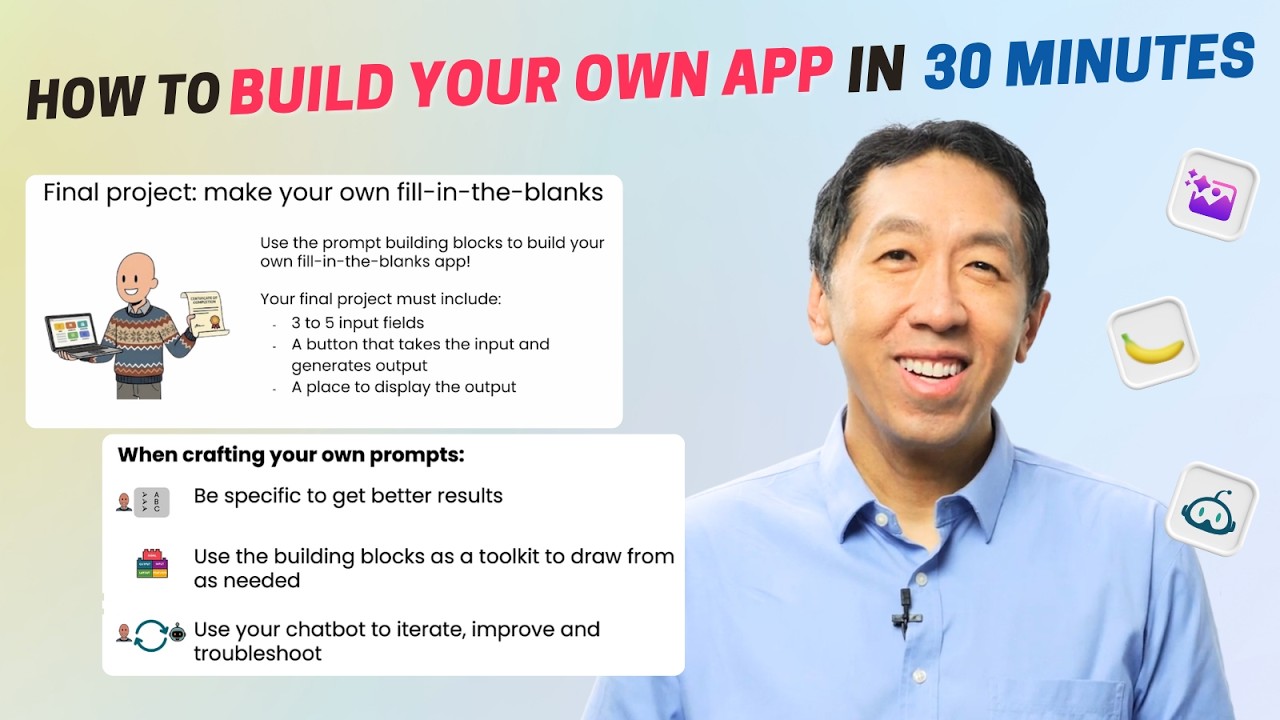
This course teaches build-engineering principles for modern software development by leveraging AI tools (like ChatGPT or Gemini). Instead of writing code manually, users learn 'prompting'—the art of giving precise instructions to an AI system to generate functional web applications (HTML files). The process emphasizes iterative refinement and mastering five key building blocks: Goal, Input, Layout, Special Features, and Output. By following this framework, users can build complex tools, such as a birthday card generator or a ping pong game, with minimal coding experience.

Key takeaways

  1. The Power of Prompting 4:30

    Creating software in the AI era involves telling the AI what to do (prompting) rather than typing out code. The more specific and precise the prompt, the more predictable the resulting application will be.

  2. The Five Building Blocks of Prompts 6:10

    To build effective prompts, consider these five components: 1) The Goal (what to create), 2) User Input (data the user provides), 3) Layout (arrangement of parts), 4) Special Features (additional functionality), and 5) Output (the desired result format).

  3. Iterative Development and Troubleshooting 11:20

    Software development is an iterative process. If the initial AI-generated app has bugs or needs improvement, users must continue the conversation with specific instructions (e.g., 'Nothing happens when I click on the generate card button. Can you fix it for me?').

Watch on YouTube Full article