Expose your site's actions to AI agents using WebMCP
Summary
This talk introduces WebMCP (Web Manifest Capabilities Protocol), a method for web sites to expose their functional capabilities directly to AI agents. Instead of relying on agents to interpret the UI like a human, developers can register tools using plain JavaScript, defining explicit inputs and outputs via a schema. This allows agents to perform direct tool calls (e.g., 'Download report CSV') rather than attempting button interactions, significantly improving reliability for automated agent workflows.
Key takeaways
-
Problem with Current AI Agent Interaction
AI agents often fail or go off course because they misinterpret the visual interface (UI) of a website, forcing them to interact like a human user.
-
WebMCP Solution: Exposing Capabilities
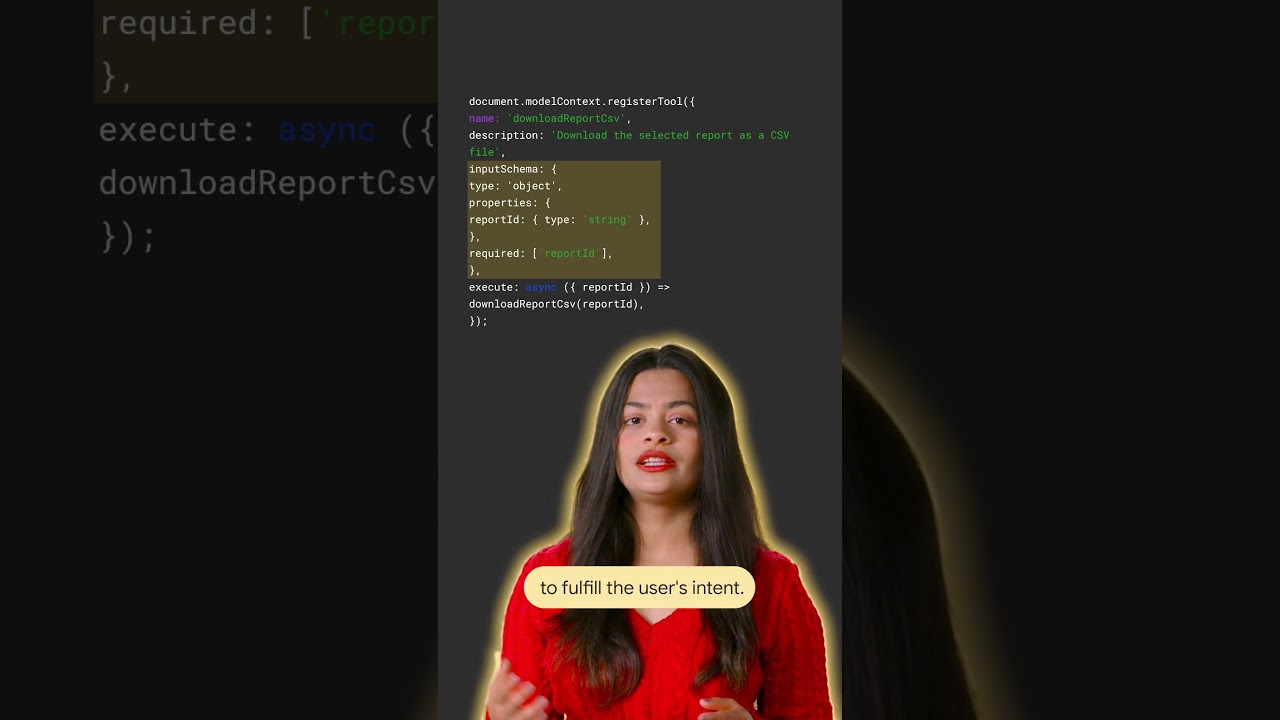
WebMCP allows sites to explicitly expose what they can do. Developers register tools using plain JavaScript, providing a name, description, and function that performs the action.
-
Reliable Agent Interaction via Schema
By defining explicit inputs and outputs (the schema), agents can bypass guesswork. They discover capabilities and execute direct tool calls, such as calling 'Download report CSV' directly.
-
Alternative Exposure Methods
If JavaScript is not used, capabilities can be exposed by annotating supported HTML forms instead.
Technical details
-
WebMCP Implementation
0s
Tools are registered using plain JavaScript and require defining a name, description, and an action function. The schema is critical for specifying explicit inputs and outputs.
-
Agent Workflow Improvement
0s
WebMCP shifts the paradigm from 'figure out what my page does' to 'here are the actions my site supports,' providing a reliable interface designed specifically for agents.
-
Availability
0s
The WebMCP origin trial is available starting with Chrome 149.
Mentioned resources
Channel & topics
Watch on YouTube · Back to latest
This independent, AI-assisted summary is provided for commentary and informational purposes. It may contain errors or omit important context. Please watch the original video for the creator's complete presentation. Video, thumbnail, and related copyrights belong to their respective owners.