Topic

Software Development Life Cycle (SDLC)

All digests tagged Software Development Life Cycle (SDLC)

Engineers… Your Software Factory NEEDS Agent Sandboxes to SCALE (exe.dev) thumbnail

· 37:15

Engineers… Your Software Factory NEEDS Agent Sandboxes to SCALE (exe.dev)

The video argues that traditional methods of running AI agents—such as allocating a small corner of a local machine or relying solely on containers/CI/CD—create bottlenecks. To achieve true scale and autonomy in an 'AI developer workflow' (ADW), the entire software factory must be moved into dedicated, isolated agent sandboxes (e.g., using exe.dev). This architecture enables complex workflows like running 'Best of N' comparisons across multiple model configurations while maintaining zero blast radius via disposable keys.

Key takeaways

  1. The Bottleneck Problem

    If an engineer is 'in the loop,' they are the bottleneck. True scaling requires moving beyond local compute limitations by giving every agent its own isolated computer, achieving isolation, scale, and autonomy.

  2. Three-Tier Architecture for Scale 23:25

    The recommended architecture involves an Out-loop orchestrator (on the engineer's machine), an In-sandbox orchestrator (on each VM), and the core Software Factory/ADW agents running inside the sandbox. This allows the top-level agent to kick off work and then go quiet, only requiring human intervention at planning and reviewing stages.

  3. Best of N Pattern 17:05

    Sandboxes enable running 'Best of N' patterns by simultaneously executing the same prompt/workflow across multiple agent configurations (e.g., Default, Frontier, Deepest, Open Weights), allowing for comparison and selection of the optimal outcome.

  4. Security and Isolation 27:50

    Sandboxes provide critical security by ensuring a 'bounded blast radius.' Agents use ephemeral resources, such as OpenRouter provisioning keys with hard spend caps, which are revoked upon teardown, preventing unauthorized access to production systems (e.g., AWS).

Watch on YouTube Full article

My Super Simple Software Factory (For Agentic Engineers) thumbnail

· 29:53

My Super Simple Software Factory (For Agentic Engineers)

The video introduces the concept of a 'Software Factory'—an advanced system for agentic engineering that moves beyond relying solely on autonomous agents. The core thesis is that combining **Agents + Code** provides significantly more leverage and reliability than agents alone. This factory automates the entire Software Development Life Cycle (SDLC) by integrating deterministic code checks, ensuring repeatability, observability, and scalability across complex AI developer workflows.

Key takeaways

  1. Agents Plus Code is Superior

    The most significant advancement in agentic engineering is the combination of agents with explicit, deterministic code. This structure ensures reliability, cost control, and verifiable output, mitigating risks associated with pure AI orchestration.

  2. Three Core Design Principles 2:00

    The Super Simple Software Factory is built on three non-negotiable principles: **Observable** (full visibility into every phase, prompt, and cost breakdown); **Customizable** (using a single YAML config to control the core four elements: context, model, prompt, tool); and **Reusable** (deployable across any codebase via an `/install` command).

  3. Scaling Compute for Impact 3:50

    The system is designed to scale compute power by orchestrating complex, multi-step workflows (e.g., Plan $ ightarrow$ Build $ ightarrow$ Test $ ightarrow$ Review) that operate without constant human intervention.

Watch on YouTube Full article

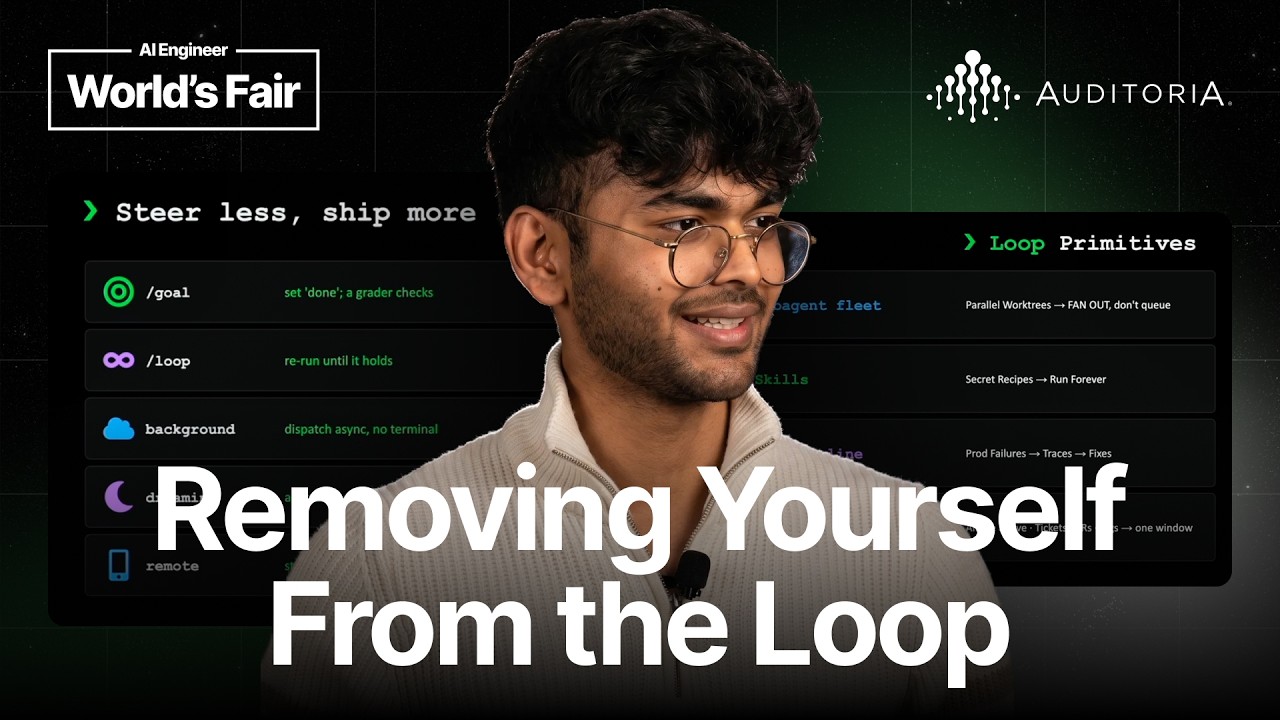
Your Finance Agent's Bottleneck Is You — Ramana Siddanth Emani, Auditoria AI thumbnail

· 13:42

Your Finance Agent's Bottleneck Is You — Ramana Siddanth Emani, Auditoria AI

The primary bottleneck in developing production AI agents, especially for regulated fields like finance, is not model capability or hardware, but the developer's manual workflow. The talk outlines how advanced agent harnesses can automate and multiply human output by implementing primitives such as sub-agents, skills, goals, and loops. By orchestrating these agents across parallel worktrees (e.g., handling multiple Jira tickets simultaneously), developers can drastically reduce time spent on repetitive tasks like testing, building, and deployment, shifting the human role from executor to final verifier.

Key takeaways

  1. The Developer Loop is the Bottleneck

    Shipping production agents fails due to developer velocity limitations. The solution lies in automating the internal developer loop rather than waiting for model or hardware upgrades (0:00, 2:37).

  2. Parallel Task Execution via Sub-Agents 7:02

    Sub-agents allow for parallel processing using isolated 'worktrees'—virtual folders where agents write and execute code independently. This enables handling multiple tasks (e.g., QA bug tickets) simultaneously, far exceeding human capacity (4:22).

  3. Minimal UX for Orchestration 8:38

    Effective agent use requires minimal User Experience (UX), consolidating all project dashboards, logs, Jira tickets, and GitHub PRs into a single pane of glass widget to reduce context switching and manual orchestration effort (5:18).

  4. Achieving Autonomy with Goals and Dreaming

    Future agent development involves combining 'goals' (setting a desired outcome) with automated loops. Furthermore, allowing agents to 'dream' by collecting customer usage patterns can drive self-improvement and feature upgrades autonomously (11:35).

Watch on YouTube Full article

AI Agents for Performance: Ship Faster, Pay Less — Rajat Shah, Netflix thumbnail

· 33:39

AI Agents for Performance: Ship Faster, Pay Less — Rajat Shah, Netflix

This talk outlines how Netflix leveraged AI agents to automate performance engineering, addressing the bottleneck of manually identifying and fixing inefficient code patterns in production services. The process involves feeding profiling data (call stacks, CPU usage) into an LLM agent, which identifies suboptimal algorithms (e.g., quadratic-time patterns). The agent then proposes a fix, validates it against a canary deployment using real production traffic, and can even scale the fix across multiple services by identifying common anti-patterns in a centralized catalog. This shifts performance optimization from a reactive, manual effort to a proactive, automated part of the SDLC.

Key takeaways

  1. The Performance Bottleneck 4:00

    Traditional performance engineering is highly manual and time-consuming (taking minutes just to identify hot paths), making it difficult to scale across large codebases. This bottleneck increases as coding agents write code faster, potentially introducing inefficiencies.

  2. AI Agent Workflow for Optimization 12:17

    An LLM agent can automate the entire loop: reading profiling data (call stack/CPU time), identifying anti-patterns (like O(N²) loops), locating the code path in the Git repo, proposing a fix, and validating it via canary deployment.

  3. Scaling Fixes with Pattern Catalogs 21:20

    Instead of fixing one instance, agents can search across multiple services using a centralized 'Pattern/Anti-pattern Catalog' (stored in a Git repo) to find and propose fixes for the same bad pattern repeatedly implemented elsewhere.

  4. Shifting Left: Proactive Performance 26:40

    The goal is to move performance improvement left in the SDLC. The catalog can be used proactively—at code review or even during code authoring—to suggest optimal patterns before suboptimal code reaches production.

Watch on YouTube Full article

Engineers... STOP Picking GPT-5.6 Sol OR Claude Fable 5… FUSE THEM thumbnail

· 26:22

Engineers... STOP Picking GPT-5.6 Sol OR Claude Fable 5… FUSE THEM

The video argues that in agentic engineering, the optimal approach is not to choose a single 'winner' model (e.g., GPT 5.6 Sol vs. Claude Fable 5), but rather to implement Model Fusion. This involves building custom agent harnesses that coordinate multiple state-of-the-art models working together. The process utilizes specialized commands—`/opinion` for diverse perspectives, `/fusion` for consolidating results, and `/auto validate` for intelligent on-the-fly review—to significantly outperform single-agent workflows.

Key takeaways

  1. Model Fusion: AND, Not OR

    The most powerful approach is combining the compute and intelligence of multiple models rather than selecting a single winner. This pattern combines concepts previously known as architect editor, prompt chaining, and agent chaining.

  2. Three Core Commands for Orchestration 2:00

    A custom fusion harness uses three commands: `/opinion` (to gather multiple perspectives), `/fusion` (to combine and consolidate results), and `/auto validate` (for intelligent on-the-fly validation, addressing the review constraint of agentic engineering).

  3. Value of Fusion vs. Single Agent 5:45

    Fusion allows agents to identify consensus, divergence, and discarded information, providing a comprehensive view that is critical for high-stakes strategic decisions.

Watch on YouTube Full article