Topic

Agentic AI

All digests tagged Agentic AI

Vertically Integrated, Horizontally Open | AI Factory Insider Ep 5 thumbnail

· 40:14

Vertically Integrated, Horizontally Open | AI Factory Insider Ep 5

The discussion outlines the concept of 'vertically integrated, horizontally open' AI factories, emphasizing that a common, accelerated computing foundation is required to support specialized AI across diverse industries. NVIDIA's CUDA platform is presented as the core enabler, providing a full-stack architecture that allows for maximum performance optimization while remaining open to external ecosystem partners (ISVs, middleware, etc.). The evolution of the platform is driven by reusable libraries (CUDAX) and the emerging paradigm of Agentic AI, where these libraries will be exposed as 'skills' for autonomous agents.

Key takeaways

  1. Understanding 'Vertically Integrated, Horizontally Open' 2:00

    Vertically integrated means designing the platform for maximum performance across the entire AI full-stack (hardware, software, libraries). Horizontally open means that every layer in this stack is open to the entire ecosystem, allowing partners to contribute their IP and workloads.

  2. The Role of CUDA and CUDAX Libraries 5:40

    CUDA is the foundational platform connecting applications to GPU hardware. CUDAX libraries are reusable, highly optimized Intellectual Property (IP) built on top of CUDA, providing domain-specific solutions (e.g., QDF for data processing, cuGraph for graphs) that accelerate development and time-to-market.

  3. Agentic AI and Skills 24:30

    The future of the platform involves exposing CUDAX libraries as 'skills' for autonomous agents. This allows agents to leverage specialized tools—such as a data processing pipeline or a visual profiler—to perform complex tasks, acting as a 'force multiplier' for developers.

  4. Hardware and Software Co-evolution 31:00

    NVIDIA maintains a tight coupling between hardware and software roadmaps (e.g., Hopper $ ightarrow$ Blackwell $ ightarrow$ Rubin). This co-evolution ensures that software advancements can often be applied to older hardware, maximizing the lifespan and utility of the GPU architecture.


Watch on YouTube Full article

Goodbye Tokenmaxxing: From AI Usage to Agentic AI Outcomes thumbnail

· 8:26

Goodbye Tokenmaxxing: From AI Usage to Agentic AI Outcomes

The industry is shifting AI success metrics from simple usage volume (token consumption) to measurable business outcomes, a concept termed Valuemaxxing. Traditional approaches like 'tokenmaxxing' (maximizing usage) and 'token minimization' (restricting usage) fail because they treat token count as a proxy for value. As AI evolves into complex Agentic AI systems that plan workflows and coordinate across multiple systems, true value is determined by system effectiveness, model orchestration, and the measurable impact on the Software Development Life Cycle (SDLC), such as reduced rework or resolved vulnerabilities.

Key takeaways

  1. The Failure of Usage Metrics

    Relying on metrics like token consumption or adoption rates (tokenmaxxing) is insufficient because these metrics only measure activity, not operational outcomes. Usage dashboards can be gamed, and cost savings achieved through token minimization can lead to critical information loss (e.g., stripping architectural context), resulting in higher debugging and rework costs elsewhere.

  2. The Shift to Valuemaxxing 4:00

    Valuemaxxing shifts the focus from 'how many tokens were used' to 'what was achieved.' Key outcome metrics include the number of deployments completed, developer time saved, rework avoided, and vulnerabilities resolved. Token consumption should be rooted in higher quality software and successful outcomes.

  3. System Effectiveness over Model Selection 5:30

    As models become infrastructure, the differentiator is shifting from access to great models to the system built around them. This emphasizes model orchestration, context management, and workflow governance. IDC predicts that by 2028, 70% of large-scale AI deployments will utilize multiple models.

Watch on YouTube Full article

When Should AI Systems Use Super Agents? thumbnail

· 11:26

When Should AI Systems Use Super Agents?

Super agents offer the benefit of a centralized 'brain' and single point of context for enterprise AI systems, allowing for coordinated workflow across an entire organization. However, due to significant risks—including privilege abuse, expanded attack surface, and lack of isolation—their deployment requires careful architectural planning. Secure implementation relies on adopting 'agent swarms' orchestrated by a central agent, coupled with strict security controls: enforcing least agency, ensuring isolation of tools, maintaining high observability, and keeping humans in or on the loop.

Key takeaways

  1. Risks of Super Agents 2:00

    Super agents pose risks due to potential privilege abuse (read, write, pull, change, delete) and creating an expanded attack surface. A compromise in one area can propagate across all connected resources, leading to a large blast radius.

  2. Architectural Solution: Agent Swarms 4:00

    Instead of a single super agent, utilizing 'agent swarms' (a set of collaborating agents) allows for collective intelligence while maintaining a single orchestrator to coordinate workflow and retrieve information.

  3. Security Design Principles 5:50

    To secure agentic systems, implement least agency (limiting what an agent can do), isolation of tools (confining a compromise to one resource), and comprehensive observability (logging all decisions for auditability).

  4. Human Oversight 9:20

    It is critical to avoid a lack of human observability; the system must incorporate the human in the loop or the human on the loop.

Watch on YouTube Full article

Where RL Will Take Search — Maximilian-David Rumpf, SID.ai thumbnail

· 9:36

Where RL Will Take Search — Maximilian-David Rumpf, SID.ai

The presentation outlines how Reinforcement Learning (RL) is poised to revolutionize search by moving beyond traditional, fixed-pipeline architectures. While current agentic search offers vastly higher quality results (roughly doubling the chance of finding correct documents), it is prohibitively expensive and slow (minutes vs. milliseconds). The proposed solution is training a specialized, highly efficient sub-agent using RL, which can adapt its search strategy on the fly, leading to massive improvements in speed and cost compared to frontier models or classical pipelines.

Key takeaways

  1. RL Enables Adaptive Search 3:40

    Unlike classical pipelines where decisions are fixed at design time, an RL-trained sub-agent can iterate, search, read results, and refine its query until it is satisfied, making it highly adaptive to complex questions.

  2. Significant Performance Gains 8:10

    Training a specialized model using RL results in search quality that is approximately 20 times faster and about 100 times cheaper than using a general frontier model for the same task.

  3. Sub-Agents for Efficiency 8:50

    By passing the searching and thinking process to a dedicated, cost-effective sub-agent, the main agent only processes high-quality results, drastically reducing the computational cost associated with context window pollution.

Watch on YouTube Full article

Ask the Experts: Inside Nemotron Post-Training | Nemotron Labs thumbnail

· 51:07

Ask the Experts: Inside Nemotron Post-Training | Nemotron Labs

This session details the advanced post-training pipeline used by NVIDIA AI researchers to build state-of-the-art (SOTA) models like Nemotron, focusing on enhancing intelligence and enabling agentic capabilities. Post-training is presented as an evolution from traditional task-specific training, utilizing structured data, chat templates, and specialized frameworks like NeMo Gym and NeMo RL. Key strategies discussed include performing ablation studies on data subsets, employing Mixture of Experts (MoE) for capability generalization, and establishing robust feedback loops using real-world user data to prevent model degradation.

Key takeaways

  1. Post-Training Evolution 3:58

    Post-training builds upon pre-training (which uses massive, diverse, unstructured data for causal language modeling) by focusing on structured data. This teaches the model to follow instructions, use chat templates, and emit tool calls, moving beyond simple task-specific or multi-task training.

  2. Structured Data for Capabilities 7:29

    To narrow model focus, post-training emphasizes structured data (e.g., tool responses, user prompts, tool sets) over unstructured text. This allows the model to learn specific formats, such as JSON or XML, for tool interaction.

  3. Mitigating Capability Degradation 13:54

    To specialize a model (e.g., for software engineering) without losing general capabilities, techniques include including general chat data in the blend and using algorithmic approaches like multi-teacher on-policy distillation (MOPD).

  4. Data Bias and Profiling 19:20

    Data quality is paramount. Researchers must analyze data statistics (e.g., trajectory length, tool call diversity) and perform ablation studies to identify and address biases (e.g., over-reliance on a single tool) that could cause model failure in real-world use.

  5. Starting the Pipeline 25:12

    For developers, the process involves defining the model's 'soul' (core capabilities), quantifying these goals via benchmarks, setting quantitative milestones, and iterating through the post-training pipeline. Starting resources include Nemotron 3.5 Lightning.

Watch on YouTube Full article

The Universal Remote Control for AI — Alex Hancock, Block thumbnail

· 11:01

The Universal Remote Control for AI — Alex Hancock, Block

The talk addresses the lack of a standardized client-to-harness interface in the agentic AI stack. While the Model Context Protocol (MCP) provides a strong standard for agents performing actions (the agent going out), a standard for client software to issue tasks and receive updates is missing, leading to bespoke, non-interoperable systems. The speaker proposes the Agent Client Protocol (ACP), developed by the Zed and JetBrains teams, which standardizes communication using JSON RPC. ACP allows multiple, independent client applications (e.g., editors, terminal clients) to drive the same agent harness, significantly increasing interoperability and enabling the modular placement of the four core components: client, harness, tools, and model, especially when remote transports are implemented.

Key takeaways

  1. The Need for Client Standardization 2:03

    Currently, many agent harnesses expose custom or bespoke interfaces, often requiring a single, dedicated client application. This lack of a universal standard hinders interoperability, comparing it to needing a different browser for every website.

  2. ACP as the Universal Remote Control 5:02

    The Agent Client Protocol (ACP) was developed to allow a single, high-quality client implementation (like an editor) to control any harness, regardless of the underlying system. It is designed to be neutral and extensible.

  3. Modular Agentic Stack Architecture

    By implementing remote transports for ACP, MCP, and model endpoints, the entire agentic stack becomes modular. The client, harness, tools, and model can all be independently placed (e.g., client on a desktop, harness in a container, model in the cloud).

Watch on YouTube Full article

Why AI Agents Need Million-Token Context — Thomas Wolf & Olive Song, MiniMax thumbnail

· 20:48

Why AI Agents Need Million-Token Context — Thomas Wolf & Olive Song, MiniMax

The discussion details MiniMax M3, a frontier open-source model featuring a functional one-million-token context window and native multimodality (text, image, video). The efficiency of this long context is achieved through the proprietary Minimax Sparse Attention (MSA) architecture. Furthermore, the conversation highlights advanced research practices at MiniMax, including using intern contributions for architectural improvements and training models from the very first step to ensure optimal multimodal performance.

Key takeaways

  1. MiniMax M3 Capabilities 4:53

    M3 is a highly capable open-source model (400B total parameters, 20B activated) that combines coding proficiency, agentic capabilities, and multimodal understanding across text, images, and video. It features a functional one-million-token context window.

  2. Long Context Necessity for Agents 6:30

    The need for extremely long context windows is driven by complex agentic tasks, which require processing multi-round conversations and accumulating tool responses from an entire environment, making shorter contexts insufficient.

  3. Sparse Attention Architecture (MSA) 7:30

    The Minimax Sparse Attention (MSA) architecture is designed to efficiently scale context length. It uses an index branch to select relevant context blocks, followed by a sparse attention branch for calculation, allowing scalability in both length and model size.

  4. Native Multimodality Training 17:25

    MiniMax trains M3 from the very first step as a multimodal model (native multimodality), rather than adding vision capabilities after text pre-training. This approach prevents performance degradation in text understanding and ensures better scalability.

  5. Internal Research Culture 13:49

    MiniMax utilizes an open research culture where external community members (including interns) can propose projects, find model weaknesses through evaluations, and contribute code/improvements that are integrated into final training runs.

Watch on YouTube Full article

How To Build And Evaluate Search Agents thumbnail

· 50:35

How To Build And Evaluate Search Agents

This talk details three critical areas for building and evaluating advanced search agents: evaluation benchmarks, synthetic data generation, and trajectory analysis. The speaker introduces ORBIT, a novel pipeline for creating complex, multi-hop questions without paid APIs or labeled data. For evaluation, the presentation highlights BrowseComp-Plus as a reproducible benchmark that converts QA tasks into open retrieval problems. Key findings emphasize that both the retriever model and the LLM contribute significantly to accuracy, but efficiency (fewer search calls/turns) is crucial for practical deployment. Finally, trajectory analysis tools like Hawkeye are presented as essential for diagnosing agent failures by visualizing query provenance, topic shifts, and repetition.

Key takeaways

  1. Search Agents vs. RAG Architecture 5:45

    Agentic search differs from naive Retrieval-Augmented Generation (RAG) because the LLM acts as the main driver, iteratively interacting with a retrieval tool to refine queries before generating a final answer. This iterative process is key.

  2. ORBIT for Synthetic Data 17:25

    The ORBIT pipeline generates complex, multi-hop questions by describing an entity's properties without naming it (inverting the question). It verifies every question by requiring the agent to confirm claims against source documents.

  3. BrowseComp-Plus Reproducibility 22:20

    To improve reproducibility, BrowseComp-Plus converts QA tasks into open retrieval problems. This involves providing a web corpus (including hard negatives) and human relevance judgments for each query/answer pair.

  4. Efficiency vs. Accuracy in Search Agents 29:20

    While high Exact Match (EM) accuracy is good, efficiency—measured by the number of search calls or turns—is equally important. A model with fewer search calls but comparable accuracy is often preferred.

  5. Trajectory Analysis Importance 41:00

    Relying solely on EM accuracy is insufficient. Analyzing agent trajectories helps identify issues like query repetition, topic shifts, and inefficient looping (e.g., a model taking many turns without reaching the answer).

Watch on YouTube Full article

Agentic video understanding in Gemini thumbnail

· 3:19

Agentic video understanding in Gemini

Agentic Video Understanding in Gemini addresses the high token cost and inefficiency of processing entire long videos by utilizing an agentic loop architecture. Instead of feeding the model the full video data (which can exceed 100,000 tokens), the system allows the model to intelligently use specialized tools—such as `get transcript` or `get frames`—to localize its analysis. This approach significantly reduces token consumption while improving accuracy by focusing attention only on relevant segments of the video.

Key takeaways

  1. Inefficiency of Naive Video Processing

    Processing an entire long video can generate over 100,000 tokens, making it computationally expensive and inefficient if the required information is localized to a small segment (e.g., frame 900).

  2. Agentic Approach for Efficiency

    The new pipeline does not require the entire video; instead, the model references the video and uses tools to extract only necessary data pieces (like transcripts or specific frames) before proceeding.

  3. Agentic Loop Mechanism 2:00

    Analysis follows a traditional agentic loop: Thinking $\rightarrow$ Acting (using tools) $\rightarrow$ Observing (receiving observations like extracted frames), and looping until the final answer is derived. This process reduces token cost and enhances performance by zooming in on critical video functions.

Watch on YouTube Full article

DGX Spark Live: Perplexity Portable Computer Goes Local thumbnail

· 26:37

DGX Spark Live: Perplexity Portable Computer Goes Local

Perplexity introduced Portable Computer, an agent platform designed to run fully on-device using NVIDIA DGX Spark. This system brings complex, multi-step AI workflows—including inference and agent harnessing—to a simple local interface, prioritizing data privacy by keeping sensitive processing offline. While defaulting to local models (like Qwen 27B), the architecture supports controlled escalation to frontier cloud models only when necessary or permitted.

Key takeaways

  1. Local-First AI Architecture 3:42

    Portable Computer runs the entire stack—including agent harness and inference—locally on DGX Spark, eliminating token caps and metered compute for local tasks. This ensures sensitive data (e.g., tax documents) remains fully private [0:03:42].

  2. Simplified Agent Experience 1:58

    The platform abstracts away the underlying complexity of agent harnesses and inference, providing users with a simple interface to execute sophisticated AI tasks without needing deep knowledge of the stack [0:01:58].

  3. Hybrid Scalability 2:36

    While designed for local operation, Portable Computer is 'local first' but can escalate to use frontier cloud models (e.g., Anthropic, OpenAI) and connect via a robust connector ecosystem when required [0:02:37].

Watch on YouTube Full article

Tell the Robot What You Want — Sandhya Subramani, AWS thumbnail

· 17:23

Tell the Robot What You Want — Sandhya Subramani, AWS

The presentation demonstrates 'Scout,' a rover running on a Raspberry Pi, that has been upgraded from a traditionally programmed robot into an agentic system using AWS's open-source framework, `strands`. This architecture allows the robot to understand and execute complex commands in natural language (e.g., counting people or responding to arbitrary prompts) by having an AI agent orchestrate calls to existing hardware policies/tools. The system utilizes a multi-agent setup (thinker, communication, voice) and operates on a hybrid cloud/edge model for both training (VLA models) and fast runtime execution.

Key takeaways

  1. Agentic Robotics Architecture 2:07

    By implementing an agent layer above existing movement policies, the robot can perform tasks it was never explicitly trained for. The agent decides *what* to do, while the policy determines *how* to execute the action.

  2. Multi-Agent System Design 5:46

    Scout runs three simultaneous agents: a thinker (constantly assessing the environment), a communication agent (via Telegram/web app), and an optional voice agent, allowing for complex, concurrent decision-making.

  3. Hybrid Cloud/Edge Deployment 11:57

    The system is designed to operate on a hybrid model: training (VLA models) occurs in the cloud using `agentcore`, while execution and policy calls happen rapidly at the edge (on the robot's local hardware).

Watch on YouTube Full article

Inside Clay's Eval Stack: 300M Agent Runs, One LangSmith Pipeline thumbnail

· 13:01

Inside Clay's Eval Stack: 300M Agent Runs, One LangSmith Pipeline

Clay detailed its agentic stack, featuring Claygent (go-to-market research) and Sculptor (go-to-market engineering workflow orchestration). The discussion emphasized that scaling agents to millions of runs requires a robust evaluation philosophy. Key architectural shifts include adopting a data lake for unified first/third-party data access, implementing comprehensive multi-stage evaluations (from local dev to CI), and leveraging large context models (like Fable) to enable complex, self-iterating agent loops.

Key takeaways

  1. Agentic Systems are Becoming Interfaces

    Clay is evolving into an 'agent interface,' making all parts of the product available via CLI and public API. This creates a flywheel where internal and external agents share the same tools, allowing failures in tool invocation to provide user signal for continuous improvement.

  2. Evals are Non-Negotiable for Scale 3:23

    With billions of runs, comprehensive evaluation suites are critical. Clay's philosophy mandates different levels of testing: low-lift local dev checks, and staging/CI environments that mirror production harnesses.

  3. Data Lake Foundation for Agents

    To handle disparate data sources (LangChain traces, Snowflake, Postgres, ClickHouse), Clay is moving to a data lake architecture. This allows agents to run wild on unified first-party and third-party data while enabling safe shadow builds.

Watch on YouTube Full article

The Missing Layer in Agentic AI — Giedrius Šteimantas, Oxylabs thumbnail

· 15:04

The Missing Layer in Agentic AI — Giedrius Šteimantas, Oxylabs

The video addresses a critical gap in agentic AI: the lack of robust infrastructure for interacting with the open web. The speaker argues that relying solely on large language models (LLMs) or general browser automation is inefficient, expensive, and unreliable. By applying principles from professional web scraping—specifically prioritizing cost control, validating content before processing, and using a browser only when absolutely necessary—the agent's performance can be dramatically improved across all stages of the purchase workflow.

Key takeaways

  1. The Core Problem in Agentic AI 13:55

    Many agents fail or waste resources because they assume an HTTP 200 status code means valid content. Feeding LLMs large HTML blocks containing CAPTCHAs or non-product data leads to wasted tokens (e.g., wasting 70% of tokens when only three out of ten pages are valid).

  2. Discovery Stage Optimization 9:50

    Instead of using a browser with a predefined list of retailers, the agent should use a dedicated search API. This approach returns compact JSON (<2,000 tokens), is fast (<700ms), and allows the agent to fan out queries across many popular search engines.

  3. Decision Stage Optimization

    The decision stage can be optimized by replacing browser scraping with a dedicated scraper API. This ensures only valid content is returned, fails loudly (with explicit errors on blocks), supports markdown, and allows parallel requests while billing only for successful results ('No cure, no pay').

  4. Checkout Stage Enhancement

    Since the checkout process requires highly dynamic interaction, a browser is necessary. The solution involves hardening the agent using Playwright MCP combined with an Oxylabs headless browser that provides stealth, residential proxy support, and geolocation capabilities.

Watch on YouTube Full article

Agentic SDLC at Uber — Uday Kiran Medisetty & Adam Huda, Uber thumbnail

· 18:26

Agentic SDLC at Uber — Uday Kiran Medisetty & Adam Huda, Uber

Uber has implemented a comprehensive 'Software Factory' powered by agentic AI to revolutionize its SDLC. Key infrastructure investments include a centralized Model Gateway for security and latency control, an MCP Gateway for token optimization, and a Context Graph that unifies knowledge across disparate systems. These building blocks enable autonomous agents (like Minion) to accelerate development from idea generation (via Cortana) through drafting PRs, validating changes in inner loops (e.g., comparing simulator screenshots against Figma specs), and managing maintenance tasks.

Key takeaways

  1. Agentic Adoption Metrics

    Over the last year, agentic AI led to more than 70% of Uber's Pull Requests (PRs) originating from local or cloud agents, resulting in double the lines of code per engineer year-over-year.

  2. Model Gateway Performance 2:06

    The Model Gateway handles all internal model calls through a single endpoint, ensuring PII redaction for over 20 types and running five specialized safety models under a strict 100 millisecond guardrail budget. It processes over 100 million requests daily across 800+ projects.

  3. Token Optimization 5:51

    The MCP Gateway, combined with projecting MCPS into CLI patterns and using Omni MCP, cut fleetwide token usage by more than 40%.

Watch on YouTube Full article

Stateless, Yet Durable: MCP Tasks v2 thumbnail

· 26:23

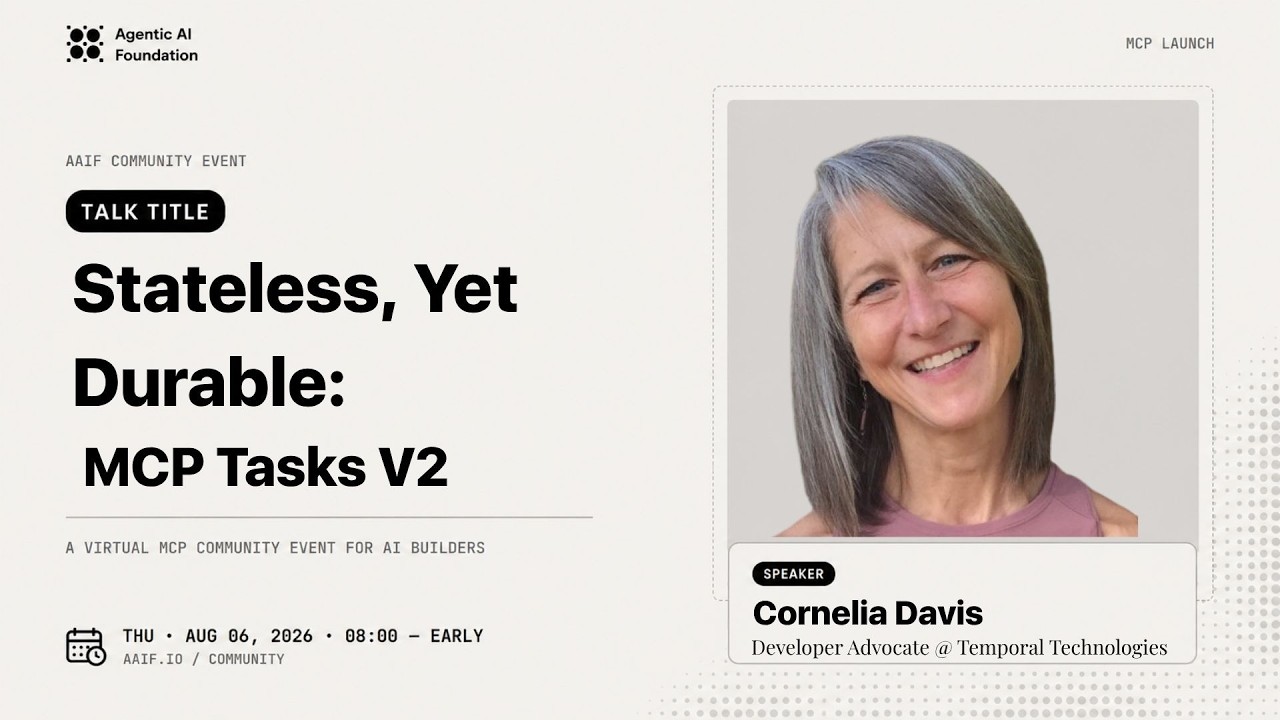
Stateless, Yet Durable: MCP Tasks v2

The session details MCP Tasks v2, an architectural evolution designed to enable durable, long-running workflows while maintaining a fundamentally stateless protocol design. Using Purchase Order processing as a concrete example, the talk contrasts the complexity and scalability issues of V1 (which relied on stateful server tracking and polling) with the simplified V2 approach. The key shift involves moving client responsibility for task ID persistence to durable storage and introducing a future notification mechanism to replace inefficient constant polling.

Key takeaways

  1. MCP Tasks v2 Simplification 17:53

    V2 eliminated the complex `task list` functionality (due to scalability concerns) and significantly changed how elicitation flows, simplifying the client-server protocol into basic polling and an explicit `update` API.

  2. Durability vs. Statelessness 4:28

    While the MCP protocol is stateless, the tasks themselves are designed as durable state machines (e.g., invoice processing), requiring robust mechanisms to track their lifecycle states (Working, Input Required, Terminal).

  3. Scaling Beyond Polling 23:50

    For massive scale (millions of tasks), constant polling is inefficient. The future direction involves implementing a notifications mechanism within the MCP Tasks protocol to allow idle tasks to consume zero resources until an event occurs.

Watch on YouTube Full article

Agentic DX: Bringing IDP into your IDE thumbnail

· 20:35

Agentic DX: Bringing IDP into your IDE

This session details how a team tackled low developer adoption of an Internal Developer Platform (IDP) by implementing 'Agentic DX'—bringing agent functionality directly into the IDE. The solution centers on a Master Agent architecture that orchestrates multiple specialized agents using A2A protocols, ensuring secure and reliable context management while mitigating issues like hallucination snowballing and redundant development efforts.

Key takeaways

  1. Addressing Low IDP Adoption

    To overcome the 'chicken and egg' problem of low developer adoption (e.g., 22% usage), the team pivoted to a 'Bring Your Own Agent' strategy, integrating agentic capabilities directly into the IDE where developers naturally work.

  2. Master Agent Architecture 4:30

    The Master Agent acts as a single entry point and orchestrator, deciding which specialized agent should handle a user query. This approach prevents the complexity of naive canonical meshes where every agent can see every other agent.

  3. Context Hygiene via Decomposition 9:30

    To combat context pollution and improve reliability, the system was decomposed into four distinct loops: Perception (planner), Decision (executor), Action (tool caller), and Memory. This structured approach ensures each component has a defined responsibility.

  4. Security and Communication Protocols 3:00

    The platform mandates 'Zero Trust Execution' and requires human approval for every tool call or agent interaction. All agent-to-agent communication must adhere to the A2A protocol.

Watch on YouTube Full article

MCP Release Overview: Stateless and the Big Changes in the New Spec thumbnail

· 17:48

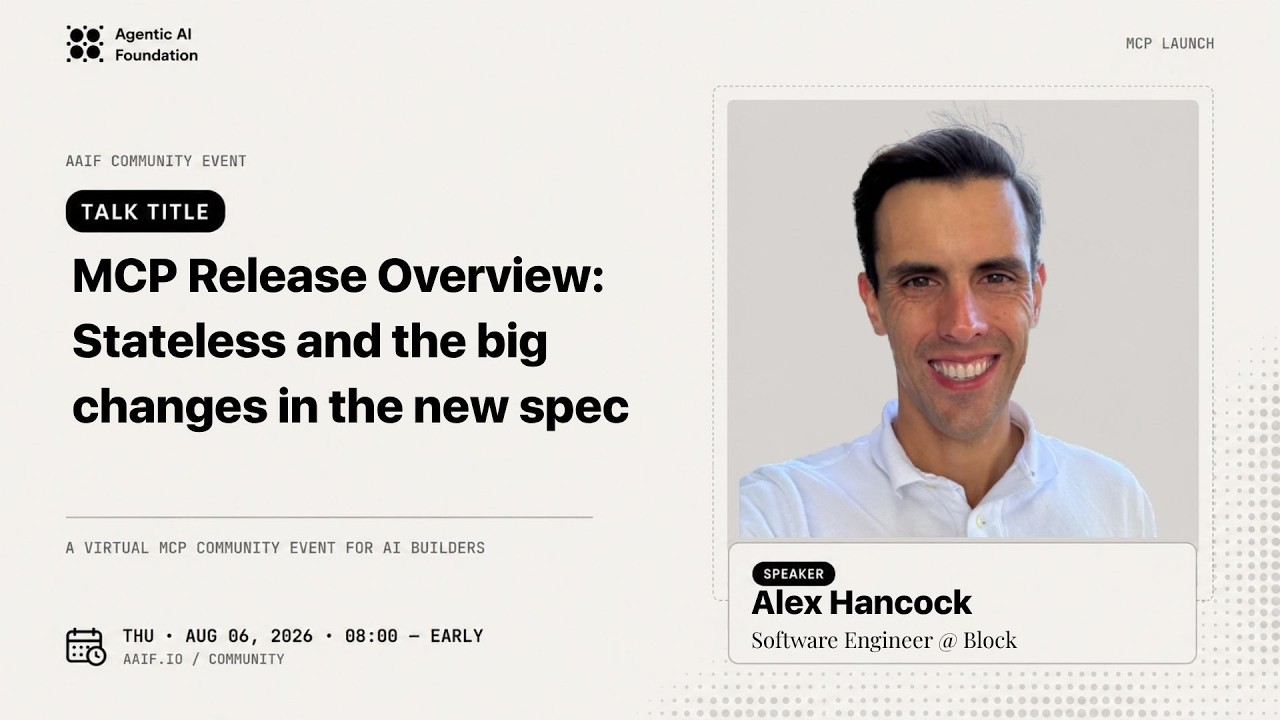
MCP Release Overview: Stateless and the Big Changes in the New Spec

The latest MCP specification introduces a major architectural shift toward statelessness, fundamentally changing how clients and servers interact. This transition addresses scalability issues inherent in previous stateful designs by ensuring every client request contains all necessary information for the server instance to process it independently. Key updates include Multi Roundtrip Requests (MRTR) for complex flows, formalizing extensions (like MCP Apps and Tasks), and enhancing authorization adherence.

Key takeaways

  1. Transition to Stateless Architecture 3:50

    MCP is moving from a stateful model that relied on session IDs and retained server-side state (requiring an `initialize` call) to a fully stateless design. This eliminates the need for complex shared session stores or sticky load balancing, enabling easier horizontal scaling across multiple server instances.

  2. Multi Roundtrip Requests (MRTR) 7:30

    MRTR simplifies complex tool calls by breaking them into multiple, discrete requests rather than relying on open streams and waiting for responses. This significantly reduces architectural overhead when deploying services behind load balancers.

  3. Formalized Extensions 9:40

    The protocol now supports formal extensions, allowing developers to add specialized functionality without modifying the core spec. Key examples include MCP Apps (for delivering rendered UI) and Tasks (for modeling long-running processes like database migrations or human-in-the-loop workflows).

  4. Authorization Improvements 12:40

    The specification enhances adherence to OAuth standards, requiring authorization servers to return the `iss` parameter. Clients must validate this before redeeming a code.

Watch on YouTube Full article

5 Ways to Connect AI Agents to Tools: From APIs to MCP thumbnail

· 11:28

5 Ways to Connect AI Agents to Tools: From APIs to MCP

The video outlines a five-step progression of architectural patterns for securely connecting AI agents to external tools, moving from simple direct API connections to highly secure systems utilizing vaults and token exchanges. The evolution emphasizes improving user visibility, eliminating impersonation, and ensuring the use of short-lived credentials.

Key takeaways

  1. Pattern 5: Direct Connection (Basic) 1:42

    Agents connect directly to tools using existing methods like API keys or service IDs. This is simple but lacks user visibility, as the tool cannot determine who the end-user is.

  2. Pattern 4: OAuth Flows Added 3:25

    Integrating an Identity Provider via OAuth flows allows authentication of the user (e.g., GitHub, Jira). While improving security, this pattern introduces impersonation and risks long-lived access tokens.

  3. Pattern 3: Model Context Protocol (MCP) Layer 5:20

    Adding an MCP layer abstracts the connection process. The agent only needs to know how to interact with MCP, rather than needing specific knowledge of every tool's API structure.

  4. Pattern 2: Token Exchange and Delegation 6:50

    This pattern requires the agent to authenticate itself and operate on behalf of the user (delegation). A token exchange mechanism is used, which significantly improves security by providing full observability into both the user's actions and the agent's role.

  5. Pattern 1: Vault Integration (Top Pattern) 9:00

    The most secure pattern involves introducing a dedicated vault. Instead of passing long-term tokens, the vault stores credentials and issues only short-lived credentials to MCP for the user, minimizing replay attack risks.

Watch on YouTube Full article

The Rise of CaaS: Context-as-a-Service for Agentic AI — Omer Primor, Bright Data thumbnail

· 22:20

The Rise of CaaS: Context-as-a-Service for Agentic AI — Omer Primor, Bright Data

The video analyzes the shift from viewing web data as a simple source of information to treating it as dynamic 'context' for agentic AI. The speaker argues that Context-as-a-Service (CaaS) vendors are emerging to provide structured knowledge graphs, acting as vertical search engines. Critically, he emphasizes that at scale, the cost killer is not initial volume but the *frequency* of repeated queries. For persistent knowledge work, owning and building a custom data pipeline—even if time-consuming—can eventually become more cost-effective than continually renting context from third-party vendors.

Key takeaways

  1. Context Decay: Data is never a snapshot 0:02

    Web data decays quickly (e.g., social content < 1 day; news/finance ~30 days). Therefore, extracting context must be treated as an ongoing process, not a one-time effort [2:43].

  2. The Rise of CaaS for Agents 0:06

    AI agents require structured knowledge beyond what general search provides. CaaS vendors address this by developing and indexing specialized knowledge graphs (vertical search) across multiple data sources, enabling deep reasoning [6:32].

  3. Frequency is the Cost Killer at Scale 0:12

    When performing repeated due diligence or market research, every query costs money, even if nothing has changed. This recurring cost (frequency) eventually surpasses the initial setup cost of building an owned pipeline [12:32].

  4. The Tipping Point for Ownership 0:15

    There is a tipping point where the cumulative cost of repeated context queries makes it economically viable to build and own the data retrieval pipeline in-house, potentially bypassing middleman costs [15:22].

Watch on YouTube Full article

Memory Harnesses for Long-Running Research Agents — Stefania Druga, Sakana.ai thumbnail

· 13:04

Memory Harnesses for Long-Running Research Agents — Stefania Druga, Sakana.ai

The presentation details the design and efficacy of 'memory harnesses' for managing state in long-running research agents. The core finding is that while memory harnesses offer no benefit when task context fits within the model's window (adding only cost), they are critical for solving long-horizon tasks where relevant information sits far outside the current context. The speaker emphasizes treating memory as a write-manage-read control loop, not merely an attached database.

Key takeaways

  1. Memory is a Control Loop, Not a Database 5:44

    The memory harness must be viewed as a 'write-manage-read' control loop wrapped around the model, rather than simply a retrieval database. This architectural focus allows for precise state management.

  2. Local Models Enable Sovereignty and Cost Control 2:36

    Running evaluations on local hardware (e.g., M3 Ultra) enables better control over the entire pipeline, which is crucial for maintaining 'sovereign AI' capabilities and reducing operational costs.

  3. Ranked Recall Outperforms Other Policies 7:16

    Across the X-Bench benchmark (over 68 questions), the 'ranked recall' policy consistently achieved the best performance, outperforming even approaches that simply gate memory usage or use an ideal 'oracle' ground truth.

Watch on YouTube Full article